What Is Quid Pro Quo Harassment A Guide for Employees
You’ve probably heard the Latin phrase “quid pro quo” before. It literally means “this for that,” and in the workplace, it describes a particularly blatant and illegal form of harassment.
At its core, quid pro quo harassment happens when someone in a position of power—like a manager or supervisor—links a job benefit to an employee’s submission to unwelcome sexual advances. It’s a direct abuse of authority, creating a toxic environment where your career path is held hostage.
Defining Quid Pro Quo Harassment

Think of it this way: a manager holds the keys to your professional future—a promotion, a pay raise, or even just keeping your job. Quid pro quo harassment occurs when they demand a personal, often sexual, “payment” to unlock those opportunities. It’s a corrupt bargain where professional merit is pushed aside for personal exploitation.
This behavior is a clear violation of Title VII of the Civil Rights Act of 1964, a federal law that prohibits employment discrimination based on sex. When a supervisor uses their authority to pressure an employee for sexual favors, they are illegally changing the terms of that person’s employment. The employee is put in an impossible situation: sacrifice their dignity or risk their job.
To better understand what a quid pro quo harassment claim involves, it helps to break down its core elements. The table below outlines the fundamental components that legally define this type of workplace misconduct.
Quid Pro Quo Harassment Key Characteristics
| Component | Description |
|---|---|
| Unwelcome Conduct | The advances, requests for favors, or other verbal/physical conduct must be unwelcome and of a sexual nature. |
| Authority Figure | The harasser is typically a supervisor, manager, or someone with the power to make or influence employment decisions. |
| Tangible Employment Action | The harassment is directly linked to a specific job-related outcome, like hiring, firing, promotion, or demotion. |
| “This for That” Condition | There is an explicit or implied understanding that submitting to or rejecting the conduct will result in a specific job consequence. |
Essentially, these components establish a direct line between the harasser’s inappropriate demands and a tangible impact on the victim’s employment status.
The Two Sides of the Quid Pro Quo Coin
This type of harassment usually shows up in two distinct ways, which you can think of as the classic “carrot and stick” approach. Both are equally illegal.
- The Offer (The Carrot): This is when a supervisor promises a tangible job benefit in return for a sexual favor. It might sound like, “If you go out with me this weekend, I’ll make sure you get that promotion,” or, “Help me out, and that big raise we talked about is yours.”
- The Threat (The Stick): Here, the supervisor threatens a negative consequence if their advances are rejected. This often looks like, “If you don’t play along, you can forget about a good performance review,” or even a direct threat of termination or demotion.
In both cases, the critical element is the connection. The unwelcome advance isn’t just a standalone comment; it’s tied directly to a real, tangible change in your job conditions.
Key Takeaway: The heart of a quid pro quo case is the abuse of power. The law focuses on how a person with authority leverages their position to create a coercive “this for that” dynamic, tying an employee’s job security or career advancement to their submission.
This behavior is a severe form of sexual harassment and is treated with the utmost seriousness by the courts. Recognizing this dynamic is the first step toward understanding your rights and knowing when a line has been crossed.
The Legal Anatomy of a Quid Pro Quo Claim
To really grasp quid pro quo harassment from a legal perspective, we have to go deeper than the simple “this for that” translation. For an incident to be something you can actually take legal action on, it has to meet a specific set of criteria. Think of it like building a legal case brick by brick—if even one brick is missing, the whole structure can fall apart in court.
Proving a quid pro quo claim isn’t just about showing bad behavior. The law requires a clear, provable line connecting unwelcome conduct to a real, negative change in your job status. It’s looking for a specific type of power abuse that has tangible consequences for your career.
The Essential Elements of a Claim
When we build a case, we have to prove several key points. These are the elements that courts and agencies like the EEOC look for to determine if what happened was illegal.
- Unwelcome Conduct: This is the foundational piece. The advances, requests, or comments were unwanted. It doesn’t matter if you tried to laugh it off or play along out of fear or discomfort; what matters is that you did not genuinely welcome the behavior.
- Based on Sex: The harassment happened because of your sex. This is often obvious with sexual advances, but it’s a critical legal link that must be established.
- Involvement of a Supervisor: The person making the demands held a position of power over you. This means they were a manager, supervisor, or someone else with the authority to hire, fire, promote, or otherwise change the conditions of your employment.
The final piece of the puzzle is the one that often sees the most argument in legal battles, and it’s the most critical.
Defining Tangible Employment Action
This is a legal term you absolutely need to know. A tangible employment action is a significant, concrete change in your job status. We’re talking about things like being hired, fired, denied a promotion, or being reassigned to a dead-end role with drastically different duties.
It’s the “that” in the “this for that” exchange—the real-world consequence tied directly to your response to the harassment.
A tangible employment action isn’t a subtle slight or a bruised ego. It’s an official, documented company decision that directly changes the terms and conditions of your job. It’s the kind of action that leaves a paper trail and is carried out by someone with the authority to do so.
So, if a manager says, “Come to my hotel room on our business trip, and I’ll make sure you get the lead on that big project,” the project lead is the tangible action. If you say no and suddenly find yourself fired or demoted a week later, that firing or demotion becomes the tangible employment action. These aren’t just hollow threats; they are career-altering decisions.
The Equal Employment Opportunity Commission (EEOC) has been fighting this kind of abuse for decades. Protections against this behavior have been on the books since the 1980s, with clear guidelines stating that harassment is illegal when it’s tied to the terms of your job. Landmark cases, like the 2017 Jones v. Needham litigation, show classic quid pro quo scenarios where an employee’s termination directly followed their refusal of a supervisor’s sexual advances. This case reinforced how federal courts rely on that “tangible employment action” standard to decide these claims. For more on the history and statistics of harassment claims, Pasternak Law offers some valuable insights.
By understanding these components—the unwelcome conduct, the supervisor’s power, and the tangible job consequence—you have a clear checklist. It allows you to step back and evaluate your situation against the established legal standards to see if the unfair treatment you suffered crosses the line into actionable quid pro quo harassment.
Recognizing Harassment in Real-World Scenarios

Legal definitions are a good starting point, but they rarely capture the messy reality of workplace harassment. In the real world, quid pro quo propositions aren’t usually as blatant as what you see in corporate training videos. They’re often subtle, wrapped in friendly language, or disguised as a casual suggestion that leaves you questioning your own judgment.
Understanding what this misconduct actually looks like day-to-day is the key. By walking through some realistic scenarios, we can bridge the gap between legal theory and those gut feelings that tell you something is deeply wrong. These examples should help you trust your instincts and see the patterns of power abuse for what they are.
The Ambiguous Offer: The Coveted Project
Imagine this: your manager, Mark, calls you into his office to talk about that high-profile project you’ve been dying to lead. He’s full of praise for your work, telling you you’re his top choice. But then, the conversation takes a turn.
“This project is going to require a lot of late nights and total dedication,” he says. “We’ll need to be perfectly in sync. How about we get a head start and discuss the details over dinner Saturday night? Just the two of us.”
You politely suggest a lunch meeting during work hours would be better. Suddenly, Mark’s whole demeanor shifts. He mentions needing someone with “total commitment” and says he’ll have to “reconsider” who gets the lead. A week later, you find out the project went to a colleague with less experience.
This is a textbook, if subtle, example of quid pro quo harassment.
- The Power Dynamic: Mark held the power to give or take away a major career opportunity.
- The Unwelcome Advance: The invitation to a private weekend dinner was unprofessional and clearly unwanted.
- The Tangible Action: Taking the project away from you right after you declined his personal invitation is a concrete, negative employment action.
He never explicitly said, “Go to dinner with me or you won’t get the project,” but the message was crystal clear. Your professional advancement was tied to your willingness to engage with him personally.
The Veiled Threat: The Performance Review
Let’s look at another common situation. Your supervisor, Sarah, has been making unwanted comments and asking you out for months. You’ve consistently found polite ways to turn her down, just trying to keep things professional. Now, your annual performance review is coming up.
During a one-on-one meeting, Sarah brings up your “unfriendly” attitude. “You know,” she says, “your work has been fine, but real team players are willing to build relationships outside the office. Your review really depends on showing you’re committed to the whole team.” The implication hangs heavy in the air: if you don’t finally agree to a date, your review is going to suffer, killing your chances for a raise.
This is quid pro quo disguised as a threat. The supervisor is weaponizing her authority over your performance evaluation and pay to punish you for rejecting her. It’s a classic case of linking a negative job outcome to your refusal of unwelcome conduct.
Even if the threats are implied, they create a coercive and fearful environment. It’s also important to note that you could be facing retaliation for simply setting a boundary, which is a separate but often related legal claim. For more on this, you can learn about the signs you might be facing workplace retaliation in our detailed guide.
Beyond Sexual Advances: Non-Sexual Demands
While we often associate quid pro quo with sexual advances, the “this for that” framework can apply to other inappropriate demands, too. For instance, what if a manager asks you to regularly run their personal errands on your own time—picking up dry cleaning, grabbing their groceries, or even watching their dog for an hour?
When you finally say you’re not comfortable doing it anymore, your manager suddenly sticks you on the night shift and pulls you from an important committee. Although the demands weren’t sexual, the manager is still abusing their authority to punish you for refusing to perform personal favors that have nothing to do with your job.
This kind of coercion is still a serious abuse of power. The core elements are the same: a person in authority links your job security or work conditions to your willingness to comply with their personal, unwelcome demands. Proving that connection is what builds the foundation for a quid pro quo harassment claim.
Why the Company is on the Hook
When a supervisor propositions or threatens an employee, it’s easy to pin all the blame on that one bad actor. But in the eyes of the law, the responsibility usually lands right at the company’s feet.
This legal concept is called vicarious liability. Think of it this way: the company handed the supervisor the keys. They gave that person the power to hire, fire, promote, and direct your work. When that power is abused to harass someone, the law holds the company that gave them the power responsible for the fallout.
This is a crucial point. It means your legal fight is with the company itself—the entity with the resources to actually make things right—not just with an individual manager who may not be able to compensate you for lost pay or emotional pain.
Strict Liability: When the Company Has No Excuse
The company’s responsibility gets even more serious when the harassment leads to a “tangible employment action,” like getting fired, demoted, or passed over for a promotion. In these clear-cut cases, a standard of strict liability often applies.
Strict liability means the company is automatically on the hook. It doesn’t matter if upper management knew about the harassment or if they had a stack of anti-harassment policies in a binder somewhere.
The reasoning is simple. The supervisor couldn’t have fired you or denied your raise without the authority the company gave them. Because the company’s power was the weapon used, the company is responsible for the injury it caused.
In quid pro quo cases that result in a tangible employment action, the employer can’t just claim, “We had no idea.” Legally, the supervisor’s action is the company’s action.
This automatic liability is a defining feature of quid pro quo claims and sets them apart from other types of workplace harassment, like hostile work environment cases, where the rules are different.
Why the Usual Defenses Don’t Work Here
In many harassment lawsuits, a company can try to defend itself by proving two things:
- That it had good anti-harassment policies and acted quickly to fix problems.
- That the employee didn’t bother to use the company’s internal reporting system.
This is a well-known legal defense called the Faragher-Ellerth defense. But here’s the kicker: this defense is completely unavailable to an employer in a quid pro quo case involving a tangible employment action.
The law sees an official act like a firing or demotion as the company itself acting. The harm is so direct and final that the company isn’t allowed to sidestep responsibility. Once that line is crossed, the damage is done, and accountability is locked in. This gives victims a much more direct path to holding the organization responsible for the abuse of power that happened on its watch.
What To Do If You’re Facing Quid Pro Quo Harassment
It’s a tough, often scary, realization. If you believe you’re the target of quid pro quo harassment, it’s easy to feel overwhelmed and unsure of what to do next. But you have rights, and there’s a clear path you can follow to protect yourself and hold the right people accountable.
The single most important thing you can do right now is document everything. Memories can get fuzzy under stress, but a written record is solid proof. Grab a notebook or start a private file on your personal device—never use your work computer for this.
- Dates and Times: When did each conversation, threat, or incident happen? The more precise, the better.
- Location: Where were you? In the office? On a Zoom call? At an after-hours work event?
- What Was Said and Done: Try to write down exact quotes. Describe the harasser’s actions, their tone of voice, and the overall context.
- Witnesses: Did anyone else see or hear it? Jot down their names.
- Your Response: What did you do or say? Did you refuse, try to deflect, or show you were uncomfortable?
This journal is more than just notes; it’s the foundation of your entire case.
Using Your Company’s Internal Reporting System
With your initial notes organized, the next logical step is usually to report the behavior internally. Your employee handbook should have an anti-harassment policy that tells you exactly who to go to—it’s almost always the Human Resources department.
When you file your report, put it in writing. An email is perfect because it creates a digital paper trail with a timestamp, proving you notified the company. In your report, stick to the facts you’ve documented. State clearly that you believe this is quid pro quo harassment and be ready to provide the details from your log.
Once you hit “send,” the ball is in their court. The law requires your employer to investigate promptly and take meaningful steps to stop the harassment.
A Word of Caution: Following the company’s process is usually the right move. But what if you don’t trust HR, or the harasser is a top executive? In that situation, it might be smarter to talk to an attorney before you file an internal complaint.
Filing a Formal Charge with the EEOC
You also have the right to take your complaint outside the company by filing a charge with the U.S. Equal Employment Opportunity Commission (EEOC). This is the federal agency that enforces laws against workplace harassment.
Filing with the EEOC isn’t just an option; it’s a required first step before you can ever file a lawsuit in federal court. It puts your employer on official legal notice and kicks off a federal investigation. Be aware of the clock, though. In Mississippi, you typically have just 180 days from the last incident to file your charge.
The diagram below shows just how seriously the law treats harassment by a supervisor.
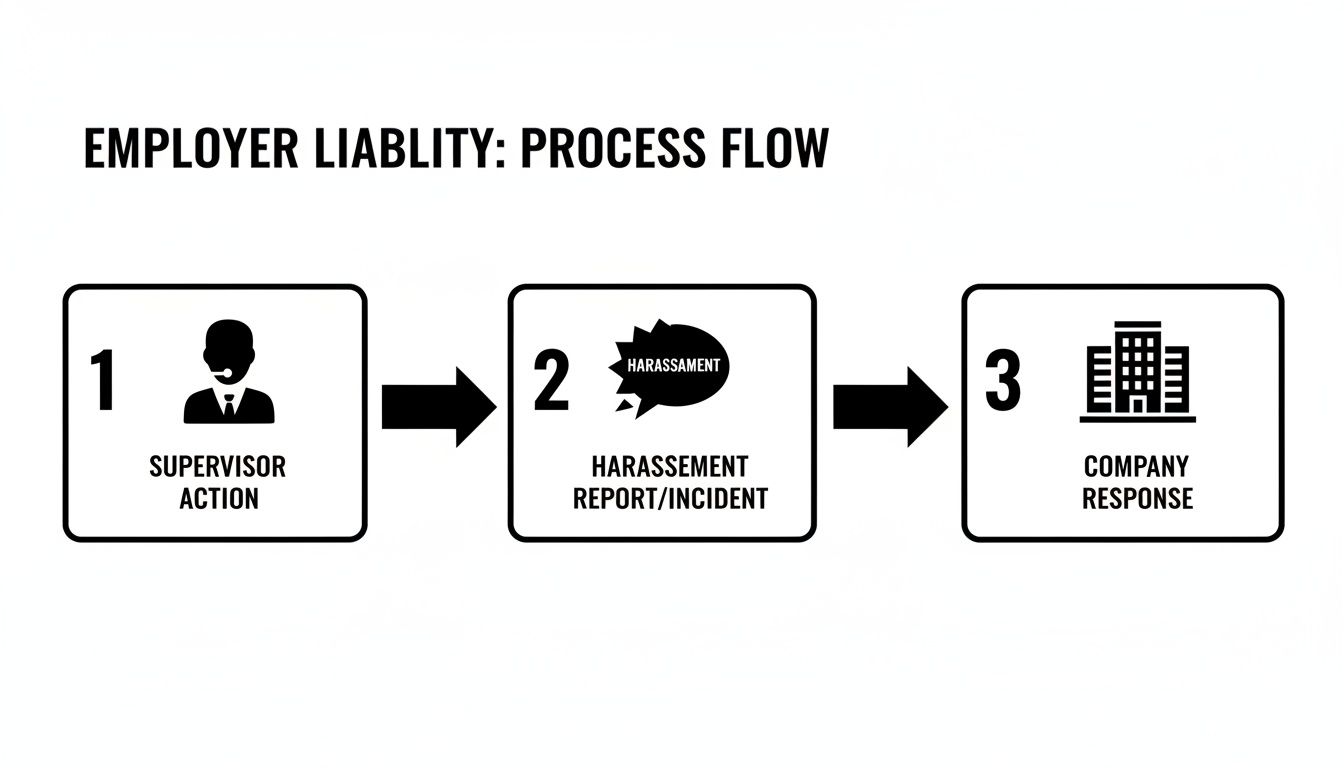
As you can see, when a supervisor is the one doing the harassing, the company is often held directly responsible for their actions.
Why Talking to a Lawyer Early is a Game-Changer
Trying to handle all of this by yourself is a heavy burden. Bringing in an experienced employment lawyer early on can completely change the dynamic. A good attorney does more than just file paperwork; they become your advocate and guide.
They will help you:
- Figure out if you have a strong case and walk you through your legal options.
- Pinpoint the most critical evidence you need to gather.
- Take over all communications with your employer and government agencies.
- Protect you from illegal retaliation and fight back immediately if it happens.
An initial consultation gives you a clear strategy and the confidence that you’re making the right moves. If you’re thinking about taking this step, check out our guide on how to prepare for your first talk with an employment lawyer. It’s full of tips to help you get the most out of that important conversation. Remember, you don’t have to go through this alone.
Navigating Federal and Mississippi Harassment Laws
If you’ve experienced quid pro quo harassment, knowing your legal options is the first step toward getting justice. Both federal and Mississippi laws give you a path to hold your employer accountable, but these protections come with some very strict rules and deadlines you absolutely cannot miss.
When you win a harassment claim under federal law, the court can award remedies designed to make you “whole” again. The idea is to put you back in the financial and professional position you would have been in if the harassment had never happened.
Depending on your case, this could mean:
- Back Pay: All the wages, bonuses, and benefits you lost because of the negative job action.
- Reinstatement: If you were fired, you could get your job back.
- Compensatory Damages: Money to cover the emotional distress and mental anguish the harassment caused.
- Punitive Damages: These are meant to punish employers for especially bad behavior and to stop other companies from doing the same thing.
- Attorney’s Fees: The court can order your employer to pay for your lawyer and other legal costs.
Mississippi Law and Filing Deadlines
Here’s a crucial point for Mississippi workers: Mississippi doesn’t have its own state-level agency like the EEOC for private company employees. This means your primary protection comes from federal laws, making the federal filing process the one that matters most.
And that process is all about the deadline. It’s called the statute of limitations, and it is non-negotiable.
In Mississippi, you have just 180 days from the last harassing act to file a formal charge with the U.S. Equal Employment Opportunity Commission (EEOC). This isn’t a suggestion—it’s a hard cutoff. If you miss it, you lose your right to sue in federal court.
That 180-day window is incredibly tight. It’s why documenting everything and talking to a lawyer right away is so important. The clock starts ticking from the very last incident, whether that was the day a supervisor made a threat, the day you were demoted, or the day you were fired.
Federal vs Mississippi Harassment Claim Deadlines
The deadlines for filing a harassment claim can be confusing because they sometimes change from state to state. While some states have their own employment agencies and a longer 300-day window to file, Mississippi is not one of them. It’s vital to understand which deadline applies to you.
This table breaks down the crucial time limits for filing a claim if you work in Mississippi.
| Legal Body | Filing Deadline | Key Considerations |
|---|---|---|
| Federal (EEOC) | 180 days | This is the primary, controlling deadline for almost all private-sector employees in Mississippi. |
| States with FEPAs | 300 days | This longer deadline does not apply in Mississippi for most private employment cases. Stick to the 180-day rule. |
As you can see, the 180-day federal deadline is the only one that truly matters for most Mississippians facing this difficult situation.
Trying to navigate this legal system alone is tough. From figuring out your exact deadline to gathering the right evidence and filing a formal charge, the process is full of potential pitfalls. The strict 180-day rule for what is quid pro quo harassment leaves zero room for error. Working with an experienced employment attorney is the best way to ensure your claim is filed correctly and on time, giving you the best chance to secure the justice you deserve. Protecting your rights starts with acting quickly.
Common Questions About Quid Pro Quo Harassment
It’s completely normal to have questions when you’re trying to figure out if what you’re experiencing is actually quid pro quo harassment. The law can feel murky, but walking through some common scenarios can help you understand your rights and feel more confident about your situation.
A lot of people think it only “counts” if their job is explicitly on the line. That’s a common misconception. Let’s clear it up.
Does It Count if I Wasn’t Fired or Demoted?
Absolutely. The legal concept here is called a tangible employment action, and it covers a lot more ground than just being fired. Think of it as any significant, negative change to your job status or benefits.
If you rejected an inappropriate advance and something concrete about your professional life suffered as a result, it can still be quid pro quo harassment.
This could look like:
- Being denied a promotion or raise you clearly earned.
- Getting a suddenly negative performance review that stalls your career growth.
- Being deliberately excluded from a high-profile project you were qualified for.
- Getting reassigned to a dead-end role or an undesirable shift, even if your pay stays the same.
The key question is simple: Did refusing the demand lead to a real, negative consequence for your job?
What if the Person Isn’t My Direct Supervisor?
This is a great question. While the classic quid pro quo scenario involves your direct boss, the law is smart enough to know that power structures aren’t always so simple. The claim can stick even if the person doesn’t sign your timecard, as long as they have significant sway over your career.
For instance, it could be a senior partner who can kill your promotion with a single comment, or a department head from another team who has the influence to get you transferred. If they can tie their demands to your job and have the clout to follow through, you may have a case.
The legal standard really boils down to this: Does the harasser have the actual or perceived authority to change the terms of your employment? If they can make good on a promise of a benefit or the threat of a loss because of their position, their behavior likely crosses the line into quid pro quo harassment.
Can It Be “This for That” if the Demands Aren’t Sexual?
Yes, though it’s less common. The “this for that” structure is most often seen in sexual harassment cases, but the principle can apply to other protected characteristics, like religion or race. For example, if a manager insists you join their church’s weekend retreats to be considered for a leadership role, that could potentially be quid pro quo harassment.
It’s important to note, however, that if the demand is just personal and not tied to a protected class—like a boss asking you to house-sit for them—it’s definitely unprofessional and abusive, but it probably wouldn’t qualify as quid pro quo harassment under federal law.
What if I Agreed at First but Now I Feel Pressured?
Consent has to be voluntary. If it’s given under the threat of losing your job, it isn’t truly consent. The law understands the immense pressure and power imbalance in these situations.
If you initially complied with a supervisor’s demands because you were scared of the consequences, you haven’t forfeited your rights. The core of the issue is their abuse of authority, not how you reacted under duress. You can still come forward, and any legitimate investigation should take that coercive environment into account.
Trying to make sense of a harassment claim on your own can be overwhelming. If you believe you are a victim of quid pro quo harassment in Mississippi, Nick Norris, P.A. is here to offer the clear guidance and strong advocacy you deserve. Contact us to protect your rights and understand your legal options.
This article has been reviewed for legal accuracy by Nick Norris. For employment law matters in Mississippi, consult with an attorney licensed to practice in your state.
Leave a Reply