

Your Guide to Impairment Rating Workers Compensation in Mississippi
After a work injury, your focus is on getting better. But as your medical treatment winds down, the focus of your workers' compensation case shifts to a single, critical number: your impairment rating.
This percentage, assigned by a doctor once you've reached Maximum Medical Improvement (MMI), is the foundation for calculating your permanent disability benefits and any potential settlement in Mississippi.
What Is an Impairment Rating and Why It Matters

Think of your recovery as a journey. The final stop is a point called Maximum Medical Improvement, or MMI. This simply means your condition has stabilized as much as it's going to. No more major improvements are expected, even with additional treatment.
It’s at this MMI stage that a doctor steps in to answer a crucial question: What permanent impact has the injury left on your body? The answer comes in the form of an impairment rating.
An impairment rating is a doctor's medical opinion, given as a percentage, on the permanent loss of function you have in a specific body part or your body as a whole.
This isn't a rating of your pain level or your ability to do a specific job. It’s a clinical measurement of the physical damage that remains after your treatment is complete. For your workers' comp claim, this number is everything.
The Financial Stakes of Your Rating
So, why is one percentage so important? Because the insurance company uses it to calculate how much they owe you for your permanent disability.
A higher impairment rating can lead to a significantly larger settlement or benefit award. A lower one, on the other hand, can drastically reduce the compensation you receive for a lifelong injury. It’s a direct link.
This is precisely why the rating is often a major point of contention. The insurance company knows that every percentage point can be worth thousands of dollars, so they will often send you to their own doctor, hoping for a lower number that saves them money.
It’s vital to understand that the first rating you get isn’t always the final word. It's really the starting pistol for the final leg of your claim—the one that determines your financial future.
Consider the national picture. A major NCCI study found the average whole-body impairment rating across the U.S. is just 6.5%, with workers taking an average of 363 days to reach MMI. Even more telling, half of all permanent partial disability claims involve ratings of 4% or less. This shows just how conservative initial ratings can be.
Knowing this prepares you for the road ahead. Protecting your rights isn't just about getting medical care; it's about ensuring the long-term financial impact of your injury is fairly valued. To get a better handle on the overall legal process and support available, exploring dedicated Workers Compensation Solutions can provide valuable insight.
How Doctors Calculate Your Impairment Rating
When it comes to your impairment rating workers compensation claim, the number isn't just pulled out of thin air. A doctor in Mississippi can't just assign a percentage based on a hunch. Instead, they have to follow a very specific, standardized process designed to turn your medical condition into a number. Knowing how this works is the first step in making sure the number you get is fair.
The entire system is built on a book published by the American Medical Association called the "Guides to the Evaluation of Permanent Impairment," or the AMA Guides for short. You can think of it as the official instruction manual for rating injuries. It gives doctors a step-by-step method for assessing injuries to any part of the body and assigning a precise percentage based on how much permanent function you've lost.
For example, the AMA Guides have dedicated chapters for the spine, arms, legs, and even internal organs. Each chapter lays out the exact tests and measurements a doctor must perform to come up with a rating. The goal is to ensure a 10% back injury rating in Jackson means the exact same thing as a 10% rating for a similar injury in Gulfport.
The Rating Examination and Objective Factors
Once your doctor agrees you’ve healed as much as you’re going to—a point called Maximum Medical Improvement (MMI)—they'll conduct a special exam to determine your rating. This exam isn't about how much pain you feel, even though your pain is a real part of your experience. The rating itself has to be based on objective, measurable proof of your permanent limitations.
Here’s what the doctor will actually be measuring:
- Range of Motion: Using a device called a goniometer, the doctor will measure the precise angles your joints can move. If you can no longer fully bend your knee or lift your arm, that loss of motion translates directly to a percentage in the AMA Guides.
- Loss of Strength: They might test your grip strength or perform other muscle tests to put a number on any weakness caused by muscle or nerve damage.
- Nerve Function: For nerve-related injuries, a test like an electromyography (EMG) can objectively measure how well your nerves are firing, providing hard data on your functional loss.
- Anatomical Loss: In the unfortunate case of an amputation, the process is more direct. The Guides have specific values assigned for the loss of a finger, a hand, or an entire limb.
When a doctor puts together your rating, the quality of their notes is everything. Each measurement has to be carefully recorded to support the final percentage, following strict medical record documentation standards.
The Independent Medical Examination
This is where things often get complicated. The workers' comp insurance carrier has the right to get a second opinion on your condition. To do this, they’ll send you to a doctor they choose for an Independent Medical Examination, or IME.
The purpose of the IME is for the insurance company to obtain a second opinion on your impairment rating. The IME doctor is not your treating physician; they are hired by the insurer to evaluate you and issue a report.
It’s common for the IME doctor to come back with a report that gives you a much lower impairment rating than your own doctor did. They might say your range of motion is better than your doctor measured or that your overall condition isn't as limiting. This creates a "battle of the experts," leaving the insurance company with two competing medical opinions.
And which one do you think they'll use? The lower one, of course. The insurance company will point to their doctor's lower rating as justification for offering you a much smaller settlement. It's critical to understand that the IME is a tool used by the insurer to protect its bottom line. It isn't an impartial exam—it's the insurance company’s opening move in the fight over your final impairment rating workers compensation settlement.
How Your Rating Translates to Settlement Dollars
After all the medical appointments and legal back-and-forth, there's really only one question that matters: What does this impairment rating actually mean for my wallet? This is the moment your workers' comp claim moves from a medical diagnosis to a real financial number. Your rating is the single most important factor that drives the calculation for your permanent disability benefits and, ultimately, what a fair settlement looks like.
In Mississippi, once your doctor says you’ve reached Maximum Medical Improvement (MMI)—meaning you’re as recovered as you’re going to get—your impairment rating is used to figure out what you’re owed for the permanent effects of your injury. This compensation generally falls into two categories:
- Permanent Partial Disability (PPD): This is the most common scenario. It applies when you have a permanent loss of function in a body part but are still able to work in some capacity. Your impairment rating is the key number used in the formula to calculate your PPD benefits.
- Permanent Total Disability (PTD): This is for truly catastrophic injuries that prevent you from ever returning to any kind of meaningful work. While a high impairment rating is a crucial piece of evidence, it doesn't automatically qualify you for PTD, but it certainly strengthens your case.
From Percentage to Paycheck
For the vast majority of injured workers, the fight comes down to PPD benefits. The best way to think about your impairment rating is as a multiplier. Even a small change in that percentage can have a massive impact on the final dollar amount you receive.
Let's walk through a common example. Say you hurt your back on the job, and your treating doctor—the one you've been seeing all along—gives you a 15% impairment rating. The insurance company, wanting a second opinion, sends you for an Independent Medical Examination (IME). Their doctor comes back with a much lower rating of only 5%.
This isn't just a simple disagreement between doctors. It's a conflict that could be worth thousands of dollars. The insurance carrier will seize on that low 5% rating and use it to justify a rock-bottom settlement offer, claiming their doctor's opinion is the more accurate one.
Understanding this dynamic is everything. The battle over your impairment rating is the battle over your settlement. Every single percentage point is a negotiating chip, and the insurance company's primary goal is to push that number as low as it can possibly go.
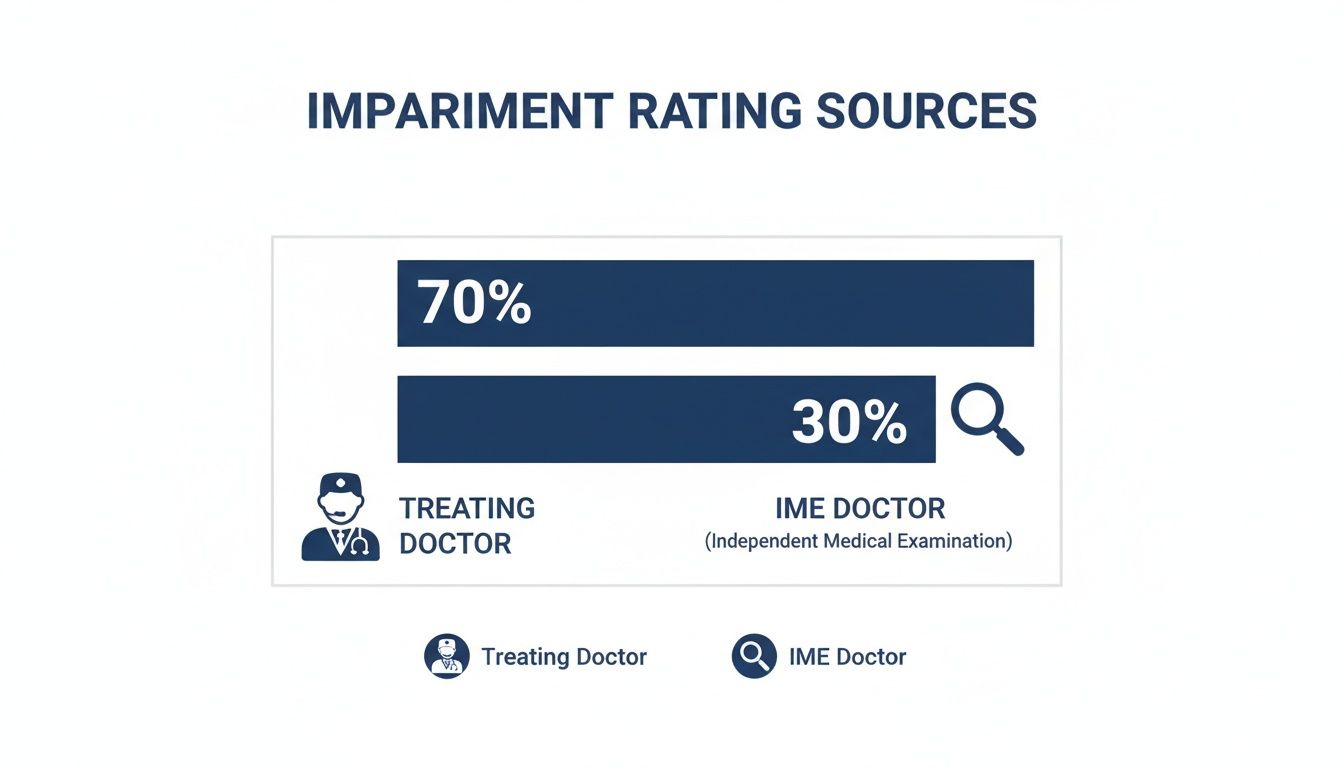
As you can see, the treating physician's rating, which is often higher, stands in stark contrast to the IME doctor’s rating, which the insurance carrier will almost always favor.
The table below illustrates just how much money can be at stake depending on the final impairment rating.
How Impairment Ratings Impact Potential Compensation
| Impairment Rating | Affected Body Part | Hypothetical Weeks of Benefits | Potential Monetary Difference |
|---|---|---|---|
| 5% | Back Injury | 22.5 weeks (5% of 450 weeks) | Baseline Amount |
| 15% | Back Injury | 67.5 weeks (15% of 450 weeks) | $10,000s more than the 5% rating |
| 10% | Arm Injury | 20 weeks (10% of 200 weeks) | Baseline Amount |
| 25% | Arm Injury | 50 weeks (25% of 200 weeks) | $10,000s more than the 10% rating |
This table shows that what might seem like a small difference in percentage points can translate into a significant difference in your final compensation, underscoring why an accurate rating is so critical.
The Foundation for Settlement Negotiations
At the end of the day, most Mississippi workers' compensation cases are resolved with a single lump-sum settlement, not years of weekly checks. Your impairment rating is the cornerstone of those negotiations. The insurance adjuster will begin their calculation using the lowest credible rating they can find—which is almost always the one from their hand-picked IME doctor.
When there's a big gap between your doctor's rating and the IME's rating, the final settlement value will probably end up somewhere in between. This is precisely where having an experienced workers' compensation attorney becomes invaluable.
A good lawyer doesn't just take the insurance company's lowball number. They build a powerful case to show why your doctor's higher rating is the more credible and accurate one. Without a strong advocate in your corner, it's far too easy to get pressured into accepting a settlement that is based on an unfairly low rating, leaving significant money on the table.
How to Fight an Unfair Impairment Rating

Getting your impairment rating can feel like you've finally reached the end of a long road. But for many injured workers in Mississippi, it’s often just the start of another fight. If the percentage assigned by the insurance company’s doctor seems suspiciously low, you need to know that you don't have to accept it.
That first rating is rarely the final word, especially when it comes from a doctor hand-picked by the insurer for an "Independent" Medical Examination (IME). An unfair impairment rating workers compensation assessment is something you absolutely can, and should, challenge.
Common Grounds for Disputing a Rating
It's no surprise that disagreements over impairment ratings are extremely common. An insurance carrier will always push for the lowest number possible to limit their payout, but their doctor’s opinion isn't gospel.
Here are some of the most frequent—and legitimate—reasons a rating gets challenged:
Misusing the AMA Guides: The AMA Guides are incredibly complex medical rulebooks. A doctor can easily misinterpret a section, use an outdated edition, or mess up the formula for combining ratings for multiple injuries, all of which can lead to a much lower percentage.
Downplaying the Real Impact: An IME doctor who spends a mere 15 minutes with you can’t possibly grasp the full scope of your daily pain and limitations. They often gloss over the struggles your own treating physician has documented for months.
Ignoring Crucial Medical Evidence: We see it all the time. The IME doctor’s report conveniently fails to mention the MRI, nerve study, or surgical report that clearly shows the severity of your condition.
Never forget: The IME doctor is working for the insurance company, not for you. Their job is to provide an opinion that serves their client's bottom line, which means minimizing your permanent impairment.
The financial stakes here are massive. In fact, permanent partial disability claims, which are driven by these ratings, make up about 50% of all workers' comp benefit costs. And there's huge variability. Research shows average ratings for similar injuries can swing wildly from 4% to 11% depending on the state, proving just how much a doctor's opinion can shape your outcome.
The Step-by-Step Process for Contesting a Rating
If you get a rating that doesn't feel right, you need to act quickly and decisively. Letting a lowball rating sit unchallenged can sink your entire claim.
Formally Object to the Rating: The first move is simple but crucial. You must notify the insurance carrier, in writing, that you dispute their doctor’s impairment rating. This puts them on notice that the fight isn't over.
Get a Second Opinion: This is the most important step you can take. You must get an evaluation from a doctor who is actually on your side. An experienced workers' comp attorney can connect you with a qualified physician who truly understands the AMA Guides and can perform a thorough, credible evaluation.
Build Your Case with Stronger Evidence: Armed with this new, more accurate rating, your attorney will build the case to prove it's the correct one.
This is where a lawyer's expertise really comes into play. The evidence they gather often includes:
- Doctor Depositions: Your attorney can put the insurance company's doctor under oath and poke holes in their reasoning, forcing them to justify their low rating on the record.
- Vocational Expert Testimony: If the injury affects your ability to work, a vocational expert can testify about how your specific limitations reduce your earning power here in the Mississippi job market.
Fighting an unfair impairment rating workers compensation claim is a complex legal battle, not a medical one. An attorney’s job is to package all this evidence into a persuasive argument for the Mississippi Workers' Compensation Commission. If you’re facing this situation, it’s best to go in prepared. You can find out what to expect by reading our guide on how to prepare for your first talk with an employment lawyer.
Navigating Mississippi's Unique Legal Landscape
Protecting your rights after a work injury in Mississippi is about more than just understanding the medical facts. The state has a unique legal environment that can throw some serious curveballs, especially when it comes to your impairment rating workers compensation case. Knowing these local rules is the only way to truly safeguard your benefits.
A common fear I hear from clients is, "What happens if my boss fires me for filing a claim?" It's a valid concern, and in Mississippi, the answer isn't as straightforward as you might think.
A Critical Gap in Mississippi Law
Here's a crucial fact many people don't realize: Mississippi does not have a state-level human rights commission to investigate workplace retaliation or discrimination claims. This is a big deal. In most other states, you could file a complaint with a state agency, and they would step in to investigate for you. That safety net simply doesn't exist here.
This gap can leave you feeling exposed. Without a state commission to turn to, your only real advocate is a skilled attorney who knows the ins and outs of the Mississippi Workers' Compensation system. This makes hiring a lawyer less of a choice and more of a necessity if you're facing a tough situation. They can ensure your employer's actions don't derail your claim for a fair impairment rating.
The bottom line is this: without a state human rights commission, you can't rely on a government agency to fight for you if your employer acts unfairly. You need experienced legal counsel in your corner.
Sadly, the need to protect injured workers is a global issue. Worldwide, work-related injuries and diseases were responsible for an estimated 2.9 million deaths annually as of 2019. That's a sharp increase from 2.3 million back in 2014. These sobering statistics highlight why effective impairment rating systems are so vital everywhere, including right here at home.
Understanding Legal Costs
I get it—many injured workers are already in a financial bind and hesitate to call a lawyer because they're worried about the cost. It’s important to pull back the curtain on how attorneys in this field actually get paid.
Nearly all reputable Mississippi workers' comp attorneys work on a contingency fee basis. In plain English, this means you pay nothing upfront. The attorney's fee is just a percentage of the money they win for you, and it's only paid after your case is successfully resolved.
- No Upfront Fees: You won't pay a dime out of your own pocket to get legal help.
- Payment from Recovery: The lawyer's fee comes directly from the settlement or award they secure on your behalf.
- Typical Fee Structure: In Mississippi, the contingency fee for these cases generally falls between 40-50%.
This arrangement means your attorney is just as motivated as you are to get the best possible outcome. They don't get paid unless you do. It puts you on the same team and gives you access to expert legal help without any financial risk. When you're fighting over an impairment rating, that partnership is your strongest asset.
You can learn more about your protections by reading our detailed guide on the state of Mississippi labor laws.
Common Questions About Mississippi Impairment Ratings
Trying to understand workers' compensation can feel like learning a foreign language, full of confusing terms and high-stakes rules. When it comes to your impairment rating, it’s completely normal to have questions. Let's cut through the jargon and get you some straight answers to the most common concerns injured workers in Mississippi face.
Can I Get a Second Opinion on My Impairment Rating?
Yes, you absolutely can—and in many cases, you absolutely should. If you get an impairment rating that just doesn’t feel right, especially if it came from a doctor the insurance company sent you to for an Independent Medical Examination (IME), you have the right to get a second opinion.
This is often the most important step you can take to fight an unfair rating. The opinion of another qualified doctor, one who can give a thorough, evidence-based assessment of your condition, is one of the most powerful tools you have. An experienced attorney can help you find a physician who really understands the AMA Guides and can create a credible report to back up your claim.
What Happens When Doctors Disagree on My Rating?
It’s incredibly common for doctors to land on different impairment ratings. This "battle of the experts" is at the heart of many workers' compensation disputes. You can almost guarantee the insurance carrier will latch onto the lowest rating they can find, usually from their IME doctor, to pay out as little as possible.
When you have two or more different ratings, the case comes down to which doctor's opinion is more convincing.
- Your Doctor's Opinion: Your own treating doctor has the benefit of history. They've seen you over time and have firsthand knowledge of your progress and your struggles.
- The IME Doctor's Opinion: The insurance company’s doctor usually only sees you once for a brief exam, but their report is still presented as a valid medical opinion.
If you can't reach a fair settlement through negotiation, the Mississippi Workers' Compensation Commission will have to make the final call. An Administrative Law Judge will weigh all the evidence—the medical reports, the doctors' credentials, and their deposition testimony—to decide which rating is more believable. Having a sharp lawyer to cross-examine the IME doctor and emphasize the strengths of your doctor's opinion is crucial.
A disagreement between doctors isn't just a medical debate; it's a financial one. The outcome of this disagreement directly determines the value of your permanent disability benefits and potential settlement.
Successfully navigating these disputes often comes down to skilled negotiation and solid legal arguments. As you move toward this part of your claim, it helps to understand what you're walking into. To learn more, take a look at our guide on how to prepare for mediation, which gives practical tips for resolving these disagreements.
Does a High Rating Mean I Am Permanently and Totally Disabled?
Not necessarily. An impairment rating is a medical number that measures your body's loss of function—it’s not a direct measurement of your ability to work. For example, you could have a high rating for a shoulder injury but still be perfectly capable of doing a different job that doesn't require heavy lifting.
That said, a high impairment rating is a powerful piece of evidence. It becomes the foundation for arguing that you've lost the ability to earn a living like you used to. If you have a 25% impairment to your back and can no longer work in construction, your attorney can use that rating to prove that your capacity to earn a good wage in the Mississippi job market has been permanently reduced.
To strengthen this argument, we can bring in a vocational expert. This specialist analyzes your impairment rating, physical restrictions, age, education, and work history to give an expert opinion on what jobs, if any, you can still perform. This testimony, combined with your impairment rating, is what you need to prove you are permanently and totally disabled.
What Is the Deadline to Dispute My Impairment Rating in Mississippi?
In a workers' compensation case, the clock is always ticking. Mississippi has a strict two-year statute of limitations from the date of your injury to file a formal claim, called a Petition to Controvert, with the Workers' Compensation Commission.
Any fight over your impairment rating has to happen within this legal window. If you get a lowball rating and wait too long to challenge it, you could lose your right to do so. You’d be stuck accepting a settlement based on a number that doesn't truly reflect what you've lost.
Because of this hard deadline, you have to act fast. As soon as you receive an impairment rating you believe is unfair, you should call an attorney right away to protect your rights and explore your options.
If you're dealing with an unfair impairment rating or feel you've been mistreated at work after an injury, you need an advocate who knows Mississippi's unique laws inside and out. At Nick Norris, P.A., we fight for the rights of injured workers across the state. Contact us for a consultation at https://www.nicknorris.law.
This article has been reviewed for legal accuracy by Nick Norris. For employment law matters in Mississippi, consult with an attorney licensed to practice in your state.
Leave a Reply