

Your Guide to PTSD Work Accommodations in Mississippi
Living with Post-Traumatic Stress Disorder (PTSD) is challenging enough on its own. When you're also trying to hold down a job in Mississippi, it can feel overwhelming. The good news is, you're not alone, and you have significant legal rights. Federal law mandates that employers provide reasonable accommodations—specific adjustments to your job or workplace—that help you manage your symptoms and succeed professionally.
This isn’t about asking for special favors. It's about accessing the support you are legally entitled to.
Understanding Your Workplace Rights for PTSD in Mississippi

The first step in advocating for yourself is knowing where you stand legally. The most important law on your side is the federal Americans with Disabilities Act (ADA). This powerful legislation covers most employers and protects employees with qualifying disabilities, which absolutely includes mental health conditions like PTSD.
It's critical to know that Mississippi doesn't have a state-level agency like a human rights commission to oversee these claims. This means your rights and the enforcement process are governed almost entirely by federal law through the ADA and the Equal Employment Opportunity Commission (EEOC).
What the ADA Means for You
At its heart, the ADA is about giving you an equal opportunity to thrive at work. It accomplishes this by requiring your employer to provide reasonable accommodations, so long as they don't create an "undue hardship" for the company. That "undue hardship" standard is a very high bar to clear, typically meaning a major disruption or expense.
So, what is an accommodation? It’s any change that helps you work around the barriers created by your PTSD symptoms. Many people mistakenly believe they only qualify for help if they're completely unable to do their job. That’s not true. Even if you can power through your tasks under extreme stress, you may be entitled to an accommodation. The law is designed to help you work without unnecessary difficulty or pain.
Key Takeaway: You don't have to prove that an accommodation is absolutely necessary to perform your job. If a reasonable change can ease the burden your PTSD places on you at work, your employer is generally required to provide it.
The Interactive Process: A Two-Way Conversation
Once you ask for help, the ADA kicks off a mandatory dialogue called the "interactive process." Don't let the legal term intimidate you. Think of it as a structured, good-faith conversation between you and your employer to figure out a solution that works.
This isn’t a one-and-done demand. It’s a collaborative back-and-forth where you and your employer work together. You’ll need to:
- Let your employer know you have a medical condition that's impacting you at work.
- Suggest some potential changes that you think might help.
- Talk through the options with HR or your manager to land on something that's effective for you and feasible for the business.
Coming to the table with a cooperative, problem-solving mindset is far more effective than treating it like a fight. Many of the most effective accommodations are simple, zero-cost adjustments that make a massive difference in your day-to-day experience. The same principles apply to other conditions, and seeing how they work for ADA accommodations for anxiety can offer more context. The goal here is to find common ground that supports both your well-being and the company's needs.
How to Identify and Document Your Specific Needs

Figuring out you need help is one thing; knowing exactly what to ask for is another challenge entirely. Effective PTSD accommodations aren't generic solutions—they’re tailored adjustments tied directly to the specific ways your symptoms show up at work. This all starts with some honest self-reflection.
You need to connect the dots between your PTSD symptoms and the real-world difficulties they cause on the job. Take a close look at the moments or environmental factors that trigger your symptoms or make them feel a hundred times worse.
Connecting Symptoms to Workplace Challenges
Think through your daily routine at work. Where do you hit a wall? What specific tasks seem to drain you more than they should or cause a wave of distress? The goal is to draw a straight, clear line from a symptom to a work-related problem.
Let’s look at a few common examples I’ve seen:
Symptom: Hypervigilance and an exaggerated startle response.
Workplace Impact: You feel on edge all day in a loud, open-office layout. It’s impossible to focus because your brain is constantly scanning for threats, and every sudden noise makes you jump.
Symptom: Difficulty concentrating or experiencing “brain fog.”
Workplace Impact: You find yourself losing the thread during long meetings or struggling to finish projects with multiple steps without making mistakes.
Symptom: Avoidance of people, places, or things that remind you of the trauma.
Workplace Impact: A certain client, a specific route you have to drive, or even a particular topic of conversation triggers intense anxiety, causing you to miss necessary meetings or avoid colleagues.
Getting a handle on how PTSD shows up for you personally is key. A bit of research into understanding common trauma responses like fight, flight, freeze, or fawn can be incredibly helpful here. It gives you the language to explain your reactions in a way that makes sense to someone who hasn't experienced it.
Building Your Case with Medical Documentation
Once you have a good sense of your needs, it's time to get your medical documentation in order. This isn't about sharing the deeply personal details of your trauma with your boss—you absolutely have a right to privacy. The real goal is to get a professional letter from your doctor, therapist, or another healthcare provider.
A strong support letter is your most important tool in this process. It needs to do two things very clearly:
- Confirm that you have a medical condition (PTSD) that is considered a disability under the Americans with Disabilities Act (ADA).
- Explain that this condition causes specific functional limitations that affect your ability to perform certain tasks at work.
Important: Your employer isn’t entitled to your entire medical history or the story behind your diagnosis. A focused letter confirming your condition and its impact on your work is all that’s needed to kick off the interactive process.
What Your Doctor's Note Should Include
When you go to your doctor’s appointment, be ready to guide the conversation. You're the expert on your job, so explain the specific challenges you’ve already identified. This helps your doctor write a letter that’s relevant and genuinely effective.
A solid letter will usually include:
- A statement that you are a patient under their care.
- Confirmation of your diagnosis (PTSD).
- A description of your limitations at work (e.g., "experiences difficulty concentrating in noisy environments," "requires a predictable schedule to manage anxiety," or "has a heightened stress response to unexpected changes").
- A professional recommendation for specific accommodations that would help.
Example Language for Your Doctor:
Try saying something direct and practical. For instance: "The open-plan office is a real struggle for me because of my hypervigilance. In your letter, could you mention that I have difficulty maintaining focus in distracting environments and recommend that I be allowed to use noise-canceling headphones or work from a quieter area?"
By taking this collaborative approach, you ensure your doctor's note is precise and directly supports the accommodations you’re about to request. It turns a medical diagnosis into a practical, actionable plan that makes it much easier for your employer to say "yes."
Formally Requesting Your Accommodations
You’ve done the hard work of identifying your needs and have a letter from your doctor. Now comes the part that often feels the most daunting: officially asking for your PTSD work accommodations. It's completely normal to feel a bit anxious about this, but remember, this isn't about starting a conflict. It's about starting a conversation.
While you can make a verbal request under the ADA, I always tell people to put it in writing. An email is perfect. It creates a timestamped paper trail that shows exactly when you started the process and what you asked for. If there are any misunderstandings down the road, this written record becomes your best friend.
Who Should You Talk To? Manager or HR?
This is a question I get all the time, and the honest answer is: it depends on your workplace. There’s no single right person, but thinking through your specific situation can point you in the right direction.
Starting with Your Manager: If you have a good, trusting relationship with your direct supervisor, this is often the best place to start. They understand your day-to-day role better than anyone and might be able to approve simple changes—like a desk move or a modified schedule—on the spot.
Going Straight to HR: If you're not comfortable talking to your manager, or if you think they might not be supportive, go to Human Resources. HR professionals are trained in ADA compliance and are the designated point-person for handling these formal processes, especially for more complex requests like leave under the FMLA.
The "CC" Approach: A great strategy is to email them both. Address the email to your manager and CC the HR representative. This keeps your direct supervisor in the loop while formally notifying HR, ensuring the company's legal obligation to respond is triggered.
Putting Your Request in Writing
Your email should be professional, concise, and focused on solutions. This isn't the place for a long, emotional story. You're simply giving your employer the information they need to begin the "interactive process" with you.
Your request really only needs to accomplish three things:
- State that you have a medical condition requiring an accommodation.
- Briefly explain how it affects a specific part of your job.
- Suggest a solution or ask to discuss potential options.
Crucially, you do not have to disclose your specific diagnosis or the details of your trauma. Simply stating you have a "medical condition" is enough.
A Pro Tip: Frame your request as a way to maintain or improve your productivity. Wording it this way shows you're a committed employee looking for a collaborative solution, not someone trying to get out of work. This simple shift in tone can make all the difference in how your request is received.
Before we get to the sample request, let's look at some concrete examples. It’s one thing to know you need an accommodation, but it's much more powerful to suggest specific, practical solutions.
Common PTSD Challenges and Practical Workplace Solutions
This table connects common PTSD-related difficulties with reasonable accommodations you can propose. Having these ideas ready can make your conversation with your employer much more productive.
| Symptom or Challenge | Example Workplace Impact | Potential Reasonable Accommodation |
|---|---|---|
| Hypervigilance / Startle Response | Feeling constantly on edge; being easily startled by sudden noises or people approaching from behind. | A desk in a low-traffic area, facing the entrance. Permission to use a mirror to see who is approaching. |
| Difficulty Concentrating | Trouble focusing in open-plan offices due to noise, distractions, or internal thoughts. | Permission to use noise-canceling headphones. A cubicle with higher walls or a move to a quieter office space. |
| Memory Impairment | Forgetting instructions, deadlines, or multi-step processes. | Allowing the use of checklists, schedulers, and written instructions. Regular, brief check-in meetings to review priorities. |
| Anxiety or Panic Attacks | Sudden, overwhelming feelings of fear triggered by specific situations (e.g., crowded meetings, performance reviews). | A private space to retreat to during a panic attack. Allowing a support animal. Restructuring feedback to be more frequent and less formal. |
| Sleep Disturbance / Fatigue | Feeling exhausted during the day due to insomnia or nightmares. | A flexible start time or a modified work schedule. Allowing for more frequent, short breaks throughout the day. |
Thinking in these terms—problem, impact, solution—helps your employer see that your request is practical and directly tied to helping you succeed in your role.
Sample Request Email
Here’s a template you can adapt. It's straightforward, hits all the key points, and avoids oversharing.
Subject: Request for Reasonable Accommodation
Dear [Manager’s Name] and [HR Representative’s Name],
I am writing to formally request a reasonable accommodation for a medical condition. This condition can make it difficult for me to [mention the functional limitation, not the diagnosis, e.g., concentrate in a noisy environment or manage last-minute changes to my tasks].
To help me perform all my job duties effectively, I’d like to discuss some potential solutions. I believe an accommodation such as [list a specific idea, e.g., permission to wear noise-canceling headphones or having a more predictable daily workflow] would be very helpful.
I have a letter from my healthcare provider supporting this request, which I can provide. I am confident that we can find a practical solution that allows me to continue contributing fully to the team.
Please let me know when you would be available to discuss this further.
Thank you,
[Your Name]
Once you hit "send" on that email, you've officially put your employer on notice and triggered their legal duty to engage with you. If you want to dive deeper into the specifics of this process, you can find out more about how to request a reasonable accommodation and what to expect next. This preparation is key to a productive dialogue and, ultimately, getting the support you need.
So, you’ve submitted your accommodation request. What happens next? This is where the interactive process kicks in, a requirement under the ADA. It’s not a one-and-done meeting; think of it as an ongoing, good-faith conversation between you and your employer to find a solution that works.
Your part in this dialogue is to stay engaged and focused on the goal. Your employer will likely have questions about how your specific limitations affect your ability to do your job. Your job is to answer them professionally and guide the conversation back to finding a practical, effective accommodation.
Who should you even be talking to? Your manager? HR? It depends on your company's culture and your relationship with your boss. This chart can help you decide on the best starting point.
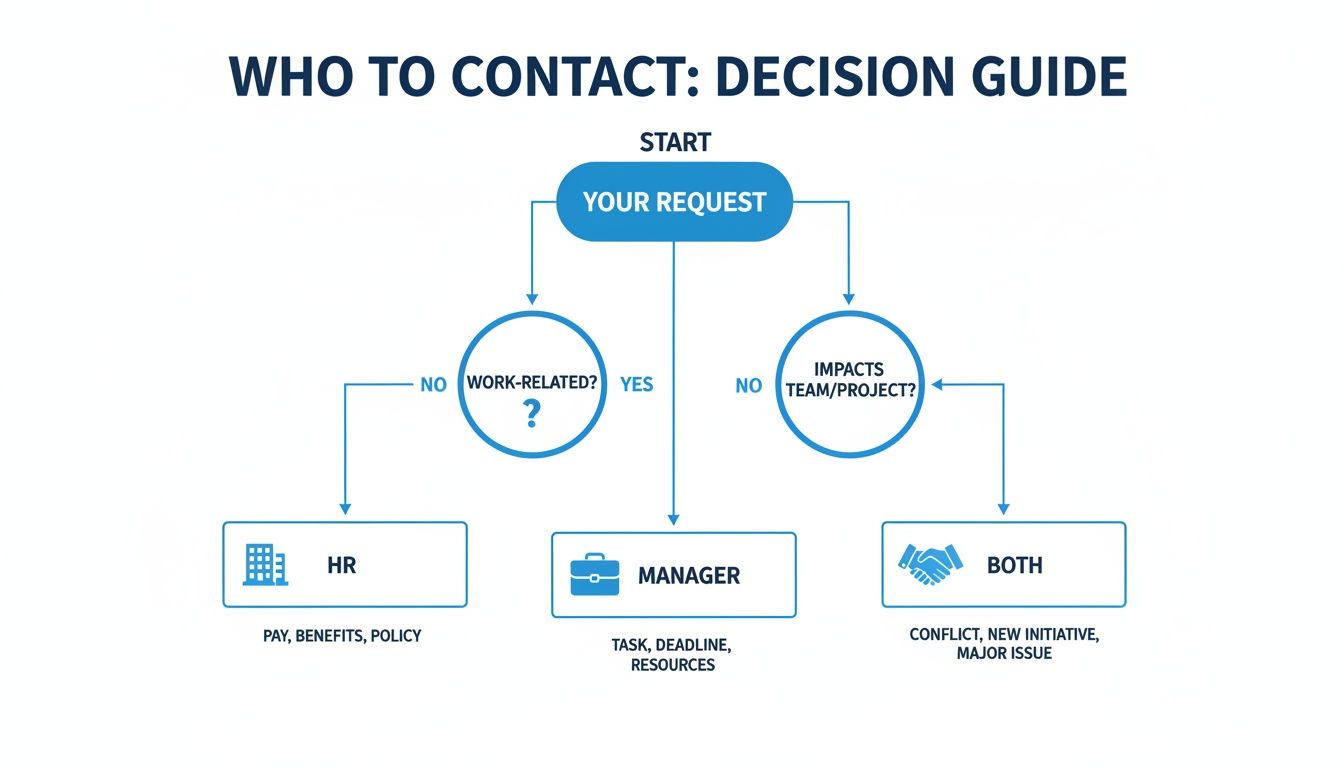
As you can see, there isn't one right answer. Sometimes looping in a trusted manager first is the smoothest path, while other times, a formal HR-led process is the way to go.
What to Expect When They Respond
An employer's response can go a few different ways. While we all hope for an immediate "yes," it's smart to be ready for other common scenarios.
Here’s what you might encounter:
- A "Yes" to Your Request: This is the ideal outcome. Your employer agrees to what you asked for. The next step is simple: get the agreement in writing. Make sure it clearly states what the accommodation is and when it will begin.
- A Request for More Information: Don't be alarmed if they ask for more medical details. This is a standard part of the process. The key is that their request must be reasonable and directly related to the accommodation you’re seeking.
- An Offer of a Different Accommodation: Your employer doesn’t have to give you the exact accommodation you requested, but they do have to offer one that is effective. Be open to hearing their ideas, but you know your needs best. If their suggestion won’t actually solve the problem, you need to be prepared to explain why.
From my experience, you are your own best advocate here. If your employer suggests an alternative—like moving you from one cubicle in a loud, open-plan office to another—you can professionally point out that it doesn't address the core issue of noise-induced triggers and steer the conversation back toward truly effective solutions, like headphones or a quieter space.
The Art of Negotiation and the Power of a Paper Trail
If your initial idea is met with resistance, don't take it as a final rejection. The interactive process is, at its heart, a negotiation. Treat this as an invitation to keep the conversation going.
A great tactic is to propose a trial run. Suggest trying an accommodation for 30 or 60 days, with a plan to check in and see how it’s working for everyone. This often makes employers more willing to try something new.
Through all of this, your single most important tool is documentation. Create a detailed log of every conversation, meeting, and email exchange.
- Follow up after every phone call or in-person chat with a quick email. It can be as simple as, "Hi Jane, just wanted to recap our conversation from this morning. We agreed I'd begin using noise-canceling headphones at my desk, and we'll touch base on June 1st to review. Thanks for your help."
- Keep copies of everything. Save all emails and written correspondence in a personal folder, completely separate from your work computer or email account.
- Note the basics for every meeting: the date, the time, who was there, and a summary of what was discussed.
This paper trail is absolutely invaluable if the process stalls, you face pushback, or you feel your rights are being violated.
Understanding "Undue Hardship"
An employer can legally deny an accommodation for PTSD if they can prove it would cause an "undue hardship" on the business. It’s critical to know that this is an extremely high legal bar to clear.
Undue hardship means the requested change would cause significant difficulty or expense for the company. It does not mean a minor inconvenience or a negligible cost.
For instance, allowing an employee to have a more flexible schedule is almost never considered an undue hardship. On the other hand, a request to hire a new, full-time employee just to assist you probably would be. If an employer claims undue hardship, they must provide a specific, credible business reason—they can't just say "it's too much trouble."
To advocate for yourself effectively, it helps to know the legal landscape. You can learn more about what is considered a reasonable accommodation under the ADA to better understand your rights and your employer's obligations.
When to Seek Legal Help for a Denied Request
You’ve done your part. You followed the steps, submitted your request, and tried to engage in a good-faith conversation with your employer. But what happens when you hit a brick wall?
While most employers want to do the right thing, sometimes the process completely breaks down. Maybe your request was flatly denied, or worse, you're now facing punishment just for asking for help. If your gut is telling you something is wrong, it’s time to listen. Knowing when to stop advocating for yourself and start talking to an attorney is a critical step.
Warning Signs Your Employer Is Crossing a Legal Line
It's not always obvious whether an employer is just being difficult or actually breaking the law. Based on years of experience, certain actions are massive red flags that signal you may need legal backup.
If you encounter any of these situations, it's a strong sign your rights under the ADA are being violated:
- They Refuse to Talk. You made a reasonable request, and your employer is giving you the silent treatment or explicitly refuses to discuss it. The law requires them to engage in an "interactive process"—ignoring you is a failure to meet that duty.
- You Get a "No" Without a Real Reason. An employer can't just deny your request on a whim. They need to show that your accommodation would cause an "undue hardship"—a very high legal bar that means it would create significant difficulty or expense for the business. A vague rejection isn't good enough.
- They Retaliate Against You. This is one of the most serious violations. If you're suddenly fired, demoted, written up, or harassed after requesting an accommodation for your PTSD, that's illegal retaliation. The timing is often the biggest giveaway.
Expert Insight: The law is clear: you are protected from being punished for asserting your rights under the ADA. Retaliation is illegal, and employers know it. This is why documenting every negative action that follows your request is absolutely essential.
Your Legal Path Forward in Mississippi
It’s crucial for workers here to know how the system works in our state. Mississippi does not have a human rights commission to handle discrimination claims.
This means your primary, and most important, route for filing a formal complaint is with the federal Equal Employment Opportunity Commission (EEOC). The EEOC is the agency that enforces the ADA nationwide.
Filing what's called a "Charge of Discrimination" with the EEOC is a required first step before you can ever file a lawsuit in federal court. This is where an experienced employment attorney becomes invaluable. They can ensure the charge is drafted correctly, includes all necessary evidence, and is filed before the strict deadlines expire. While the details are specific to autism, the legal strategies discussed in this guide on Autism Workplace Accommodations can offer helpful context for understanding this process.
Don't Let Cost Stop You from Getting Help
I talk to people all the time who are afraid to call a lawyer because they think they can't afford it. Here’s the good news: most reputable employment attorneys in Mississippi take these cases on a contingency fee basis.
This means you pay absolutely nothing upfront. The attorney's fee is simply a percentage of the financial compensation they win for you from a settlement.
This system is designed to give everyone access to justice, no matter their financial situation. The average contingency fee for these cases is typically between 40-50%. Because the lawyer only gets paid if you get paid, their goals are perfectly aligned with yours—to get the best possible result. Don't let fear of cost prevent you from getting a professional opinion on your situation.
Common Questions on PTSD Accommodations
When you're trying to get workplace accommodations for PTSD, a lot of "what-if" questions pop up. It's completely normal. I've worked with countless employees across Mississippi, and I hear the same concerns time and again. Let’s walk through some of the most common ones so you can feel more confident about advocating for what you need.
Do I Have to Share the Details of My Trauma with My Boss?
Absolutely not. This is probably the biggest misconception I see. You are legally protected from having to disclose the sensitive, private details of your trauma.
Your only obligation is to inform your employer that you have a medical condition and need an accommodation because of it. Your employer’s business is the solution, not the origin story. A doctor's note should simply confirm you have a condition and explain your work-related limitations—for instance, that you have difficulty concentrating in loud environments or need a predictable schedule. That's it.
Can I Use FMLA Leave for My PTSD Treatment?
Yes, and this is an excellent strategy. If your employer is covered by the Family and Medical Leave Act (FMLA), you can absolutely use it for PTSD-related needs. It’s a powerful form of reasonable accommodation.
FMLA allows you to take job-protected leave, often intermittently, for therapy sessions or to manage periods when your symptoms are particularly severe. This is crucial if your treatment requires regular appointments that fall during your normal work hours.
Key Insight: A really effective approach is to combine an FMLA request with other on-the-job adjustments. This creates a complete support system, addressing both your need for ongoing treatment and your need for a more manageable daily work environment.
What if My Employer Suggests an Accommodation That Won't Work?
The "interactive process" is supposed to be a good-faith conversation, a negotiation. Your employer can suggest alternatives, and you should consider them, but the key is that any accommodation they provide must be effective. Just checking a box isn't good enough.
If their suggestion genuinely won't solve the problem, you need to say so. Politely explain why it falls short and steer the conversation back to what would actually work.
Here’s a great tactic I advise clients to use: propose a trial period. You could say, "I appreciate that idea. My concern is that it won't fully address the noise issue, but I'm willing to try it for 30 days. Can we agree to meet again on [date] to see if it's working?" This shows you're being collaborative but keeps the door open to find a real solution.
Can My Employer Fire Me for Asking for Help?
No. The law is crystal clear on this: it is illegal for an employer to retaliate against you for making a good-faith request for a reasonable accommodation under the ADA. Asking for help is a protected activity.
Retaliation can take many forms, not just firing. It includes things like:
- Being fired or laid off
- Getting demoted or suddenly being passed over for a promotion you were in line for
- Enduring harassment or intimidation from managers or coworkers
- Being reassigned to a dead-end position or an undesirable shift
If you notice any of these things happen shortly after you make your request, start documenting everything immediately. Keep a detailed timeline of events. Retaliation is a serious violation, and that record will be essential if you need to take legal action.
If you've been denied a reasonable accommodation or are facing retaliation for requesting help with your PTSD, you don't have to face it alone. At Nick Norris, P.A., we are dedicated to protecting the rights of Mississippi workers. Contact us today to get the dedicated, knowledgeable representation you deserve.
This article has been reviewed for legal accuracy by Nick Norris. For employment law matters in Mississippi, consult with an attorney licensed to practice in your state.
Leave a Reply