
Can a Federal Employee Be Fired? A 2026 Guide to Your Rights
It’s one of the biggest myths out there: that federal employees are impossible to fire. The short answer is yes, you absolutely can be fired from a federal job. But the process is nothing like what you see in the private sector.
Unlike most private jobs where "at-will" employment is the norm, federal employment comes with a host of powerful legal protections. Before an agency can terminate you, it has to prove it has a legitimate reason.
So, Yes, You Can Be Fired—But It's Not Easy

Many people assume a federal government position is a job for life. While the job security is certainly a major perk, thinking you’re completely untouchable is a dangerous mistake. The reality is far more complex.
Think of your federal job not as an invincible shield, but as a fortress with strong walls and a very specific set of rules for entry. Those walls are your due process rights, and an agency must follow a strict, legally defined procedure to get through them. These protections are built on the merit system principles in Title 5 of the U.S. Code, which exist to stop firings based on politics, favoritism, or a manager's whim.
A World Away From "At-Will" Employment
To truly grasp federal job security, it helps to compare it to the private sector. The differences are stark, mainly because most private-sector jobs are "at-will."
Federal vs Private Sector Employment At A Glance
Here’s a quick look at how the two systems stack up when it comes to job termination.
| Feature | Federal Employee | Private Sector (At-Will) Employee |
|---|---|---|
| Termination Standard | Requires "just cause" (proven misconduct or poor performance). | Can be terminated for any reason, or no reason, as long as it's not illegal discrimination. |
| Burden of Proof | The agency must prove its case for removal. | The employee must prove the termination was illegal (e.g., discriminatory). |
| Procedural Rights | Entitled to advance notice, a chance to respond, and representation. | Typically no required notice or opportunity to respond before termination. |
| Appeal Process | Robust appeal rights to an independent body like the MSPB. | Limited options, usually involving filing a lawsuit in court. |
As you can see, the protections are significant. An agency can't just decide it doesn't like you one day and show you the door.
An agency must provide a specific, documented reason for taking an adverse action like termination. The burden of proving that reason—whether it’s poor performance or misconduct—falls entirely on the agency.
This system provides a level of stability almost unheard of in private industry. However, you should know that agencies sometimes try to get around these formal processes. Be wary if you start seeing tactics like:
- Creating an intolerably hostile work environment to make you quit.
- Proposing a "directed reassignment" to a job in an undesirable location.
- Pressuring you to accept "voluntary" early retirement or a buyout.
Official data on federal workforce reductions reveals that formal firings are less frequent than these other "voluntary" departures. In one major reduction, only around 24,000 employees were officially fired or laid off, while many more left through buyouts and early retirement programs. This distinction matters—your appeal rights are strongest when you are facing an involuntary removal. The Partnership for Public Service offers deeper insights into these complex workforce dynamics.
Ultimately, the protections you have depend heavily on your specific employment status. Whether you are a probationary, competitive service, or excepted service employee is the first thing you need to know to understand your rights.
Understanding Your Federal Employment Status

While federal jobs are known for their security, that protection isn't automatic. The answer to "can a federal employee be fired?" really comes down to where you are in your career journey. Your specific rights, the procedures an agency must follow, and your options for fighting back are all tied to your employment status.
The biggest dividing line by far is whether you’ve completed your probationary period. Think of this as the government’s “trial run” before you gain full job protections.
The Critical Probationary Period
For most new hires, the first one to two years on the job is a probationary period. This is, without a doubt, the most vulnerable time in your federal career.
During this phase, an agency has a lot of leeway. They can let you go for almost any reason that isn’t illegal discrimination—like poor performance or conduct—with very few hoops to jump through. You generally don’t have the right to appeal a termination to the Merit Systems Protection Board (MSPB), which makes it far easier for the agency to remove you.
The purpose of the probationary period is to give the agency an opportunity to evaluate a new employee's skills, character, and overall fit for federal service. It is designed to be a final, practical step in the hiring process.
But once you successfully cross that finish line, everything changes. You effectively "level up" from a probationary employee to a tenured one, unlocking a powerful set of due process rights and appeal options.
Tenured Employees in Competitive and Excepted Service
After probation, you become an employee with the full force of the law behind you. Most permanent federal employees fall into one of two main groups.
- Competitive Service: These are the classic merit-based positions filled through open competition. Once you're a tenured employee in the competitive service, you have full appeal rights to the MSPB if you face a serious adverse action, like being fired.
- Excepted Service: These roles are "excepted" from the standard competitive hiring rules. While these employees also gain significant job security after their trial period, their appeal rights can sometimes vary depending on the specific agency and position.
For both tenured competitive and excepted service employees, an agency can't just show you the door. It has to build a case, give you advance notice, and provide a real opportunity for you to respond to the charges.
It’s also important to remember that other laws give service members an extra layer of protection. You can learn more about these by reading our guide on USERRA rights for federal employees.
The best way to figure out your own status is to pull out your SF-50 (Notification of Personnel Action). This form is your official record, and it will clearly state your service type (competitive or excepted) and the dates of your probationary period. Knowing exactly where you stand is the crucial first step if your job is ever on the line.
Of course. Here is the rewritten section, designed to sound like it was written by an experienced human expert.
The Legal Grounds for Firing a Federal Employee
Let's get one thing straight: while federal jobs come with significant protections, you can absolutely be fired. It’s a myth that it's impossible. The real question isn't if an agency can fire you, but how. It all comes down to whether the agency has a legally sound reason and meticulously follows the proper procedures.
These reasons boil down to two main categories: your performance and your conduct. It's crucial to know the difference, as the path an agency must take is entirely different for each. With performance, they have to prove you can't do the job. With misconduct, they have to prove you broke a rule.
Performance-Based Actions and the PIP
When your manager believes your work just isn't cutting it, they can't simply show you the door. The government has a formal process for this, designed to document the issues and, importantly, give you a chance to turn things around. This process is centered on the Performance Improvement Plan (PIP).
A PIP is a formal, last-chance-agreement that usually lasts between 30 to 90 days. It's a written document that spells out exactly where your work is falling short and what specific, measurable goals you need to hit to be considered successful.
- It Must Be Specific: A PIP can't be vague. It won't just say "improve your writing." It has to point to concrete examples and define what "good" actually looks like.
- It Must Be a Real Opportunity: This isn't just a formality. The law demands that the agency give you a genuine opportunity to succeed. That means providing the right training, tools, and consistent feedback throughout the PIP period.
Think of a PIP as a final warning that comes with a built-in coaching plan. If you meet the goals, the action stops. But if the agency decides you failed to improve sufficiently, it can then issue a proposal to remove you for "unacceptable performance."
Misconduct and the Nexus Requirement
The other path to removal is misconduct. This umbrella term covers everything from obvious offenses like insubordination or chronic lateness to more serious issues like ethics violations or even off-duty criminal charges. But for any charge of misconduct to be legally valid, the agency has to prove a critical point called the nexus requirement.
Nexus is the essential connection between what you allegedly did and the "efficiency of the service." In plain English, the agency must demonstrate that your actions either hurt your ability to do your job, damaged the agency’s mission, or tarnished its reputation.
For example, an IRS agent being convicted of tax fraud has a very clear nexus. The misconduct directly undermines the agency's integrity. However, a minor off-duty disagreement that has no impact on your work likely fails the nexus test. An agency can't fire you just because it disapproves of your personal life; it has to prove that your conduct directly and negatively affects your federal service. To get a better handle on the complex legal world of federal employment, it helps to start by understanding HR compliance in a broader sense.
The Douglas Factors: Making the Penalty Fit the Crime
Even if an agency proves you committed misconduct, termination is not a given. The agency also has to prove that firing you is a fair and reasonable penalty. To do that, the deciding official must analyze the case using a specific checklist known as the Douglas Factors.
These twelve factors essentially force the official to weigh the severity of the offense against any mitigating circumstances. Some of the most important factors they have to consider are:
- The nature and seriousness of the offense itself.
- The employee’s job level and visibility.
- The employee’s past disciplinary record (or lack thereof).
- How the offense impacts the employee's ability to perform their duties.
- Whether the penalty is consistent with what others received for similar offenses.
This framework ensures that firing is treated as a last resort, not a default punishment. If an agency doesn't properly consider these factors, its decision to fire you can be challenged and even overturned on appeal. This is especially true during large-scale staff reductions. For example, planned cuts for 2025-2026 are slated to remove nearly 9% of the federal civilian workforce in less than a year, including huge reductions at the Department of Defense (55,533 employees) and the Treasury Department (30,267 employees). As you can discover in this analysis of federal workforce data, even these broad workforce-shaping actions must still respect individual employee rights and procedures.
Your Due Process Playbook During a Removal Action
When a federal agency wants to fire a tenured employee, they can't just show you the door. The Constitution guarantees you due process, which means the agency has to follow a strict set of rules. Think of it as a formal, internal process where they present their case, and you get to present your defense.
Knowing how this process works is your first line of defense. Any misstep the agency makes along the way isn't just a minor mistake—it can become a powerful argument in your favor if you decide to appeal the decision.
Step 1: The Proposed Removal Notice
The entire process kicks off when you are handed a Proposed Removal Notice. This is a crucial document, but it's important to remember it's not the final word. It’s simply the formal accusation, laying out exactly why the agency wants to fire you.
This letter can't be vague. It has to detail the specific charges, whether they relate to your performance or alleged misconduct, and describe the specific incidents the agency is relying on. This isn't just a formality; the notice must give you enough information to understand their case and begin building your own.
At this stage, your most important right is the right to see the evidence. The agency is legally required to give you a copy of the entire evidence file they used to build their case against you.
This file is the bedrock of your defense. It contains every report, email, witness statement, or document they plan to use. You can't effectively fight the charges without it, which is why you or your attorney should request it immediately.
Step 2: Your Right to Respond
Once you have the proposed removal notice and the evidence file, the spotlight turns to you. You have the Right to Respond, which is your chance to tell your side of the story to the Deciding Official. This person is typically a higher-level manager who wasn't involved in the initial proposal, making them a theoretically neutral party.
You get two shots at making your case, and you should absolutely use both:
- A Written Response: This is your opportunity to formally rebut the agency's claims, point by point. Here, you can challenge their facts, submit your own evidence, and include statements from witnesses who can back up your version of events.
- An Oral Response: You also have the right to speak directly to the Deciding Official, either in person or over the phone/video. This is invaluable. It lets you add context, convey sincerity, and answer any questions they might have, ensuring they hear the story directly from you.
Frankly, this is the stage where many cases are won or lost. A strong, well-reasoned defense can poke holes in the agency's narrative, highlight procedural errors they made, or bring mitigating factors to light that could convince the Deciding Official to downgrade the penalty or cancel the removal altogether.
Step 3: The Final Decision Letter
After you’ve made your written and oral replies, the Deciding Official reviews everything on the table: the initial proposal, the evidence file, and your entire defense. They then issue a Final Decision Letter.
This letter gets straight to the point. It will state whether the charges were upheld and what the final outcome is. If the decision is to move forward with your termination, the letter must explain the official's reasoning and, critically, inform you of your appeal rights—where you can file (such as the Merit Systems Protection Board), and the strict deadlines you must follow.
If you are fired, the agency must give you at least 30 days' notice before your employment officially ends. This period is designed to give you time to get your affairs in order and prepare your appeal. The only time this notice is shorter is in rare situations where the agency can prove the employee is a direct threat.
Navigating this due process playbook is complex, and the stakes couldn't be higher. If you receive a proposed removal notice, your first call should be to an experienced federal employment lawyer. They can help you secure the evidence, craft a compelling response, and make sure your rights are protected every step of the way.
Challenging a Firing: Where to Turn for Help
Getting that final decision letter saying you're fired feels like a gut punch. It’s easy to feel like it’s all over, but for a federal employee, this is often just the beginning of a different process. Your due process rights don't end with your agency's decision; they extend to several independent forums created specifically to review these actions. The challenge is figuring out which path is the right one for your unique situation.
Before you can appeal externally, you have to go through the agency’s internal process first. It starts with a proposed action, gives you a chance to respond, and ends with the agency’s final decision.
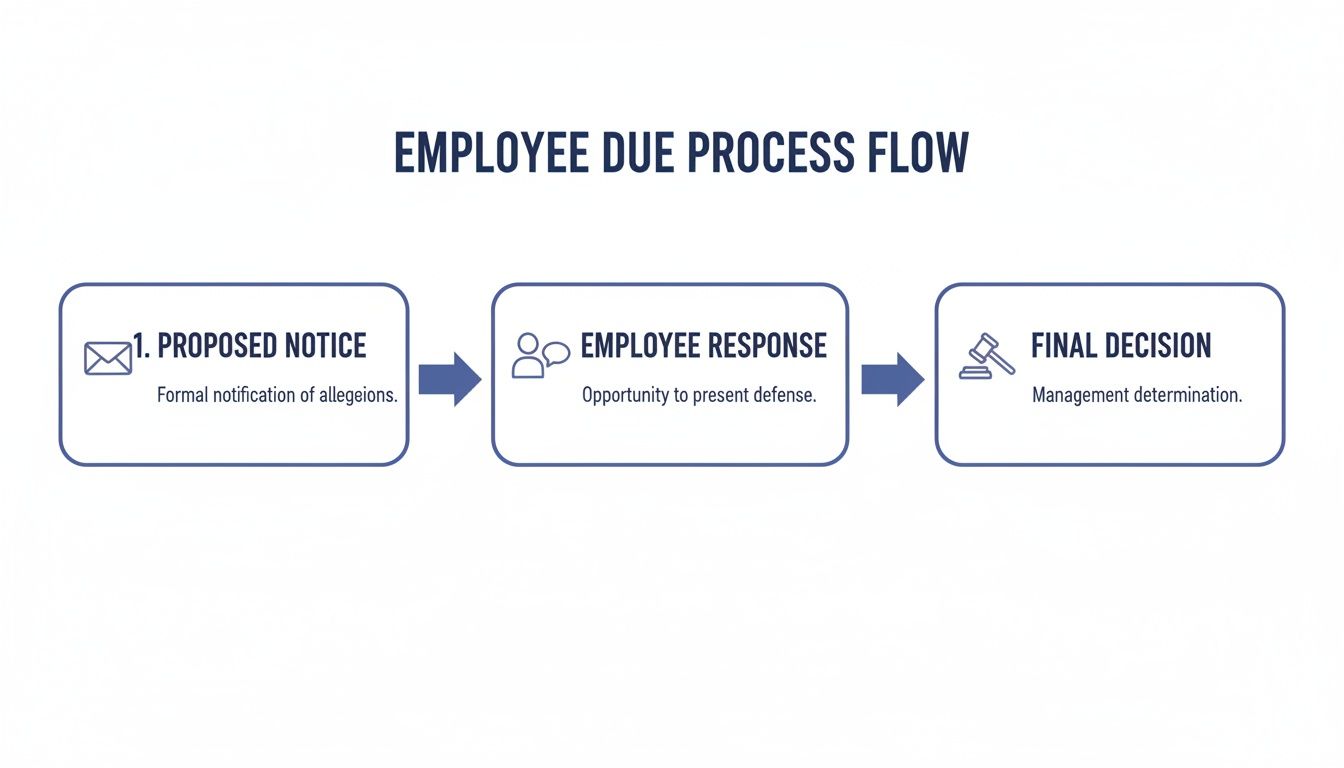
It’s critical to pay close attention to how your agency handles these internal steps. Any procedural mistakes they make along the way can become powerful arguments in your appeal once you take it to an outside body.
Merit Systems Protection Board (MSPB)
For the majority of tenured federal employees, the main place you'll go to appeal a firing is the Merit Systems Protection Board (MSPB). You can think of the MSPB as a specialized court system just for the federal workforce. Its entire purpose is to safeguard merit system principles and protect employees from unfair agency actions.
Your appeal to the MSPB will focus on arguing that the agency got it wrong. Common grounds for a successful appeal include:
- Procedurally Flawed: The agency didn't follow the rules of due process.
- Not Supported by Evidence: The agency’s case against you was weak and they couldn't prove the charges.
- A Prohibited Personnel Practice (PPP): The real reason for your firing was illegal, such as cronyism or retaliation for exercising a legal right.
- An Unreasonable Penalty: Even if the charges were proven, getting fired was far too harsh a punishment, especially when considering the Douglas Factors.
It's also crucial to know that for federal employees in certain states, like Mississippi, these federal avenues are your only recourse. Mississippi does not have a human rights commission or a state-level equivalent where you could bring a claim against your federal agency.
Equal Employment Opportunity Commission (EEOC)
If you have a strong reason to believe your firing was a result of illegal discrimination, then your fight will likely start with the Equal Employment Opportunity Commission (EEOC). This is the path you take if you were terminated because of your race, religion, sex, national origin, disability, or age (if you are 40 or over).
The process here is very time-sensitive. You must contact an EEO counselor at your agency within 45 days of the day you were fired. This is a hard-and-fast deadline you absolutely cannot afford to miss. If informal counseling doesn't resolve the situation, you can then file a formal complaint, which kicks off a full investigation. You can learn more about what that entails in our guide to the EEOC investigation process.
The Office of Special Counsel (OSC)
What if you were fired for doing the right thing—for blowing the whistle on waste, fraud, or abuse? In that scenario, your best ally is the Office of Special Counsel (OSC). The OSC is an independent agency dedicated to protecting federal employees from Prohibited Personnel Practices (PPPs), with a special focus on shielding whistleblowers from retaliation.
If you made what's known as a "protected disclosure" and were then fired, you can file a complaint directly with the OSC. The OSC has the power to investigate your claim and, if they find retaliation, can demand corrective action from the agency, which could include reinstating you to your job.
Understanding "Mixed Cases" and Constructive Dismissal
Sometimes, a case isn't so clear-cut. Your firing might be based on alleged misconduct, but you also have evidence that it was motivated by discrimination. This is what's known as a "mixed case." When this happens, you have a critical choice to make: you can file an EEO complaint with your agency, or you can appeal the entire action directly to the MSPB. You cannot do both at the same time.
It’s also important to recognize that not every firing comes in a formal termination letter. Sometimes, agencies make working conditions so unbearable that an employee feels they have no choice but to resign. This is called a constructive dismissal, or a firing in disguise. Federal programs have even offered financial buyouts for "voluntary" resignations that felt anything but voluntary. An experienced attorney can help you determine if your resignation could legally be treated as a firing, opening the door to an appeal. In cases where you might win monetary damages, a lawyer often works on contingency, typically taking 40-50% of the recovered amount.
Special Protections Against Wrongful Termination

On top of the standard procedural rights we've discussed, federal law provides another powerful layer of defense against being fired. These aren't about your performance or on-the-job conduct. Instead, they shield you from illegal retaliation and discrimination.
If you were fired shortly after doing something the law specifically protects—like reporting fraud or taking medical leave—your termination might not just be unfair. It could be illegal. The key is understanding how to connect the dots between your protected action and the agency's decision to fire you.
The Whistleblower Protection Act
One of the strongest shields a federal employee has is the Whistleblower Protection Act (WPA). In simple terms, this law makes it illegal for an agency to fire you, demote you, or take any other negative personnel action because you made a "protected disclosure."
So, what counts as a protected disclosure? It's when you report something you reasonably believe is evidence of:
- A violation of a law, rule, or regulation
- Gross mismanagement or a gross waste of funds
- Abuse of authority
- A substantial and specific danger to public health or safety
Imagine you file a report because your agency is skipping mandatory safety inspections. A few weeks later, you're fired for a minor paperwork error that others have made without consequence. The timing alone raises a massive red flag, and the WPA is designed to protect you in exactly this situation. For a deeper dive, our guide on how the False Claims Act protects employees from retaliation has more on this topic.
Protections for Family Leave and Military Service
Life happens. Federal laws recognize this by offering rock-solid job security when you need to step away for critical family needs or to serve your country. If you're fired under suspicious circumstances related to this type of leave, you have a very strong case.
- Family and Medical Leave Act (FMLA): This act gives you the right to take job-protected leave for qualifying medical and family reasons. If you take approved FMLA leave to care for a sick child and come back to find out you've been "restructured" out of a job, the timing strongly suggests illegal retaliation.
- Uniformed Services Employment and Reemployment Rights Act (USERRA): USERRA ensures that you don't lose your civilian job because you answered the call to military duty. If you return from a deployment with the National Guard and are told your position was filled and you're being let go, that's a direct violation of your reemployment rights under this powerful law.
Anti-Discrimination Laws and Wrongful Termination
Sometimes, a firing has nothing to do with performance and everything to do with prejudice. Any termination motivated by discrimination is automatically illegal. A host of federal laws, mostly enforced by the EEOC, prohibit firing someone based on who they are.
Your job security is protected by laws like Title VII of the Civil Rights Act and the Americans with Disabilities Act (ADA). An agency cannot fire you because of your race, religion, sex, national origin, disability, or age (40 and over).
Think of it this way: if you are the most senior, experienced person in your unit but also the only one over the age of 60, and you're suddenly fired for "poor performance" while younger, less productive colleagues keep their jobs, that's a textbook red flag for age discrimination. Likewise, getting fired right after you request a reasonable accommodation for a disability is a clear-cut sign of illegal retaliation under the ADA.
Frequently Asked Questions About Federal Termination
When you're facing a potential firing from a federal job, your mind is probably racing with questions. Let's cut through the noise and get straight to the answers you need most.
What Is the First Thing I Should Do If I Receive a Proposed Removal Letter?
First, take a deep breath. Getting a proposed removal letter can feel like the floor just dropped out from under you, but panicking is the worst thing you can do. Read the entire document carefully and find the deadline for your response—missing it is a critical, and often irreversible, mistake.
Your next immediate step is to formally request a complete copy of the evidence file the agency has compiled against you. You have a legal right to see every single piece of information they are relying on to justify their action.
Most importantly, find an experienced federal employment lawyer immediately. The time you have to build a defense is incredibly short, and a skilled attorney is vital for dissecting the agency’s evidence, preparing your written reply, and representing you in your oral reply.
Can I Be Fired for Off-Duty Conduct or Social Media Posts?
Yes, it’s possible, but there are strict rules. An agency can only discipline you for something you did off the clock if they can establish a nexus—a clear, direct link between your conduct and your job performance or the overall "efficiency of the service."
For example, a federal law enforcement officer being convicted of a felony has an obvious nexus. But if you post a personal political view on your private Facebook page, the agency has a much higher mountain to climb to prove that it harms their mission. Whether an employee can be fired for off-duty conduct is a question that always comes down to the specific facts of the case.
A nexus isn't something the agency can just assume exists. The burden of proof is on them to demonstrate exactly how your off-duty actions tangibly harm their mission, damage public trust, or make you unable to do your job.
What Is Constructive Discharge and How Does It Affect Me?
Think of constructive discharge (also called constructive removal) as being forced out. The agency doesn't hand you a termination letter; instead, they make your work life so unbearable that any reasonable person would feel they had no choice but to quit. This could look like a hostile work environment, an impossible and punitive reassignment to a location you can't move to, or other forms of intense pressure.
If you can prove your resignation wasn't truly voluntary, the law treats it as an involuntary firing. This is a crucial distinction because it can give you the same appeal rights to the Merit Systems Protection Board (MSPB) that you would have had if you were formally terminated.
How Much Does It Cost to Hire a Federal Employment Lawyer?
The cost really depends on the unique details of your situation. For cases where you are seeking financial compensation, like in a discrimination or whistleblower retaliation claim, many lawyers will take the case on a contingency fee. This means the attorney's fee is a percentage of the money you recover, typically between 40-50%.
For other matters, like defending you against a proposed removal where the goal is to save your job rather than win damages, lawyers often charge a flat fee or an hourly rate. A good firm will always start with a consultation to review your case and transparently explain all the potential costs and how their fees work. Remember, unlike private-sector employees, federal workers can't just sue in their local state court; you must use the designated federal forums for these claims.
If you are a federal employee in Mississippi staring down a proposed removal or feel you’ve been wrongfully terminated, you don’t have to go through this alone. The team at Nick Norris, P.A. is here to protect workers' rights with the clear guidance and strong advocacy you deserve. Contact us to explore your options and fight for a just outcome by visiting us at https://www.nicknorris.law.
This article has been reviewed for legal accuracy by Nick Norris. For employment law matters in Mississippi, consult with an attorney licensed to practice in your state.

Leave a Reply