
How to Respond to a Performance Improvement Plan
Being put on a Performance Improvement Plan can feel like the floor just dropped out from under you. One minute you’re doing your job, and the next, your manager is sliding a document across the table that feels a lot like a formal warning. It’s stunning, and your first instinct might be to get defensive.
Don’t. The best thing you can do is stay calm, avoid refusing to sign anything, and get professional advice right away. How you respond to a PIP can make a big difference on whether you will be able to continue employment.
Your First 24 Hours After Receiving a PIP
That moment your manager hands you a PIP is jarring. Before you say or do anything you might regret, just take a breath. The initial moves you make are the most important, and approaching this strategically, not emotionally, is your strongest defense. Panic leads to mistakes; a clear head lets you protect your rights.
This graphic breaks down the three simple things you need to do immediately after that meeting.
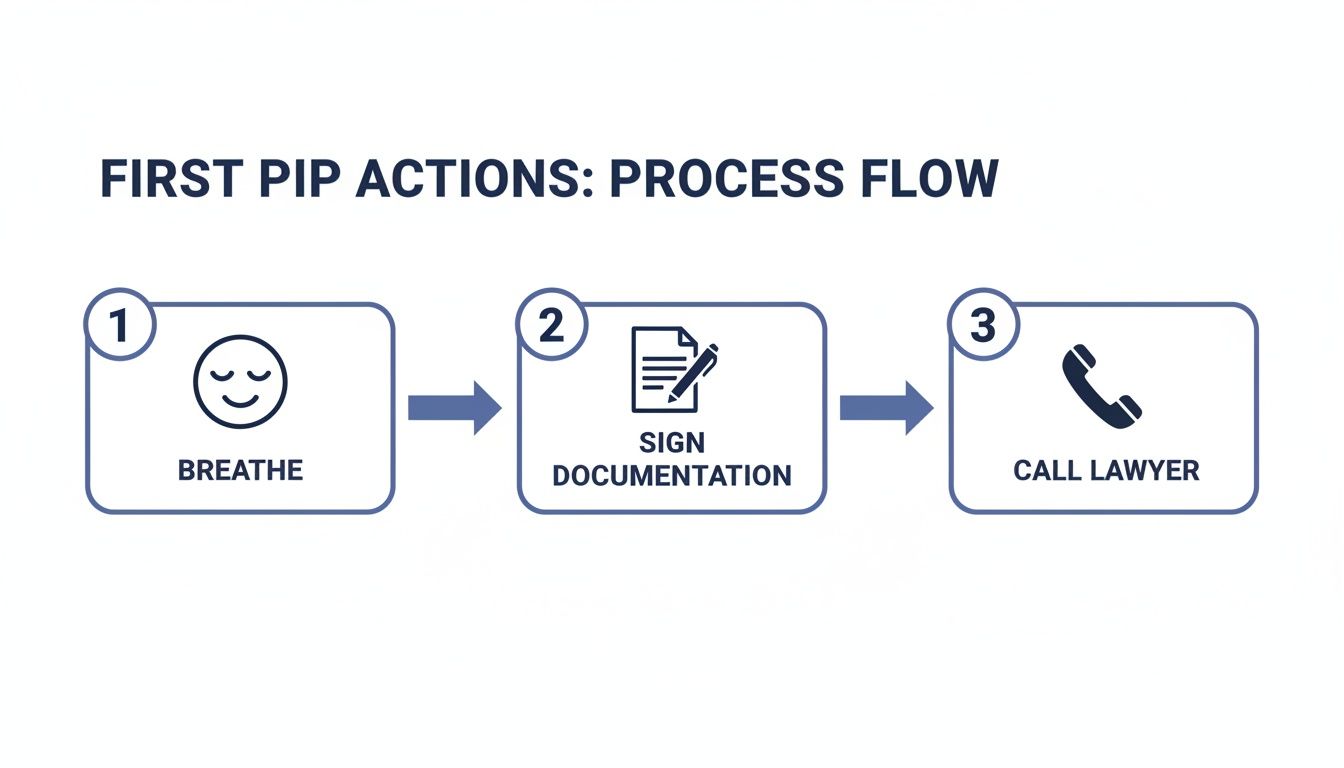
Following this sequence helps de-escalate the situation while building a foundation to protect yourself legally. It’s about being smart, not confrontational.
The Two Most Important First Actions
From my experience handling PIP cases for employees across Mississippi, everything boils down to two immediate actions that you absolutely must get right.
- Do Not Refuse to Sign. This is the most common and damaging mistake I see. People refuse to sign the PIP because they don’t agree with it. Your employer can then immediately fire you for insubordination, and it’s a clean, easy termination for them. Employers use this refusal as an excuse to terminate employees. Signing the document is not an admission of guilt.
- Call an Employment Lawyer. A PIP isn’t just a tough performance review; it’s a legal document. More often than not, it’s the first step an employer takes to build a paper trail to fire you. Getting an attorney involved gives you a confidential advisor who can help you navigate what to do next to protect your job and your rights.
A PIP is the first formal step an employer takes to build a case for your termination. How you respond can make all the difference in whether you keep your job or negotiate a favorable exit. It’s a critical moment that demands a strategic, not emotional, reaction.
What to Say When You Sign
When you’re handed the pen, you can protect yourself by adding a short, handwritten note beside your signature. This simple step preserves your ability to challenge the PIP’s claims later on.
Consider writing one of these phrases:
- “Signing to acknowledge receipt only.”
- “Acknowledging receipt, not agreement with content.”
- “I am signing to acknowledge I have received this document.”
This small act neatly sidesteps any claim of insubordination while making it perfectly clear you don’t accept their version of events. If the PIP feels like the latest in a string of unfair attacks, you might need to read up on how to respond to false accusations at work.
Understanding the Reality of a PIP
You need to be clear-eyed about what a PIP really is. While a few managers might use them in good faith, I’ve found that most are simply tools to justify a firing. They’re often designed for you to fail.
In fact, aggregated HR data shows that only about 10-15% of employees on a PIP actually manage to turn things around and keep their job long-term. Many plans are intentionally punitive, setting impossible goals to pave the way for a termination that looks legally sound.
This is exactly why calling a lawyer isn’t an overreaction—it’s a necessary move. An attorney can dissect the document to spot unfair standards, unattainable goals, or signs of illegal retaliation. Here in Mississippi, where we don’t have a state-level human rights agency, an experienced lawyer is your best bet for understanding and defending your federal rights. A consultation can quickly tell you if the PIP is a genuine effort to help or just a bad-faith tactic to push you out the door.
Deconstructing Your Performance Improvement Plan
That feeling in your gut when your manager slides a Performance Improvement Plan across the desk is unmistakable. After the initial shock wears off, you have to get strategic. The first, most critical question you need to answer is: is this a genuine lifeline, or is it just the first step in a paper trail leading to your termination?
How you move forward depends entirely on the answer.

This document is now the single most important piece of paper in your professional life. Your first move is to read every single word—and, more importantly, what’s written between the lines.
Spotting Red Flags in the Plan
From my experience, a fair PIP is clear and objective. A PIP designed to fail you is often full of vague language and impossible demands. You need to look for the warning signs that suggest the company isn’t actually interested in your improvement.
Here are the big red flags I always look for:
- Vague and Subjective Language: Goals like “show more initiative” or “improve your attitude” are giant red flags. Why? Because they’re impossible to measure objectively. It gives your manager complete power to decide whether you’ve “improved” or not, regardless of what you do.
- Unmeasurable Metrics: If you can’t measure it, you can’t prove you did it. A legitimate plan will have clear, quantifiable goals, like “reduce your report error rate from 5% to under 2%” or “increase your monthly sales pipeline by 15%.” Without hard numbers, it’s just your word against theirs.
- Unrealistic Timelines: Is the plan demanding you complete a project that normally takes a quarter in just 30 days? Or master a complex new software in a single week? An impossible deadline is a classic way to set an employee up for failure.
Make no mistake, PIPs are on the rise. HR Acuity data shows documented underperformance cases jumped from 33.4 per 1,000 employees in 2020 to 43.6 per 1,000 in 2023. This tells us that more companies are using these formal processes, but not always for genuine development. Sometimes, it’s just business, and you can explore more data on the truth about these plans and how they’re really used.
Good Goals vs. Problematic Goals
Let’s look at how this plays out in the real world. The difference between a fair goal and a trap is usually obvious once you know what to look for.
Example of a Fair, SMART Goal:
“Over the next 60 days, you will reduce the average response time for Tier 1 customer support tickets from your current average of 12 hours to the team standard of 4 hours. Your progress will be measured weekly using the Zendesk analytics dashboard.”
See how clear that is? It’s specific, measurable, achievable, relevant, and time-bound (SMART). You know exactly what’s expected and how your success will be judged.
Example of a Problematic, Vague Goal:
“Within 30 days, you need to show more leadership and take greater ownership of team projects. We expect to see a significant improvement in your overall contribution.”
This is a classic trap. What does “more leadership” or “greater ownership” actually mean? Who decides what a “significant improvement” looks like? Your manager does. This kind of subjective goal makes it incredibly easy for them to claim you failed to meet expectations.
Connecting the PIP to Recent Events
Now, think about the timing. Often, the when is just as important as the what. What happened in the weeks or months right before this PIP landed on your desk? An employer will almost never admit they’re retaliating, but the timing can tell the real story.
Ask yourself these critical questions:
- Did you recently complain about harassment or discrimination?
- Did you file a wage complaint for unpaid overtime?
- Did you just request or come back from FMLA leave?
- Did you blow the whistle on an unsafe or illegal company practice?
If you can answer “yes” to any of these, your PIP might be illegal retaliation. While Mississippi is an at-will employment state, employers are prohibited from firing you for exercising a legally protected right.
Suddenly, the PIP isn’t just about your performance anymore—it’s a piece of evidence. Documenting the connection between your protected action and the PIP is crucial for building a potential legal claim down the road.
How to Document Everything to Protect Yourself
When you’re handed a Performance Improvement Plan, your most powerful tool isn’t just hard work—it’s hard evidence. I’ve seen it time and again in my practice: a detailed log of your performance can completely dismantle an employer’s vague claims that you “failed to improve.” Simply doing the work isn’t enough; you have to prove you did the work.
Detailed performance logs make it very clear that the goals set in a PIP have been met, and it makes it difficult for employers to dispute them. Every email you save and every task you log becomes a piece of your defense, whether you’re trying to save your job or building a case for wrongful termination.
Start a Meticulous Performance Log—Today
The minute you get that PIP, your documentation needs to begin. Don’t rely on your memory, and certainly don’t rely on your manager’s notes. Grab a notebook or start a digital document on a personal device (not your work computer) and get ready to track everything.
For every single goal listed in your PIP, you need to be logging the specifics:
- Actions You’ve Taken: Write down every task you complete that’s tied to a PIP objective. Be specific. Include the date, the time, and exactly what you did.
- Proof of Progress: Numbers are your best friend here. If your goal is to reduce errors by 10%, log every error-free report. If it’s about increasing client outreach, track your calls and emails daily.
- Roadblocks and Obstacles: This is critical. Did you need data from another department that arrived two days late? Did a manager cancel a crucial meeting? Document anything that gets in your way.
- Every Piece of Positive Feedback: Save it all. Forward emails from happy clients to your personal email account. If your boss gives you a verbal “good job” in the hallway, go back to your desk and immediately write down the date, time, and what was said.
This log is your shield. A manager’s vague complaint of “lack of progress” has a hard time standing up against a spreadsheet filled with dated, concrete achievements.
Document Every Single Interaction
Your paper trail needs to go beyond just your work tasks. You also have to create a record of every conversation, meeting, and check-in about your PIP. The goal here is to leave no room for misinterpretation.
After any meeting with your supervisor to discuss the PIP, send a brief, professional follow-up email. This isn’t about being confrontational; it’s about creating clarity and a written record.
Here’s a simple script you can adapt:
“Hi [Manager’s Name], thanks for chatting with me today about my progress. Just to make sure I’m on the right track, my understanding is that we agreed I’m meeting the target for [Goal 1], and my main focus for next week should be on [Goal 2] by completing [Specific Task]. Please let me know if I misunderstood anything. Thanks, [Your Name].”
An email like this does something powerful: it creates a record of the conversation. If your manager doesn’t reply to correct you, your summary is essentially accepted as an accurate account. Make sure you save these emails—and any other PIP-related messages—to a secure, personal folder off your company’s network.
Gather and Organize Your Evidence
As you collect all this information, you have to keep it organized. A jumble of notes and unsorted emails is far less effective than a well-structured file. Think of yourself as building a case file on your own performance. The checklist below can help you make sure you’re gathering everything you need.
Your PIP Documentation Checklist
This table breaks down the key evidence you should be collecting. A systematic approach ensures you don’t miss anything important and can quickly find what you need.
| Evidence Category | What to Collect | Why It Matters |
|---|---|---|
| Performance Logs | Daily records of tasks completed, progress on goals, and metrics achieved. | Creates an undeniable, date-stamped record of you meeting or exceeding PIP expectations. |
| Communications | Emails, saved chat messages (Slack, Teams), and written summaries of verbal talks. | Provides a timeline and context, preventing your manager from later changing their story. |
| Positive Feedback | Emails from satisfied clients, praise from colleagues, and notes on verbal compliments. | Directly contradicts the narrative that your performance is poor and demonstrates your value. |
| Obstacles & Roadblocks | Records of denied resource requests, technical issues, or lack of support from management. | Shows that any failure to meet goals was due to external factors, not your lack of effort. |
| Past Performance | Copies of previous performance reviews, awards, and commendations showing your strong history. | Establishes a pattern of success, making the sudden PIP appear suspicious and potentially retaliatory. |
By meticulously gathering these documents, you arm yourself with leverage. You shift from being a passive victim of the process to an active participant who is building a robust defense.
If you start to feel the PIP is just a paper trail for a predetermined outcome—especially if it feels discriminatory or retaliatory—this documentation becomes even more vital. At that point, it’s also wise to understand how to report workplace discrimination in Mississippi and ensure your evidence is preserved accordingly.
Drafting a Strategic and Professional Written Response
Once you’ve signed to acknowledge you’ve received the PIP, your next move is crucial. You need to write a formal response. I’ve seen too many Mississippi employees make the mistake of staying silent, assuming their hard work will speak for itself. Unfortunately, in this situation, silence can be seen as agreement with everything the company has written.
This written response is your chance to officially get your side of the story into your employee file. It’s not about being emotional or starting a fight. Instead, your goal is to create a calm, professional, and fact-based document that corrects the record and protects your legal interests down the road. It shows you’re taking this seriously and are an active participant in your career, not just someone letting things happen to them.

Structuring Your Rebuttal for Impact
Don’t just fire off a long, rambling email. A powerful rebuttal is organized and easy to follow. The most effective approach I’ve seen is a point-by-point format that directly mirrors the structure of the PIP itself. This makes your counterpoints impossible to overlook.
Think of it like this: for every specific criticism they’ve listed, you provide a clear and documented answer.
- First, reference their point. Clearly state which part of the PIP you are addressing. “Regarding the claim about missing project deadlines…”
- Then, bring in your evidence. This is where that detailed performance log you’ve been keeping becomes your most valuable tool. Use specific dates, project names, and hard numbers to counter their claims.
- Finally, correct any factual errors. Politely but firmly point out any misstatements or incorrect information in their version of events.
Wrap it all up with a professional closing. Reiterate your commitment to your job and to working constructively with your manager. This reinforces that you’re a team player, even while you’re standing up for yourself.
Using Professional Language to Challenge the PIP
The tone you use is everything. You have to be firm and disagree with the substance of the PIP, but you must do it respectfully and without attacking your boss or the company. The right phrasing can make the difference between coming across as insubordinate and coming across as a diligent professional setting the record straight. As you draft your letter, remember that clear communication is vital; you might even want to improve your written communication skills to ensure your points land effectively.
Here are a few phrases that help you find that perfect balance:
- To correct a factual mistake: “I’d like to offer a clarification on the point regarding…” Or, a bit more directly: “My records from that week show a different timeline for this project…”
- To present your counter-evidence: “The PIP expresses concern about project turnaround times. For instance, the XYZ project, which was mentioned, was submitted on March 15—two full days ahead of the deadline—as noted in my email confirmation that day.”
- To push back on vague goals: “I am committed to succeeding in my role and would appreciate more specific, measurable metrics for the goal of ‘improving proactive communication.’ This would help me track my progress more effectively.”
Key Takeaway: Think of your written response as a legal document in the making. It’s not about winning an argument in the moment. It’s about building a factual, evidence-based record that makes it incredibly difficult for your employer to later claim you failed to meet the PIP’s goals.
Proposing Reasonable Modifications
Your rebuttal isn’t just about defense; it’s also a chance to negotiate. If the goals laid out in the PIP are genuinely unrealistic or the timeline is impossibly short, you should professionally suggest reasonable changes. This is a smart move because it shows you’re engaged and want to succeed, but that you need fair and achievable terms to do so.
For example, if a goal is vague like “show more initiative,” you can propose a SMART (Specific, Measurable, Achievable, Relevant, Time-bound) version of that goal. If they haven’t given you the tools to succeed, your response is the place to formally request them. You might state that to meet a new sales target, you’ll need access to the company’s premium CRM software or a half-day of training on the new product line.
By offering these constructive solutions, you change the entire dynamic. You’re no longer just reacting; you’re actively shaping the path forward. For a deeper dive into getting this document just right, our guide on how to write a rebuttal letter will walk you through the process from start to finish.
Spotting Red Flags for Unlawful Discrimination
Let’s be honest. Sometimes, a Performance Improvement Plan has absolutely nothing to do with your performance. It can be a calculated move by an employer to create a paper trail, giving them what looks like a legitimate reason to fire you when their real motive is illegal. Recognizing when a PIP isn’t about improvement—but is actually a pretext for discrimination or retaliation—is the first step in protecting your job and your rights.
You have to look beyond the document itself and examine the entire situation. The timing, the language used, and how you’re being treated compared to your colleagues are all potential clues. If a PIP feels fundamentally unfair, it might be more than just bad management. It could be illegal.

Suspicious Timing Is a Major Red Flag
One of the most telling signs of an unlawful PIP is when it appears out of the blue. Employers are rarely foolish enough to write “this is retaliation” in a memo, but a sudden, intense focus on your “poor performance” right after you’ve engaged in a legally protected activity is incredibly suspicious.
Think back over the last few weeks or months. Did you recently:
- Report sexual harassment or a toxic work environment?
- File a complaint about unpaid wages or missing overtime?
- Request or return from legally protected FMLA leave for a health condition or new child?
- Act as a whistleblower by reporting illegal or unsafe company practices?
- Ask for a reasonable accommodation for a disability?
- Serve as a witness in another employee’s discrimination complaint?
If that PIP landed on your desk shortly after one of these events, you may be facing illegal retaliation. There’s a reason retaliation is the most common charge filed with federal authorities. In fact, the EEOC received over 67,000 retaliation charges in 2023 alone. Many of these cases begin with a disciplinary action, like a PIP, that suspiciously follows an employee’s formal complaint. You can find more insights on performance management trends and how they are sometimes used to mask deeper issues.
Are You Being Singled Out?
Another huge red flag is being held to a different standard than your coworkers. Take an objective look around your department. Are other people making the same kinds of mistakes or struggling with similar tasks, but they aren’t on a PIP?
This is a classic example of “disparate treatment,” and it can be powerful evidence of discrimination. If you are the only person of color on your team, the oldest employee in the office, or the only woman in your department, and you’re the one being disciplined for behavior that’s overlooked in others, pay close attention. This kind of selective enforcement is a common tactic to push out employees who belong to a legally protected class.
It’s absolutely crucial to document these inconsistencies. Write down specific examples of colleagues who engaged in similar behavior without any consequence. This evidence is what helps shift the conversation from your “poor performance” to targeted, unequal treatment.
Understanding Your Rights in Mississippi
For Mississippi employees, it’s vital to know that Mississippi does not have its own state-level human rights commission to handle discrimination claims. This is a critical distinction because it means your primary protections come from federal law.
These powerful federal laws make it illegal for an employer to treat you differently based on your protected status:
- Title VII of the Civil Rights Act: Protects against discrimination based on race, color, religion, sex, and national origin.
- The Age Discrimination in Employment Act (ADEA): Protects workers who are 40 years of age or older.
- The Americans with Disabilities Act (ADA): Protects qualified individuals with disabilities and requires employers to provide reasonable accommodations.
These laws are all enforced by the U.S. Equal Employment Opportunity Commission (EEOC). An employer cannot legally use a PIP as a smoke screen to fire you for any of these reasons. If you believe your PIP is a cover for discrimination or retaliation, recognizing these red flags is your first move. Your next one should be to speak with a Mississippi employment lawyer who understands how to navigate the federal system and protect Mississippi workers. An attorney can help you determine if you have a valid claim and how to best use the evidence you’ve gathered.
Common Questions About Responding to a PIP
Getting hit with a Performance Improvement Plan is stressful, and your mind is probably racing with questions. Let’s cut through the noise. Here are the real-world answers to the most frequent concerns I hear from employees across Mississippi who are in this exact spot.
Should I Refuse to Sign My PIP if I Disagree With It?
No. Absolutely not. This is probably the biggest, and most common, mistake you can make.
When you refuse to sign, your employer doesn’t see it as a principled stand against the PIP’s content. They see it as insubordination, plain and simple. This gives them a brand-new, clean reason to fire you on the spot, making it incredibly difficult to challenge your termination later.
Instead, you sign the document, but you add a crucial note next to your name. All you need to write is something like:
- “Signing to acknowledge receipt only.”
- “Acknowledging receipt, not agreement with contents.”
- “Signing to confirm receipt and will provide a formal response.”
Doing this protects you from being fired for insubordination while saving your right to fight back against the PIP’s claims. Your first move should always be to sign with this disclaimer, then immediately get advice from an employment lawyer.
Can I Be Fired While on a Performance Improvement Plan?
Yes. A PIP gives you zero special job protection. Mississippi is an “at-will” employment state, meaning a company can fire you at any time for almost any reason, as long as it isn’t an illegal one like discrimination or retaliation.
In fact, many employers see the PIP as the final step in their paper trail before termination. They might fire you before the 30 or 90 days are up, claiming you aren’t making “sufficient progress.” This is exactly why it’s so important to keep your own detailed records of your work. Your logbook becomes your best defense when they try to argue you weren’t meeting their goals.
What if the Goals in My PIP Are Impossible to Meet?
Unrealistic or vague goals are a huge red flag. It often means the PIP isn’t a good-faith effort to help you improve—it’s a setup designed to make you fail. This is something you must address head-on in your written rebuttal.
Calmly and professionally, lay out exactly why the goals are unachievable. Point to your current workload, show data from past projects, or highlight the lack of training or resources you’ve been given. Don’t just complain about it; propose your own clear, measurable, and realistic goals as an alternative.
When you present a logical, data-backed argument for why a goal is impossible and the company refuses to budge, their refusal becomes powerful evidence. It significantly strengthens your case that the PIP is just a cover story—a pretext—for an unfair and potentially illegal firing.
Beyond these legal steps, don’t forget the human element. A PIP can take a serious emotional toll, and the stress can be overwhelming. Seeking support is not a sign of weakness. Sometimes, talking with professional counselling services can give you the tools you need to manage the anxiety that comes with this kind of high-stakes workplace pressure.
What Does It Cost to Hire an Employment Lawyer for a PIP?
Most employment lawyers in Mississippi will offer an initial consultation to review your situation and talk through your options. If it looks like you might have a case for wrongful termination, discrimination, or retaliation, many will take your case on a contingency fee basis.
A contingency fee means you don’t pay any attorney’s fees upfront. The lawyer only gets paid if they win your case and recover money for you, whether through a settlement or a court verdict. In Mississippi, the average contingency fee runs from 40% to 50% of the total recovery. Any reputable lawyer will put their fee structure in writing for you to review before you sign anything.
If you’ve been placed on a Performance Improvement Plan and believe it’s unfair, retaliatory, or discriminatory, you don’t have to face it alone. If the PIP followed a complaint or other protected activity, our workplace retaliation page covers your legal options, and if it leads to termination, our wrongful termination page explains what comes next. The team at Nick Norris, P.A. is dedicated to protecting the rights of Mississippi workers. Contact us today for a consultation to understand your options and how to protect your career. Learn more at https://www.nicknorris.law.
This article has been reviewed for legal accuracy by Nick Norris. For employment law matters in Mississippi, consult with an attorney licensed to practice in your state.
Leave a Reply