

Secure Disability for Depression and Anxiety
Some Mississippi workers reach the point where getting through a shift feels harder than doing the job itself. You may still be showing up, answering emails, stocking shelves, driving routes, charting patients, or managing a crew. But depression has slowed your thinking, and anxiety has made every call, deadline, and interaction feel like a threat. At some point, willpower stops being enough.
That’s often when people start searching for disability for depression and anxiety. They’re not looking for a shortcut. They’re trying to figure out how to keep a roof overhead, protect their job if they still have one, and make sense of a system that seems built for paperwork rather than people.
In Mississippi, that confusion is worse because workers often have to piece together federal rights on their own. Social Security disability is one track. The FMLA and ADA are separate tracks. Private long-term disability coverage may be a fourth. If you don’t understand how those systems interact, it’s easy to make a move that hurts your case, your paycheck, or both.
When Depression and Anxiety Make Work Impossible
A worker in Jackson starts missing small things first. She forgets routine steps she’s done for years. She dreads opening her email. Her chest tightens on Sunday because Monday is coming. She uses sick days here and there, then burns vacation days just to sit in a parking lot and try to calm down before walking inside.
Her employer may see attendance issues, distraction, or irritability. What the employer usually doesn’t see is the effort it takes just to get dressed, drive in, and stay composed through one ordinary conversation.

That pattern is common. It’s also serious. A national survey reported by Medical Xpress found that adults with intellectual and developmental disabilities were nine times more likely to report diagnosed anxiety (56.8%) and depression (56.9%) than the general population. Those numbers matter because they show how often mental health and disability overlap.
When the problem becomes a work problem
Social Security doesn’t award benefits because a diagnosis exists on paper. The agency looks at whether your symptoms prevent sustained work. Employers look at something different. They look at performance, attendance, communication, and reliability.
That mismatch creates danger.
You may know you’re in crisis while your employer is still documenting missed deadlines. You may need leave before you’re ready to admit you need leave. If you’re still employed, one of the smartest first steps is learning how federal leave works in practice. A practical starting point is this guide on how to apply for FMLA.
Practical rule: If your symptoms are affecting attendance, focus, pace, or your ability to interact with others, treat it as both a medical issue and an employment issue.
What workers usually get wrong
Many people wait too long because they think they need to collapse completely before they qualify for help. That’s not how these cases work. The better approach is to recognize the shift early and start documenting what’s happening.
Watch for patterns like these:
- Work tasks take far longer: You read the same email several times and still can’t process it.
- Routine interaction becomes unmanageable: Coworker conversations, phone calls, or customer contact trigger panic, shutdown, or conflict.
- Attendance slips for mental health reasons: You’re late, absent, or leaving early because symptoms make functioning impossible.
- Basic self-management drops: Hygiene, sleep, meals, medication compliance, and keeping appointments all become harder.
If that sounds familiar, you’re not weak, and you’re not alone. You may be at the point where legal protections and disability benefits need to be part of the plan.
Understanding Your Options SSDI vs SSI
The phrase “disability benefits” is often used as if there’s only one program. There isn’t. The two main federal programs are SSDI and SSI, and confusing them causes problems from the start.

SSDI is based on your work history
Social Security Disability Insurance, or SSDI, is the program workers usually think of first. It’s tied to your earnings record and the payroll taxes taken from your paycheck over time.
If you’ve worked steadily, especially in jobs where FICA taxes were withheld, SSDI may be the first program to examine. In plain terms, SSDI is an earned benefit. The question is whether you have enough recent covered work and whether your medical condition keeps you from substantial work.
Common signs SSDI may fit:
- You’ve had a regular work history: W-2 work is often the clearest starting point.
- You became unable to keep working after years on the job: That pattern often points people toward SSDI rather than SSI.
- You want to review your earnings record: A Social Security account can help you see whether your work history supports a claim.
SSI is based on financial need
Supplemental Security Income, or SSI, is different. It isn’t built around work credits. It’s a needs-based program for people with limited income and resources.
That means SSI often matters for younger workers, people with interrupted work histories, or people who’ve been out of the workforce long enough that their SSDI insured status may be in doubt. It also matters when someone has severe depression or anxiety but doesn’t have the earnings record needed for SSDI.
Here’s the practical comparison:
| Program | Main question | Usually fits people who | Health coverage connection |
|---|---|---|---|
| SSDI | Did you work enough in covered employment? | Have a stronger recent earnings history | Often tied to Medicare eligibility |
| SSI | Are your income and resources limited enough? | Have limited means and may not have enough work history | Often tied to Medicaid eligibility |
Some people should examine both
This isn’t always an either-or choice. In some cases, a worker should look at both programs at the same time.
A good intake starts with two questions. Can you prove disability medically, and do you qualify financially or through your work record?
Workers in Mississippi often assume that if they haven’t worked recently, they’re out of options. That’s not always true. Others assume that years of work automatically qualify them for SSDI. That’s also not always true. The answer depends on the combination of work history, timing, and finances.
What matters most at this stage is accuracy. Don’t guess. Don’t rely on what happened to a cousin or a coworker. Start with your earnings record, your current finances, and the date your symptoms made work unrealistic. Those details control which door is open.
Meeting the SSA's Medical Rules for Mental Health
The Social Security Administration doesn’t decide mental health cases by asking whether depression and anxiety are real. It asks whether your medical evidence proves impairment at the level required by its rules.

For depression, the agency looks to Listing 12.04. For anxiety-related conditions, it looks to Listing 12.06. You don’t need to memorize those numbers, but you do need to understand what the agency is looking for. It wants proof that your condition doesn’t just exist. It limits functioning in concrete ways.
What marked and extreme limitations look like
The outcome of many claims is decided here. The SSA uses phrases like marked limitation and extreme limitation in areas such as understanding information, interacting with others, concentrating, and adapting.
In plain English, that can mean:
- Understanding and remembering information: You can’t reliably follow multi-step instructions, retain new procedures, or apply basic training.
- Interacting with others: You avoid supervisors, freeze in meetings, misread social cues, or can’t tolerate ordinary criticism.
- Concentration and pace: You start tasks and abandon them, lose track of steps, or work so slowly that a normal job pace becomes impossible.
- Adapting or managing yourself: Small changes in schedule, demands, or environment trigger shutdown, panic, or emotional collapse.
A diagnosis alone won’t carry the claim. A doctor’s note that states “patient has anxiety” won’t carry it either. The file needs to show how symptoms affect work-like functioning.
The strongest mental health claims read like a functional story, not just a medication list.
There’s also an important overlap between physical and mental disability. DMEC’s summary of the research explains that employees with pre-existing depression or anxiety had over double the odds of needing disability leave for a physical issue, while workers on leave for a physical issue had over four times the odds of developing new-onset depression or anxiety. That matters because many Mississippi workers don’t present with a “pure” mental health claim. Their depression and anxiety often intensify after pain, surgery, injury, or chronic illness disrupts work.
A helpful overview of how Social Security evaluates trauma-related conditions appears in Morgan & Morgan’s article on Post Traumatic Stress Disorder And Social Security, especially for readers whose anxiety symptoms overlap with trauma.
What the agency wants to see in real life
This is a good place to hear the legal language translated into ordinary examples:
A persuasive file usually shows repeated problems over time, not one bad week. Missed appointments may hurt a claim unless the records explain why they happened. Emergency visits, medication changes, therapy notes, psychiatrist evaluations, and consistent symptom reporting all help the decision-maker understand severity.
What does not work
Several things routinely weaken cases:
- Gaps with no explanation: Long periods without treatment can make the SSA question severity.
- Records that only discuss feelings, not function: “Still anxious” is weaker than “unable to finish tasks or tolerate interaction.”
- Minimizing symptoms at appointments: Many workers downplay symptoms out of shame, then wonder why the file looks mild.
- Inconsistent descriptions: Telling one provider you’re stable and another that you can’t leave the house creates avoidable conflict in the record.
If you’re seeking disability for depression and anxiety, your goal is to make the file reflect your actual limits, not the version of yourself you wish were still functioning.
Building Your Case with Medical and Work Evidence
A Social Security claim is not won by the diagnosis line. It’s won by evidence showing what you can no longer do, how often you can’t do it, and why those limitations keep you from working consistently. That’s where Residual Functional Capacity, often called RFC, becomes central.
The RFC question is practical. Can you sustain work activities on a regular basis despite your symptoms? The answer depends on records, not assumptions.
The file you need to build
For mental health claims, I tell people to think in terms of a case file, not a stack of records. You want evidence from different angles that all point to the same conclusion: depression or anxiety has reduced your ability to perform reliable work.
That usually includes treatment records, but it shouldn’t stop there. Work history, attendance issues, pharmacy history, and statements from people who watched your decline can help explain what the medical chart alone may not show.
Why this matters: The SSA is trying to measure function. Every document should help answer what work tasks break down and how often.
Essential Documentation Checklist for Your Disability Claim
| Document Type | What It Proves | Where to Get It |
|---|---|---|
| Psychiatrist records | Diagnosis, medication management, symptom severity, clinical observations | Treating psychiatrist or clinic |
| Therapist or counselor notes | Ongoing symptoms, coping struggles, panic episodes, isolation, missed functioning | Treating therapist, counselor, or mental health center |
| Primary care records | How often you reported depression, anxiety, insomnia, fatigue, or medication side effects | Family doctor, internist, clinic portal |
| Hospital or crisis records | Acute episodes, safety concerns, emergency intervention, sudden worsening | Hospital medical records department |
| Medication and pharmacy history | Consistent treatment, medication changes, side effects, attempts to stabilize symptoms | Pharmacy printout or online prescription portal |
| Employer attendance or disciplinary records | Missed work, tardiness, write-ups, reduced performance, inability to meet expectations | Human resources file, supervisor communications, payroll records |
| Short statements from family or former coworkers | Day-to-day functional limits that may not appear fully in charts | Individuals who observed your symptoms regularly |
| Personal symptom log | Frequency of panic, crying spells, inability to get out of bed, concentration failures, social avoidance | Your own written record |
| Prior leave paperwork | Evidence that your condition already affected work enough to require leave or accommodation | Employer, HR department, your saved records |
Evidence that usually carries weight
Not every piece of evidence matters equally. A short, vague letter rarely helps as much as detailed treatment notes that repeatedly describe functional problems over time.
Focus on evidence with specifics like:
- Task failure: You couldn’t complete forms, instructions, reports, or customer interactions.
- Pace problems: Ordinary work took far longer because you lost focus or shut down.
- Social strain: You withdrew, had conflict, or couldn’t tolerate supervision.
- Adaptation trouble: Schedule changes, criticism, noise, or routine work pressure caused severe symptoms.
What works is consistency. If your therapist notes, medication history, and work records all show the same pattern, the claim becomes much harder to dismiss.
Navigating the Application and Appeals Process
Most workers expect the disability application process to feel bureaucratic. What catches them off guard is how discouraging the first denial can be.
That first denial often lands when the person is already exhausted, broke, and trying to hold life together. It feels personal. In most cases, it isn’t. It’s part of the system.
The first application is only the opening round
A typical claim starts with the initial application, supporting records, and agency review. Then comes waiting. Then comes a letter that can read as if the government barely understood what you submitted.
That happens often in mental health claims. Atticus notes that roughly 70% of initial Social Security Disability claims for mental health are denied, often because the file doesn’t sufficiently document functional limitations. That doesn’t mean the claim was hopeless. It often means the evidence wasn’t framed the right way yet.
What to expect after a denial
Once the denial arrives, the claim usually moves into a different phase. The work becomes less about filing and more about correcting.
Here’s what that often means:
Review the denial closely
Look for what’s missing. Was the problem treatment gaps, weak function evidence, or a flawed understanding of your work history?Appeal on time
Deadlines matter. Waiting too long can force you to start over.Add stronger evidence
Updated records, better symptom descriptions, and function-focused statements can change the posture of the case.Prepare for a hearing if needed
If the case goes before an Administrative Law Judge, detail matters more, not less.
Some workers also benefit from non-legal support that helps them stay organized and communicate their limitations clearly. For people who want help understanding the process side by side with emotional support, disability advocacy coaching can be a useful supplemental resource.
Don’t treat a denial letter as the final word. Treat it as a map of what the agency still doesn’t understand.
Hearings reward preparation
By the hearing stage, the question usually isn’t whether you have a condition. It’s whether you can explain, with support from the record, why sustained work is no longer realistic.
Judges tend to focus on daily functioning, treatment history, and credibility across the file. If your records say you isolate, panic, can’t maintain pace, and struggle with ordinary changes, your hearing testimony should match that reality. Not exaggerate it. Not soften it. Match it.
The appeals process is draining, but it’s often where serious cases finally get a fairer look.
Protecting Your Rights at Work with FMLA and ADA
Some workers reading this are still employed. Others were pushed out before they understood their rights. In either situation, federal employment law matters because disability claims and workplace protections often run at the same time.
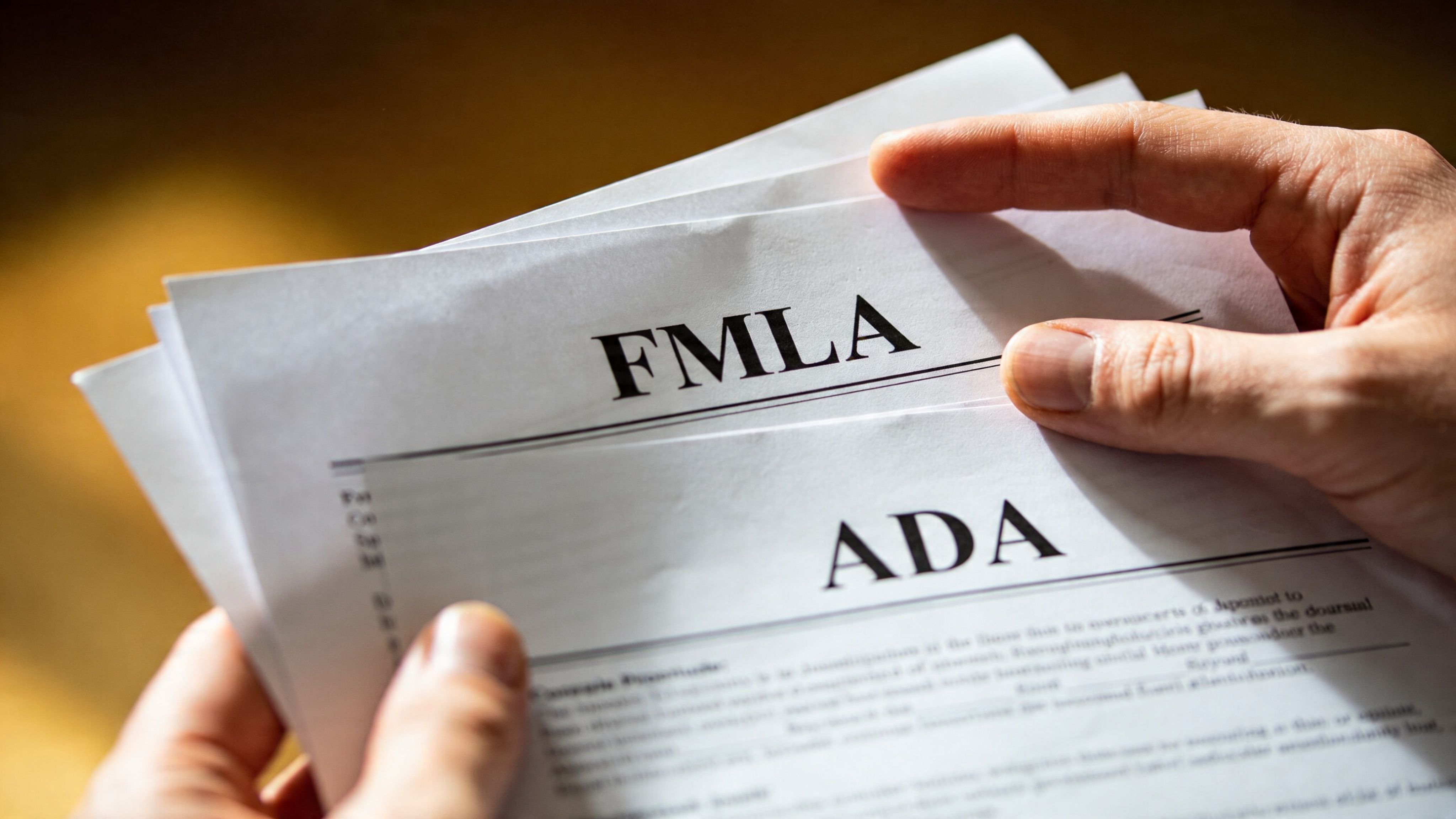
FMLA can buy time when symptoms spike
The Family and Medical Leave Act can provide up to 12 weeks of unpaid, job-protected leave for a serious health condition, including severe depression in the right circumstances. That leave can be the difference between stabilizing and getting fired while you’re trying to get treatment.
For some workers, FMLA leave creates breathing room to attend therapy, adjust medication, or gather records for a disability application. For others, intermittent leave helps manage recurring panic, treatment appointments, or episodes that make attendance unpredictable.
ADA rights look different from disability benefits
The Americans with Disabilities Act is not a wage replacement system. It’s an anti-discrimination law. If depression or anxiety substantially limits major life activities, the ADA may require a reasonable accommodation and may protect you from discrimination tied to your condition.
Possible accommodations depend on the job, but common examples include schedule adjustments, quieter work arrangements, modified communication methods, or leave as an accommodation in some cases. If you need a practical starting point, this guide on ADA accommodations for anxiety lays out the issue in workplace terms.
Private long-term disability can add another layer
Many salaried employees and some hourly workers also have private Long-Term Disability, or LTD, coverage through work. That’s separate from Social Security. It has its own definitions, deadlines, and traps.
As CCK Law explains, LTD claims often focus on whether you can perform your own occupation, but benefits may stop after 2 years if the standard shifts to whether you can perform any occupation. That change creates a real strategy problem. A worker may qualify early under the job-specific standard, then face a tougher review later.
Mississippi reality matters here
Mississippi does not have a human rights commission that steps in as a state-level backstop for many workplace discrimination problems. That means workers often need to understand federal law quickly and act carefully. If you request leave the wrong way, fail to document the need for accommodation, or resign before the record is clear, you can make both the employment side and the disability side harder.
The better approach is coordinated. Protect your job if you can. Protect your health either way. Build one consistent record across leave requests, accommodation requests, and disability paperwork.
When to Contact a Mississippi Employment Attorney
Some people can start the process on their own. Fewer can finish it on their own when the facts get complicated.
You should strongly consider talking with a Mississippi employment attorney if any of these things happen:
- You receive a denial letter: The appeal is often more evidence-driven and more technical than the original filing.
- Your employer is pressuring you while you’re in treatment: Discipline, forced resignation pressure, or suspicious attendance actions can overlap with FMLA and ADA issues.
- You need leave or an accommodation and don’t know how to ask: The wording, timing, and medical support matter.
- You were fired after disclosing depression or anxiety: That can trigger separate workplace-rights analysis.
- You have LTD coverage through work: ERISA-governed claims often involve rules very different from Social Security.
A lot of workers hesitate because of cost. That’s understandable. In employment matters, contingency fees commonly fall in the 40% to 50% range. That makes it important to ask hard questions at the beginning. What exactly will the lawyer handle? Is the representation limited to an employment claim, a disability issue, or both? What costs are separate from the fee?
Bottom line: Legal help is most valuable when one bad decision could affect both your job and your benefits.
If your employer has already started treating you differently because of your condition, or if you’ve been terminated after raising disability-related concerns, it helps to understand the warning signs early. This discussion of disability discrimination by employers is a useful place to start.
You do not need to have every answer before you call a lawyer. You do need to act before deadlines pass, records disappear, or a preventable mistake gets locked into the file.
If depression or anxiety has pushed you to the edge of keeping your job, your income, or both, Nick Norris, P.A. helps Mississippi workers evaluate federal workplace rights involving the FMLA, ADA, retaliation, and related employment issues. A timely review can help you protect your position, document your condition properly, and avoid missteps that make a disability claim harder than it already is.
This article has been reviewed for legal accuracy by Nick Norris. For employment law matters in Mississippi, consult with an attorney licensed to practice in your state.
Leave a Reply