

Disability Discrimination Attorney: A Mississippi Guide
Your work record was solid. Then you told your employer about a medical condition, asked for a small adjustment, or took protected leave. After that, the tone changed.
You stopped getting included. A supervisor began documenting minor issues that were ignored before. Someone hinted that you might not be “reliable” anymore. In some workplaces, nobody says the quiet part out loud. They just make your job harder until you quit, or they fire you and call it performance.
That pattern is common enough that federal law addresses it directly. A disability discrimination attorney helps sort out whether what happened was unfair management, illegal discrimination, retaliation, or some combination of all three. In Mississippi, that matters because the process is less intuitive than many people expect. There is no state human rights commission handling these claims for you. If you wait too long or document the wrong things, you can damage an otherwise strong case.
The good news is that you don't need to guess. You need a clear view of your rights, the timeline, and the evidence that helps.
Facing Unfair Treatment at Work Because of Your Health
A common Mississippi workplace story typically involves an employee developing migraines, a back injury, diabetes complications, anxiety, or another condition that starts affecting the workday. The employee doesn't ask for anything dramatic. Maybe it's a stool at a workstation, a modified schedule for treatment, a short leave extension, or permission to avoid one task that aggravates the condition.
Then the relationship changes.

A manager who used to be supportive becomes distant. Coworkers are told you're getting “special treatment.” Your requests sit unanswered. A write-up appears after years of good reviews. If that sounds familiar, you're not overreacting. Disability bias often shows up through changed behavior, selective enforcement, and pressure tactics long before an employer admits anything directly.
What employees usually notice first
It's uncommon for someone to walk into a lawyer's office saying, “I have a clean ADA claim.” They say things like:
- “My boss was fine until I asked for help.” That usually means the timing matters.
- “They keep saying they need someone with no restrictions.” That can be a red flag.
- “I came back from leave and everything got worse.” Leave and disability rights often overlap.
- “They never really answered my accommodation request.” Silence can matter just as much as an outright refusal.
If you're still deciding whether to raise the issue internally, it helps to understand how to request a reasonable accommodation in a way that creates a record and reduces avoidable disputes.
Your case often turns less on one dramatic event and more on the sequence. Request. Response. Shift in treatment. Discipline. Termination.
What a lawyer actually does here
A disability discrimination attorney doesn't just file paperwork. The job is to identify what legal theory fits the facts, preserve deadlines, and keep you from making avoidable mistakes.
That includes figuring out whether your issue involves failure to accommodate, discriminatory termination, retaliation after protected activity, interference with medical leave rights, or several of those at once. It also means giving direct advice about practical trade-offs. For example, a strongly worded complaint to HR can help in one case and hurt in another if it's unsupported and poorly timed.
The first step is usually simple. Build the timeline, gather the documents, and stop treating your memory as the main evidence.
Your Rights Under Federal Disability Law
A Mississippi employee usually has federal rights long before the employer admits there is a problem. That matters here because Mississippi does not have a state agency that investigates disability discrimination claims the way some states do. In most workplace disability cases, the ADA and the EEOC process are the starting point.
The Americans with Disabilities Act, or ADA, applies to employers with 15 or more employees. The law prohibits disability discrimination in hiring, firing, promotion, job assignment, pay, and other terms of employment. The EEOC still receives a large volume of disability-related charges each year, as reflected in the agency's disability discrimination and employment decisions guidance. In practice, I see many Mississippi workers assume they have no case because the company used neutral language. The legal question is usually more specific than that.
Who the ADA protects
The ADA protects a qualified individual with a disability.
That phrase does a lot of work. A disability can include physical impairments, chronic medical conditions, cancer, diabetes, epilepsy, mobility limitations, mental health conditions, and other impairments that substantially limit major life activities. Some conditions are obvious. Many are not.
A qualified employee is someone who can perform the job's essential functions, with or without a reasonable accommodation. Employers and employees often disagree about what is essential. A written job description helps, but it does not end the analysis. Courts and agencies also look at how the job is performed, what duties take up real time, and whether the employer has treated a task as flexible for other workers.
What federal law requires from the employer
The ADA does more than ban outright firing based on disability. It also requires employers to address accommodation issues in good faith and to avoid decisions based on assumptions about medical restrictions, future absences, safety fears, or productivity.
Common duties under the law include:
- considering reasonable accommodations for a known disability
- discussing workable options instead of issuing a blanket refusal
- keeping medical information confidential in the manner the law requires
- avoiding retaliation after an employee requests an accommodation or complains about discrimination
The law does not require an employer to eliminate core job duties or accept an accommodation that creates undue hardship. Those limits are real. So are the employer's obligations.
Where these cases usually turn
In Mississippi, employees often expect a state-law process that does not exist. For most private-sector disability claims, the route runs through federal law and an EEOC charge. That makes the early framing of the issue more important than many people realize. If the employer describes the problem as attendance only, misconduct only, or performance only, the disability piece can get buried unless the record clearly ties the issue to a medical condition and a requested accommodation.
Clear communication helps. So does consistency. In accommodation disputes, wording matters more than employees expect, much like precision matters when teams are understanding SRT and VTT files for accessibility and captioning work. If the request is vague, if the doctor's note is too thin, or if the employer's explanation keeps shifting, the case usually gets harder and more fact-specific.
Practical rule: ADA protection is not limited to visible injuries or permanent conditions. Many valid claims involve ordinary jobs, manageable restrictions, and employers who treated a medical issue as a reason to stop dealing fairly.
Employees also make a common mistake here. They assume the company had enough information because a supervisor "knew" they were struggling. That is rarely the safest position. In a real case, the employer may later deny knowing the medical basis for the problem, deny receiving an accommodation request, or deny that any limitation was ever explained in a usable way.
Signs You May Have a Disability Discrimination Claim
The most obvious cases involve direct comments, mocking, or a flat statement that the company doesn't want disabled workers. Most cases aren't that clean. They look like ordinary workplace conflict until you line up the timing and compare how you were treated before and after your condition became known.

Common patterns that deserve attention
You may have a viable claim if your employer did something like this:
- Ignored an accommodation request: You asked for a schedule adjustment, ergonomic equipment, reassignment of a nonessential task, or medical leave flexibility, and nobody engaged with the request in a meaningful way.
- Changed your treatment after disclosure: Your reviews were strong until you disclosed a condition, returned from treatment, or submitted medical paperwork.
- Used restrictions as an excuse to push you out: Employers sometimes act as if any restriction means you can't work at all.
- Disciplined you for disability-related issues without considering accommodation: Attendance, productivity, or conduct problems tied to a medical condition can trigger accommodation duties.
- Passed you over because of assumptions: This shows up when a manager decides you “wouldn't be up for” promotion, travel, training, or a physically lighter role without asking.
The accommodation issue is often the center of the case
A reasonable accommodation is not a favor. It's part of the legal analysis. The employer doesn't have to accept every request exactly as proposed, but it can't ignore the issue, shut down discussion, or insist on one rigid answer.
That process should be interactive. In plain terms, both sides should communicate about what the employee needs and what would allow the job to be done.
One major rule catches employers off guard. Under the ADA, an employer can't require an employee to be “100% healed” before returning to work if the employee can perform the essential functions with a reasonable accommodation. And FMLA compliance alone does not satisfy ADA obligations, because ADA protection doesn't depend on the same tenure or hours-worked rules, as the EEOC explains in its leave guidance.
Mini-scenarios that raise legal concerns
A warehouse worker asks for a different lifting arrangement after a back condition flares up. Management stops scheduling him rather than discussing alternatives.
An office employee requests flexibility for recurring medical appointments. Two weeks later, she gets her first poor review.
A nurse returns from leave with restrictions. The employer says she can't come back unless she has no restrictions at all.
Those fact patterns don't prove liability by themselves. They do justify a serious review.
A short explainer can help if you're trying to recognize these patterns in real time.
Employers rarely announce discrimination. They usually package it as policy, attendance, performance, or “business needs.”
What usually does not make a strong claim
Not every unfair workplace decision is illegal. Personality conflicts, rude supervisors, and bad management are frustrating but not always actionable. A case gets stronger when there is a link between your disability, your accommodation request, your protected leave, and the adverse treatment that followed.
That link is what a disability discrimination attorney looks for first.
The Mississippi Legal Process for Discrimination Claims
You report a medical restriction, ask for help staying on the job, and then your hours are cut. A week later, HR says you can file an internal complaint. Many Mississippi employees assume that starts the legal process. It usually does not.
Mississippi has no state human rights commission handling disability discrimination charges. That is the point many national articles miss. In most Mississippi employment cases, the formal process starts with the EEOC, not a state agency. If you wait for a state filing option that does not exist, you can lose time you do not have.
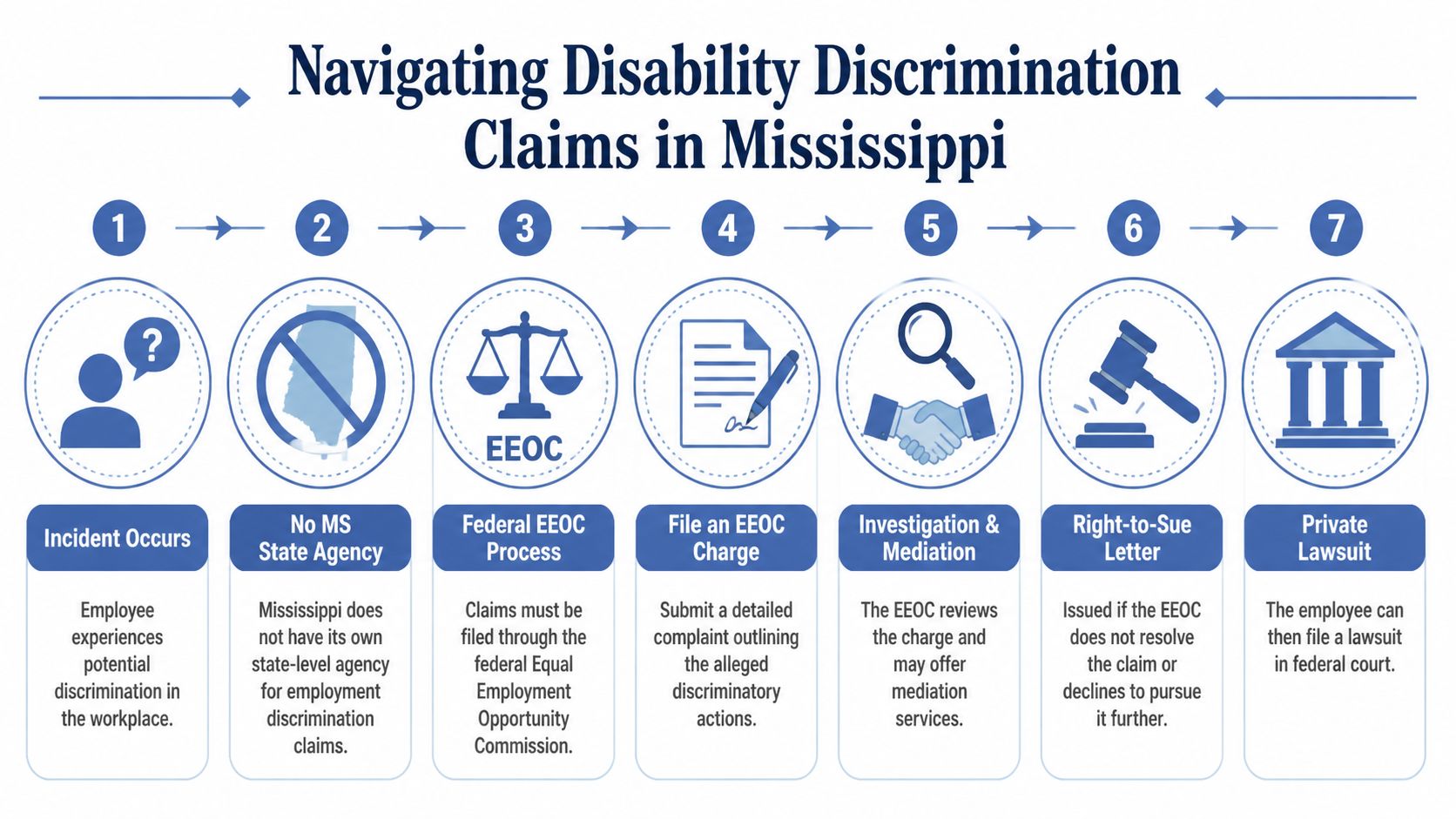
How the process usually works
The sequence is fairly straightforward, even if the facts are not:
A legally significant event happens
That may be a firing, refusal to accommodate restrictions, forced leave, demotion, write-up after a request for help, or a refusal to return you to work unless you are "100 percent" healed.You prepare an EEOC charge
In Mississippi, that filing is usually the gatekeeper step. A lawsuit generally does not come first.The charge is filed with the EEOC
The charge should identify the employer, the decision-makers if known, the dates that matter, and the type of disability-related problem involved. A vague filing can limit arguments later.The EEOC reviews the charge
The agency may offer mediation, ask for a position statement, request documents, or investigate further. For a practical overview, see this explanation of the EEOC investigation process.A Notice of Right to Sue is issued
That notice opens the door to filing in court. Without it, many claims are not ready for a lawsuit.
Deadlines are the first serious risk
In Mississippi, workers should act as if the EEOC deadline is 180 days from the discriminatory act. Waiting on HR, hoping a supervisor changes course, or assuming an internal grievance preserves your rights can create a deadline problem fast.
I tell clients this often. Internal complaints can help show notice and sometimes help prove retaliation. They do not replace an EEOC charge.
The charge also needs to match the issue. If the problem involved failure to accommodate, retaliation after a request, discriminatory discipline, or discharge tied to medical restrictions, that should be stated clearly. Broad statements like "I was treated unfairly" do not do much work for you.
Strategy matters at this stage
A good charge is more than paperwork. It frames the case.
That does not mean every employee should file the same day something goes wrong. There is a real trade-off. Filing too little, too early can leave out facts that matter. Waiting too long can kill the claim altogether. In practice, the right approach is usually to gather the key documents quickly, build a short timeline, and file before the deadline becomes a fight.
Lawyers help most at this point by tightening the facts, identifying the correct legal theory, and spotting issues that employers often use as defenses. The goal is not dramatic language. The goal is a charge that is specific, accurate, and useful later if the case reaches federal court.
ADA disputes also arise outside employment. Businesses dealing with digital accessibility claims may need guidance on managing website ADA compliance legal action. The setting is different, but the lesson is similar. Early, specific action usually puts you in a better position than delay.
How to Document Evidence for Your Case
Most employment cases are won or lost on documentation, not outrage. You may know exactly what happened. The question is what you can prove six months from now, after memories shift and emails disappear.
That matters even more in disability cases because the paper trail often shows the turning point. Bureau of Labor Statistics data shows disabled individuals are more than twice as likely to be unemployed, and the verified summary also notes that retaliation makes up over 28% of EEOC charges while termination affects nearly 60%, which is why careful recordkeeping is so important according to the National Partnership summary of disability employment barriers and EEOC trends.
What to collect immediately
Start with the items that exist right now, before anything gets lost:
| Document Type | Why It's Important |
|---|---|
| Emails about your condition or restrictions | They can show notice to the employer and the employer's response |
| Accommodation requests | They help establish what you asked for and when |
| Doctor notes or work restrictions | They connect the medical issue to workplace limitations |
| Performance reviews | They can show a before-and-after change in treatment |
| Write-ups and disciplinary notices | They often reveal timing and pretext issues |
| Text messages with supervisors | Informal messages sometimes contain the clearest admissions |
| Leave paperwork | This helps where ADA and FMLA facts overlap |
| Job descriptions | They matter when the employer argues a task was essential |
Keep a timeline, not a diary of feelings
A personal log helps if it is factual. Record dates, who was present, what was said, what you requested, and what happened next. If there were witnesses, note their names. If a meeting happened, write it down the same day.
Useful entry: “March 4. Told supervisor I needed schedule flexibility for treatment on Tuesdays. Supervisor said department needed someone with no medical issues causing absences.”
Less useful entry: “Work was awful again. I feel targeted.”
Evidence point: Judges, investigators, and defense lawyers care about sequence, wording, and consistency. Your notes should reflect that.
Be careful how you gather proof
Don't take documents you're not allowed to take. Don't record conversations if you haven't gotten legal advice about doing that. Don't edit screenshots. Preserve things in their original form when possible.
If your case involves psychiatric harm, anxiety, depression, or another mental health component, independent assessment can become important in some cases. For context on how those issues are approached in legal settings, resources discussing medico-legal experts for mental health can help you understand why clear medical support sometimes matters beyond ordinary treatment records.
If you're still at work and need a practical starting point, this guide on how to report workplace discrimination can help you create a record without making avoidable mistakes.
The short version
- Save first, sort later
- Write dates down while they're fresh
- Keep your records factual
- Assume access to work systems can end quickly after a complaint or termination
Potential Remedies and Attorney Fee Structures
Clients usually want two straight answers. What can a case recover, and how does the lawyer get paid?
What relief may be available
The remedy depends on what happened and which claims fit the facts. In disability and related leave cases, relief can include lost wages, reinstatement, changes to job conditions, and compensation tied to the harm caused by the violation.
Where ADA and FMLA issues overlap, damages can become more significant. The verified data here states that employers who retaliate against workers for taking protected leave can face damages that include back pay and an equal amount in liquidated damages, potentially doubling that portion of the award, according to the discussion of common FMLA violations and damages exposure.
Other possible remedies may include:
- Back pay: Wages and benefits you lost because of the employer's actions
- Front pay: Compensation in place of returning to the job in some situations
- Compensatory damages: This can include emotional distress where supported
- Punitive damages: In the right case, these may be available under federal law
- Equitable relief: Reinstatement, accommodation, policy changes, or corrected records
What clients often misunderstand
A strong liability case does not always mean a large recovery. If you found comparable work quickly, the wage-loss piece may be smaller. If the employer has a plausible documented reason for part of what happened, settlement value may change even if the case still has merit.
The reverse is also true. A case with messy facts can still matter if the employer handled the accommodation process badly or retaliated after protected activity.
A legal claim is not a lottery ticket. It is a proof problem tied to damages, deadlines, and credibility.
How contingency fees usually work
In Mississippi employment cases, many attorneys handling this work use a contingency fee. That means the attorney fee is taken from a recovery rather than billed up front. The author's brief for this article states that the average contingency fee is 40 to 50%.
That structure helps many employees pursue claims they otherwise couldn't afford to bring. It also means you should ask practical questions during a consultation:
- What percentage applies if the case settles early?
- Does the percentage change if litigation becomes more involved?
- How are expenses handled?
- What happens if there is no recovery?
You should expect a clear written fee agreement. If the terms aren't plain, ask again until they are.
Take the Next Step to Protect Your Rights
You tell your supervisor about a medical restriction. A week later, your schedule changes, the write-ups start, or the accommodation request goes quiet. At that point, the problem is no longer just workplace tension. It may be the start of a federal disability claim, and in Mississippi, that usually means dealing with the EEOC from the beginning because there is no state agency stepping in first.
What you do in the next few days matters.
Start with three practical steps:
- Keep the record. Save emails, texts, write-ups, doctor notes, leave paperwork, and any messages about your restrictions or accommodation request.
- Do not quit before getting legal advice. Resigning may affect both the facts and the value of the case.
- Get the claim evaluated quickly. In Mississippi, employees generally have to work through the EEOC process. HR reviews do not extend federal deadlines.
Set realistic expectations, too. These cases often move slowly, and the employer may deny conduct that felt obvious to you at the time. Some claims resolve in mediation. Others require a charge, an investigation, and possibly a lawsuit before the employer takes the matter seriously. The right strategy depends on the paper trail, the decision-makers involved, whether you are still employed, and whether the core issue is accommodation, retaliation, leave, termination, or some combination of them.
One point Mississippi workers often miss is that not every unfair act at work creates the same legal claim. As noted earlier, Mississippi does not have a state-level human rights commission for disability discrimination claims, and it also does not treat every retaliation complaint the same way. The legal theory has to fit the facts.
If you are dealing with that situation now, get a focused review before more time passes and the record gets harder to prove.
If you need help evaluating a disability discrimination, retaliation, or medical leave issue in Mississippi, Nick Norris, P.A. represents employees statewide in federal employment matters and can help assess deadlines, evidence, and next steps based on your specific facts.
This article has been reviewed for legal accuracy by Nick Norris. For employment law matters in Mississippi, consult with an attorney licensed to practice in your state.
Leave a Reply