
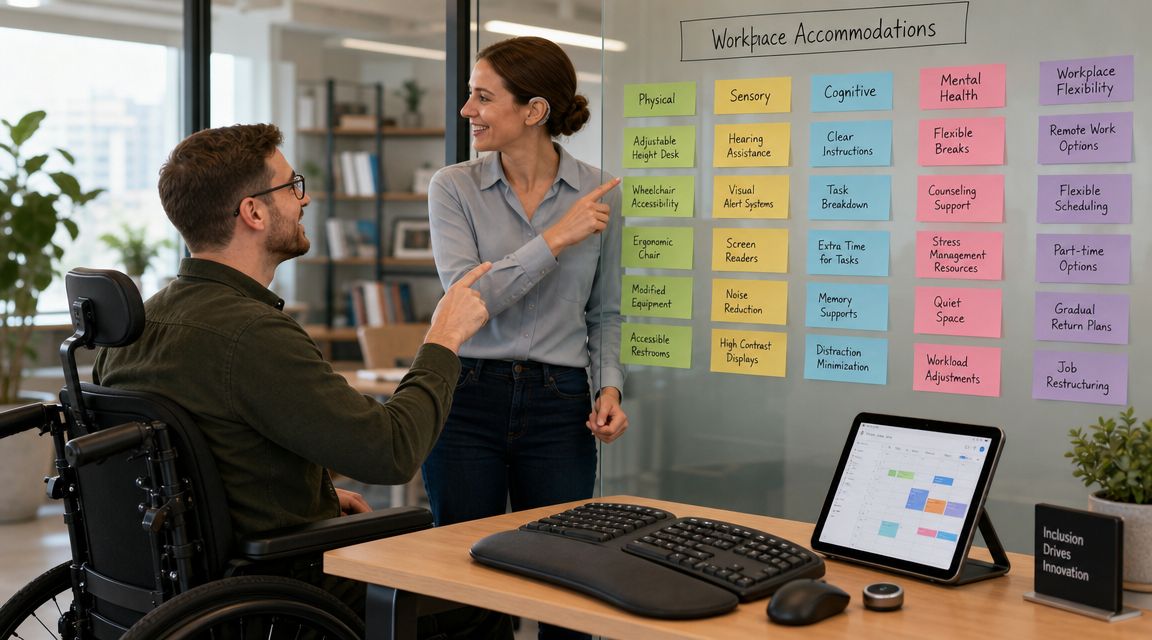
10 Disability Accommodation Examples in Mississippi
You are trying to keep working while a medical condition keeps colliding with the way your job is set up. In Jackson, Gulfport, Hattiesburg, Tupelo, and across Mississippi, that often looks ordinary on the surface. A rigid start time. Constant phone use. Bright fluorescent lighting. Hours on your feet. Software that does not work with the tools you rely on.
In Mississippi, those problems usually have to be handled through federal law because the state does not have a separate human rights commission stepping in to process most disability accommodation claims. For many employees, the practical enforcement path runs through the EEOC. That reality changes how you should approach the issue from the start. A clear request, medical support when needed, and a documented back-and-forth with your employer matter.
The Americans with Disabilities Act (ADA) sets the baseline. Covered employers must provide reasonable accommodations to qualified employees with disabilities unless the employer can show undue hardship. In practice, that can include changes to schedules, equipment, workplace policies, communication methods, job duties, or the physical work environment. If you need a workable explanation of what counts as reasonable accommodation under the ADA, start there before you make the request.
Mississippi employees need to understand the trade-off. Employers do not have to give the exact accommodation you ask for if another effective option exists. But they also cannot lawfully shut the conversation down because your request is inconvenient, unfamiliar, or different from what they have done before. The interactive process is supposed to be a real exchange, not a delay tactic.
If you are dealing with ADHD, autism, or similar workplace barriers, this guide on how to support neurodivergent employees gives added context.
1. Flexible Work Schedules and Remote Work Arrangements
For many Mississippi employees, the most effective accommodation isn't expensive equipment. It's control over time and location. A later start time, split shift, work-from-home arrangement, or reduced exposure to commuting and overstimulating environments can make the difference between staying productive and burning out.
This shows up often with chronic pain, migraines, anxiety disorders, PTSD, long COVID, autoimmune conditions, and fatigue-related limitations. If your symptoms flare at predictable times, a fixed 8-to-5 schedule may be the barrier, not the job itself. The ADA often reaches those practical schedule changes because accommodations can include modifications to how work is normally done.

What works in practice
A good request is specific. “I need flexibility” is weaker than “I'm requesting a schedule adjustment that allows me to begin work at 10:00 a.m. on flare days and complete my full duties later in the day.”
The stronger version tells the employer what you need and shows you've thought about performance. If you need help framing that request, this explanation of what counts as reasonable accommodation under the ADA is a good starting point.
Practical rule: Ask for the change that solves the work problem, not the broadest change you can imagine.
A remote arrangement also works better when expectations are concrete:
- Set communication rules: Identify how you'll respond during the day, whether by Teams, phone, or email.
- Define output clearly: Tie the arrangement to deadlines, production, client response, or other measurable duties.
- Revisit the setup: Some accommodations need adjustment after a few weeks because symptoms, technology, or job duties change.
What usually doesn't work is an informal verbal agreement with a manager who later leaves. In accommodation cases, written requests and written approvals matter.
2. Assistive Technology and Software Solutions
A Mississippi employee can often do the job just fine once the software and equipment fit the disability. The legal problem usually is not the employee's skill. It is the employer's system.
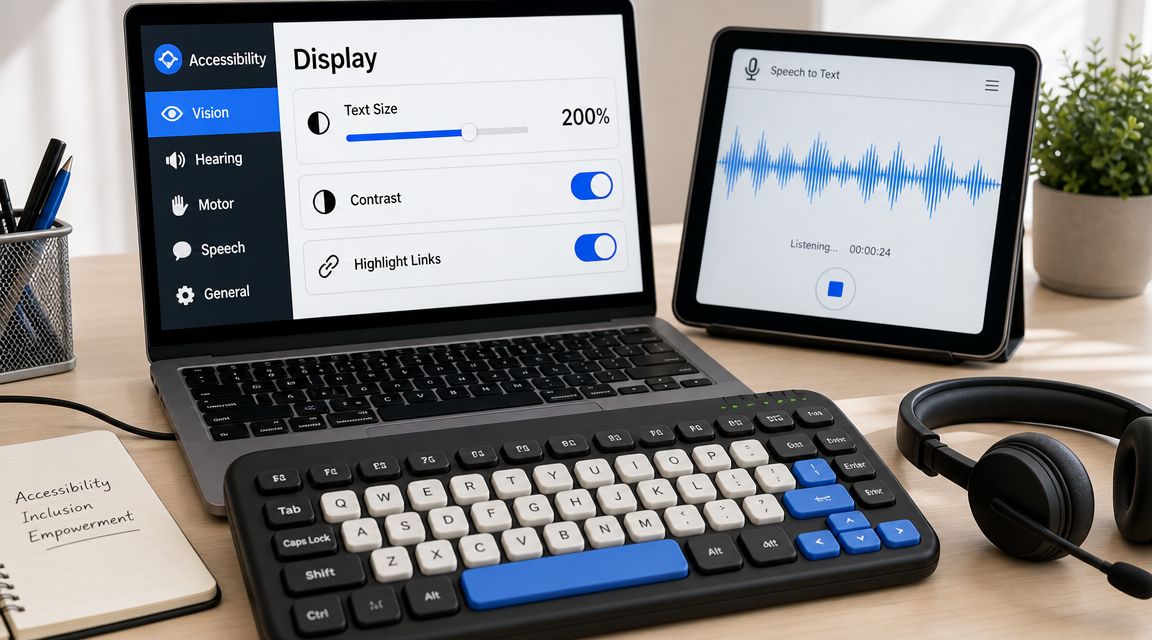
Assistive technology can include screen readers, speech-to-text programs, magnification tools, captioning, alternative keyboards, noise-filtering tools, and the accessibility settings already built into common workplace software. In Mississippi, where employees usually rely on federal law rather than a state agency process, I tell people to focus on function. Can you log in, read the documents, complete the forms, join the meeting, and produce the work required by the position? If the answer is no because the employer's systems do not work with the tool you need, that is often an accommodation issue, not a personal failing.
Employers often make the same mistake. They buy a license and call the problem solved.
Real-world use is harder than that. The software has to work with the company's HR portal, timekeeping system, training modules, security settings, and shared file platforms. If IT blocks installation, if captions fail inside the employer's video system, or if a screen reader cannot handle the internal database, the accommodation is not working in any meaningful sense. The EEOC treats accommodations as individualized changes that must effectively let the employee perform the job.
A practical request usually does three things:
- Names the specific barrier: “I cannot reliably read the text in the inventory platform without screen magnification.”
- Names the tool or category of tool: “I am requesting screen magnification software compatible with our current system.”
- Connects it to job duties: “This will allow me to review orders, update records, and complete my assigned work accurately.”
That level of detail matters. It gives the employer something concrete to evaluate, and it makes it harder for the request to be brushed aside as vague or unsupported. If you need a model, this guide on how to request reasonable accommodation gives request language you can adapt.
There are trade-offs. Some tools require training time. Some work better on one operating system than another. Some accommodations cost very little because the feature is already built into software the employer uses, while others require new equipment, admin access, or outside setup. Those details do not defeat the request, but they do affect how the discussion should be framed.
Medical support can help here too, especially if the employer is questioning whether the technology is tied to actual work limitations. Orange Neurosciences on work capacity evaluation offers a useful explanation of how functional limits can be assessed in work terms.
A short overview may also help if your request involves digital access tools:
3. Job Restructuring and Modified Job Duties
Job restructuring is one of the most misunderstood disability accommodation examples. It doesn't mean your employer has to remove the core of your position. It means the employer may need to look closely at which duties are essential and which ones are marginal, infrequent, or handled flexibly already.
That distinction matters. An accountant may need relief from occasional field travel but still be able to perform analysis, reporting, and client review work. A customer-service employee may struggle with one communication channel but remain effective through another. A warehouse employee may need a reassignment of lifting-heavy side tasks while continuing inventory and tracking work.
Essential functions decide the fight
The first question is usually not “Can you do the job?” It's “What are the essential functions of the job?” Employers often overstate this after a request comes in. Employees sometimes understate it. The answer usually sits in the middle and should be tied to what the job requires, not just what a stale job description says.
Employers should separate core duties from side duties before deciding that no accommodation is possible.
This is also where documentation helps. If a task is rarely performed, routinely shared, or already shifted among coworkers, that may support a restructuring request. If removing the task would gut the role, the employer has a stronger argument.
For employees trying to think this through, a useful framework is to compare your actual workday with the formal position description. Resources discussing work capacity evaluation can help you think in that more functional way.
What doesn't work well is asking for “less stress” or “fewer hard tasks” without identifying the actual duty that creates the barrier. A targeted request works better: remove nonessential travel, shift an audio-dependent task, change the order of tasks, or redistribute a narrow duty that triggers the limitation.
4. Physical Accessibility Modifications and Workplace Equipment
Some accommodation issues are visible immediately. The entrance isn't accessible. The workstation causes pain. The restroom setup is unusable. The employee can do the job, but the building or equipment creates the obstacle.
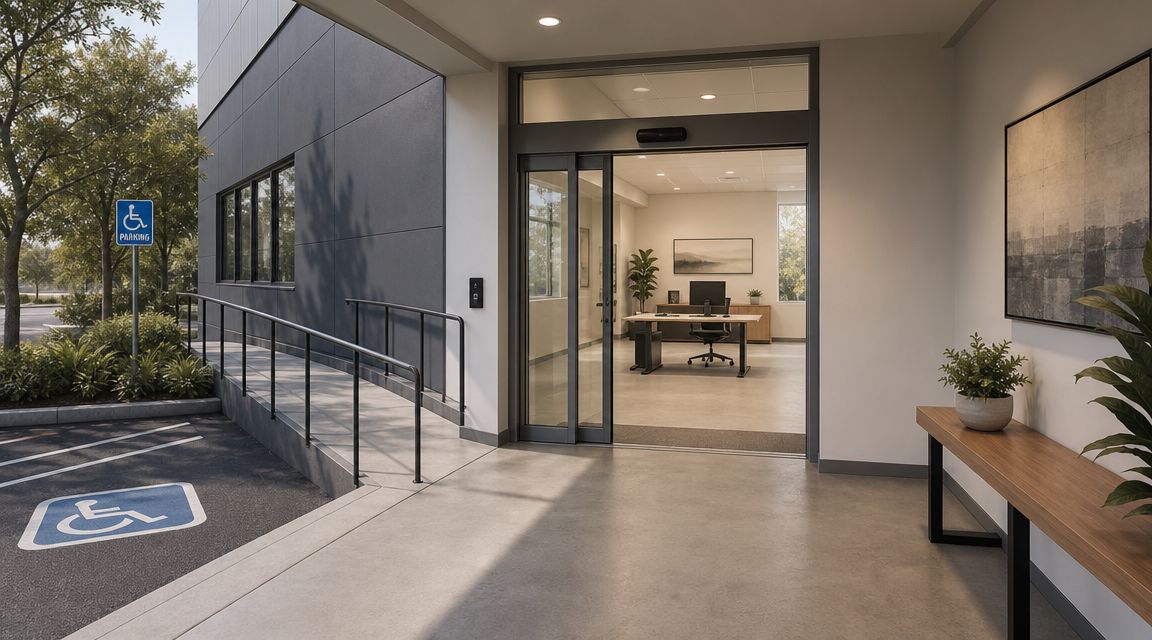
Common examples include ramps, accessible restrooms, ergonomic workstations, automatic doors, adjusted desk height, alternative seating, anti-fatigue supports, reachable storage, and parking changes. Those are all consistent with the basic examples the EEOC identifies when discussing reasonable accommodation.
The real trade-off
In practice, employers sometimes resist these requests by calling them too expensive or too disruptive without doing much analysis. But undue hardship is not just a phrase an employer can recite. It requires a real look at what the change costs, how difficult it is, and whether there are workable alternatives. This discussion of ADA undue hardship helps explain that line.
A quieter issue comes up with ergonomic equipment. Employers may say, “We already gave you a chair.” That's not the right test. The question is whether the equipment is effective for the employee's disability-related limitation. An off-the-shelf chair that doesn't solve the problem may not be enough.
Consider a few practical steps:
- Ask for assessment, not guesswork: If posture, lifting range, or workstation setup is the issue, ask for an ergonomic review.
- Focus on the job function: Explain how the equipment change helps you type, stand, reach, sit, or move safely.
- Keep records: Save photos, emails, and any written recommendations tied to the requested change.
Some employers also look at accessibility improvements as useful beyond a single employee. Businesses that already serve the public often see overlap between employee access and customer access, and related vendors like mobility equipment providers reflect the broader market for access solutions, even though your workplace request should stay focused on your own job needs in Mississippi.
5. Leave Accommodations and Medical Appointment Time
Leave can be a reasonable accommodation. That surprises many employees, especially when they've already heard about FMLA and assume that once one leave category is exhausted, the analysis is over. It isn't always.
A disability-related leave request may involve time for treatment, recovery, therapy, medication adjustment, symptom flare management, or recurring medical appointments. Modified schedules for dialysis, therapy, infusion treatment, or symptom monitoring may fit here too. The key question is whether the leave or time adjustment helps the employee return to work or continue working.
Mississippi employees should watch the paperwork
One of the biggest practical problems is that employers often funnel everything into a single leave form and never clearly separate FMLA, attendance policy issues, and ADA accommodation analysis. That can hurt employees because a request for disability-related time off deserves its own review.
A good written request usually includes three points:
- State the legal basis clearly: Say you're requesting a reasonable accommodation under the ADA.
- Describe the limitation briefly: You don't need a long personal narrative.
- Connect the leave to work: Explain whether you need intermittent time, appointment flexibility, or a defined period away from work.
If the employer treats every absence as misconduct without considering disability-related adjustment, the employer may be skipping the interactive process.
What doesn't work well is silence. If you miss work repeatedly and hope HR infers you need an accommodation, you create room for the employer to frame the issue as attendance alone. Put the request in writing before that happens if you can.
6. Communication Accommodations and Interpreters
A supervisor calls an unplanned meeting, gives verbal instructions, and expects immediate feedback. If you cannot hear, process, read, or relay that information in the format the workplace uses, you can be shut out of the job even while sitting in the room. Under the ADA, that is an access problem tied to employment, not a minor communication preference.
Communication accommodations can include sign language interpreters, CART captioning, assistive listening devices, written agendas sent in advance, written follow-up, visual alerts, relay support, modified phone duties, or another reliable communication method that fits the job. In many workplaces, a key issue is consistency. If the barrier shows up in weekly meetings, client calls, disciplinary discussions, and team trainings, the accommodation usually needs to be part of the regular process.
Access has to work in real time
I often see employers offer substitutes that sound cooperative but miss the point. Notes sent after a meeting do not give the employee a fair chance to participate during the discussion. Asking someone to read lips in a group meeting, speak louder, or "catch up later" may leave the barrier in place.
Research discussed earlier shows accommodation approval rates can differ by disability category. The more useful lesson for Mississippi employees is practical. Make the request directly, tie it to a specific workplace barrier, and explain what format lets you perform the job.
A stronger request identifies where communication breaks down:
- Meetings and trainings: interpreter, live captioning, advance agendas, or accessible handouts
- Phone-based work: relay services, reassigned call tasks, text or email alternatives where feasible
- HR and performance discussions: accessible delivery of feedback, policies, warnings, and evaluation materials
- Worksite alerts and announcements: visual alarms, written notices, or app-based alerts
Professional interpreters also matter. Employers sometimes suggest a relative, a friendly coworker, or whoever happens to know some sign language. That creates accuracy, privacy, and fairness problems. For high-stakes conversations such as discipline, safety instructions, benefits meetings, or performance reviews, the accommodation should be reliable enough to let the employee understand and respond on equal terms.
That point matters even more in Mississippi because employees usually are dealing with federal law, internal HR, and the EEOC rather than a separate state disability agency. Put the request in writing. A simple version works: "I am requesting a reasonable accommodation under the ADA. Because of my disability, I need a qualified interpreter for staff meetings and disciplinary or performance discussions, or another effective communication method that gives me real-time access." That wording gives HR a clear legal label and a concrete fix to evaluate.
7. Accessible Training and Professional Development Programs
An employee's rights don't stop at basic job retention. If your employer offers training, certification, mandatory compliance education, advancement programs, or leadership development, those opportunities must also be accessible.
That can mean captioned videos, readable digital materials, accessible slide decks, screen-reader-compatible portals, extended exam time, quiet testing space, virtual attendance options, or alternate formats for handouts and manuals. The legal issue is straightforward. If a disabled employee can do the job but is blocked from training or promotion pathways because the employer won't make access adjustments, the problem isn't solved just because the employee remains employed.
Promotion barriers often hide inside training systems
This comes up more than many employees realize. A company may accommodate daily tasks but ignore the certification test, management workshop, or required online training that controls promotion. From the employee's perspective, that can stall a career just as effectively as a termination.
The practical move is to raise the issue before the training date, not after a failed session. Ask for the format you need, explain why the standard delivery method creates a barrier, and request confirmation in writing.
Consider the common failure points:
- Vendor platforms: Outside training vendors may use inaccessible portals or videos.
- Timed assessments: Standard test timing may not be workable for some disabilities.
- In-person-only sessions: Travel, physical access, or symptom management may require a virtual option.
An employer that offers training as a benefit of employment should think beyond attendance. The employee has to be able to participate meaningfully.
8. Workplace Environmental Modifications
Some employees can perform their jobs well if the environment changes slightly. Others struggle because the workspace itself keeps triggering symptoms. Bright overhead lighting, heavy fragrance, crowded open-plan noise, temperature extremes, visual distraction, or constant interruptions can all create disability-related barriers.
This category matters for employees with migraines, PTSD, autism, ADHD, sensory processing issues, respiratory conditions, anxiety disorders, and some chronic pain conditions. It also matters for people whose disabilities fluctuate. A workspace that is manageable one week may be impossible during a flare.
Small changes can solve big problems
Environmental accommodations are often low-conflict when the request is specific. Asking for “a better environment” is vague. Asking for a desk relocation away from a loud printer, a fragrance-reduced area, adjustable lighting, a white-noise machine, a noise-canceling headset, or a quiet room for concentrated work is much easier to evaluate.
A good accommodation request describes the trigger, the effect on work, and the adjustment that reduces the barrier.
The EEOC also warns employers not to use one-size-fits-all rules when handling accommodations, which is especially important for invisible or fluctuating conditions, as noted earlier in the article. In practical terms, employers shouldn't insist that an employee's limitation must look obvious before they consider adjustments.
What tends to work best is trial and revision. Move the workstation. Test a lighting change. Reassess after a short period. That kind of iterative approach usually produces better outcomes than arguing in the abstract about whether the condition is “serious enough.”
9. Personal Care Attendant or On-Site Support Services
Some employees need support that overlaps with, but isn't identical to, ordinary workplace tools. That may include a job coach, on-site support professional, interpreter, or an employee-provided attendant whose presence allows the employee to be at work and perform the role effectively.
The legal analysis here can get more fact-specific. Employers generally focus on whether the support is tied to job performance and whether allowing it creates operational or safety problems. The cleaner the boundary between personal care and work duties, the easier the accommodation tends to be to evaluate.
Define the role before conflict starts
Employees should explain what the support person does and does not do. If the employer thinks the attendant will perform the employee's essential job functions, resistance goes up quickly. If the explanation is clear that the support helps the employee access the workplace, communicate, transition tasks, or manage disability-related needs while the employee still performs the actual job, the request is stronger.
Useful points to address in writing include:
- Scope of support: What tasks the support person handles, and what the employee handles
- Confidentiality and access: Whether the person will be present in meetings, restricted areas, or shared spaces
- Scheduling and logistics: When the support is needed and where the person will be stationed
This is also an area where dignity matters. Employers sometimes discuss these requests as if the employee is asking for an exception to ordinary professionalism. That's the wrong frame. The proper question is whether the support allows the employee to work effectively without imposing undue hardship.
10. Workplace Violence Prevention and Disability-Related Accommodations
Safety planning can be part of accommodation. That's true when a disability affects how an employee responds under stress, when certain triggers escalate symptoms, or when communication barriers create problems during emergencies, conflict, or high-pressure interactions.
Examples include individualized emergency communication plans, modified reporting channels, supervisor guidance for de-escalation, alternative contact methods, reduced exposure to known triggers, or planning around panic symptoms, trauma triggers, or communication limitations. This isn't about labeling the employee as dangerous. It's about making sure safety systems work for that employee.
Mississippi workers should document concerns early
If your disability affects how you process emergency instructions, customer aggression, loud conflict, or sudden supervisory confrontation, raise it before there's an incident. Waiting until after discipline is imposed makes the conversation harder.
This is especially important in call centers, healthcare settings, retail, and other jobs with high conflict or fast decision-making. A role-specific review often works better than broad statements about stress. In a November 2023 matter discussed by SHRM, Citizens Bank agreed to pay $100,000 after allegedly refusing to consider reassignment or other accommodations for a call-center employee with an anxiety disorder. One important lesson from that case is that reassignment to a vacant position can be a recognized accommodation, and employers should evaluate alternatives before forcing a return to the original role.
For employees, that means thinking beyond “make this job less stressful.” A better request may be an alternate reporting method, a change in customer-contact duties, a modified emergency plan, or reassignment if the specific duties trigger the disabling barrier.
10-Point Disability Accommodation Comparison
| Accommodation | Implementation Complexity 🔄 | Resource Requirements ⚡ | Expected Outcomes 📊 | Ideal Use Cases 💡 | Key Advantages ⭐ |
|---|---|---|---|---|---|
| Flexible Work Schedules and Remote Work Arrangements | Moderate, policy updates, manager training, scheduling systems | Low–Moderate, remote tech, occasional equipment, management time | Improved retention, reduced commute fatigue, productivity gains | Digital roles; chronic conditions, mobility limits, fluctuating symptoms | High inclusivity with relatively low cost; improves retention |
| Assistive Technology and Software Solutions | Moderate–High, assessments, integration, ongoing IT support | Moderate, licenses, compatible systems, training and support | Enables full job performance; efficiency and accessibility gains | Visual/hearing/cognitive impairments; knowledge work | Directly enables core tasks; often scalable and cost-effective |
| Job Restructuring and Modified Job Duties | Moderate, job analysis, documentation, team communication | Low–Moderate, managerial time; possible temporary coverage | Retains valued employees; better job fit and efficiency | Roles with marginal duties that can be reassigned | Preserves employment with minimal direct cost |
| Physical Accessibility Modifications and Workplace Equipment | High, construction, permits, landlord coordination | High, capital investment, maintenance; potential tax credits | Long-term barrier removal; compliance and safety improvements | Mobility impairments; facility renovations or new builds | Permanent accessibility benefits many employees; legal compliance |
| Leave Accommodations and Medical Appointment Time | Moderate, integrate with FMLA, tracking and policies | Moderate, staffing coverage, HR administration | Better health outcomes; reduced long-term absences; retention | Chronic/episodic illnesses, treatment schedules | Supports recovery and retention; legally protected accommodation |
| Communication Accommodations and Interpreters | Moderate, vendor sourcing, scheduling, advance notice | Moderate–High, interpreter/CART fees, planning | Equal access to information; improved participation and accuracy | Deaf/hard-of-hearing, speech or cognitive disabilities in meetings | Ensures information access and legal compliance |
| Accessible Training and Professional Development Programs | Moderate, content conversion, vendor coordination, planning | Moderate, captioning, alternative formats, accessible venues | Equitable advancement; improved retention and capability | Employees pursuing promotions; mandatory or certification trainings | Expands internal talent pool; benefits varied learning needs |
| Workplace Environmental Modifications | Low–Moderate, sensory assessments, shared-space coordination | Low, lighting/noise adjustments, low-cost equipment | Reduced triggers; improved focus, reduced fatigue | Sensory issues, migraines, anxiety, PTSD | Cost-effective; benefits multiple employees with minimal disruption |
| Personal Care Attendant or On‑Site Support Services | High, policy creation, confidentiality, space and scheduling | High, coordination, possible employer-provided support, privacy measures | Enables employment for high‑support needs; sustained productivity | Employees with significant medical or personal care needs | Preserves independence and job performance for high-need workers |
| Workplace Violence Prevention and Disability‑Related Accommodations | High, individualized safety plans, training, HR coordination | Moderate, training, EAPs, crisis planning resources | Improved safety, reduced incidents, legal risk mitigation | Employees with trauma-related conditions or safety triggers | Protects safety and dignity; reduces liability and discriminatory risk |
How to Secure Your Rights in Mississippi
You ask for a stool, a schedule change, or software that lets you do the job. Your manager says to bring a doctor's note. Then nothing happens. In Mississippi, that kind of delay matters because these cases usually turn on federal law, and employees do not have a state fair employment agency stepping in to sort it out.
Start with a written request. Email HR, your supervisor, or both. Use plain language and say three things clearly: you have a medical condition covered by the ADA, the condition affects a specific part of your job, and you are requesting a reasonable accommodation. If you know what would help, say so.
A practical example: “I have a medical condition that limits my ability to stand for long periods. I can perform my job duties if I am allowed a stool at my workstation and brief sitting breaks as needed. I am requesting a reasonable accommodation under the ADA.”
That wording does two things employers often claim they did not understand. It ties the limitation to the job, and it makes clear that this is an ADA request, not a casual complaint.
Keep records from the first day. Save the request email, any medical forms, calendar invites, text messages, and notes from meetings. If a supervisor talks to you in the hallway or by phone, send a short follow-up email confirming what was discussed. In a disputed case, that paper trail often matters more than either side's memory.
Mississippi employees need to approach this differently than workers in states with their own enforcement agency. Here, many disability accommodation disputes go through federal channels and EEOC deadlines. That creates a real trade-off. A verbal request may still count, but a written request is easier to prove and harder for the employer to minimize later.
Employers do not have to approve the exact accommodation you ask for. They do have to address the request in good faith, ask for reasonable supporting information when needed, and discuss workable alternatives. Silence, repeated stalling, or a flat refusal to discuss options can create legal problems for the company.
Pay attention to what happens after you ask. If your schedule suddenly changes, discipline starts over minor issues, or your performance is questioned in ways it never was before, those facts may matter. Retaliation claims often turn on timing and documentation.
If the company denies the request, refuses to discuss alternatives, or starts treating you as a problem after you ask for help, get legal advice quickly. In Mississippi, delay can make a bad situation harder to fix because the process usually runs through federal procedures rather than a separate state system. An employment lawyer can assess whether the job duty was essential, whether the proposed accommodation was reasonable, and whether the employer failed to participate in the interactive process.
If you need help evaluating an ADA accommodation problem in Mississippi, Nick Norris, P.A. is one option to consider: https://www.nicknorris.law
This article has been reviewed for legal accuracy by Nick Norris. For employment law matters in Mississippi, consult with an attorney licensed to practice in your state.
Leave a Reply