

USERRA Return to Work Requirements: A Mississippi Guide
You got home. Your duffel bag is still half-zipped. Your phone has texts from family, maybe a message from your supervisor, and a creeping question in the back of your mind: Do I still have my job, and what exactly do I need to do to get back to work?
That question matters more than most employers realize. The USERRA return to work requirements are not loose suggestions. They are hard rules that protect Mississippi service members when they leave civilian work for military duty and come back ready to resume their careers.
I'll be blunt. A lot of employers get this wrong. Some demand paperwork they aren't entitled to. Some put returning service members back into lesser roles. Some act as if military service was a personal inconvenience instead of a legally protected obligation. If you work in Mississippi, you need a clear understanding of your rights because this state does not have a human rights commission to step in and sort it out for you.
Your Guide to Returning to Work After Military Service
Coming back from military service can feel oddly disorienting. You know how to follow orders, solve problems, and handle pressure. Civilian employers, on the other hand, often create confusion where the law is pretty clear.
USERRA exists to stop that. It protects employees who leave civilian jobs for qualifying military service and return to work. The law is federal, which matters in Mississippi because workers here often need to rely on federal rights and federal enforcement when an employer refuses to do the right thing.

The practical question isn't whether USERRA sounds noble. It's whether you know how to use it. That means knowing when to report back, what your employer can ask for, what job you're entitled to, and what to do if your employer starts stalling.
Practical rule: Treat your return to work like a mission with deadlines, documents, and follow-up. Good intentions won't protect your rights. Timely action will.
For many Mississippi Guard and Reserve members, the transition also includes figuring out the next stage of civilian work. If you're rethinking your longer-term path, this military to civilian career guide is a useful starting point for translating service experience into job language employers understand.
What this means for Mississippi workers
Mississippi employees need straightforward answers, not legal fog. Start with these core ideas:
- USERRA protects your civilian employment relationship. If you left for covered service, the employer usually has reemployment obligations when you come back.
- Deadlines control everything. Miss one without a valid reason and you can create avoidable problems for yourself.
- Your old job title isn't always the finish line. In some situations, USERRA requires more than that.
- Mississippi workers often need to be proactive. If the employer is confused, passive, or hostile, waiting rarely improves the situation.
This article is built for that reality. If you're back in Mississippi and trying to protect your job, you need clarity fast.
Are You Eligible for USERRA Reemployment Rights
Not every return-to-work dispute is complicated. Some are decided by a simple checklist. Before you argue with HR or your supervisor, figure out whether you meet the core requirements for reemployment rights.
The five-part checklist
You usually need five things in place.
You had a civilian job before service
USERRA protects your right to return to civilian employment. If there was no job to return to, there's no reemployment claim.You gave advance notice of military service
That notice can often be handled in a practical way. The point is that your employer should know you're leaving for military duty, not just disappearing from the schedule.Your service fits within USERRA's service-limit framework
There are rules and exceptions here, and they can get technical. If you're unsure, don't guess.Your separation from service wasn't disqualifying
Discharge status matters. If you need a plain-English explanation of discharge categories, this breakdown of what's the difference in discharge can help you understand why employers sometimes focus on this issue.You returned or applied back on time
At this point, strong cases often get damaged. A valid claim can become harder if you miss the return deadline.
Questions to ask yourself right now
Use these questions instead of broad legal labels:
- Did I have a job when I left?
- Did my employer know I was leaving for service?
- Did I complete service in a way that keeps me eligible?
- Am I acting within the required timeline now?
- Has the employer told me I can come back, but only in a reduced role?
If those answers are mostly yes, you may be in strong shape.
If you're uncertain about the legal framework for reemployment rights, this overview of USERRA reemployment rights gives a useful Mississippi-focused starting point.
Don't let employer confusion redefine your rights
A common mistake is trusting the first answer from payroll, a frontline manager, or HR generalist. They may be sincere and still be wrong. USERRA questions often get handled by people who rarely deal with military leave.
That's why I tell Mississippi service members to do a self-audit early. Confirm your eligibility before the employer frames the situation as a scheduling issue, a paperwork issue, or an attendance issue. If you qualify, this is a legal rights issue.
Critical Deadlines for Claiming Your Job Back
You get home from military service, check your phone, and see a message from work asking when you are coming back. Your rights may depend on what you do next.
The USERRA return to work requirements turn on deadlines. Miss the deadline, and an employer may try to treat your protected absence like an attendance problem. In Mississippi, that matters even more because you do not have a state human rights commission stepping in to sort this out for you. You need to protect the record yourself from day one.
The deadlines that matter
USERRA sets different return rules based on how long you were away, as explained in the BLR guidance on returning veteran employees to work.
| Length of service | What you must do |
|---|---|
| 1 to 30 days | Report to your employer by the beginning of the first regularly scheduled work period on the next calendar day after service ends, plus time for safe travel and an eight-hour rest period |
| 31 to 180 days | Apply for reemployment within 14 days after completing service |
| 180 days or more | Apply for reemployment within 90 days after completing service |
If you are hospitalized or recovering from a service-connected injury or illness, the return period can extend for up to two years.
Where Mississippi workers get tripped up
The shortest deadline causes the most trouble. Service members who were gone for 1 to 30 days often assume they have a few days to get settled, catch up at home, and then call work. That is a mistake.
USERRA expects a prompt return after short periods of service, with time built in for travel and rest. Employers often get this wrong too. A supervisor may say, “Just let us know when you're ready.” Do not rely on that. A casual conversation is not a substitute for meeting the legal deadline.
Another problem is confusion about what “apply” means for longer service. You do not need a polished legal letter. You need a clear communication that you are seeking reemployment within the required time. Keep it simple and keep proof.
Put the deadline on your calendar the day service ends. Do not wait for HR to explain your rights.
What to do in practice
Use a paper trail. I recommend three steps.
- Record your service end date immediately
- Calculate the correct USERRA deadline that same day
- Send written notice that you are reporting back or applying for reemployment
An email or text is often enough to prove timing. Say that your military service has ended and that you are reporting back or applying for reemployment under USERRA. Save screenshots, sent emails, and any reply.
That written record can make the difference if an employer later claims you were late, unclear, or never contacted them at all.
Do not wait for the employer to guide you
Some Mississippi employers mean well but do not understand USERRA. Others count on returning service members not knowing the rules. Either way, the risk lands on you.
Handle the deadline like evidence, not a courtesy. If you act on time and document it, you start from a position of strength. If the employer still resists, you have already closed off one of their favorite excuses.
The Escalator Principle Not Just Your Old Job
A lot of employers think USERRA means this: “We gave you your old job back, so we complied.” That's often wrong.
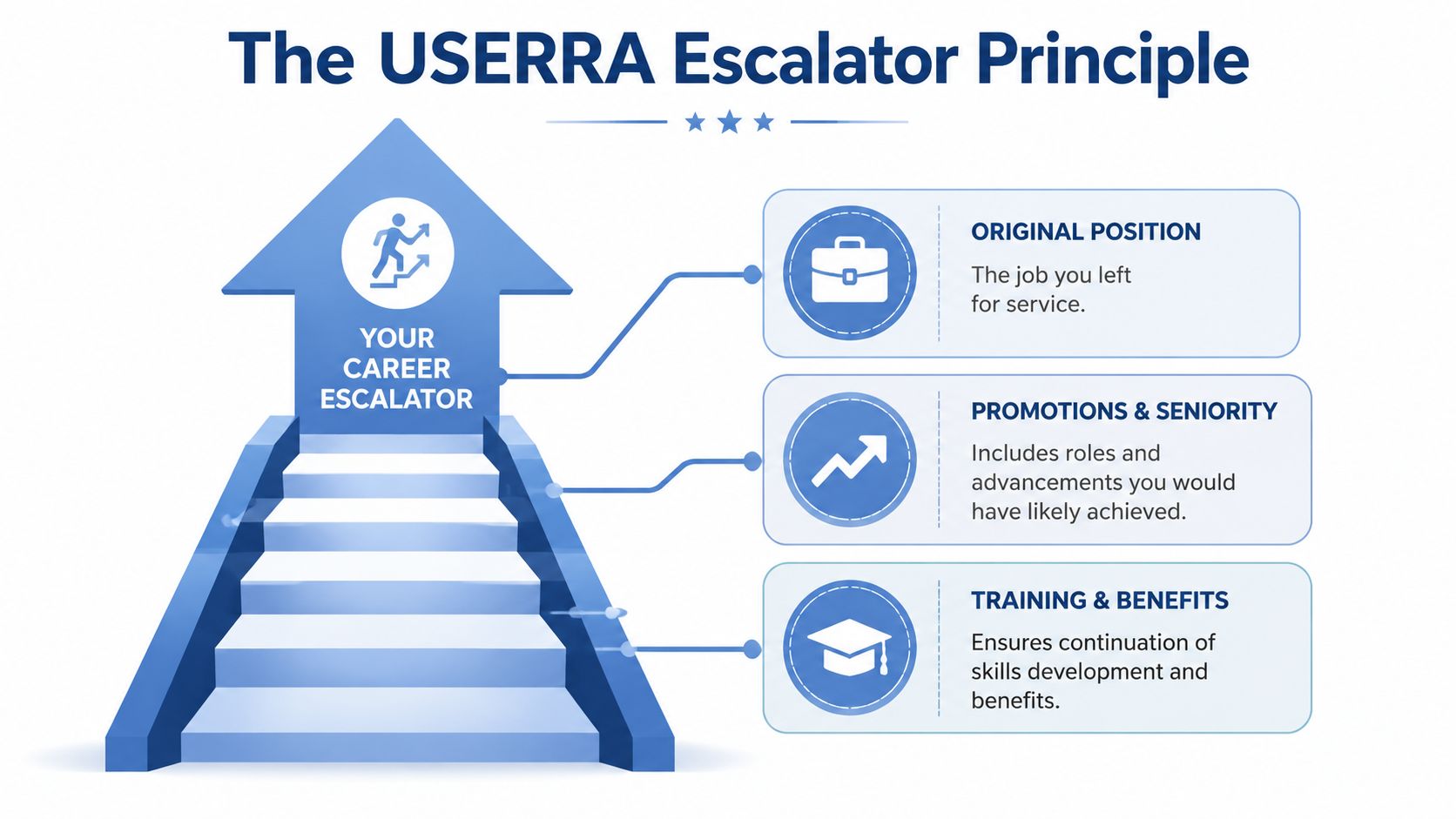
USERRA uses what lawyers call the escalator principle. The basic idea is simple. Your career didn't freeze just because you served. When you come back, you may be entitled to the position you would have attained if you had remained continuously employed.
What the escalator principle really protects
Think about a moving escalator in a department store. If you step off for military service, the escalator keeps moving. When you return, USERRA may require the employer to place you where that escalator would have carried you.
That can include:
- Seniority you would have accrued
- Promotions you likely would have received
- Pay increases tied to continued employment
- Status attached to the role you reasonably would have reached
This is not a minor technicality. It changes the value of your claim.
Where employers commonly get it wrong
Some employers place the returning service member into a lower role, a temporary role, or a stagnant role while pretending they're being generous. They aren't. They may be cutting away the very benefits USERRA protects.
Data shows that 18% of USERRA disputes in 2024 centered on employers placing returning members in lower roles than their pre-service equivalent, despite eligibility for the escalator position. That escalator position includes accrued seniority, promotions, and pay increases that were probable during service.
In Mississippi, this issue can show up in workplaces with layered supervision, shift-based leadership, and industries where “temporary” assignments become permanent if no one challenges them. A returning employee may be told, “We'll start you back here and see how it goes.” That sounds reasonable. It can still violate USERRA.
Your employer doesn't get to define your rights by offering the easiest slot they have open.
A simple example
Say you left a civilian job as a team lead. During the time you were gone, employees with your seniority level typically moved into a supervisor role, received a standard pay increase, and gained additional scheduling authority. If that advancement was likely, USERRA may entitle you to that higher position, not just the team lead job you held when you left.
The same logic works in reverse if the business changed in a way that would have affected you even if you had never left. The key question is what would likely have happened in your real employment path.
What to do if the offer feels too low
If the employer's return offer feels like a step down, don't accept the explanation at face value. Ask direct questions:
- What position would I have attained if I had remained continuously employed?
- What happened to workers with similar seniority while I was away?
- Why am I being placed in this role instead of that one?
Those are the right questions because they focus on career trajectory, not employer convenience.
Navigating Notice and Documentation Requirements
Notice and documentation get mashed together all the time, but they are not the same thing. One concerns what you tell your employer before service. The other concerns what the employer may ask for when you come back.
Before you leave
Advance notice matters. In practical terms, tell the employer you're leaving for military service as early as reasonably possible. Keep it clear and direct.
A strong notice usually does three things:
- Identifies the reason for leave as military service
- Gives the expected dates if you know them
- Creates a record by email, text, or another written format
Verbal notice can work, but written notice is safer. It reduces later nonsense about whether anyone knew what was happening.
When you return
The bigger problem is paperwork. Employers often demand documents immediately, even when the law doesn't require them.
Employer Support of the Guard and Reserve data reveals that 32% of USERRA complaints in 2024 involved employers incorrectly demanding documentation for short-term service of less than 30 days, violating the statute.
That is not a harmless HR mistake. It can delay a service member's return and create pressure to “prove” something the law doesn't require them to prove at that stage.
The short-service rule employers miss
For service under 30 days, documentation is not required unless the employer requests it. For service over 30 days, the employer may request proof of service such as duty orders or discharge-related documentation.
Here's the practical takeaway:
| Service length | Documentation issue |
|---|---|
| Under 30 days | Documentation is not automatically required |
| Over 30 days | Employer may legally request proof of service |
If you're in the Guard or Reserve and you cycle through short training periods, this matters a lot. You should not be forced to clear invented paperwork hurdles every time you complete a short period of duty.
Ask yourself whether the employer is requesting lawful confirmation, or creating delay because military leave inconveniences them. Those are not the same thing.
My recommendation
Keep copies of your orders anyway. Keep emails. Keep text messages. Keep any discharge or release paperwork you receive. Even when the employer is wrong to demand immediate documentation, good records help you shut down bad arguments quickly.
But don't surrender the legal point. If the employer claims you can't return without documents for a short service period, that's a red flag. They may not understand USERRA, or they may be testing whether you understand it.
Handling Health Issues and Disability Accommodations
Some returns are not clean or easy. You may be ready to work but dealing with a service-connected injury, medical restrictions, or a condition that changes what you can do right away. That does not erase your rights.
What the employer must do first
If you are not immediately qualified for the position you should receive because of a disability connected to service, the employer's first obligation is to make reasonable efforts to help you become qualified. That can include training, retraining, or other practical steps that help you perform the role.
Some employers skip straight to, “You can't do this exact job, so there's nothing for you.” That is not the right analysis.
If the escalator job isn't workable
When reasonable efforts won't get you there, the employer still has work to do. The next question is whether there is another position that is equivalent in seniority, status, and pay, or otherwise the closest comparable fit available under the law.
That process should be interactive, concrete, and focused on real job duties. If your employer handles disability issues with vague comments and no real dialogue, that's a problem. The same is true if they reduce your role without exploring accommodations or comparable placement.
For a broader look at how workplace accommodation discussions should function, this article on the ADA interactive process is worth reading.
A realistic example
Suppose you return to a Mississippi operations job after service with lifting restrictions or mobility limitations. The employer should not just decide, on its own, that you're done. The employer should examine whether training, reassignment of marginal tasks, or another comparable role would allow lawful reemployment.
That discussion often overlaps with benefit concerns too. If you're sorting out coverage during the transition, this overview of health insurance for veterans may help you evaluate options for yourself and your family.
What you should do
Start with facts, not emotion:
- Get your restrictions in writing from the appropriate medical provider
- Communicate what you can do, not only what you can't
- Ask for a concrete reemployment plan
- Document every response from HR or management
A lot of disability-related employment disputes turn on whether anyone seriously worked the problem. If you show up prepared, cooperative, and documented, you put yourself in a much stronger position.
Enforcing Your USERRA Rights in Mississippi
Knowing the law is one thing. Enforcing it is another. In Mississippi, enforcement matters because the state does not have a state-level human rights commission. Workers often have to rely on federal agencies or private legal counsel instead, as noted by the U.S. Department of Justice information for the Southern District of Mississippi.
That reality changes how you should think about a USERRA problem. You cannot count on a Mississippi state agency stepping in to informally sort this out for you.

Where enforcement usually starts
For many service members, the first stop is informal help. Employer Support of the Guard and Reserve can sometimes help resolve misunderstandings. If that fails, a complaint may move through the federal enforcement process, including DOL-VETS.
That federal path is important in Mississippi because there is no state human rights commission to absorb these employment-rights disputes. If your employer refuses to return you, downgrades your position, or imposes unlawful documentation barriers, federal enforcement channels may become central.
Why local legal advice matters
Mississippi workers need advice that accounts for Mississippi realities. That includes knowing which rights are federal, which state remedies do not exist, and where employers commonly overplay their hand.
For example, Mississippi does not provide statutory protection against retaliation for filing workers' compensation claims, and there is no retaliation claim solely for filing workers' compensation. That has nothing to do with weakening USERRA. It means you should be careful not to assume every unfair employment action in Mississippi comes with a state retaliation remedy.
The same practical caution applies to fees. The average contingency fee for employment law cases in Mississippi ranges between 40% and 50%, based on regional legal resources from the Mississippi Access to Justice Commission Workers' Center page. If you're considering representation, ask direct questions about fee structure, costs, and what happens if the matter resolves early.
What to do this week if your employer is violating USERRA
Don't wait for the employer to clean up its own mistake. Do this instead:
- Send a written summary of what happened, including dates, service period, and your return request.
- Preserve documents such as orders, emails, texts, job postings, pay records, and any return-to-work messages.
- Identify the exact violation. Missed reemployment, improper role, unlawful documentation demand, or refusal to accommodate.
- Get legal guidance early if the employer is stalling or pushing you into a lower role.
If you want a Mississippi-focused resource on this topic, review this page about working with a USERRA lawyer.
Federal rights are only as useful as your willingness to enforce them. In Mississippi, that often means acting quickly, documenting carefully, and getting informed help before the employer hardens its position.
A final point. Don't let an employer convince you that military service made you “difficult” or “unavailable.” The law was written for people exactly in your position. If you met the requirements, your job rights are not a favor.
If you're a Mississippi service member or veteran dealing with a return-to-work problem, Nick Norris, P.A. helps employees understand federal employment rights, evaluate reemployment violations, and take practical action when an employer gets USERRA wrong. Reach out if you need clear advice about your options and your next step.
This article has been reviewed for legal accuracy by Nick Norris. For employment law matters in Mississippi, consult with an attorney licensed to practice in your state.
Leave a Reply