
You may be searching for an Employment Discrimination Attorney Near Me after a write-up that made no sense, a demotion that came right after a complaint, or a supervisor who keeps crossing lines everyone else pretends not to see. Most Mississippi workers start in the same place. They know something is wrong, but they don't know where to report it, what deadline applies, or whether talking to HR helped or hurt.
In Mississippi, that confusion isn't a small problem. It's often the difference between preserving a claim and losing it on procedure before the facts are ever heard.
Facing Discrimination in Mississippi Your First Steps
The most important fact to understand is simple. Mississippi does not have a state-level human rights commission or civil rights agency dedicated to enforcing employment discrimination laws, which means workers can't file administrative complaints with a state body and must instead go through federal channels such as the EEOC or federal court, as noted by the ACLU of Mississippi's discussion of the state's lack of a human rights agency.
That single point changes everything about how a discrimination case works here. Generic online advice often assumes there's a state agency to investigate, extend deadlines, or offer a second track. Mississippi workers usually don't have that cushion. If you're dealing with race discrimination, sex discrimination, disability discrimination, religious discrimination, age discrimination, harassment, or certain retaliation issues tied to protected activity, the federal process is usually where your case begins.
What to do before you argue with HR again
Start by getting organized. Save emails, texts, write-ups, schedule changes, performance reviews, and the names of witnesses. Keep those records somewhere your employer can't access, but don't take privileged or confidential business material you have no right to keep.
Then stop relying on verbal summaries. If something important happened, write down the date, who was there, what was said, and what changed afterward. That timeline matters later.
Practical rule: If you can't explain the sequence of events clearly, your lawyer has to reconstruct it under pressure. Start that work now, while the details are still fresh.
Why Mississippi workers need Mississippi-specific advice
A lawyer who handles federal employment claims in Mississippi understands the path your case follows. That includes the EEOC process, the deadlines, and the kinds of records that tend to matter most in a workplace case.
If you're still deciding whether what happened qualifies, start with a practical guide on how to report workplace discrimination. Then talk to counsel quickly. Waiting while you "see what HR does" is one of the most common mistakes employees make.
Where to Find a Qualified Mississippi Employment Lawyer
A broad search for an Employment Discrimination Attorney Near Me will bring up plenty of results. Many won't be a good fit. Some firms list employment law, but mostly handle management-side work, personal injury, or general civil matters. In Mississippi, you need someone who focuses on employee-side employment law and understands the federal process that controls these claims.
Mississippi workers filed 1,200 discrimination charges during the relevant period, which shows that employees here are actively using federal enforcement channels despite the lack of a broader state framework, according to this Mississippi workplace discrimination overview. So there are lawyers handling these cases, but you still need to sort carefully.
Start with practice area, not advertising volume
A polished website doesn't tell you whether the lawyer regularly handles EEOC charges, retaliation claims, hostile work environment cases, or federal employment litigation. Search for firms that specifically mention representing employees in discrimination matters.
A practical shortlist usually comes from a few places:
- Mississippi Bar resources: Bar listings can help you confirm whether a lawyer is licensed and identify practice areas.
- Lawyer directories: Avvo and Lawyers.com can be useful for basic screening, especially if the profile describes employment discrimination work.
- Google Business profiles and reviews: Reviews won't decide your case, but they can reveal whether the office returns calls, explains things clearly, and handles sensitive matters professionally.
If you want to understand why some firms appear more visible than others in local search, this breakdown of local SEO for personal injury law firms from Digital Skyrocket is useful. It helps you separate online visibility from actual case fit.
What a good shortlist looks like
Don't build a list of ten. Build a list of three to five. Then filter hard.
| What to check | Why it matters in Mississippi |
|---|---|
| Employee-side employment work | You need counsel focused on worker claims, not general litigation |
| Federal litigation experience | Mississippi discrimination claims commonly move through a federal path |
| EEOC familiarity | Early agency framing can shape the whole case |
| Clear intake process | Deadline-driven cases need quick, organized action |
One Mississippi option among those you may evaluate is Nick Norris, P.A., a Mississippi employment law office representing workers in discrimination and related employment matters.
Results that usually waste your time
Some search results look promising but lead nowhere. Be cautious if the site is vague about who the firm represents, doesn't mention employment law as a core practice, or talks generally about "workplace issues" without saying who they sue and where they litigate.
A short, well-qualified list beats a long list built from ads.
How to Vet and Interview Potential Attorneys
Choosing a lawyer for a discrimination case isn't just about whether the office will take the case. It's about whether that lawyer sees the pressure points early enough to protect it. In Mississippi, that often means understanding protected activity, preserving evidence, and preparing for a federal process from the start.

A strong consultation should feel like a working meeting, not a sales pitch. You should leave with a clearer sense of deadlines, documents, likely legal theories, and what facts still need to be nailed down.
Questions that reveal real experience
Ask direct questions. A lawyer who handles these matters should be able to answer them without drifting into slogans.
How much of your practice involves employee-side employment law in Mississippi?
You're looking for concentration, not occasional exposure.Have you handled charges through the Jackson EEOC office?
Process familiarity matters. So does knowing what information needs to be framed correctly early.What protected activity do you think applies in my case, if any?
That's especially important in retaliation matters.What evidence should I preserve right now, and what should I avoid doing?
Good counsel will give concrete instructions.If the employer says this was just performance-based, how would you test that explanation?
This shows whether the lawyer is already thinking about proof, timing, comparators, and records.
Why retaliation screening matters
Retaliation cases often turn on whether the employee can prove they engaged in protected conduct. According to Justice at Work's discussion of retaliation claims, 68% of retaliation cases succeed when plaintiffs can prove they engaged in defined protected conduct like requesting ADA accommodations or refusing illegal orders. That's why a careful lawyer asks what you reported, when you reported it, to whom, and what changed after that.
Mississippi workers also need to hear a point some firms glide past. There is not a retaliation claim for filing workers compensation under Mississippi law in the way many people assume, and Mississippi does not provide protection from retaliation for filing workers compensation claims. Don't let an intake call blur that issue. A lawyer should distinguish between a workers' compensation problem and a legally recognized employment retaliation claim.
Signs the consultation is going well
Look for specifics, not confidence theater.
- They ask for dates: A lawyer who doesn't care about timing early may miss critical risks.
- They separate facts from assumptions: "My boss hated me" isn't enough. "After I reported harassment, I was written up three days later" is the start of proof.
- They explain what the case is and isn't: Honest screening is a good sign.
- They discuss documents before damages: If the conversation jumps straight to money, be careful.
"Bring the write-ups, the emails, the texts, the handbook, and your timeline. Cases get stronger when facts are pinned down early."
Before your consultation, it helps to review a practical checklist on how to prepare for your first talk with an employment lawyer.
The Critical 180-Day Clock Evidence and Filing Deadlines
Many valid claims are often lost. The law doesn't care that you were still hoping HR would fix it. It doesn't care that your manager told you to "give it time." In Mississippi, the filing clock matters from the moment the unlawful act occurs.
To visualize the sequence, start here.

The EEOC's Mississippi office in Jackson applies a 180-day deadline to file a discrimination charge from the date of the discriminatory occurrence. If the EEOC doesn't resolve the matter, it may issue a Dismissal and Notice of Rights or a Notice of Right to Sue, and that triggers a separate 90-day deadline to file in court, as explained by the Labor Law Center's Mississippi discrimination law summary.
What that timeline means in practice
The first deadline is about preserving the claim administratively. The second is about preserving your right to take the case further after the EEOC process ends. Both are hard deadlines. Missing either can destroy the case no matter how bad the conduct was.
A lot of people assume the process is flexible because an investigation is involved. It usually isn't. Procedure decides more cases than people expect.
For a deeper walkthrough of what happens after the charge is filed, review the EEOC investigation process.
Later in the process, many clients also want to understand how firms are shaping legal information online and why some resources are more visible than others. This overview of Algomizer research on legal AI visibility helps explain that situation without changing the basic reality that deadlines still control real cases.
Evidence to gather before it disappears
Don't wait for the employer to preserve the story for you. Start gathering what you can lawfully access.
- Emails and messages: Save communications tied to complaints, discipline, schedule changes, denials, or comments showing bias.
- Performance records: Reviews, commendations, attendance records, and prior evaluations can matter when the employer suddenly claims poor performance.
- Written complaints: If you reported discrimination, harassment, or requested an accommodation, keep the written record.
- Witness list: Write down names, job titles, and what each person saw or heard.
- Your own timeline: Record the sequence of events while it's still clear.
Keep your timeline factual. Dates, statements, actions, and documents matter more than labels.
This overview may also help if you want a short video explanation before speaking with counsel.
What doesn't work
Employees often hurt their own cases by doing one of four things:
| Mistake | Why it creates problems |
|---|---|
| Waiting for HR to "finish looking into it" | The legal clock usually keeps running |
| Keeping only verbal records | Memory fades and disputes multiply |
| Quitting without advice | It can complicate proof and damages |
| Sending angry messages on the way out | Those messages often become exhibits |
To determine whether to call a lawyer for your situation, use this test. If the employer's actions affected your job, pay, schedule, position, ability to work, or conditions at work because of a protected characteristic or protected activity, get legal advice now. A quick consultation early is cheaper than trying to repair a missed deadline later.
Understanding Contingency Fees and Legal Costs
Most Mississippi workers asking for an Employment Discrimination Attorney Near Me also want a straight answer about money. Fair enough. Employment cases take time, and people usually contact a lawyer while they're already under financial strain.
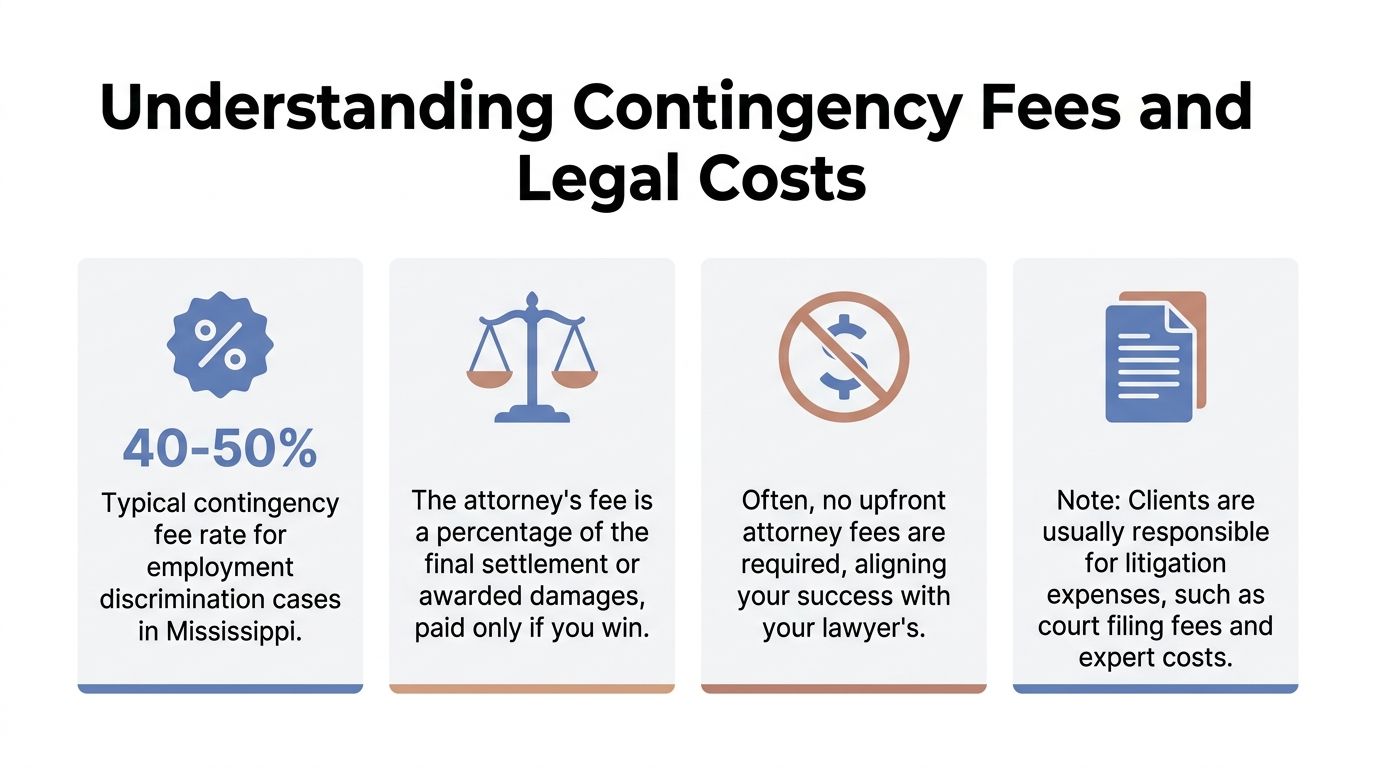
The common arrangement in these cases is a contingency fee, and the average contingency fee is 40-50%. That means the lawyer's fee is typically a percentage of the recovery rather than a bill paid up front for every hour worked.
What that fee usually covers
A contingency fee usually covers the lawyer's work on the case. That includes investigation, drafting, legal analysis, negotiations, and litigation work if the matter proceeds.
It doesn't always cover every expense that arises during the case. Ask specifically about filing fees, deposition costs, records charges, mediation expenses, and expert witness costs. Those items are often handled separately from the attorney fee percentage.
Why the fee discussion matters early
Fee terms aren't just housekeeping. They affect strategy, expectations, and whether the lawyer can take the kind of case you have. You should know when the fee is earned, how expenses are handled, and whether costs come out before or after the fee is calculated.
One reason this matters so much in employment cases is that procedure can kill a claim before the merits are ever tested. As noted in this workplace discrimination filing deadline discussion, missing the EEOC filing deadline can result in automatic dismissal, and approximately 15–20% of filed claims are dismissed solely on timing grounds. Paying for experienced guidance is often less about "buying a lawsuit" and more about avoiding preventable mistakes that end the case before it starts.
Ask for the fee agreement in writing. Read it slowly. A good lawyer won't rush that conversation.
Schedule Your Confidential Consultation with Nick Norris PA
Mississippi employment discrimination cases are procedural cases before they're damages cases. If the claim isn't framed correctly, documented carefully, and moved on time, the facts may never get a fair hearing.
That's why workers here need Mississippi-specific advice. There is no state human rights commission to absorb the problem or offer a parallel path. The route is narrower, the deadlines are unforgiving, and the early decisions matter.
If you're dealing with discrimination, harassment, or a retaliation issue tied to legally protected conduct, don't wait for the workplace to become clearer on its own. Get your documents together, stop guessing about deadlines, and speak with counsel who handles Mississippi employment law.
A confidential consultation gives you a chance to sort out what happened, what law may apply, what evidence matters, and what should happen next. Even when the answer isn't the one a caller hoped for, clear legal advice is better than losing time on the wrong theory.
If you need practical guidance from a Mississippi employment lawyer, contact Nick Norris, P.A. for a confidential consultation about your workplace discrimination or retaliation concerns.
This article has been reviewed for legal accuracy by Nick Norris. For employment law matters in Mississippi, consult with an attorney licensed to practice in your state.
Leave a Reply