

You're staring at a paycheck that doesn't add up. Maybe your hours were cut on paper, your overtime disappeared, or a manager told you to “fix it next pay period” while the short pay kept coming. If that sounds familiar, you don't need a lecture, you need a straight answer on whether a wage theft attorney near you can help, or whether a government complaint is the better move.
Mississippi workers run into wage theft in plain, ordinary jobs. A warehouse hand clocks 50 hours and gets paid for 40. A server sees a manager take a cut of tips. An assistant manager gets labeled “salary” and then works like an hourly employee anyway. Those aren't abstract legal theories, they're real payroll problems, and they often fall under the Fair Labor Standards Act when the employer is skimping on minimum wage, overtime, or off-the-clock time.

The scale of the issue is larger than commonly assumed. The Economic Policy Institute found that in the 10 most populous U.S. states, 2.4 million workers were paid less than the applicable minimum wage, losing $8 billion annually, about $3,300 per worker per year and nearly one-quarter of earned wages. That same analysis estimated that if the pattern held nationwide, minimum-wage violations alone could exceed $15 billion each year. It also reported that from 2017 to 2020, more than $3.24 billion in stolen wages was recovered through the U.S. Department of Labor, state agencies, attorneys general, and class-action litigation, which tells you two things, the problem is large, and legal enforcement matters. EPI's wage theft analysis
If you want a practical business-side view of how local search content gets built, find legal SEO experts is a useful reference. For workers, the core issue is simpler: if your pay is short, don't guess. Check your records, then decide whether the claim is strong enough to press.
Recognizing Wage Theft in Your Mississippi Workplace
The first clue is usually not dramatic. It's a shrinking paycheck, a missing overtime line, or a supervisor who keeps saying the clock system “glitched” right after a busy week. That's how wage theft hides, in repetitive little cuts that look explainable until you compare them against your hours.
A Mississippi worker should think in patterns, not excuses. If you worked before clocking in, after clocking out, through meal breaks, or while the system showed fewer hours than you put in, that's a wage issue worth checking. The same goes for tip handling, improper deductions, and being treated as exempt when the job still looks hourly in practice.
The job title is not the whole story
Employers love titles because titles are cheap. Calling someone a “manager” or “administrator” doesn't make overtime disappear if the actual work is routine, supervised, and tied to a time sheet. What matters is what you really do, not what the handbook calls you.
Practical rule: if your schedule, paycheck, and actual duties don't match, stop trusting the title and start looking at the records.
A lot of workers wait too long because they assume payroll will self-correct. It usually doesn't. The better habit is to compare one pay period to the next and ask whether the missing money tracks with a real hour, a real shift, or a real deduction. That's the point where a claim stops being a hunch and starts looking like a wage-and-hour case.
Mississippi workers dealing with overtime or short pay should also keep a broader compliance lens. Our wage and hour compliance guide covers the kinds of employer practices that create these disputes in the first place. If the same payroll mistake keeps happening, you're not looking at bad luck, you're looking at a system.
Gathering the Evidence That Makes or Breaks Your Claim
A wage claim lives or dies on documents. If you show up with only a story, the employer will say the numbers are wrong, the manager will deny it, and the agency or lawyer will have to spend time rebuilding what you could have preserved yourself. That's why the sequence matters, collect the records first, then call for help.
Start with the papers you can still control
Pull together your pay stubs, time records, work schedules, written policies, and every text or email about hours, breaks, or pay. If you have personal notes about shifts worked, add those too. When records are incomplete, your own notes can fill the gap, especially if they show a repeating pattern that lines up with the paycheck problem.
The most useful approach is simple. Gather the last several months of pay stubs, then compare them against time cards and schedules line by line. If the employer uses a digital timekeeping system and you can't log in anymore, save screenshots of what you can see, download anything available, and preserve every message that mentions hours or corrections. In a real dispute, documentary proof is what gets measured, not memory.
Keep your evidence in two places. One copy on your phone, one copy somewhere the employer can't touch.
If you're still employed, don't announce that you're building a file. Just collect your evidence discreetly. Save messages to a personal email, photograph posted schedules, and write down the dates when a supervisor told you to work off the clock or skip a break. If a coworker saw the same thing, note their name. Witnesses matter later, but the paper trail comes first.
For a clean way to think about back pay calculations after you gather the records, see our back pay calculation guide. And if you want to see how the evidence should be organized before you meet a lawyer or agency, the video below shows the basic workflow.

What to bring to the consultation
Bring the cleanest version of the story you can make. That means copies of the pay stubs, a summary of the missing hours, and any written company policy that conflicts with what happened. If your file has gaps, say so directly. A good attorney would rather see an imperfect file than a polished story with no support.
The key is to preserve the original records. Don't edit screenshots, don't rewrite time sheets, and don't “fix” dates in your notes. If something looks inconsistent, leave it inconsistent and flag it. That honesty helps more than a tidy narrative ever will.
If the worker and the employer are still in contact, preserve every exchange about pay, shifts, or schedule changes. Those messages often prove that the employer knew about the issue and kept going anyway. That's the kind of evidence that turns a complaint into a strong case.
Deciding Between a Government Agency and a Private Attorney
Most workers think there's only one path. There isn't. You can report wage theft to the U.S. Department of Labor's Wage and Hour Division, or you can hire a private attorney and press the claim directly. That choice matters because it changes who controls the file, how fast the matter moves, and how much attention your case gets.
When an agency complaint makes sense
A government complaint is a sensible starting point when the facts are straightforward and the unpaid amount is modest. If the employer is shaving hours, skipping overtime, or making a clear minimum-wage mistake, an agency can sometimes get traction without a full-blown fight. That path can also make sense if you want a formal record but don't want to manage a legal case yourself.
The trade-off is control. Agency enforcement is limited, and the workload is heavy. Academic analysis of U.S. wage-and-hour enforcement has estimated the chance of an investigation at only 0.5% to 1%, and it says staffing would need to more than double to restore prior inspection intensity. That's why a claim can sit unless it's well documented and easy to prove. Fordham Law Journal analysis
When a private lawyer is the better move
A private attorney makes more sense when the case involves misclassification, missing overtime across many pay periods, or a boss who's likely to stonewall. Private counsel can build the record faster, push for settlement, and file the kind of claim an employer takes seriously. That matters because EPI reported that from 2021 to 2023, wage-recovery efforts through the Department of Labor, state agencies, and litigation recovered about $1.5 billion in stolen wages, including nearly $700 million by the federal Department of Labor and $201.4 million by state departments and attorneys general. EPI's 2021 to 2023 update
A private case also lets you focus on the size of the damage, not just whether a violation happened. In 2021, the top 10 wage-and-hour class-action settlements totaled $641.3 million, which is a reminder that private attorneys can force real money onto the table when the employer has been underpaying workers at scale. The point isn't to chase every dispute into litigation. The point is to know when the agency route is too small for the harm.
Bottom line: if the issue is simple, start with the agency. If the employer is complex, evasive, or the lost pay is serious, talk to a lawyer first.
If you want to see how to report the problem before deciding, our guide to reporting unpaid wages lays out the complaint route in plain language. That's the fork most workers need to understand before they pick a lane.
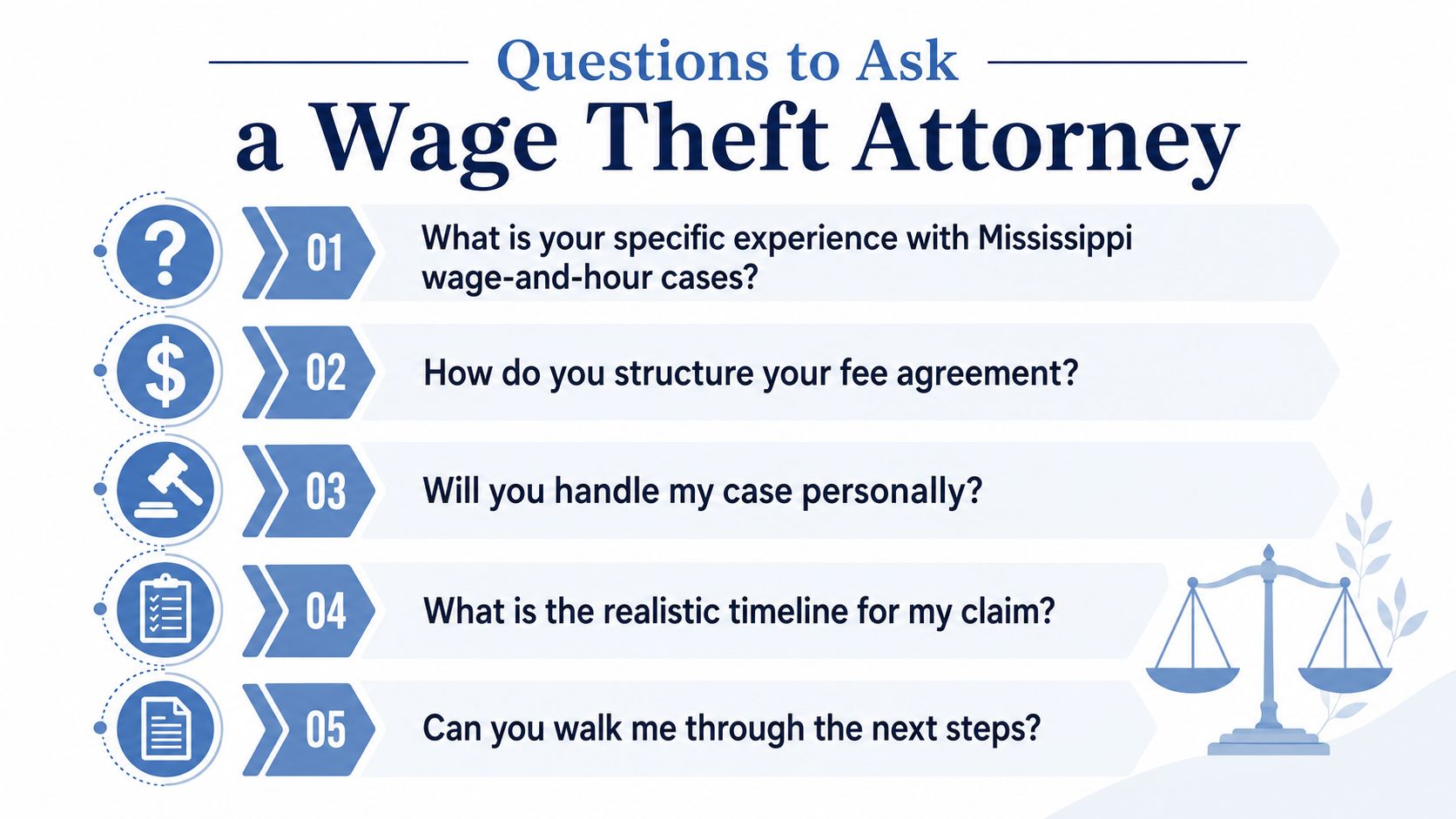
Questions to Ask at Your Attorney Consultation
A consultation is wasted if you just sit there and nod. Ask direct questions and listen for direct answers. A lawyer who handles wage cases should explain the path plainly, without hiding behind slogans.
Ask about experience, process, and ownership
Start with this question, What is your specific experience with Mississippi wage-and-hour cases? If the answer is vague, keep pressing. You want to know whether the lawyer has handled unpaid overtime, off-the-clock work, misclassification, and agency complaints, not just general employment disputes.
Then ask, Who will handle my case day to day? Some offices sell the consultation and hand the file to someone else. That can work if the team is organized, but you deserve to know whether the person across the desk is the one moving the matter.
A third question matters just as much, What is the timeline for my claim? If the answer sounds like a sales pitch, that is a warning sign. Good lawyers explain the steps, the bottlenecks, and what has to happen before settlement talks even start.
Ask what they need from you
Bring up documents and ask, What do you want me to gather first? A competent lawyer should tell you to bring pay stubs, schedules, time records, written policies, and messages about pay. If they brush past that and promise to “handle everything,” they are not telling you how wage cases really work.
You should also ask how the lawyer evaluates strength. Clear answers sound like this, “We need proof of the hours, proof of the pay, and proof the employer knew or should have known.” Evasive answers sound like, “Every case is different, but we win a lot.” You want method, not marketing.
In Mississippi, that question matters even more because your path splits fast. The state does not have a human rights commission to take over a workplace pay dispute, so a worker often ends up choosing between a government complaint and a private lawsuit with very little local bureaucracy in the middle. If your issue involves retaliation after a workers' compensation claim, do not assume you have broad statutory protection, ask the lawyer exactly what claims are available and what are not.
For a useful outside perspective on how clients choose counsel, a study on what makes clients pick a lawyer is a decent read. The point holds true here, workers usually pick the attorney who sounds organized, specific, and honest.
Understanding Contingency Fees and Realistic Timelines
A wage case should not drain your wallet before it ever gets heard. That is why contingency fees matter. You pay the lawyer from the recovery, which usually makes sense for a worker who cannot afford hourly billing up front. The fee range in the materials available here is 40% to 50%, but treat that as a negotiating starting point, not a guarantee and not a Mississippi-specific rule.
What the fee math looks like
You need the fee agreement in writing before you sign. In many cases, the lawyer's fee comes out of the recovery, and case expenses may be taken before or after the fee is calculated, depending on the contract. The practical point is simple. The settlement number and the amount you keep are not the same thing.
| Estimated Recovery After Contingency Fees | |||
|---|---|---|---|
| Gross Recovery | Attorney Fee (40%) | Estimated Costs | Worker Net Recovery |
| $10,000 | $4,000 | varies by case | $6,000 minus costs |
| $50,000 | $20,000 | varies by case | $30,000 minus costs |
The table is meant to keep you grounded. A bigger recovery still matters because the attorney's fee is tied to what comes in, not to how hard the argument sounds. Ask how costs are handled, ask when they are deducted, and ask what happens if the case does not produce a recovery.
Why timing changes the value of the claim
Delay helps the employer, not you. Wage claims lose force when workers sit on them, witnesses drift away, records disappear, and the payroll trail gets harder to pin down. Analysts at the EPI's recovery update noted that government action and litigation recovered more than $3.24 billion from 2017 to 2020, but that still leaves a much larger amount of stolen wages unrecovered. A separate summary from the National Institute for Workers' Rights says less than 3% of total stolen wages are recovered each year.
A good lawyer will tell you the timeline straight. Government agency matters can move slowly, especially when your records are thin. Private cases can also take time if the employer fights, but they often get stronger once the hours, pay records, witness statements, and employer knowledge are lined up. Start collecting documents now if you are missing them. Waiting turns a case with real value into a complaint with very little pressure.
Mississippi-Specific Realities Every Worker Should Know
Mississippi has some legal gaps that catch workers off guard. The biggest one is simple, Mississippi does not have a human rights commission. That means discrimination complaints aren't routed through a Mississippi human rights agency, they move through federal channels or other state-level processes instead. Justia's Mississippi employment-law note
The other trap is retaliation after a workers' compensation claim. Mississippi does not provide protection from retaliation for filing workers' compensation claims, so a worker who is fired after a workplace injury should not assume there's a state retaliation remedy tied to that filing. That does not erase every possible employment claim, but it does change the analysis fast.
Why that matters in a wage case
Wage theft often overlaps with other problems. A worker may be underpaid, pressured after complaining, or dealing with a separate workplace injury issue at the same time. In Mississippi, you need a lawyer who sees those overlaps clearly and doesn't assume the state has a commission or a retaliation path it doesn't have.
This guide stays focused on Mississippi employment law and federal wage rules. That focus matters because generic articles often blur state lines and give workers bad expectations. If you're in Mississippi, you need Mississippi-specific advice, not a copy-paste answer from somewhere else.
Nick Norris, P.A. handles Mississippi employment matters, including wage-and-hour disputes under federal law. It's one option for a worker who wants a direct review of unpaid overtime, short pay, or related workplace retaliation concerns without wasting time on broad promises.
If your paycheck is short and the employer is stonewalling, talk to Nick Norris, P.A. and bring your pay stubs, schedules, and messages about hours or pay. You'll get a straight answer on whether the facts point to a wage claim, whether the agency route makes sense, and what needs to happen next. Call 601-641-4897 and get the file reviewed before more pay periods slip by.
Leave a Reply