

88,531 new discrimination charges hit the EEOC in fiscal year 2024, and that was more than 9% higher than fiscal year 2023. A workplace discrimination policy is the employer rulebook that should spell out protected classes, reporting channels, anti-retaliation promises, and investigation steps, and in Mississippi these claims run through the EEOC, not a state human rights commission.
If you're a Mississippi worker and something feels off at work, that's usually where the confusion starts. Your boss may say the company has a policy, HR may hand you a handbook, and nobody tells you whether that paper protects you when the problem is race, sex, disability, age, religion, pregnancy, retaliation, or something else the law covers.
The hard truth is this, a policy matters only if it gives you a real path to report, a real promise against retaliation, and a real investigation process. The EEOC's own employer guidance says a solid policy should use multiple complaint recipients, allow reporting to any manager, protect complainants and witnesses from punishment, and document outcomes after a thorough investigation. That's the standard I look for when I review a handbook for a worker who's already been ignored once.
What a Workplace Discrimination Policy Actually Does
A worker in Mississippi usually notices the problem long before anyone in management admits it. Maybe the same supervisor keeps skipping you for training, maybe your schedule changes after you complain, or maybe the slurs never stop but HR acts like it's “personality conflict.” That's when the policy stops being abstract and becomes the company's test of whether it knows how to handle discrimination at all.
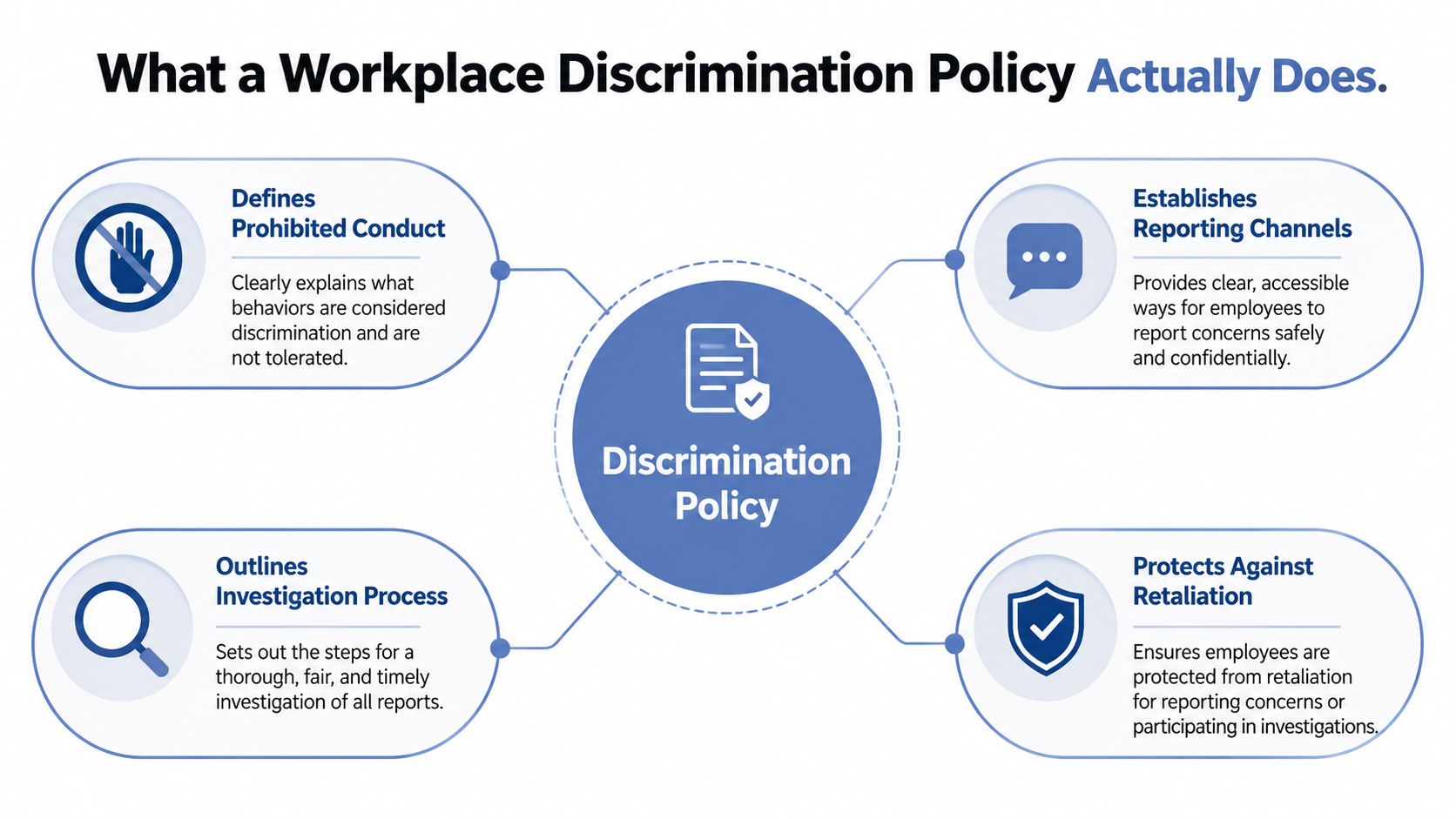
The policy is supposed to do real work
A workplace discrimination policy is not a decorative page in the handbook. It should define prohibited conduct, name the protected traits, explain where complaints go, and say what happens after the complaint lands. If it doesn't do those things, it's not helping the worker, it's helping the employer look prepared without being prepared.
The EEOC's employer tips are the benchmark here. A serious policy should allow multiple reporting paths, not just one manager who may be the problem, and it should promise a prompt, impartial investigation with status updates and documented results. That is the minimum standard for a policy that deserves to be trusted.
Practical rule: if the policy only says “report to HR” and says nothing about retaliation, investigation steps, or follow-up, it's too weak to rely on.
What a worker should expect to see
A good policy tells employees who is protected, what behavior is banned, how to report, and how the company will respond. It also makes clear that witnesses are protected, because people stop cooperating fast when they think they'll be punished for telling the truth. The EEOC specifically advises employers to designate more than one complaint recipient and let people report to any manager, which matters in small offices where everyone knows who controls the schedule.
A policy also has to reach beyond the cubicle. Employer toolkits recommend covering supervisors, co-workers, contractors, clients, and customers, and extending the rules to conferences, office parties, and field trips, because discrimination does not politely wait until everyone gets back to the building. A policy that stops at the office door leaves a lot of bad conduct untouched.
The point is simple. A real policy gives employees a path, a process, and protection. A weak one gives the company a talking point.
Core Elements Every Strong Policy Must Include
A Mississippi employee should read the handbook like a lawyer would. Skip the branding language and go straight to the parts that matter, because a policy either gives you an advantage or it doesn't.

Start with the protected classes
The first thing to look for is a clear list of protected traits. If the policy is vague, incomplete, or written so narrowly that it seems to protect only a few situations, that's a problem. A serious policy names the categories the employer won't tolerate discrimination against and ties them to conduct, not just labels.
Then check the reporting routes
The best policies give employees more than one way to complain. HR is fine, but HR alone is not enough if HR is tied to the same manager who caused the problem. The EEOC specifically advises employers to designate more than one complaint recipient and allow reporting to any manager, which is exactly what you want to see in writing.
The investigation language has to mean something
A policy that promises a “prompt” or “fair” investigation without explaining who investigates, how the company handles witnesses, or whether the worker gets updates is usually doing PR, not compliance. Look for language about confidentiality to the greatest extent possible, a neutral process, and a written outcome. If the policy talks about action but never says what happens after the facts are gathered, it's missing the point.
Retaliation and discipline matter just as much
An anti-retaliation clause should be direct. It should say the company won't punish people for reporting, supporting a coworker, or participating in an investigation. It should also say the company will discipline violators, because a policy without consequences invites repeat misconduct.
If you want a quick compliance check, compare the handbook to the EEOC's own tips for rapid, impartial case handling. If the handbook falls short there, it's not a policy you should trust blindly.
Federal Laws That Shape Mississippi Claims
A Mississippi worker who is waiting on a state agency to rescue a discrimination case is waiting for the wrong thing. Mississippi does not give you a separate state human rights commission for this fight. The federal route is the route that matters, and the EEOC is where the charge starts.
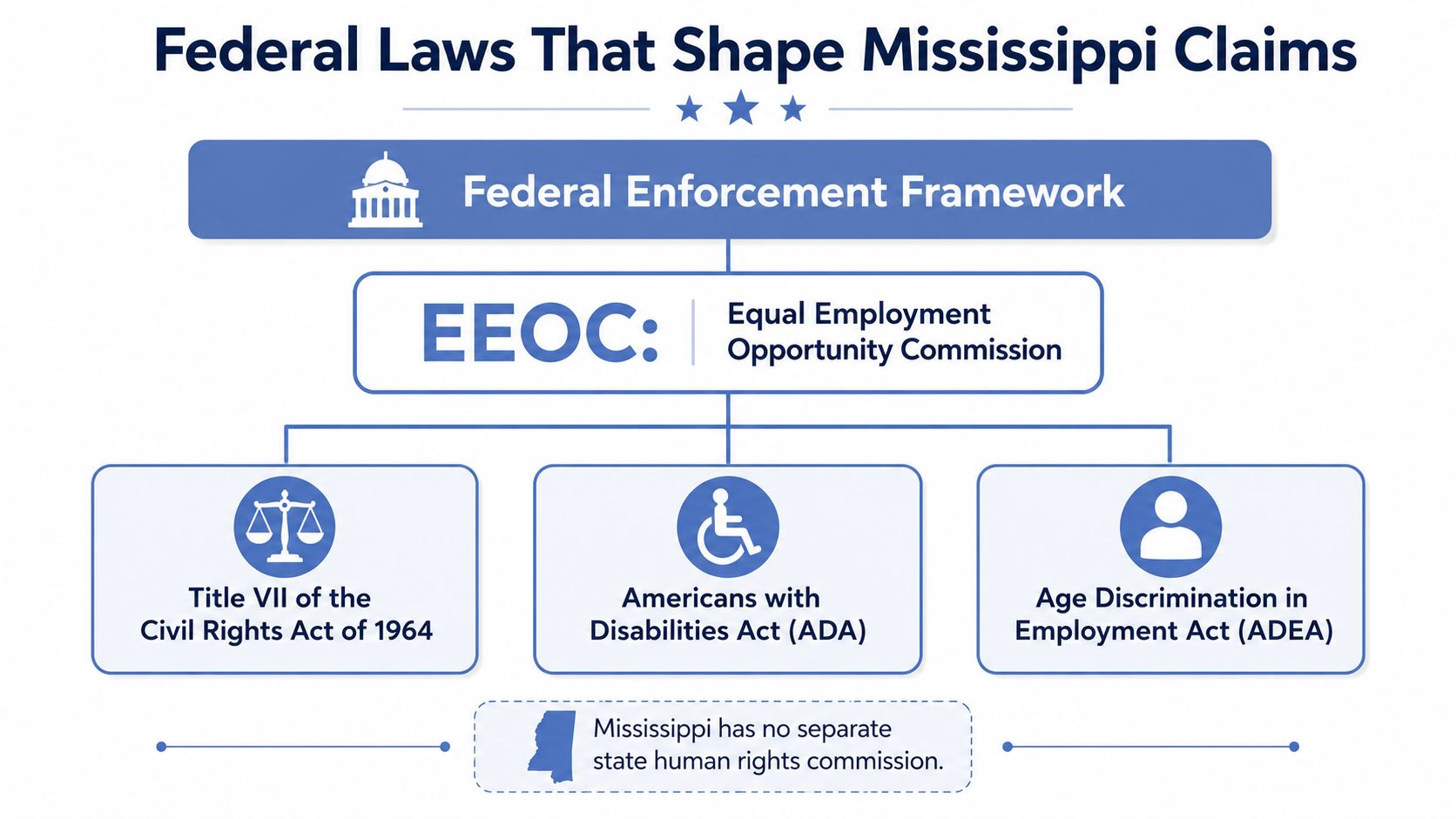
The federal statutes do the heavy lifting
Title VII covers discrimination tied to race, color, religion, sex, and national origin. The ADA covers disability discrimination and the duty to treat qualified employees fairly. The ADEA protects older workers from age discrimination. The FMLA matters when leave rights are mishandled, and USERRA protects service members' reemployment rights. Those are the federal statutes Mississippi workers rely on when a workplace policy breaks down.
At-will employment does not wipe any of that out. An employer can still fire someone for a lawful reason, but it cannot hide unlawful discrimination or retaliation behind at-will language. Companies make that mistake all the time when they act as if a handbook disclaimer overrides federal law.
Who handles what
For discrimination, the EEOC is the first stop. For wage and hour issues, the Department of Labor usually matters more. If you are trying to decide whether a complaint belongs in a discrimination file or a pay file, the facts control it, not the employer's preferred label.
For a worker who wants to see how those rules fit together in practice, the law policy mentor job listing is a plain reminder that policy language only works when someone understands how statutes, procedures, and enforcement line up.
Mississippi workers also need a workable state-law frame for the issues that are not federal-only. this overview of Mississippi employment law gives that context. If you are sorting out whether your problem is discrimination, leave, retaliation, or another employment issue, start there before you assume the handbook controls the answer.
The law still needs a clean complaint path
The strongest statute in the world does nothing if the company hides the reporting process. That is why the employer's policy matters before a charge is filed. The policy is the map, and the EEOC is the public enforcement route when the employer refuses to fix the problem on its own.
If the employer says “we take complaints seriously” but gives you no clear path, that is not protection, it is a stall tactic.
Mississippi workers also need to know where federal anti-retaliation protection ends. Federal law protects opposition to discrimination and participation in an EEO process, but filing a workers' compensation claim is not identified in the provided federal retaliation materials as a protected basis for a retaliation claim. Do not let anyone blur that line.
What to Do Before You File Anything
The worst mistake workers make is reporting with nothing in hand. You do not need a perfect case file on day one, but you do need a record that survives denial, delay, and the company's version of events.
Build the record while the facts are fresh
Write down dates, names, exact words, and who was present. Keep your notes in your own phone or notebook, not just in a workplace system the employer controls. If you're getting messages by text, email, or chat, save copies outside the company's devices and outside any thread that can be deleted later.
Do this first: save the message, then write down what happened, then identify who saw it. That order matters.
Keep witnesses and avoid loose talk
If someone saw the incident, note that person's name and job title. You're not asking them to become your lawyer, just preserving the fact that they exist. Don't vent the whole story in group chats or public social media posts, because those messages can be twisted into a credibility fight you never wanted.
A short internal report is better than a long emotional essay. Say what happened, when it happened, who did it, and what you want fixed. If the employer has a written reporting process, follow it, because the paper trail matters later.
A Mississippi worker should also understand the limit on workers' compensation retaliation claims. Federal retaliation law protects complaints about discrimination and participation in EEO activity, but a workers' comp claim is not the same thing. If your problem is tied to a compensation claim, don't assume it automatically becomes a federal retaliation case.
For a practical example of how to organize the facts before contacting counsel, this reporting guide is a useful companion.
Reporting Internally and Filing With the EEOC
A Mississippi worker should do both things at once, report internally and protect the right to file with the EEOC. HR often acts like those are competing moves. They are not. You report the problem inside the company so the employer cannot later claim it had no chance to fix it, and you keep the federal charge option alive in case the company stalls, minimizes, or retaliates.
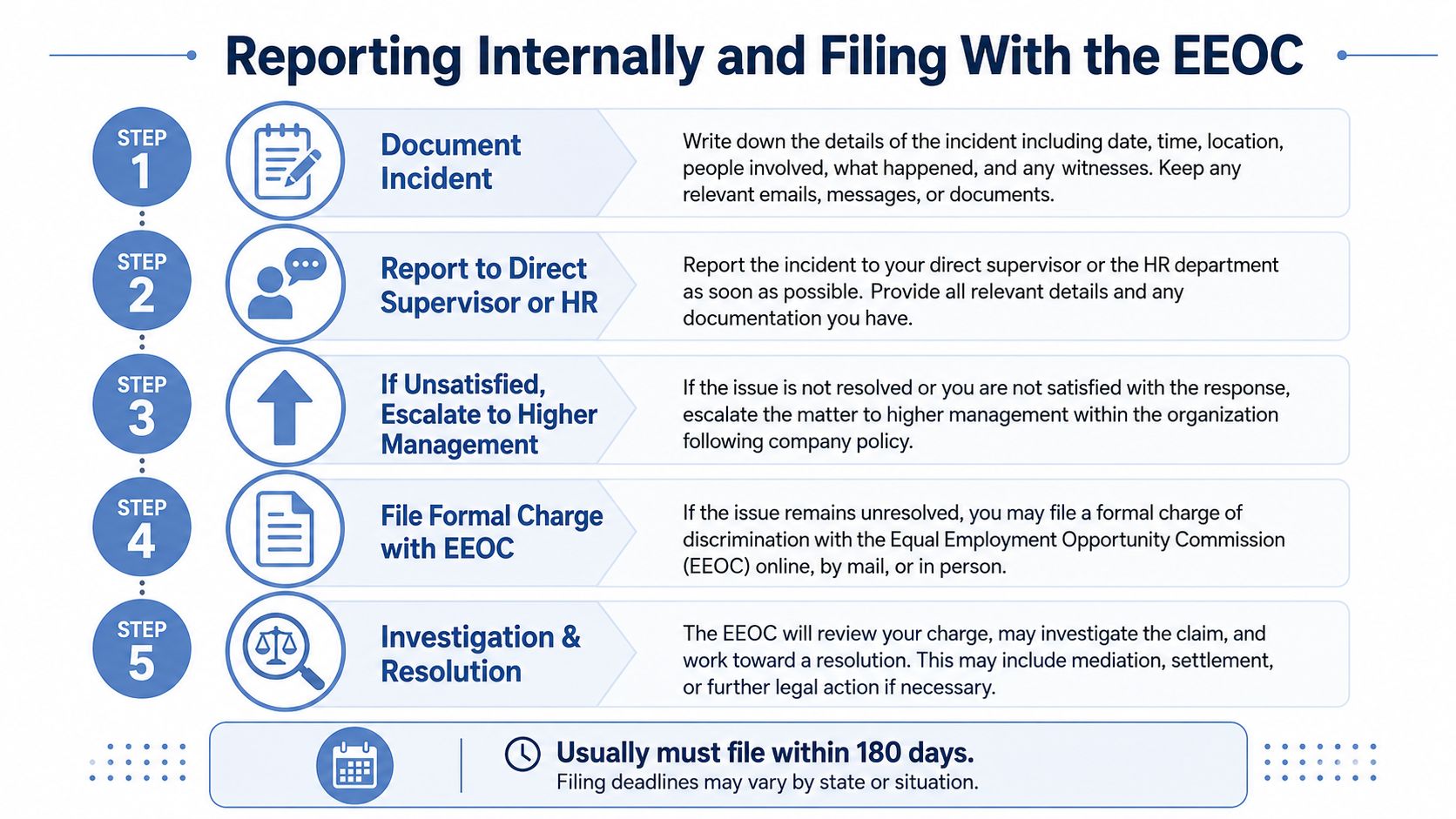
Start with the employer's process, then escalate if needed
Follow the handbook if it tells you to report to a supervisor or HR. If the first person buries the complaint, ignore it, or sides with the wrongdoer, move to the next available channel and keep going up the chain. Multiple reporting paths exist for one reason, to keep a single manager from controlling the whole story.
Put the complaint in writing. State what happened, when it happened, who was involved, and what you want corrected. Keep a copy outside the company system, because if the employer controls the only record, the record is easier to lose, edit, or pretend never existed.
Once you have reported it, watch what the employer does next. If the company fails to act or the retaliation starts, file the EEOC charge. That charge is the administrative step Mississippi workers usually need before a federal case can move forward. The EEOC still sees a heavy workload, and its own EEOC Annual Performance Report shows just how often workers keep turning to the agency for help.
Don't miss the filing deadline
Most Mississippi discrimination charges must be filed within 300 days. That deadline kills claims when workers wait too long, no matter how ugly the facts are. If you are close to that cutoff, stop hoping the company will suddenly do the right thing and get the charge filed.
The EEOC process is straightforward once you strip away the paperwork. You submit the facts, the agency reviews the charge, and then the matter moves into investigation and possible resolution depending on what the evidence shows. For a closer look at that stage, this EEOC investigation guide breaks down what happens after the charge is filed.
Use the right outside help
A single email usually will not fix a discrimination problem. It may help create a record, but it will not force an employer to act, and it will not preserve every legal option if the clock is running. If you need help framing the charge, organizing the timeline, or deciding whether you are dealing with discrimination, retaliation, or both, a Mississippi employment lawyer should get involved before the deadline runs out.
Red Flags and When to Call an Attorney
The signs of a buried complaint are usually obvious if you know what to watch for. HR starts dragging its feet, a supervisor suddenly writes you up for things nobody mentioned before, your schedule changes without explanation, you get cut out of meetings, or you're terminated soon after you complain. That's not normal workplace friction, that's the company showing you where it stands.
Don't wait for the final blow
A lot of workers wait because they think they need one more bad act before calling a lawyer. That's a mistake. If the employer has already started treating you differently after protected activity, the pattern matters more than any single incident.
Watch the timing closely: when a complaint is followed by discipline, isolation, or termination, the employer is creating evidence whether it wants to or not.
The closer you get to the 300-day EEOC deadline, the less room you have to keep hoping management will “circle back.” If the deadline is near and the internal process is still stalled, you need outside help before the window closes.
Cost matters, so be realistic
Mississippi employment cases often move on a contingency fee, and the common range is 40% to 50%, according to NELP's anti-discrimination materials. That's why the fee conversation should be direct from the start. No one should pretend employment cases are free, and no worker should be surprised by the split after the case is already underway.
If you're comparing options, ask whether the lawyer has handled EEOC charges, retaliation claims, and Mississippi employment disputes before. That matters more than a flashy website or a generic promise.
In some situations, Nick Norris, P.A. is one of the Mississippi options for a worker who needs a charge evaluated, a timeline checked, or a retaliation issue framed correctly. That kind of early review can keep a weak internal report from turning into a lost claim.
Sample Policy Language and What to Look For
The clearest policies sound like they were written for an actual complaint, not for a compliance binder. If you're reviewing a handbook or pushing for a better one, the wording tells you a lot.
Strong language sounds specific
A good protected-classes paragraph does more than say “we comply with the law.” It names the kinds of discrimination the company bans and ties them to conduct in hiring, scheduling, discipline, promotion, and termination. A good anti-retaliation clause says the employer won't punish reporting, supporting, or participating in an investigation.
The investigation clause should also say the employer will review complaints promptly, keep information confidential as far as practical, and document the outcome. If the policy only promises “prompt attention,” that's too soft. If it says who can receive the complaint, that's better.
Weak wording is easy to spot
Watch for policies that only mention a few traits, only let you report to one person, or say nothing meaningful about discipline. That kind of language gives the employer room to stall. It also gives the worker less bargaining power when the employer later claims it had “a policy” all along.
A useful rule of thumb is this, if the policy reads like it was written to defend the company after the fact, it probably was. If it reads like it was written to stop bad conduct before it spreads, it's closer to what you want.
A Mississippi worker's checklist
- Protected traits listed clearly. The policy should identify the categories the company covers, not hide them in a vague “equal opportunity” sentence.
- More than one reporting route. HR, a manager, or another designated contact should all be available.
- Anti-retaliation language. The policy should protect the person complaining and the witnesses.
- Investigation steps. There should be a process, not just a promise.
- Discipline for violators. The company should say it will act if the investigation confirms misconduct.
A short, careful review of the policy can tell you whether the company is serious or just papering over risk.
Frequently Asked Questions for Mississippi Workers
Does Mississippi have a human rights commission?
No. Mississippi has no state human rights commission, so discrimination complaints in this state usually run through the EEOC. That reality matters. Your policy review should focus on federal procedure, because there is no Mississippi agency that steps in and fixes the problem for you.
How much does a contingency fee usually run?
In employment cases, the common contingency-fee range is 40% to 50%. Get that number on the table before you sign anything. A lawyer should tell you what the fee covers, when it applies, and how litigation costs are handled. That is basic clarity, not a bonus.
What if I miss the EEOC deadline?
For most Mississippi discrimination claims, the EEOC filing window is 300 days. Miss it, and you can lose the administrative route that keeps the claim moving. Do not sit around waiting for the employer to “get back to you” while the clock runs.
Does workers' compensation retaliation work the same way?
No. Federal anti-retaliation rules protect opposition to discrimination and participation in an EEO process, but a workers' compensation claim is not identified in the provided federal retaliation materials as a protected basis for retaliation. If that is the issue, get the facts checked before you assume the law helps you.
For related Mississippi employment issues, these posts are a useful starting point, FMLA guidance, USERRA questions, WARN layoffs, and wage-and-hour concerns. If you want a broader compliance perspective that helps you think through documentation and accuracy before you file, the compliance guide for personal injury practices is a smart read.
| Key Numbers a Mississippi Employee Should Memorize | What It Means for You |
|---|---|
| 88,531 EEOC charges in fiscal year 2024 | Your complaint is part of a very real federal enforcement system. |
| More than 9% higher than fiscal year 2023 | Charge volume is rising, not fading. |
| More than $665 million in fiscal year 2023 | EEOC enforcement can lead to monetary relief, not just paperwork. |
| About $440.5 million for 15,143 victims | Mediation, conciliation, and settlements can produce real recoveries. |
| 300 days | This is the filing window most Mississippi workers need to protect. |
| 40% to 50% | This is the common contingency-fee range in employment cases. |
If you are sitting on a discrimination issue right now, do not guess your way through it. Call 601-641-4897 and get the facts reviewed before the deadline controls the case. Nick Norris, P.A. helps Mississippi workers evaluate discrimination, retaliation, and EEOC charges with a direct, case-specific approach.
Leave a Reply