

You probably know the feeling already. A doctor told you to avoid certain tasks, you asked for a schedule change or light duty, and then your hours got cut, your supervisor started writing you up, or somebody decided you were “not a fit” anymore. In Mississippi, that's not just bad management, it can be the start of a disability discrimination claim, and the first mistake people make is assuming they can deal with it later or file in some local office that doesn't exist.
By Nick Norris, Attorney
Last updated: 2026-08-01
Reviewed by Nick Norris
What a Disability Discrimination Claim Looks Like in Mississippi
A Meridian retail manager asks for a predictable shift because a medical condition makes rotating nights rough. A week later, her schedule gets slashed and somebody else gets the hours she used to work. A Jackson warehouse worker gives his supervisor a lifting restriction, then gets moved off the good route and told he's “better suited elsewhere.” That's how a lot of these cases start.
Mississippi is different from states with a local human rights agency. There is no Mississippi human rights commission, so the practical path for most workers runs through the EEOC and, if it gets that far, the federal system. That matters because generic advice online often talks like you can file a local complaint first. In Mississippi, that's not the setup.
The federal reality also changes the strategy. You need to treat the first written complaint, the first doctor's note, and the first employer response like evidence, not like paperwork. If your employer is already acting like the problem is you, that's a sign to get organized immediately.
Practical rule: if the employer's response comes fast and feels punitive, don't wait for the situation to “settle down.” Start documenting now.
For workers trying to understand the next legal step, what reasonable accommodation means under the ADA is the right place to start. It helps separate a real legal claim from a simple workplace conflict.
The Legal Standards Behind a Federal Disability Discrimination Claim
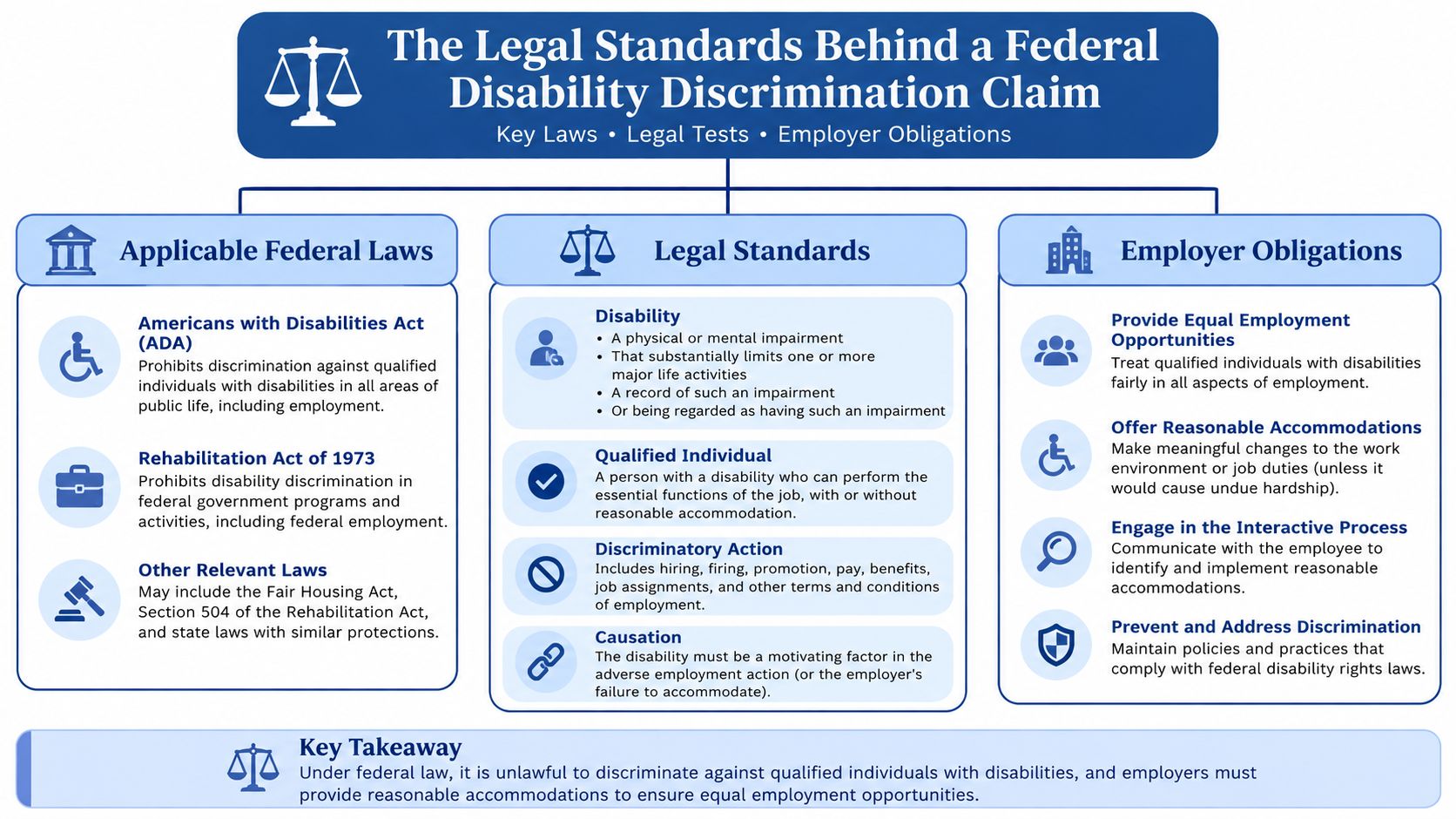
A federal disability discrimination claim turns on proof, not sympathy. The EEOC says the claimant has to show disability status, qualification to do the job with or without accommodation, an adverse employment action, and a causal link between the action and the disability (EEOC guidance on disability and employment decisions). That's the core structure. If one part is weak, the employer will try to collapse the whole case.
Who counts as disabled
The ADA covers people with an actual disability, a record of disability, or people who are regarded as disabled. In real cases, that “regarded as” theory matters because employers sometimes react to a diagnosis, a restriction, or a medical leave request as if the worker is suddenly unreliable. That reaction can matter even when the employer never uses the word “disability.”
Federal-sector employees are on a different complaint track under Section 501 of the Rehabilitation Act, but the basic evidence questions stay familiar. What did the employer know, what did it do, and what reason did it give for the action?
What the employer will attack
The employer usually attacks the second and fourth parts of the claim. It says you couldn't perform the job, or it says the decision had nothing to do with the condition. That's why your records matter so much. Medical restrictions, job duties, performance history, and the timing of the decision all show whether the employer's story holds up.
Three Theories of Recovery Mississippi Employees Should Know
A lot of workers think “disability discrimination” is one claim with one path. It isn't. There are three different theories, and the wrong one can waste a lot of time.
Failure to accommodate
This is the claim most often brought. The issue is the employer's notice and response. The employee has to identify a reasonable accommodation and show that the employer knew about the disability and the need for accommodation, knew or should have looked into a workable option, and then failed to provide it (technical framework for accommodation claims).
If a Tupelo office worker asks to work from a quieter location because concentration is part of the problem, the legal question isn't whether the manager liked the request. The question is whether the employer dealt with it in good faith.
Disparate treatment
This is the straight discrimination theory. The employer took an adverse action because of the disability. Timing matters. So do comparator records, supervisor comments, and any sudden change in treatment after the worker disclosed the condition or asked for help.
A Hattiesburg supervisor who praises a worker for months, then starts documenting every minor issue after the worker discloses a diagnosis, raises a very different set of facts than an employer who had documented problems long before the disclosure.
Disparate impact
This theory targets a neutral policy that screens out disabled workers in practice. Mandatory overtime, rigid attendance rules, or inflexible physical requirements can all create problems when applied without room for accommodation. The policy may look neutral on paper, but the effect can still be discriminatory.
A claim gets stronger when the facts match the theory cleanly. If the real problem is refusal to adjust duties, don't force the case into a firing claim just because termination happened later.
The Step-by-Step Claims Process for Mississippi Workers
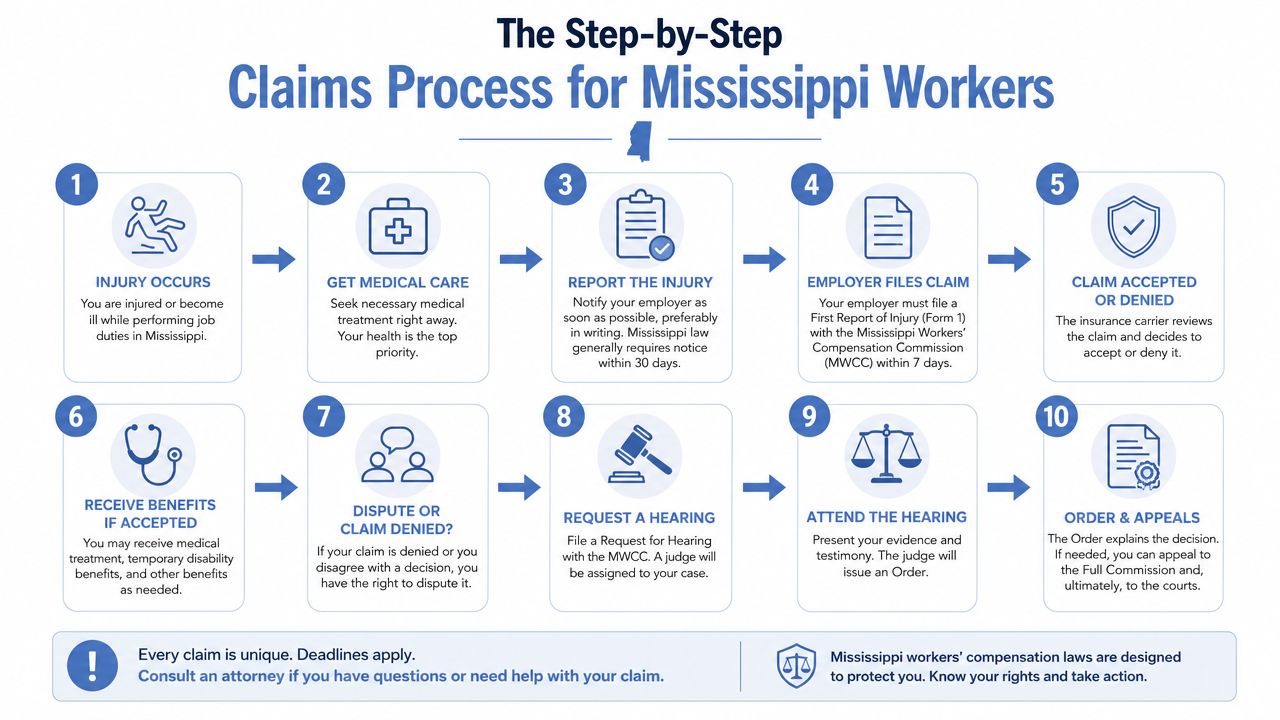
Start with a written internal report. Send the email, save the text, and keep the attachment. If the issue is accommodation, write plainly that you need a change because of a medical condition. If the issue is treatment after disclosure, document the date, the person involved, and what changed.
Then file a charge with the EEOC. In Mississippi, the practical deadline is 300 days because there is no state fair-employment agency to extend the process. Miss that deadline, and you can lose the claim before anybody even reviews the facts.
The EEOC process is usually slower than people expect. Investigators ask for documents, position statements, and sometimes interviews. Mediation can happen early and it's voluntary, but it can also solve the case in a way that saves a job, fixes a record, or gets accommodation language built into the resolution. Nick Norris explains the EEOC investigation process here.
If the charge doesn't resolve, the EEOC issues a notice of right to sue. That notice matters because it opens the door to federal litigation. Don't sit on a charge for months waiting to “see what happens.” The timing of the request, and the way the charge is framed, can change the dynamics in the case.
Bottom line: internal reporting first, EEOC charge next, then strategy on mediation or a right-to-sue notice. In Mississippi, that sequence is the real gateway.
Evidence That Wins a Disability Discrimination Claim

The best cases are built on records created close to the event. Start with medical documentation from treating providers. Diagnosis matters, but function matters more. What can you lift, stand, concentrate on, or avoid, and for how long?
The paper trail that matters most
You need the accommodation request trail. Keep the email, the text, the note to HR, and the response. If you asked for help verbally, write a follow-up message that memorializes the conversation.
Then gather the workplace records that show a pattern.
- Performance reviews before and after disclosure: A clean record before the request and sudden criticism after it can be powerful.
- Comparator evidence: If non-disabled employees got flexibility you were denied, keep the names, dates, and examples.
- Employer communications: Emails, texts, Teams messages, and write-ups all matter.
- Internal investigation files: If the employer created one, it can show what it knew and when.
The mistakes that hurt cases
Don't delete angry text threads. Don't vent about the case on social media. Don't skip medical appointments because the workplace stress is high. And don't rely on verbal-only requests if you can put it in writing.
If the accommodation request isn't documented, the employer will often deny it happened the way you remember it.
How Employers Defend Disability Discrimination Claims in Mississippi
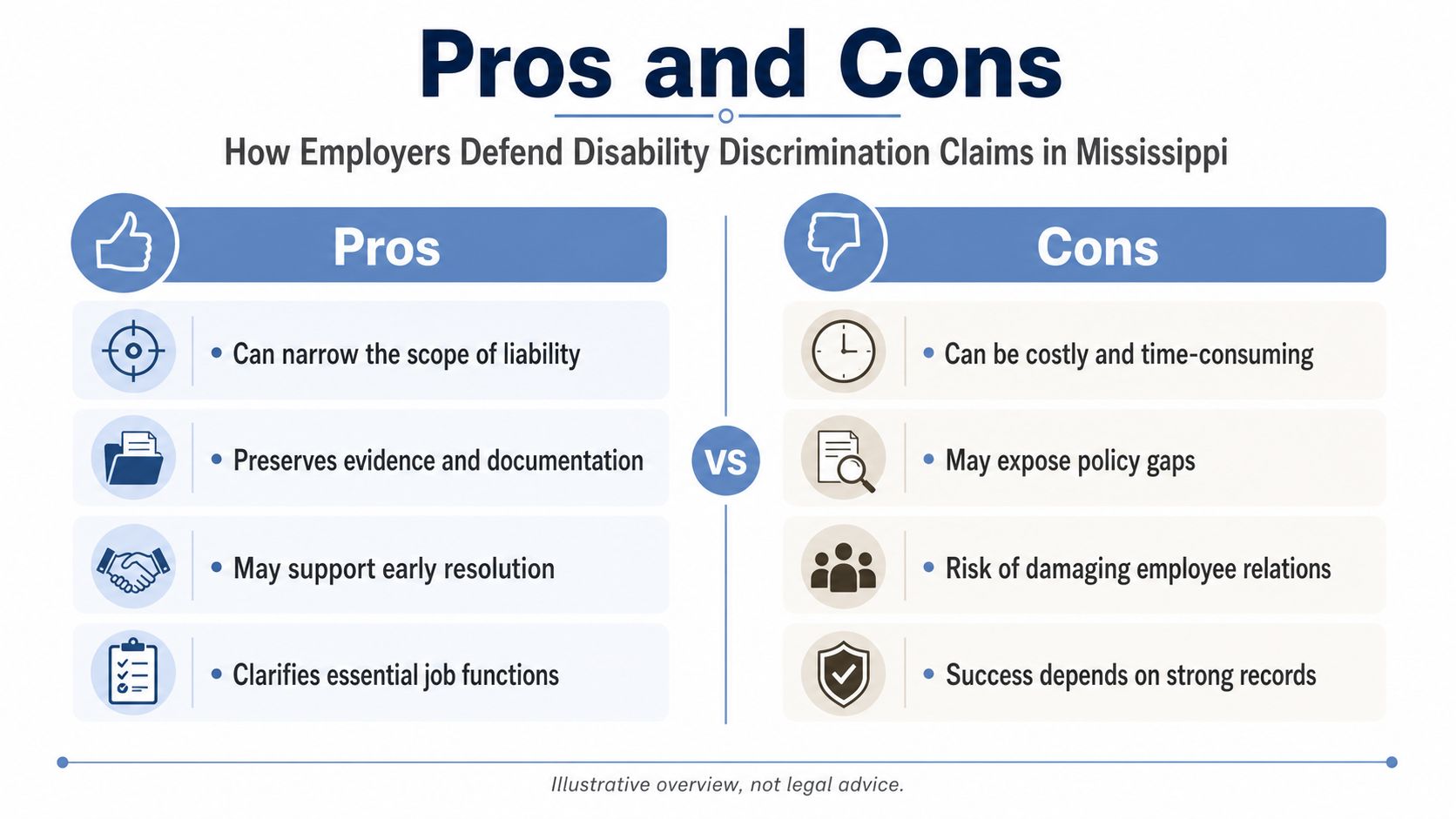
Employers rarely say, “We discriminated.” They give a cleaner reason. The job was a bad fit. The worker couldn't do the essential duties. The accommodation would have been too disruptive. The performance was already poor.
The common defenses and how they break
Business judgment. The employer says the decision had nothing to do with disability. The answer is usually timing and documentation. If there was no real performance issue until after disclosure, that defense gets shaky.
Essential functions. The employer claims the worker couldn't do the core job even with accommodation. That's where functional medical records and job-duty details matter. A vague restriction letter won't carry a case very far.
Undue hardship. The employer says the requested accommodation was too expensive or disruptive. Courts look at whether the employer actually explored alternatives. A knee-jerk no is weaker than a real, documented analysis.
Performance. The employer blames discipline on work quality. Pre-disclosure reviews and comparator evidence are how workers fight back. If others made the same mistakes and weren't punished, the employer's story starts to unravel.
Remedies, Damages, and What a Contingency Fee Really Costs
A successful claim can produce more than money. The employer may have to reinstate a worker, clean up the personnel file, change policy, or provide the accommodation going forward. Money still matters, though, and the usual buckets are back pay, front pay if reinstatement isn't realistic, and compensation for emotional distress when the facts support it. Federal law also allows punitive damages in the right case, along with attorneys' fees for a prevailing claimant.
| Potential Remedies in a Federal Disability Discrimination Claim | EEOC Settlement | Federal Court Judgment |
|---|---|---|
| Reinstatement | Sometimes | Sometimes |
| Reasonable accommodation going forward | Often | Often |
| Back pay | Sometimes | Often |
| Front pay | Rarely | Sometimes |
| Emotional distress compensation | Sometimes | Sometimes |
| Punitive damages | Rarely | Sometimes |
| Attorneys' fees | Sometimes | Sometimes |
The money question is real, and people should ask it directly. The average contingency fee in employment cases is 40 to 50 percent of the recovery (employment fee range). That's not a reason to walk away. It's a reason to ask what the fee covers, whether costs are separate, and what a realistic settlement would look like after fees.
If you want to understand legal fees before you call, this explanation of employment lawyer cost in Mississippi is worth reading first.
Taking the Next Step With a Mississippi Employment Attorney
Before you call, gather five things. First, a timeline of the key dates. Second, the accommodation request trail. Third, your medical records or the contact info for the treating provider. Fourth, your most recent performance review. Fifth, the names of the people on the employer side who were involved.
Mississippi workers also need two reality checks. There is no state human rights commission here, so the EEOC process is the administrative path that matters. And Mississippi does not provide a separate retaliation claim for filing workers' compensation claims, so many workers need to look at the disability discrimination facts, the accommodation failure, or a different federal employment theory instead of forcing the wrong label onto the case.
If your job changed after you disclosed a condition, asked for help, or handed over restrictions, call before the deadline starts to control your options. I handle these cases from the first charge through settlement talks and federal litigation strategy, and the earlier you get counsel involved, the more options you usually keep.
Call 601-641-4897 if you're facing a Mississippi disability discrimination claim and want a direct review of the facts. Bring the documents, bring the dates, and don't wait until the employer has built the whole story first.
If you're dealing with a disability discrimination claim in Mississippi, Nick Norris, P.A. can review your timeline, your accommodation requests, and the employer's response before the deadline runs. Visit Nick Norris, P.A. to get started, or call 601-641-4897 for a practical case evaluation rooted in Mississippi employment law.
Leave a Reply