

A federal discrimination lawyer can mean two different things. In Mississippi, most workers need a lawyer who handles EEOC charges and federal discrimination claims, while federal employees follow the separate agency EEO counselor process.
If you're getting pushed out, written up unfairly, passed over, or punished after complaining, don't wait around hoping HR fixes it. Mississippi has no human rights commission, so for most private employees the EEOC deadline is the gatekeeper, and missing it can end the case before anybody looks at the facts.
By Nick Norris, P.A.
Last updated: August 12, 2026
Reviewed by Nick Norris
What a Federal Discrimination Lawyer Actually Does
Many people in Mississippi search for a federal discrimination lawyer because they've been treated badly at work, but they're not sure what kind of lawyer they need. That confusion matters. If you work for the federal government, your route starts with an agency EEO counselor. If you work for a private employer, or many state and local employers, your route usually starts with the EEOC.
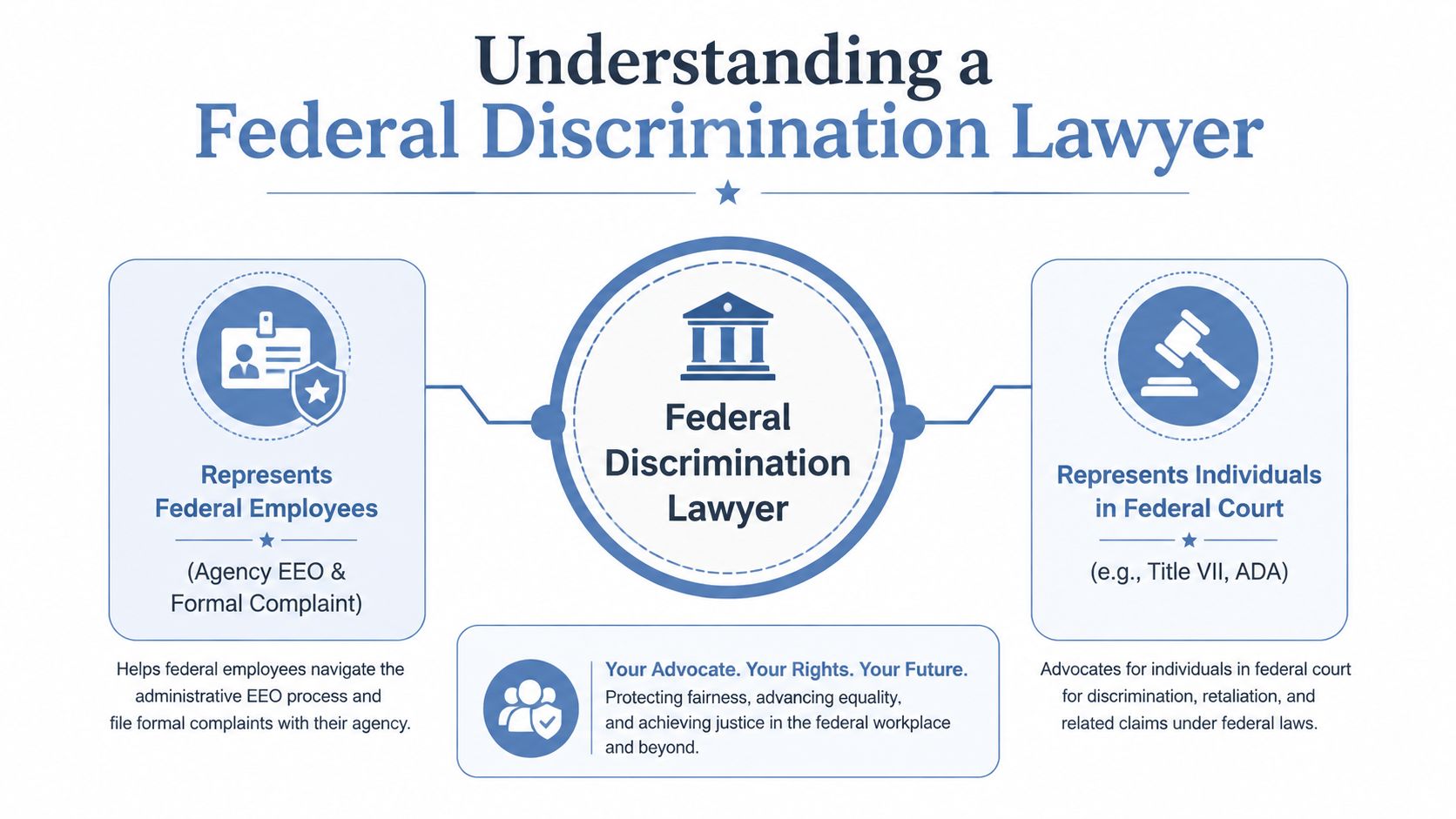
Two tracks, not one
For federal employees, counsel is often about protecting deadlines, framing the complaint correctly, and keeping the case moving through the agency process. That process has its own rules, starting with contact to an EEO counselor within 45 days of the act you're challenging. For private-sector workers, the lawyer is usually building the case for an EEOC charge, then a possible federal lawsuit after the charge process runs its course.
Mississippi workers need this distinction spelled out because the state doesn't have a human rights commission to catch routine discrimination complaints. So if you're a private employee in Jackson, Hattiesburg, Tupelo, or anywhere else in the state, your lawyer usually has to think in federal terms from day one. That means your facts, your dates, and your paperwork need to line up with the EEOC process, not some imagined state agency route.
What the lawyer actually controls
A good lawyer does more than file forms. They identify the right legal theory, organize the timeline, flag the deadline problem early, and decide whether the case is strongest as race discrimination, sex discrimination, disability discrimination, age discrimination, retaliation, or some combination of those theories. They also tell you when the case is too weak to overpromise on and too strong to sit on.
Practical rule: if the adverse act happened recently, your first job is not to debate the merits, it's to protect the filing window and preserve proof.
The core point is simple. In Mississippi, an EEOC charge is usually the mandatory first move for private employees, and the lawyer's job is to make sure you don't blow that chance while trying to “see what happens” internally. If the employer has already made its move, you need counsel that matches the path the law uses.
The Core Federal Statutes You Will Hear About
Most workplace discrimination claims in Mississippi are built on a handful of federal statutes. They overlap more often than people think, and one bad work pattern can violate more than one law. That's why a lawyer should talk to you in plain English, not recite acronyms like they're the point.
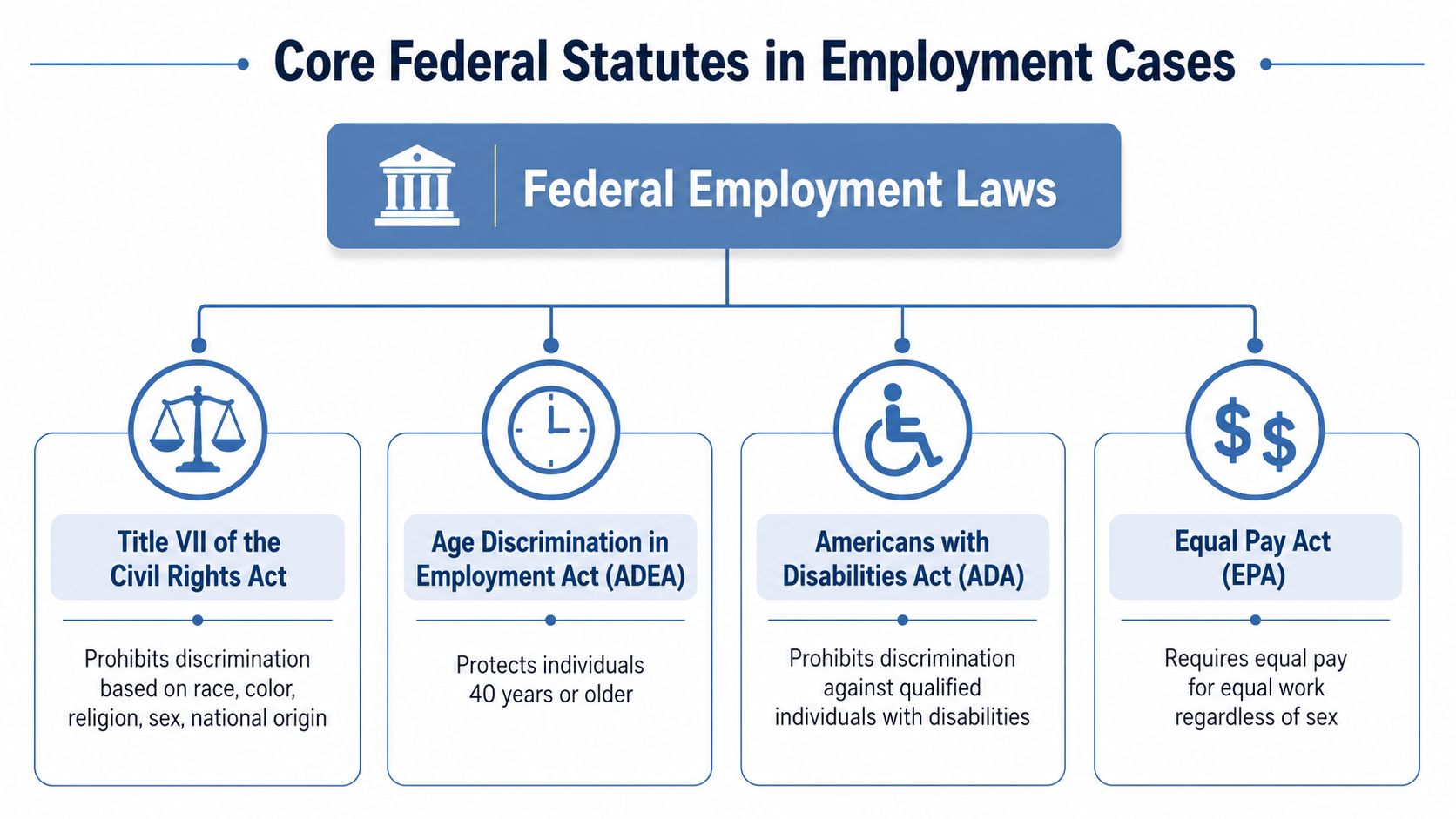
Title VII, ADA, ADEA, and the pay laws
Title VII is the statute often encountered first. It covers discrimination based on race, color, religion, sex, and national origin, and the EEOC's modern enforcement materials make clear that sex discrimination also reaches pregnancy, gender identity, and sexual orientation. If your boss treats you differently after a pregnancy disclosure, after you report harassment, or because of who you are, Title VII is often where the case starts.
The Americans with Disabilities Act handles disability discrimination and failure to accommodate. If you asked for a reasonable accommodation after surgery, after a medical diagnosis, or because a job duty became impossible without a change, the ADA may be the right fit. The Age Discrimination in Employment Act protects workers who are 40 or older. The Equal Pay Act deals with unequal pay for equal work tied to sex-based pay disparity.
The laws that often show up beside them
The Genetic Information Nondiscrimination Act matters when an employer misuses genetic information. USERRA appears when military service creates trouble at work. FMLA matters when leave rights are involved, even though it is not a classic discrimination statute. Retaliation also cuts across these laws, because employers often get into trouble not only for the original bias, but for punishing a worker who complained.
One Mississippi worker can have several theories at once. A denied accommodation can overlap with disability discrimination and retaliation. A demotion after a pregnancy disclosure can overlap with sex discrimination and retaliation. The lawyer's job is to sort out which theory has the cleanest proof and the strongest remedy.
The five elements that matter
The EEOC's framework boils a discrimination claim down to five pieces, protected class, adverse action, discriminatory intent, causation, and timely filing. The adverse action can be termination, demotion, denial of promotion or training, or a cut in pay, benefits, or responsibilities. If one of those pieces is missing, the claim gets weaker fast.
For a broader Mississippi employment-law overview, see this employment law guide for Mississippi workers. You don't need a law degree to spot the issue. You need to know whether the facts fit one of these statutes and whether the deadline is still alive.
How an EEOC Charge Actually Works
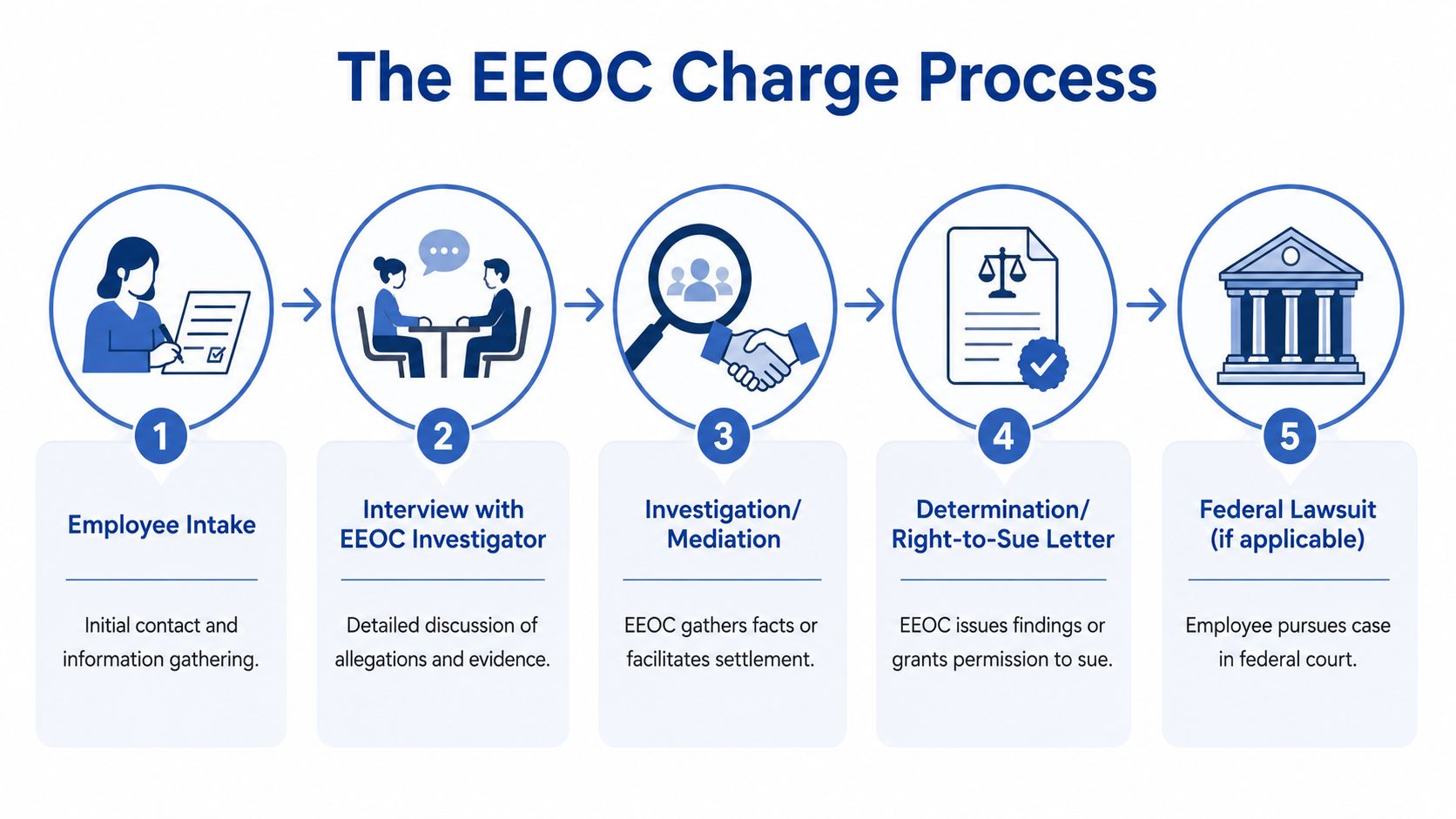
The EEOC charge process is not a court trial. It's the administrative path most Mississippi private employees must use before they can get to federal court. If you skip it, rush it, or file it late, the employer gets a strong defense before the facts are even tested.
The deadline is the whole game
The EEOC says a charge generally must be filed within 180 days of the alleged violation, and the window extends to 300 days only when a state or local anti-discrimination law also covers the claim. Mississippi workers should pay attention to that because the state has no human rights commission, so the 180-day rule is the one that usually controls. If the firing, demotion, refusal to accommodate, or discriminatory pay decision is older than that, the case can be dead before the agency looks at the merits.
The clock usually starts when the adverse action happens, not when you finally decide the employer is unfair. A termination date, a demotion date, a denied promotion date, or the date you were told your accommodation was off the table can all matter. That's why date mapping matters more than emotion in the first call.
What happens after filing
The process usually begins with intake and a charge draft. An EEOC investigator then interviews you, collects the employer's response, and decides whether the case needs more evidence, mediation, or dismissal. If the matter doesn't resolve, the EEOC may issue a right-to-sue letter, which is the gateway to federal court, not the end of the fight.
For federal employees, the path is different. The agency EEO process usually starts with counselor contact within 45 days, counseling is ordinarily completed within 30 days, and ADR can stretch that to 90 days if it's offered. Only after that can the employee move to a formal complaint with the agency.
To see what that investigation stage looks like in more detail, review this EEOC investigation process guide. The basic rule is blunt. If you are a Mississippi private employee, the EEOC charge is not optional, and the deadline is not flexible.
Federal Claims Compared with Mississippi State Law
Mississippi discrimination cases often involve more than one legal lane, but discrimination itself usually lives in federal law. That's because Mississippi lacks a state human rights commission, and many workers have no meaningful state agency route to handle a bias claim. The practical result is that the federal EEOC route is usually the center of gravity.
What belongs where
A federal discrimination claim can bring remedies like back pay, front pay, reinstatement, compensatory damages, punitive damages, and attorneys' fees and costs. Those remedies matter because they influence settlement negotiations and case value. If the employer's conduct is serious enough and the proof is solid, federal law gives real pressure points.
State-law claims can still matter in the background. A worker might have a contract issue, a hostile-work-environment fact pattern that also supports a tort theory, or a wrongful-termination theory tied to public policy concerns. But this guide is not telling you to file a discrimination case in state court, because that is not the usual path for a Mississippi bias claim.
A simple comparison
| Route | Forum | Deadlines | Typical Remedies |
|---|---|---|---|
| Federal discrimination claim | EEOC, then federal court if allowed | Usually 180 days for an EEOC charge in Mississippi | Back pay, front pay, reinstatement, compensatory damages, punitive damages, fees |
| Federal employee EEO claim | Agency EEO process first | Usually 45 days to contact a counselor | Administrative relief, then possible civil action |
| Other Mississippi employment theories | Depends on the claim | Depends on the theory | Contract, tort, leave, or service-related remedies |
The main decision for most workers is not “federal or state court.” It's whether the facts belong in the EEOC process, whether a separate federal statute is involved, and whether the case needs private counsel now. That timing choice drives everything else.
Choosing and Paying a Lawyer in Mississippi
A worker who has never hired an employment lawyer should look for fit, not hype. The right lawyer understands EEOC charges, federal litigation, and Mississippi's deadlines, and can explain the trade-offs without padding the answer. If the lawyer can't tell you what happens after the charge is filed, keep looking.
What to ask in the first call
- How many EEOC charges have you handled? You want someone who knows the administrative process, not someone learning it on your file.
- Do you litigate after the right-to-sue letter? Some lawyers only do intake and letters. You need to know whether they can carry the case forward.
- How do you track deadlines? A direct answer here tells you whether they're organized.
- What facts would make you decline the case? A straight answer is a good sign.
- How will you communicate with me? You need updates in plain language, not legal fog.
Fees should be plain in writing
Most employee-plaintiff discrimination cases are handled on contingency, and the typical range is 40% to 50%. Some narrower work, like drafting a demand letter or advising on a single issue, may be billed hourly. Hybrid arrangements also exist. Whatever the setup, the fee agreement should spell out costs, expenses, and any success fee before work starts.
For a Mississippi-specific discussion of how employment-law billing usually works, read this guide to employment lawyer cost in Mississippi. That's where you find out whether the lawyer is charging for real work or just selling reassurance.
Nick Norris, P.A. is one Mississippi option for employees who need help with a discrimination matter, and the firm also handles other workplace claims that often appear alongside discrimination facts. That matters because a worker with overlapping retaliation, leave, or pay issues needs a lawyer who can see the whole picture, not just one slice of it.
What to bring to the first meeting
- A written timeline of every key event
- The offer letter, discipline papers, or termination paperwork
- Performance reviews and write-ups
- The employee handbook
- Pay stubs or payroll records
- Emails, texts, and contemporaneous notes
Bring the paper trail, not just the story. Strong cases are built from dates, documents, and consistent details.
Workplace Scenarios That Lead to Federal Claims
A long-tenured employee tells her supervisor she's pregnant, then starts getting cut out of meetings, written up for things nobody cared about before, and eventually pushed out. That fact pattern usually points to Title VII sex discrimination and possibly retaliation if she complained about the treatment. The key proof is the timeline, who got treated differently, and whether similarly situated coworkers were spared the same discipline.
An older manager applies for promotion twice and loses to younger hires with less experience. That's where the ADEA comes into focus. The evidence that matters is the employer's explanation, the qualifications of the decisionmakers, and whether age-linked comments or unexplained shifts in the process show up in the record.
An employee returns from surgery and asks for a modest schedule change or equipment adjustment. Management ignores the request, drags its feet, or acts like the request itself is a problem. That's a classic ADA accommodation scenario, and documentation matters because the employer usually claims it was “still looking into it” long after the delay became an effective denial.
A worker reports sexual harassment or pay problems, then gets sidelined, written up, or terminated after speaking up. That raises retaliation under federal law. Protected activity, employer knowledge, adverse action, and causation are the backbone, and the sooner the complaint is documented, the better.
A clean employee handbook also matters more than people think. If the employer's own rules are inconsistent or poorly translated, that can create confusion about what policy governed the decision. For teams handling handbook issues, employee handbook language solutions can be a useful resource when policy language needs to be clear, consistent, and understandable.
The point of these examples is simple. Discrimination cases are not abstract theories. They're paper trails, witness patterns, and employer explanations that either hold up or fall apart.
Realistic Timelines and What These Cases Yield
Federal discrimination cases do not move fast. EEOC investigation can take many months, and charges that need document collection, witness statements, or employer rebuttal often take longer than people expect. If a right-to-sue letter leads to litigation, the calendar stretches again before resolution.
The EEOC's FY 2024 numbers show why these cases stay busy. The agency received 88,531 new discrimination charges, which was more than 9% higher than FY 2023, and it secured almost $700 million for workers subjected to discrimination in FY 2024, including over $469.6 million for 13,516 people in private-sector and state or local government workplaces, over $190 million for 3,041 federal employees and applicants, and over $40 million through litigation for 4,304 individuals. Those figures show both the volume and the financial stakes of these claims. EEOC FY 2024 performance and general counsel reports
That doesn't mean every case is a winner. A Harvard Law study found that by 2000, employment discrimination cases made up nearly 10% of all federal civil cases, and plaintiffs won only 10.90% of the time overall in the sample studied, with Title VII cases numbering 64,122 and winning at 10.88%. More recent EEOC activity also shows strong enforcement pressure, with 143 lawsuits filed in FY 2023 and 227 active merits cases on the district court docket at year end, including 95 class or systemic cases. Harvard Law study and EEOC litigation data
Bottom line: strong settlements usually come from strong timing, strong proof, and a charge that forces the employer to answer early.
Retaliation, accommodation disputes, and clear comparator cases can move faster when the documents are clean. Mixed-motive harassment cases and systemic issues usually take longer because the evidence load is heavier. Speed is never the goal. Advantage is.
Your Next Steps and How to Reach Nick Norris, P.A.
This week, do four things. Preserve every email, text, note, and voicemail connected to the problem. Request your personnel file and any discipline or termination paperwork. Write down the date of the most recent adverse action. Then call a Mississippi employment lawyer before the EEOC deadline passes.
If you're still trying to sort out whether the problem is discrimination, retaliation, leave interference, or something else, keep reading with these related posts: workplace retaliation, FMLA violations, USERRA issues, and unpaid overtime. Those topics often overlap with discrimination claims, and the facts matter more than the label you start with.
Call 601-641-4897 to speak with Nick Norris, P.A. about a federal discrimination claim in Mississippi. Don't wait for the employer to finish building its side of the story while you sit on the paperwork.
FAQs
What evidence matters most after Muldrow? The strongest evidence is still the timeline, comparator treatment, policy documents, and anything showing the employer's explanation doesn't hold up.
What counts as actionable retaliation under federal law? Protected activity, employer knowledge, an adverse action, and a causal link between the two. Complaining about discrimination, harassment, or other protected EEO conduct can trigger protection.
Why does Mississippi's lack of a state human rights commission matter? Because many workers don't have a state agency route to absorb the claim, which makes the EEOC filing deadline the practical gateway for private discrimination cases.
Is there a Mississippi workers' compensation retaliation claim? Not under the federal retaliation framework discussed here. If a workers' comp issue is involved, the retaliation theory has to come from some other applicable law, not a standalone Mississippi workers' comp retaliation rule.
Nick Norris, P.A. helps Mississippi workers with discrimination, retaliation, harassment, leave, and wage disputes, and the firm understands how the EEOC process affects real cases. If your job trouble is already on a deadline, visit Nick Norris, P.A. and get direct guidance before your filing window closes.
Leave a Reply