

A WARN notice is generally required when a covered employer with 100 or more workers causes a qualifying plant closing or mass layoff at a single site, with at least 60 calendar days of advance written notice. The event must also meet WARN's specific employee-loss thresholds.
You may be hearing rumors at work, watching shifts disappear, or walking into a Mississippi facility where supervisors suddenly tell everyone to clear out. A manager may call it a “restructuring,” a “temporary reduction,” or a relocation. Those labels don't decide whether WARN applies. The numbers, the location, the timing, and the type of employment loss do.
For Mississippi workers, federal WARN is usually the main notice law. The state doesn't add a broad mini-WARN statute that expands these federal protections. That makes it especially important to identify the federal trigger correctly, preserve proof, and act before the evidence and deadlines become harder to manage.
By Nick Norris, P.A.
Last updated: August 30, 2026
Reviewed by Nick Norris
What a WARN Notice Actually Is
A Jackson warehouse worker arrives for her shift and finds a letter dated sixty days earlier. She never received it. The letter says the facility is closing, but payroll has already stopped and supervisors won't answer questions. That situation raises two separate issues: whether the shutdown triggered WARN and whether the employer delivered legally sufficient notice.
The Worker Adjustment and Retraining Notification Act, commonly called WARN, is a federal law enacted in 1988 to give workers, communities, and government agencies time to respond to large job losses. It generally applies to covered employers with 100 or more workers, subject to the employee-count rules discussed below. The law focuses on a qualifying plant closing or mass layoff at a single site, not every ordinary termination or reduction in staffing. The Department of Labor's plant-closing guidance provides the federal framework.
A WARN notice is a written communication that should identify the expected action, timing, and affected employment. The employer must provide notice to affected employees or their union representative, the state dislocated worker unit, and the appropriate local chief elected official. A letter sitting in an employer's file doesn't help if the affected worker never received it in time.
What the notice does
WARN doesn't stop a company from closing, selling a facility, or reducing its workforce. It also usually doesn't create a severance obligation. Its purpose is more practical. The notice gives workers time to seek another job, apply for unemployment, investigate retraining, and plan for health insurance after the paycheck ends.
Practical rule: A notice that's late, oral, vague, or never delivered may be evidence of a WARN violation, even if the employer announced the layoff openly.
Mississippi workers generally receive the same federal floor as workers elsewhere because Mississippi has no broad state WARN law layered over federal WARN. If you're trying to understand the law in relation to another workplace issue, review this related explanation of the WARN Act and Mississippi employment rights. The critical question remains whether the employer and the employment loss satisfy the federal requirements.
The Employer Size and 60-Day Rule
A Mississippi employer announces that your position ends in two months. Whether that announcement triggers WARN starts with the employer's workforce, then turns to the timing and nature of the job losses.
Federal WARN generally covers a private employer with 100 or more workers. That headcount does not include every person listed on a payroll report. The federal framework generally excludes part-time employees from the coverage test and usually excludes employees who worked fewer than six months during the prior twelve months or averaged fewer than twenty hours per week. The U.S. Department of Labor's WARN materials explain these coverage definitions.
Count the employer's United States operations, not only the workers at the Mississippi location. Seasonal and short-tenure employees may require closer review because the definitions depend on how long and how regularly they worked. A staffing-agency arrangement does not end the analysis. The actual employment relationship and the employer's structure control.
The notice clock
Once WARN applies, the employer generally must provide at least 60 calendar days of advance written notice before the covered separation. The notice goes to affected employees or their representatives, the state dislocated worker unit, and the appropriate local chief elected official. A supervisor's verbal warning, an informal meeting, or a letter delivered after the final shift does not satisfy the ordinary advance-notice rule.
Compare the date on the notice with the first separation date. Save the envelope, email metadata, text message, and attached document. Do not rely on memory if the employer later claims that notice went out earlier.
The three central event tests are:
- Plant closing: Employment losses affecting at least 50 employees at a single site during the relevant period.
- Mass layoff below the highest threshold: At least 50 employees, with those losses equaling at least 33% of the site's workforce.
- Large mass layoff: 500 or more employees at a single site, regardless of the workforce percentage.
The Congressional Research Service overview of WARN summarizes these benchmarks and the federal notice structure. A smaller employer, or a reduction that misses an event test, may fall outside federal WARN even when Mississippi workers face serious financial harm. Because Mississippi has no broad state WARN law adding protection, identifying the federal employer and timing requirements is often the worker's first practical task.
The Numeric Thresholds That Trigger WARN
A covered employer does not owe notice for every job cut. The workforce loss must satisfy a federal event test, and the count usually focuses on one single site of employment, not the company's entire Mississippi or national payroll. That distinction matters for workers at a Gulf Coast facility: a large company can keep a local reduction below the threshold, while employees at one site may still qualify despite different departments or job titles being involved.
As outlined above, the 50/33%/500 framework determines whether a layoff triggers WARN. The employer must be covered, and the applicable employment losses must fall within the relevant period. Do not let the label “reduction in force” settle the issue. Count the affected workers at the site and compare the first separation date with the employer's notice date.
A Mississippi example
Suppose a Gulf Coast manufacturing site employs 200 workers and the company eliminates 80 positions within the relevant period. That is 40% of the site's workforce, so it meets both the 50-worker minimum and the 33% requirement. The mass-layoff threshold is met if the employer is covered and the remaining WARN requirements are satisfied.
A loss of fewer than 50 workers does not meet the ordinary 33% mass-layoff test. A loss of 500 or more workers at one site stands on its own, so the percentage calculation does not control. Plant-closing rules use a separate analysis, addressed next.
| Workforce Size at Site | Affected Employees in 30 Days | Percentage of Workforce | WARN Triggered? |
|---|---|---|---|
| 200 workers | 80 | 40% | Generally yes, if the employer is covered |
| 200 workers | 50 | 25% | Generally no under the 33% mass-layoff test, unless a plant-closing rule applies |
| Any site size | 500 or more | Any percentage | Generally yes, if the employer is covered |
The Department of Labor WARN guide explains how the site, loss count, and timing work together. Mississippi workers should document each separation, including transfers that end employment at the site, because the employer's description may not match the numbers that control under federal law.
Mississippi has no broad state WARN law filling gaps in these federal thresholds. With no state human rights commission and limited retaliation remedies, workers should preserve payroll records, rosters, notices, and messages promptly. Those records can show whether the employer split one reduction across departments or dates to make the event appear smaller.
Plant Closing vs Mass Layoff Explained
A plant closing and a mass layoff aren't interchangeable. Each has a different definition, and identifying the correct one can determine whether a worker has a federal notice argument.
A plant closing generally means a permanent or temporary shutdown of a single site, facility, or operating unit that causes employment losses for at least 50 employees during a 30-day period. The entire building doesn't have to shut down. If a distinct operating unit moves away or ends operations and workers lose their jobs, the plant-closing analysis may still apply.
A mass layoff is a reduction in force that isn't a plant closing but meets the federal employee-loss requirements. At a single site, that generally means at least 50 workers and at least 33% of the workforce, or 500 or more workers regardless of percentage, within the applicable period.
| Trigger | Definition | Headcount Threshold | 30-Day Window | Notice Required |
|---|---|---|---|---|
| Plant closing | Shutdown of a site, facility, or operating unit causing employment loss | At least 50 employees | Employment losses during 30 days | Generally 60 calendar days |
| Mass layoff | Reduction in force that isn't a plant closing | At least 50 plus 33%, or 500 regardless of percentage | Employment losses at one site during 30 days | Generally 60 calendar days |
Two timing traps
First, the employer can't necessarily avoid WARN by dividing the event into separate announcements. Related employment losses within a 90-day period may aggregate into one WARN event if they collectively reach the applicable threshold, as described in the Congressional Research Service's federal WARN analysis.
Second, an employer may call a layoff temporary and later extend it. A temporary layoff that initially appears short can become a WARN event if it extends beyond six months. Workers should track the original promise, every extension, and the date they stopped working.
A Mississippi facility that relocates an operating unit may therefore present a plant-closing question even if another part of the facility remains open. A staged reduction can present a mass-layoff question even if no single announcement tells the whole story.
How Smaller Layoffs Aggregate Into WARN Events
An employer may announce several small cuts instead of one large reduction. That strategy doesn't automatically keep WARN out of the picture. Federal rules can treat related employment losses during a 90-day period as one event when the combined losses reach the applicable plant-closing or mass-layoff threshold.
Consider three rounds of 15-person cuts at a Hattiesburg site. Each announcement looks modest by itself. Together, the reductions affect 45 workers, which still may not satisfy the minimum for a standard 50-worker trigger. If the employer adds another qualifying loss during the same 90-day period, the combined count can reach the threshold and require a complete review of the event.
The same principle applies to temporary layoffs that stretch beyond their original period. An employer can't necessarily avoid notice by first describing a layoff as lasting six months or less and later extending it beyond six months. The original decision, subsequent communications, and actual duration all matter.
The employer's exceptions
Aggregation isn't the only issue employers raise. Federal WARN includes exceptions for:
- Faltering business, where advance notice would have interfered with efforts to obtain financing or business and the employer can meet the narrow statutory standard.
- Unforeseeable business circumstances, where a sudden event outside the employer's reasonable control makes full notice impracticable.
- Natural disaster, where the employment loss results from a disaster such as a flood or hurricane.
These exceptions don't create a free pass. An employer relying on a shortened notice period generally must provide notice as soon as practicable and explain why the full period wasn't given. Internal emails, board materials, customer communications, and earlier closure plans can expose a defense that was assembled after the fact.
A delayed announcement isn't automatically an exception. The employer still has to connect the shortened notice to the specific event it couldn't reasonably anticipate.
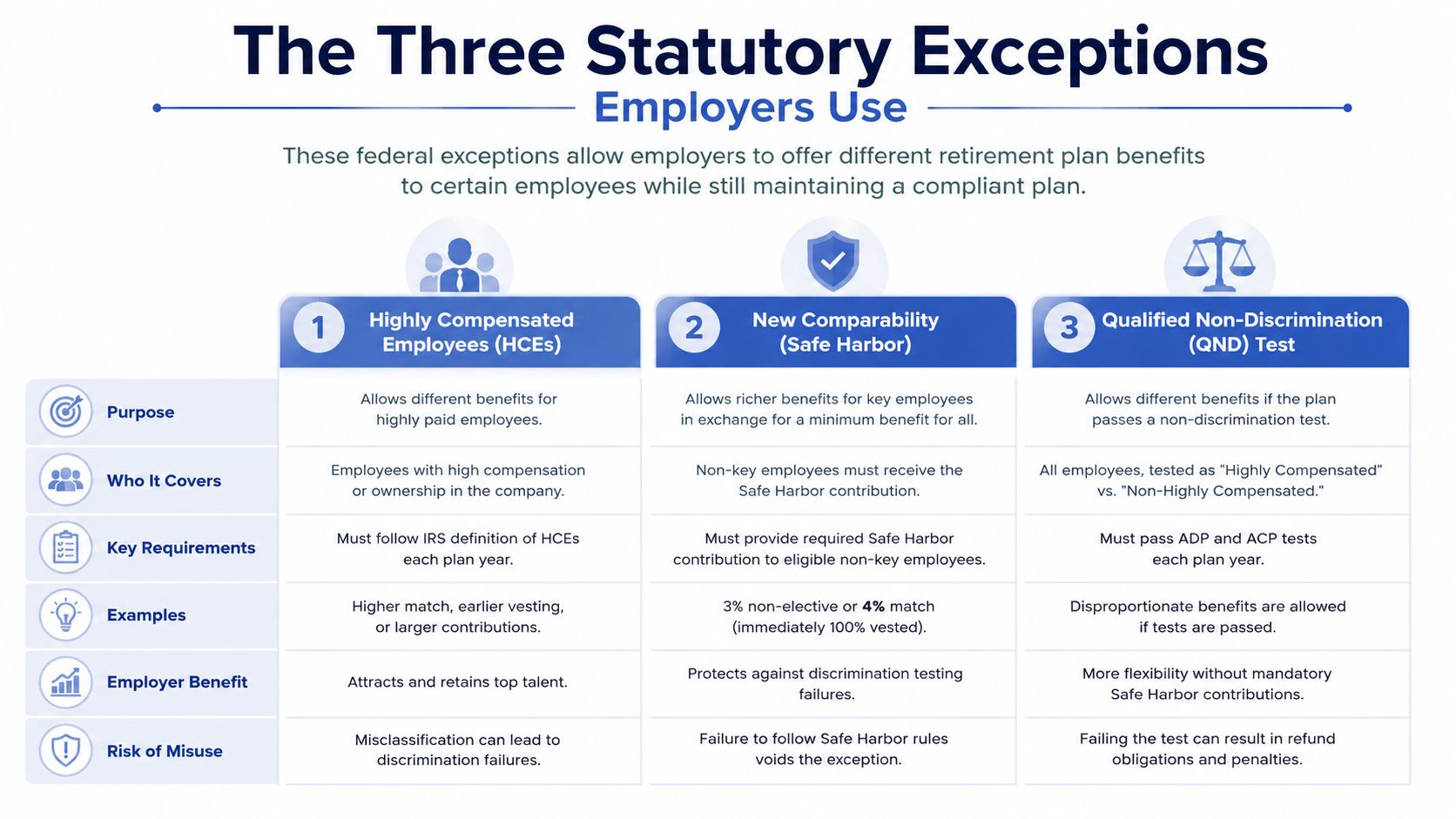
The Three Statutory Exceptions Employers Use
The three federal exceptions are narrow defenses, not convenient labels. A company that invokes one still needs facts showing why it couldn't provide the ordinary notice and why the particular employment loss fits the statutory language.
The faltering business exception applies in limited circumstances involving a company seeking capital or business that would be jeopardized by giving advance notice. The employer must show more than financial difficulty. Courts generally examine whether the company was actively pursuing a transaction or financing and whether providing notice would have undermined that effort.
The unforeseeable business circumstances exception addresses sudden events that the employer couldn't reasonably anticipate when notice would otherwise have been due. An unexpected cancellation of a major contract may raise the issue. General market pressure, a gradual decline in revenue, or a long-planned closure usually doesn't become unforeseeable merely because the employer announces it late.
The natural-disaster exception covers employment losses caused by events outside the employer's control, including floods and hurricanes. Mississippi workers know that storm damage can disrupt operations. But the exception is tied to the disaster itself. It doesn't automatically excuse a closure decision made later as part of a planned business response.
What workers should examine
An employer using an exception should give as much notice as practicable and state the reason for the shortened period. A worker should compare that explanation with the employer's earlier conduct:
- Review planning documents: Earlier closure schedules or reduction plans can contradict a claim of surprise.
- Preserve communications: Keep emails, texts, meeting invitations, and written announcements in their original form.
- Track the timeline: Record when management discussed lost business, financing, storms, relocation, or shutdown plans.
- Separate cause from excuse: A disaster may explain immediate damage, but it may not explain a later strategic decision to eliminate jobs.
Mississippi employees should also check whether a contract, union agreement, or benefit plan creates separate notice rights. A federal WARN defense doesn't erase every contractual obligation. State law may offer other employment protections, but Mississippi doesn't have a broad human rights commission that supplies an additional WARN enforcement path. The proposed Mississippi Commission on Human Relations appeared in a 1999 bill, not as an existing statewide commission in the cited legislative material Mississippi House Bill 361.
Where Mississippi Stands on State WARN Laws
Mississippi has no state mini-WARN law that adds broader coverage to federal WARN. For a Mississippi worker, the federal framework remains the starting point: the employer-size rule, the single-site event thresholds, and the advance written-notice requirement.
That gap matters. Mississippi also doesn't have a statewide human rights commission functioning as a general workplace enforcement agency in the materials cited here. Workers must therefore focus on federal WARN, employment contracts, collective bargaining agreements, and any other specific federal protection that fits the facts.
Mississippi's workers' compensation retaliation law is another important limitation. Mississippi doesn't recognize a specific state-law protection against retaliation for filing a workers' compensation claim, and the legislature hasn't enacted a cause of action for retaliatory discharge tied to those rights, as discussed in this Mississippi workers' compensation retaliation analysis. A WARN dispute doesn't become a workers' compensation retaliation claim because the layoff happened after an injury or claim.
Don't import another state's rules
Workers sometimes find online explanations for neighboring states and assume the same rules apply in Mississippi. They don't. For broader regional research, a reader may navigate Arkansas labor laws with Pebb, but Arkansas rules can't replace a Mississippi WARN analysis.
| State | Has Mini-WARN Law? | Lower Employer Threshold | Notice Period | Enforcement Body |
|---|---|---|---|---|
| Mississippi | No broad state mini-WARN law identified in the cited materials | Federal rule applies | Federal rule applies | Federal enforcement and federal litigation mechanisms |
| Neighboring states | Rules differ by state | Must be checked under that state's law | Must be checked under that state's law | Depends on the state |
For a Mississippi-specific overview of workplace rules beyond WARN, see Mississippi labor laws and employment protections. The practical takeaway is direct: don't assume another state's lower threshold, relocation rule, notice period, or state agency applies to a job site in Mississippi.
What Mississippi Employees Should Do Next
If you suspect a WARN-triggering event, build the record before the employer changes its story. Save every layoff memo, email, text, calendar invitation, severance document, and written statement about the closure or reduction. Write down the facility address, your job title, the date you learned of the action, and the number of coworkers affected.
Then organize the timeline. Separate employees who were terminated from those placed on temporary layoff, and note every later extension. Track reductions at the same Mississippi site across the relevant period rather than treating each announcement as an isolated event.
A practical evidence checklist
- Confirm the site: Identify the single facility, operating unit, or location involved.
- Count affected workers: Record names or job categories when lawfully available, along with each separation date.
- Check the employer: Look for corporate-parent disclosures, public filings, staffing arrangements, and related facilities.
- Request the notice: Ask HR in writing when notice was issued, who received it, and what date the employer claims controls.
- Protect agreements: Before signing severance, a release, or a non-compete, have a Mississippi employment attorney review what rights you may surrender.
The federal limitations period makes delay dangerous. A lawyer can assess whether the employer was covered, whether the event meets the plant-closing or mass-layoff test, whether separate losses should be aggregated, and whether an exception is credible. You can also review common WARN Act violations affecting Mississippi workers before your consultation.

Nick Norris, P.A. offers Mississippi employees guidance on WARN notice timing, plant closings, mass layoffs, temporary reductions, and related employment agreements. Call 601-641-4897 with your layoff documents and timeline, or visit Nick Norris, P.A. to request an evaluation of your potential rights.
Leave a Reply