

You clock out after a long shift, check your paycheck, and the numbers don't match the work you performed. Maybe your employer counted only scheduled hours, left overtime off the stub, deducted a meal break you never took, or called you an independent contractor even though you worked like every other employee. In Mississippi, that may be a wage and hour violation, not merely a payroll mistake.
The practical question is what you can prove and what remedy is available. The Fair Labor Standards Act, or FLSA, supplies most Mississippi workers' wage protections. This guide explains the violations employees commonly face, the records to preserve, how federal back wages and liquidated damages work, where a Mississippi worker can file, and when a private employment attorney should review the matter.
What a Wage and Hour Violation Looks Like in Real Life
A Hattiesburg server finishes a ten-hour double shift. She spent the evening moving between tables, closing checks, cleaning the dining room, and answering customer messages after the manager told everyone to clock out. When she opens her paycheck, it shows fewer hours than she worked. Her tips also appear lower than expected because the employer deducted money for a break she never received.
She may not know the legal vocabulary, but the problem has a name: wage and hour violation. The issue isn't limited to an obviously short paycheck. It can involve unpaid overtime, an unlawful deduction, an inaccurate time record, improper tip handling, or a classification decision that removes overtime protection without satisfying the law.
The facts that matter
Start with the work, not the label on the pay stub. Ask:
- How many hours did you work? Include preparation, closing tasks, required calls, training, and work performed after clocking out.
- How were those hours paid? Compare the hourly rate, overtime rate, tips, bonuses, deductions, and total deposits.
- What did your employer require? A manager's instruction to work before clocking in can matter even if the written policy says employees must record all time.
- Who else experienced the same issue? Coworkers with similar schedules or instructions may help establish that the problem was systematic.
The federal enforcement record shows why employees shouldn't dismiss a short paycheck. The Department of Labor's Wage and Hour Division has generally handled 23,000 to 30,000 Fair Labor Standards Act minimum wage and overtime cases per year over the last decade, and back wages due to workers rose from $129 million in fiscal year 2010 to $226 million in fiscal year 2019, according to the Government Accountability Office review. The WHD also reported recovering $149.96 million in FLSA back wages for 125,301 workers in fiscal year 2024, including $126.97 million in overtime back wages for 101,043 employees on its enforcement data charts.
Practical rule: Don't wait until you know the name of the legal claim. Save the records first, then get help interpreting them.
A strong review should answer four practical questions. Did the employer pay everything required? Can the unpaid time be reconstructed? Which forum can address the problem? And is the likely recovery large or serious enough to justify agency involvement or private counsel?
The Federal Floor and Where Mississippi Stands
Mississippi workers generally rely on federal law because Mississippi has no state minimum wage statute and no state overtime law. The FLSA is therefore the main legal floor for minimum pay, overtime, child labor restrictions, and employer recordkeeping.
The FLSA was enacted in 1938 and created the federal framework that still supports most wage-and-hour claims, including minimum wage and overtime protections. Federal law sets the minimum wage at $7.25 per hour and generally requires time and a half for hours worked over 40 in a workweek. The Department of Labor also requires employers to maintain records showing information such as hours worked and wages paid. You can review the law's structure in this Fair Labor Standards Act explanation.
Test coverage before arguing about pay
Most hourly employees are covered. The analysis becomes more technical for salaried employees, certain agricultural workers, outside sales employees, transportation workers, and other categories with specific rules. A job title doesn't decide the issue.
For executive, administrative, and professional exemptions, the employer generally must satisfy all three requirements:
- Salary basis: You receive a fixed salary rather than pay that changes based on the quantity or quality of work.
- Salary level: The salary meets the applicable minimum level.
- Duties: Your primary work fits the required executive, administrative, or professional duties.
The Department of Labor's overtime exemption guidance emphasizes that an employer can't make a worker exempt by calling the worker a manager or placing “salary” in an offer letter. If one required element fails, overtime may be owed.
| Protection | Federal Law, FLSA | Mississippi Law |
|---|---|---|
| Minimum wage | $7.25 per hour | No state minimum wage statute |
| Overtime | Time and a half for hours over 40 in a workweek, subject to exemptions | No separate state overtime law |
| Child labor | Federal restrictions apply | No separate Mississippi wage-and-hour framework replaces the FLSA |
| Records | Employers must maintain wage and hour records | Most claims depend on federal records and evidence |
| Waiver | Employees can't surrender FLSA rights through an informal deal | No state overtime statute supplies an alternative claim |
For broader workplace-law resources, the labor and employment page can help you identify related employment issues. But don't assume a handshake agreement, an unsigned offer letter, or a payroll label eliminates federal rights. Employers must pay for covered work that they know about or should know about.
Common Wage and Hour Violations Mississippi Workers Face
The same payroll problems appear in different clothing. A restaurant may call unpaid closing work “part of the job.” A construction company may call employees contractors. A healthcare employer may deduct breaks automatically even when staff remain responsible for patients. The label doesn't control the legal analysis.
Unpaid overtime
An hourly employee works 48 hours but is told to clock out after the scheduled shift and finish cleaning. The paycheck reflects 40 hours. The missing eight hours may create both straight-time and overtime issues, depending on the total pay calculation.
A salaried manager faces a different version. The employer calls the worker exempt, but the worker spends most of the shift performing the same production work as hourly staff and has little authority over hiring, discipline, or business decisions. Salary alone doesn't establish an exemption.
Minimum wage shortfalls
A tipped worker's direct cash wage, tips, and deductions must be evaluated together under federal rules. If unlawful deductions or tip practices leave the worker below $7.25 per hour, the employer may owe the difference. Keep the pay stubs, tip reports, schedules, and records showing which duties you performed.
Misclassification
A delivery driver receives a tax form for an independent contractor, uses a company route, follows company instructions, and performs the core work of the business. Calling the driver a contractor doesn't settle the question. The Department of Labor explains that misclassification can deprive an employee of minimum wage and overtime rights, and it updated its employee-versus-independent-contractor analysis effective March 11, 2024, as described in its misclassification guidance.
Tip pooling and tip theft
An employer can't take customer gratuities for itself or require an unlawful tip pool. Save receipts, point-of-sale records, tip-pool policies, and messages explaining who receives the money. Back-of-house participation can raise complicated questions, so the actual policy and the employer's handling of tips matter.
Off-the-clock work and automatic deductions
Answering work calls from home, preparing equipment before clocking in, completing required reports after clocking out, or working through an automatically deducted meal break can all matter. The key question is whether the employee performed work the employer knew or should have known about.
Recordkeeping failures often hide every other violation. If the employer changes time entries, refuses to provide records, or records scheduled hours instead of actual hours, your personal calendar, texts, schedules, and coworker testimony can become important evidence.

A missed punch isn't automatically proof of wage theft. A repeated instruction to work without recording time is much more serious. Preserve the pattern and the people who can confirm it.
How Back Wages and Damages Get Calculated
The basic calculation starts with the difference between what you were paid and what the FLSA required. That difference is then measured across the affected workweeks. The calculation may become more complicated when tips, bonuses, deductions, multiple pay rates, or an exemption dispute is involved.
Consider a Mississippi server paid $7.25 per hour who works 55 hours in one week and receives straight-time pay for every hour. The first 40 hours are paid at the regular rate. The remaining 15 hours should generally receive an overtime premium, meaning an additional half-time amount above the straight-time pay already received for those hours.
The example isn't resolved by multiplying every overtime hour by the full hourly rate again. If the employee already received straight-time pay for those 15 hours, the additional overtime portion is the half-time premium. A complete review would also examine whether the employee's tips, deductions, or other compensation changes the regular-rate analysis.
Liquidated damages and litigation costs
The FLSA typically permits liquidated damages equal to the back-pay award, unless the employer proves that it acted in good faith and had reasonable grounds for believing its conduct complied with the law. In a straightforward case, that can make the potential recovery larger than the unpaid wages alone.
The statute also usually allows a successful employee to recover reasonable attorneys' fees and litigation costs from the employer. That fee-shifting rule matters because an unpaid wage claim can be worth pursuing even when the individual back-pay number isn't large enough to justify paying a lawyer by the hour.
For a practical explanation of the arithmetic and supporting records, see this guide to calculating back pay.
The important question isn't only “How much is missing?” It's also “How many weeks, workers, and pay practices are affected?”
Mississippi doesn't provide a separate state-law overtime or minimum-wage claim that replaces the FLSA. The recovery usually comes through federal law, which means coverage, exemption status, limitations periods, and proof of hours all deserve careful attention.
Where Mississippi Workers Can Actually File a Claim
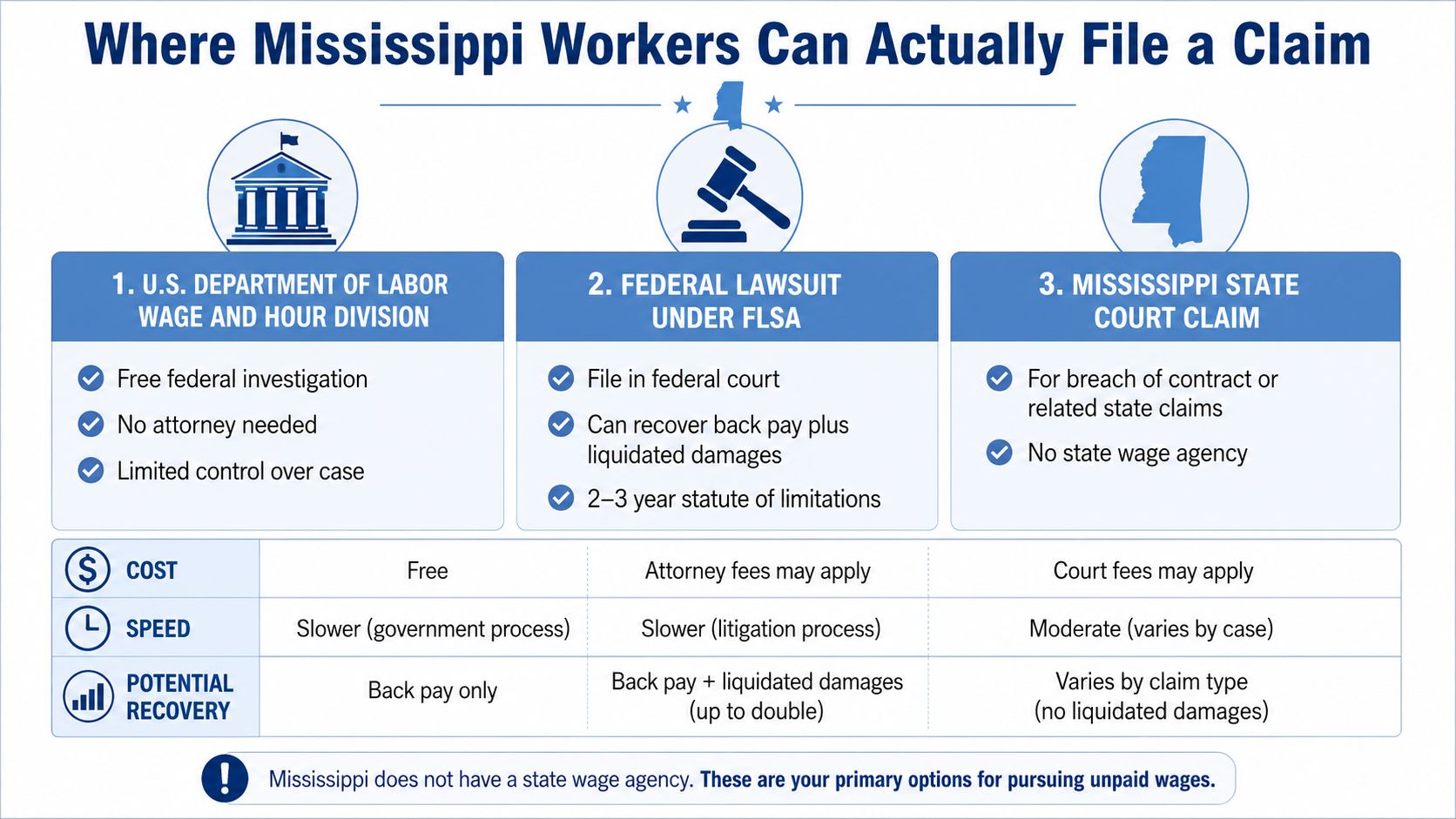
Mississippi employees need to choose the correct door. The state doesn't have a current human rights commission, and it doesn't have a state labor-agency forum for FLSA minimum-wage and overtime claims. The EEOC handles many discrimination and retaliation matters, but it isn't the agency that investigates ordinary unpaid overtime or minimum-wage claims. The Mississippi Department of Health isn't the right forum for those wage claims either.
The three practical routes
U.S. Department of Labor Wage and Hour Division: You can file a complaint with the WHD without hiring a lawyer. The agency may investigate, seek back wages, and in appropriate circumstances pursue enforcement. The process costs nothing, but you have less control over timing, strategy, settlement, and the scope of the investigation.
Private FLSA case in federal court: A private action can seek unpaid wages, liquidated damages, fees, and costs. This route gives you more control, but the filing decision must account for arbitration agreements, collective-action issues, evidence, and the applicable limitations period. This article doesn't recommend filing wage claims in Mississippi state court.
Private Mississippi employment attorney: An attorney can evaluate the records, contact the employer, negotiate, file a federal case, or coordinate with an agency process. Counsel can also identify whether the wage issue overlaps with retaliation, leave rights, discrimination, or another federal claim.
The FLSA generally uses a two-year limitations period, extended to three years for willful violations. The clock matters from the beginning, so waiting for an internal payroll review can cost you older weeks of recovery. A WHD investigation also doesn't automatically guarantee that every possible claim or every affected worker will be fully compensated.
If the wage problem involves discrimination or retaliation, the EEOC may be relevant for that separate issue. But don't send an overtime complaint to the EEOC expecting it to function as the WHD. Identify each legal theory and send it to the forum with authority over it.
Evidence to Collect and a Realistic Timeline
Your case will rise or fall on the records. Start a private folder and preserve documents before confronting the employer. Don't alter the originals, and don't use confidential customer information or protected business data that you have no right to possess.
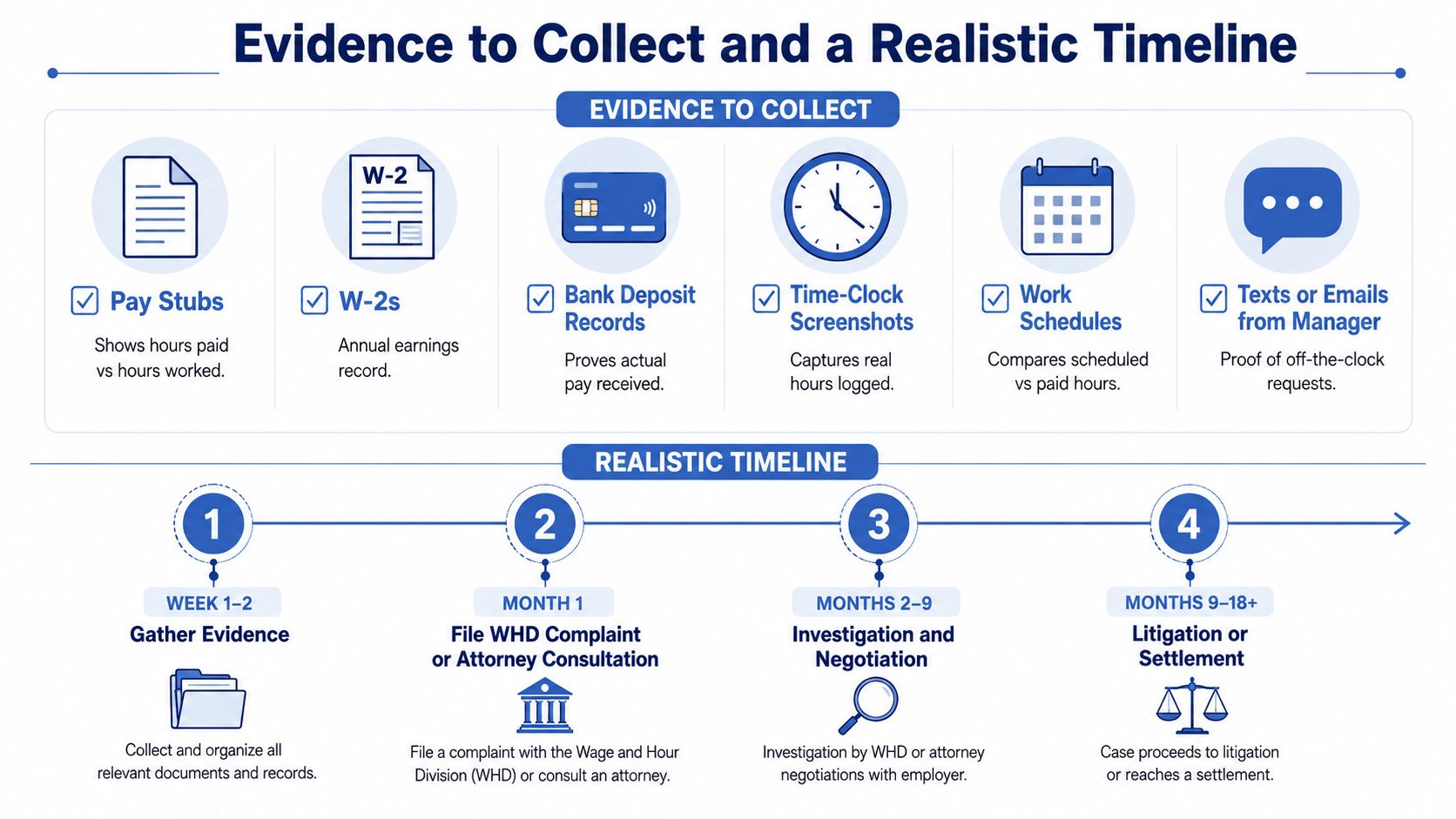
Gather these records
- Pay stubs: Compare paid hours, rates, overtime lines, deductions, and tips.
- W-2 forms: Use them to compare annual earnings with payroll records, while recognizing that they won't show every hour worked.
- Bank deposits: Match actual payments against pay-stub totals.
- Time-clock records: Save screenshots of punches, edits, and missing entries.
- Schedules: Keep posted schedules, shift swaps, and calendar entries.
- Texts and emails: Preserve instructions to work before clocking in, after clocking out, or through breaks.
- Coworker information: Record names and what each person personally observed.
Write a week-by-week reconstruction while the details are fresh. Note the dates, start and end times, breaks taken, tasks performed off the clock, supervisor instructions, and how the employer recorded the time.
Save evidence before you resign or complain. Once the dispute starts, access to scheduling apps and payroll portals may disappear.
What the process usually looks like
During the first week, collect pay records and build the timeline. During the next week or two, speak with a lawyer or complete a WHD intake. Over the following months, the matter may involve an agency investigation, an employer response, negotiations, or federal litigation. Many FLSA disputes resolve before trial, but no lawyer can promise a particular schedule or result.
Don't treat the limitations period as a deadline that can safely be ignored until the last moment. The two-year default period, and the three-year period for willful conduct, makes early review more valuable than a perfect file assembled later.
When and How to Get Help from a Mississippi Employment Attorney
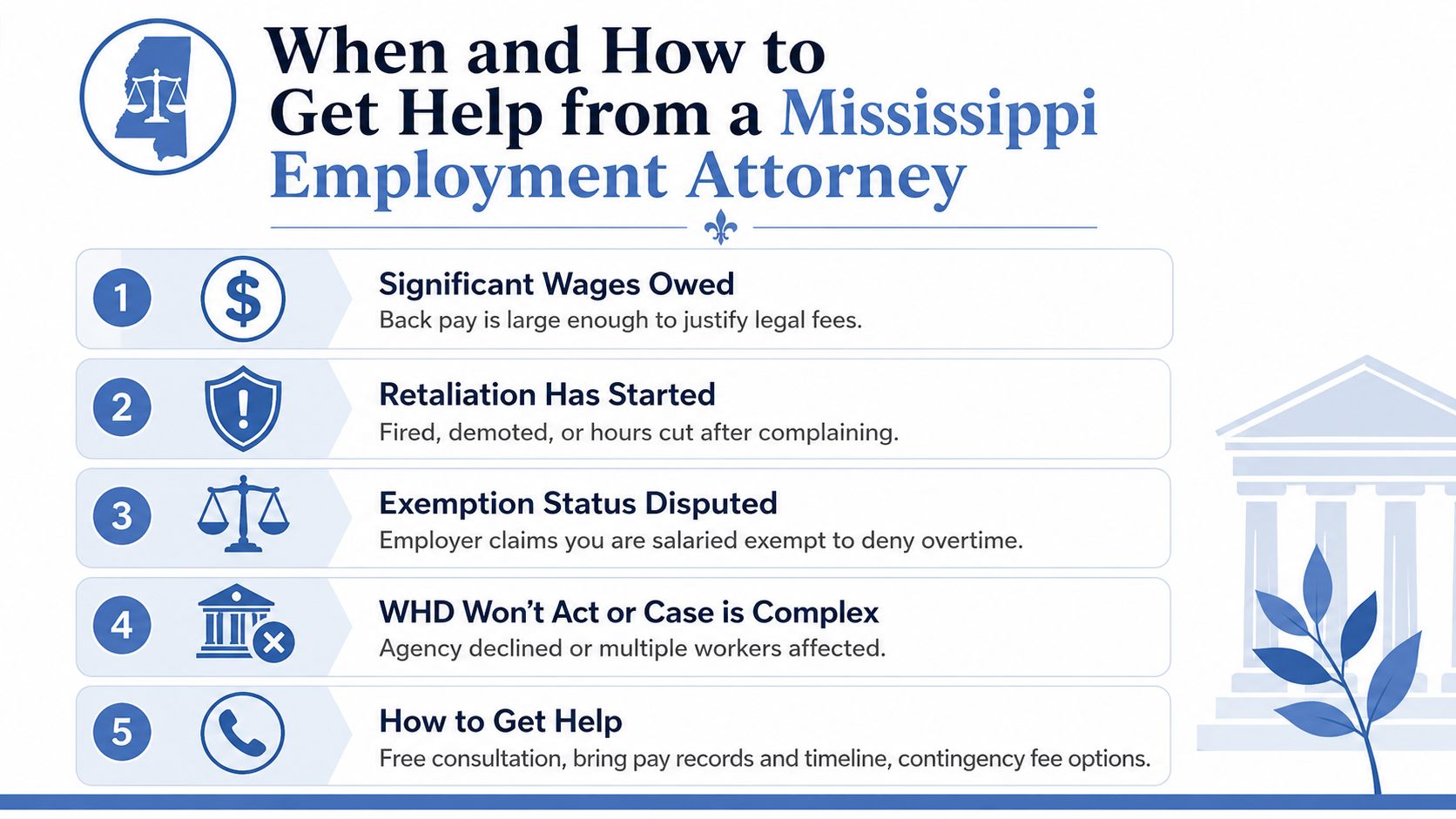
Call a Mississippi employment attorney when the employer disputes your exemption, refuses to correct the payroll, retaliates after you complain, or has already denied a WHD investigation without full recovery. Counsel is also useful when several workers have the same problem, because the evidence may support a broader federal claim rather than a single paycheck dispute.
The first consultation should be concrete. Bring pay stubs, time records, schedules, messages, the handbook, and a short written timeline. The attorney should assess whether you were covered by the FLSA, whether the exemption applies, how the unpaid time can be calculated, whether retaliation created a separate claim, and whether the matter fits a contingency arrangement.
Fees and expectations
Wage-and-hour attorneys commonly use contingency arrangements rather than requiring an upfront hourly retainer. A typical arrangement may involve a one-third contingency fee from recovered wages and liquidated damages, with case costs advanced by the firm. Fee terms vary, so insist on a written agreement explaining the percentage, expenses, settlement authority, and what happens if there is no recovery.
The stated average contingency fee in this context is 40% to 50%, but a particular employment lawyer may offer different terms. Ask for the actual agreement, not a general estimate.
You should expect document requests, written updates, decisions about agency contact or federal litigation, and a candid assessment of settlement value. If you need help organizing legal paperwork before a consultation, you can browse legal document automation, but automated forms aren't a substitute for legal advice about your wages or limitations period.
Mississippi has no current human rights commission, so discrimination and retaliation complaints generally go through the EEOC rather than a Mississippi commission. Mississippi also doesn't provide a dedicated state-law retaliation claim because an employee filed a workers' compensation claim. The Mississippi Workers' Compensation Act materials state that it contains no remedy for retaliatory discharge, so don't assume filing a compensation claim creates a standalone retaliation case.
For workers' compensation matters, the Mississippi Workers' Compensation Commission claims guide states that the Commission can't approve a fee above 25% of the recovery, although a court on appeal may approve a higher fee. That rule is distinct from the fee arrangement for a federal wage claim.
Gather your last three years of pay stubs, time records, schedules, messages, and employee handbook before requesting a review from a Mississippi employment attorney such as Nick Norris, P.A., who represents workers in Jackson, on the Gulf Coast, and across Mississippi. The wage and hour attorney resource provides another starting point for understanding what a case review involves.
Nick Norris, P.A. reviews Mississippi wage-and-hour disputes involving unpaid overtime, misclassification, minimum-wage shortfalls, and off-the-clock work, with practical guidance on agency claims and federal options. Gather your payroll records and timeline, then visit Nick Norris, P.A. to request a case review before more potentially recoverable weeks disappear.
Leave a Reply