

You leave home before daylight, drive to a job, move to another site, pick up supplies, and discover that your paycheck counts only the hours spent holding a tool. In Mississippi, that can be a serious wage problem. The difficult question isn't whether every mile is paid. It's which part of the trip is work under federal law, and which part is ordinary commuting.
Mississippi workers generally rely on the Fair Labor Standards Act, or FLSA, because the state doesn't add a separate travel-pay system. The answer turns on where the trip begins, why you're traveling, when it happens, and whether you perform duties along the way. The rules are strict enough to protect qualifying work time, but they don't turn every drive into paid time.
A Mississippi Worker's Day and the Travel Time Question
Consider a common workday for a Mississippi construction or field-service worker. You leave your trailer in Rankin County before sunrise, stop for fuel, and reach the first jobsite in Jackson by 6:30 a.m. After working there, your supervisor sends you to a second site in Pearl. Before the day ends, you drive to a supply pickup in Ridgeland and then head home.
The central question is simple: which minutes must the employer pay for? The answer depends on the category of travel, not merely on the number of miles or whether you used your own truck.
Your drive from home to the first regular work location is generally ordinary commuting. Federal law normally treats that trip as unpaid. But after the workday begins, travel between job sites or travel required for an employer's assignment is generally hours worked. The U.S. Department of Labor's travel-time guidance draws this line clearly. Travel between job sites during the workday must be paid, while ordinary home-to-work commuting generally isn't.
Three categories control the result
Mississippi travel disputes usually fit into three federal categories:
- Ordinary commuting: Your normal trip between home and a regular worksite is generally unpaid.
- Travel during the workday: Driving between job locations, picking up materials, or traveling for an employer-directed task after work begins is generally paid.
- Overnight travel: Passenger travel away from home is generally paid when it occurs during your normal working hours. Travel outside those hours is usually unpaid unless you're performing work.
The same trip can contain both paid and unpaid segments. A worker may have an unpaid drive from home to the first location, paid travel from that location to a second site, and another paid trip to retrieve employer-required supplies. The employer can't lawfully erase the paid portions by labeling the whole day “commuting.”
Practical rule: Track every departure and arrival separately. A single start and stop time can hide the precise travel segments that federal law requires an employer to count.
Mississippi doesn't have a separate state-level travel-pay layer that replaces the federal framework. If your day resembles the Rankin County, Jackson, Pearl, and Ridgeland example, don't assume the employer's time sheet answers the legal question. Compare each segment of travel to the three categories before deciding that you weren't owed anything.
How the FLSA Classifies Travel Time
The FLSA framework separates travel by function. The Department of Labor's rules at 29 C.F.R. §§ 785.7 through 785.39 ask whether the trip is ordinary commuting, part of the workday, or travel away from home that overlaps with normal working hours.
Ordinary commuting starts and ends outside work
Your regular trip from home to your usual workplace is normally not hours worked. The driveway is a useful dividing line. Before your tires leave home for the ordinary commute, the employer generally isn't paying for your movement. Once you arrive and begin the workday, later employer-directed travel usually belongs in a different category.
An employer-provided vehicle doesn't automatically change that result. The Department of Labor explains that home-to-work travel in an employer-provided vehicle is generally not compensable when it stays within the normal commuting area and the vehicle arrangement is covered by an agreement. The method of transportation matters less than the relationship between the trip and the job.
Workday travel carries the baton
Travel between job sites after the workday starts is treated differently. Think of the shift as a relay race. The employer hands you the baton at the first location, and each required move to another location keeps the work activity moving. The drive from one jobsite to another, a required supply pickup, or travel to an employer-directed assignment is generally paid time.
That principle also applies when you don't spend the entire trip doing physical labor. Driving, riding as a passenger, or waiting during a required work-related movement can still be part of the hours worked when the travel occurs during the workday or forms part of the employer's assignment. Workers dealing with suspected Fair Labor Standards Act violations should separate these minutes from ordinary commuting instead of accepting a blanket “travel isn't paid” policy.
Overnight travel follows the normal schedule
Travel away from home that requires an overnight stay has its own boundary. Time spent traveling as a passenger is generally work time when it cuts across your normal working hours, even when the trip occurs on a weekend. Travel outside your normal schedule is generally not counted when you're only a passenger, although work performed during that trip must be paid.
Sleep and bona fide meal periods are treated differently when you're relieved from duty. The hotel receipt proves that you were away from home, but it doesn't make every hour of the trip compensable. The clock still follows the work schedule and the duties you perform.
| Travel Category | Basic Rule | Example | Paid? |
|---|---|---|---|
| Ordinary commuting | Normal home-to-work travel is generally excluded | Home to a regular first worksite | Generally no |
| Workday travel | Travel between job sites or for employer-directed tasks is generally hours worked | Jackson site to Pearl site | Generally yes |
| Overnight travel | Passenger travel overlapping normal working hours is generally compensable | Daytime trip to an overnight assignment | Generally yes during normal working hours |
Employers that manage many mobile workers may also benefit from practical guidance on automating employee travel costs. That resource addresses administrative tracking, but a software system or company policy can't lawfully remove time that the FLSA treats as work.
Common Exceptions and Where Disputes Start
Most travel disputes don't begin with the obvious trip between two jobsites. They begin where an employer tries to stretch the commuting rule over a work-related obligation.
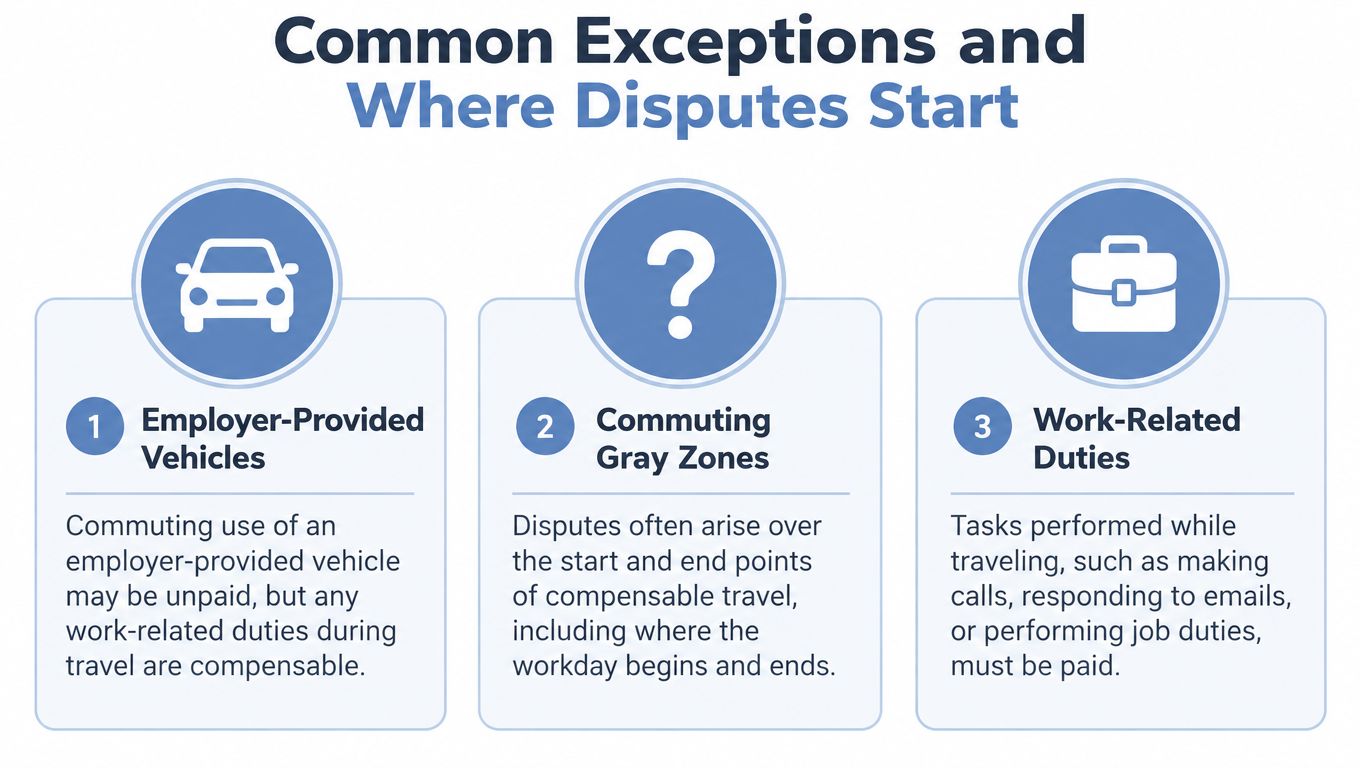
Vehicles, meetings, and reporting points
An employer-provided vehicle can create confusion. Regular commuting in that vehicle may remain unpaid under the federal rule, but a work-related detour changes the analysis. If you're required to transport equipment, collect materials, meet a coworker, or perform another duty, the employer must account for the work-related portion.
Mandatory meetings and training also require careful treatment. If attendance serves the employer's benefit and is required as part of the job, travel connected to that event may be compensable. The Supreme Court's decision in Integrity Staffing Solutions, Inc. v. Busk is important when courts assess whether an activity is integral and indispensable to the employer's work. A supervisor's informal label, such as “optional,” won't necessarily settle the issue if workers face pressure or discipline for failing to attend.
A required reporting location is another major flashpoint. If a construction laborer must report to a company yard before going to a remote site, the yard-to-site movement is not the same as driving from home to work. The employer has established the yard as the starting point for the work assignment.
Overtime is where unpaid travel becomes expensive
Paid travel counts toward the employee's total hours worked. If travel pushes a non-exempt worker beyond 40 hours in a workweek, the additional time generally must receive overtime at time and a half under the FLSA. The Department of Labor's Field Operations Handbook distinguishes travel payments from the regular-rate calculation, but that distinction doesn't authorize an employer to omit compensable travel hours from the workweek.
Volunteer work, bona fide meal periods, and sleep time create separate questions. A fully relieved meal period may be excluded. Sleep time may be excluded in circumstances where the employee is relieved from duty, while work performed during a supposedly unpaid period must still be counted. Calling required labor “volunteer work” doesn't make it voluntary.
Watch the records, not just the policy: GPS history, dispatch messages, and phone logs can show that the employer's time sheet is incomplete.
The recurring evidence problems are predictable:
- GPS contradictions: Location history may show that you left one site and reached another during hours omitted from payroll.
- Off-the-clock dispatching: Calls or texts directing you to move, report, or pick up supplies may prove that the travel was employer-controlled.
- Personal-vehicle requirements: A written instruction to use your own vehicle can establish why the trip occurred, although mileage reimbursement and wage payment remain separate issues.
Real Scenarios for Mississippi Hourly Workers
A rule becomes useful only when you can apply it to an actual workday. The following examples use Mississippi job patterns and separate paid travel from unpaid commuting.
A home health aide in Hattiesburg drives from home to her first client, then travels to three additional clients during one shift. The home-to-first-client drive and the final drive home are generally ordinary commuting. The drives from the first client to the second, the second to the third, and the third to the fourth are workday travel and should be recorded as hours worked. Her rough wage claim is the total time spent moving between clients, multiplied by the applicable wage rate, plus any overtime amount if those hours take her over the weekly threshold.
A Meridian construction laborer must report to the employer's yard before riding or driving to a remote jobsite. The trip from home to the yard is generally commuting. The yard-to-jobsite travel is part of the assigned workday, and travel between later sites is treated the same way. If those paid hours carry the worker beyond 40 hours in the workweek, the excess generally qualifies for overtime under federal law. The rough calculation is the unpaid work-related travel time, added to the recorded hours, followed by the overtime calculation for hours above the threshold.
A Jackson-based outside salesperson spends two nights in Tupelo for client meetings. Daytime travel that overlaps with the salesperson's normal working hours is generally paid, as is work performed during the trip. Normal commuting around the destination is generally not. The amount potentially owed is the compensable daytime travel and working time, reduced by excluded meal or sleep periods where the worker was fully relieved from duty.
| Worker | Paid Travel | Unpaid Travel | Overtime Trigger |
|---|---|---|---|
| Hattiesburg home health aide | Between clients during the shift | Home to first client and final trip home | Paid travel pushes weekly hours beyond 40 |
| Meridian construction laborer | Yard to remote site and between sites | Home to required yard | Total paid hours exceed 40 in the workweek |
| Jackson outside salesperson | Travel during normal work hours and work performed en route | Ordinary commuting at the destination and excluded off-duty periods | Compensable travel increases weekly hours beyond 40 |
The calculation isn't complete until you identify the correct pay rate and the full workweek. A mileage payment may address vehicle expenses, but it doesn't automatically replace wages for compensable travel time.
Documenting Travel Time for a Wage Claim
Employers usually dispute the amount of time first. Your strongest evidence is created close to the event, before anyone has a reason to reconstruct the day in a more convenient way.
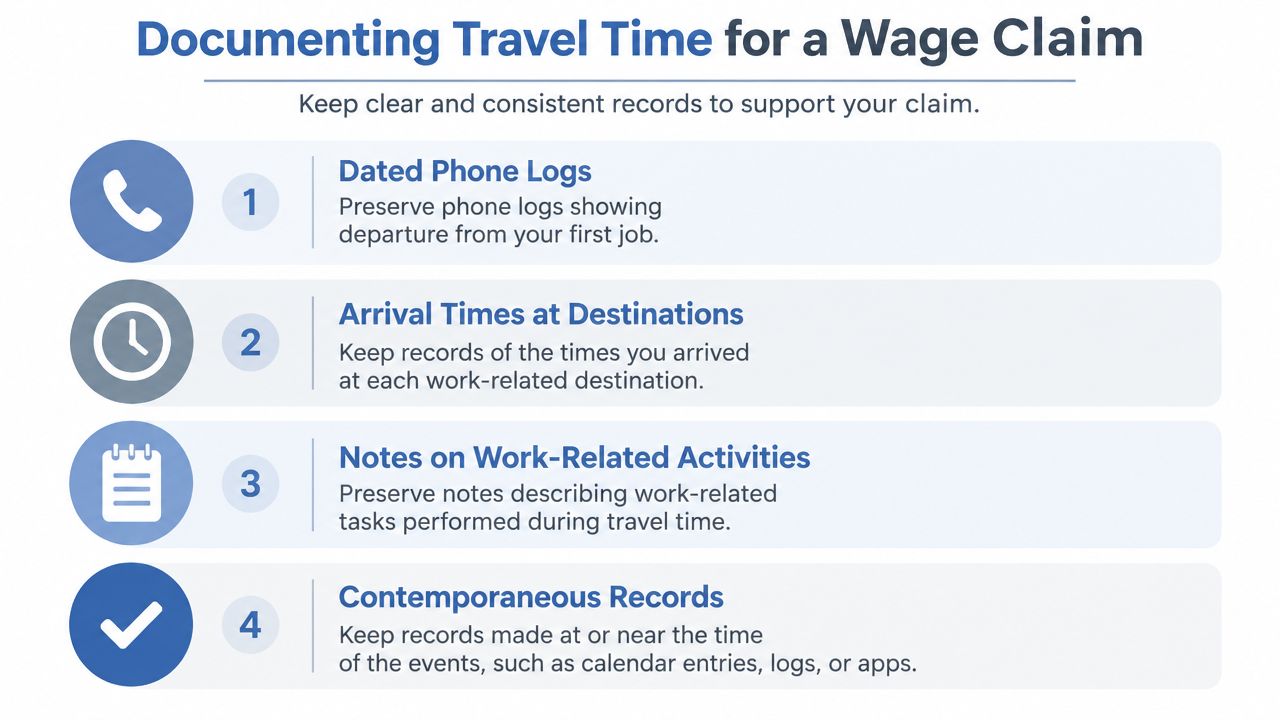
Build a contemporaneous record
Keep a dated phone log showing when you departed the first jobsite and when you arrived at the second. Gas receipts with timestamps can support the route and timing. A mileage application, vehicle log, or GPS history can corroborate the sequence, especially when the employer's time sheet shows no travel.
Save every message that explains why you moved. A dispatcher's text instructing you to report to a secondary location can establish that the trip was required rather than personal. A message directing you to pick up tools, materials, coworkers, or paperwork can identify the work purpose.
Preserve these records in their original form when possible:
- Pay stubs: Compare the hours paid with the hours spent on employer-directed travel.
- Time sheets: Save copies before correcting or submitting them, especially if the system prevents travel entries.
- Handbook policies: Keep any travel policy that conflicts with the FLSA's treatment of compensable work.
- Vehicle instructions: Preserve written acknowledgment that the employer required use of a personal vehicle.
- Personal notes: Record the date, locations, departure and arrival times, assignment, passengers, and work performed.
Match each record to the legal issue
Under 29 C.F.R. §§ 785.7 through 785.39, the question is whether the time was part of the work activity, occurred during the normal workday, or involved travel away from home. Your records should answer those questions directly.
A phone log and GPS record support duration. A dispatcher's text supports employer control. A pay stub establishes what payroll included. A written schedule helps show whether overnight travel crossed normal working hours.
Don't alter records to make them look cleaner. Preserve the original messages, export available logs, and keep a separate summary that identifies each unpaid segment. The guide to reporting unpaid wages can help you organize the issue before raising it with the employer or seeking legal advice.
Filing Windows, Agencies, and Contingency Fees
Mississippi workers with unpaid travel time generally pursue a federal path. The state doesn't have its own wage-and-hour agency for these claims, so the U.S. Department of Labor's Wage and Hour Division may investigate and seek back pay, liquidated damages, and attorneys' fees. An agency investigation doesn't eliminate the need to protect your own deadline.
Under the FLSA, a worker generally has two years to file for unpaid wages, or three years when the violation was willful, as described in the Department of Labor's travel-time materials. The clock generally runs from each unpaid pay period, not from the date employment ends. Waiting can permanently reduce the wages you can recover. Review the employment-law statute of limitations before assuming an old pay dispute is still fully available.

Don't confuse wage and discrimination channels
Mississippi doesn't have a human rights commission for employment claims. Discrimination and related retaliation matters generally go through the federal Equal Employment Opportunity Commission, or EEOC, rather than a Mississippi state human-rights agency. That path is separate from a travel-time wage claim, and its charge deadlines are separate as well.
Mississippi also doesn't provide a specific state-law retaliation claim for filing a workers' compensation claim. State workers' compensation materials state that the law contains no anti-retaliation provision for that conduct. A worker fired after filing a compensation claim therefore can't point to a dedicated Mississippi workers' compensation retaliation statute as the basis for a state retaliation claim.
Understand the financial trade-off
Employment lawyers handling Mississippi wage cases commonly use contingency arrangements of 40% to 50%, paid from the recovery, plus costs. That structure can make representation practical when the claim is substantial, but it also means a lawyer must evaluate the likely recovery, proof, deadlines, and collection prospects.
Workers' compensation fees follow a different rule. Mississippi materials state that attorney fees are limited to no more than 25% of the recovery, with an appellate court able to approve a higher amount in some circumstances. Don't assume that workers' compensation fee limits apply to an FLSA travel-time claim.
When to Call a Mississippi Employment Lawyer
Pick up the phone when unpaid travel repeats across multiple pay periods. You also need legal advice when your paycheck shows a flat amount regardless of hours driven, a supervisor orders you to clock out before driving to a second site, or required travel regularly pushes you beyond the overtime threshold.
Other red flags deserve immediate attention:
- Dispatch after clock-out: Your employer sends texts or calls directing work-related movement after payroll has stopped.
- Required reporting points: You must appear at a yard, office, or meeting location before traveling to the actual site.
- Travel-based overtime loss: Your records show compensable travel that raises the workweek above 40 hours, but payroll ignores it.
- Vehicle pressure: Management requires personal-vehicle travel and refuses to explain how the time or expenses are handled.
- Retaliation: A supervisor cuts hours, changes assignments, threatens discipline, or terminates you after you raise the wage issue.
Gather pay stubs, time sheets, mileage logs, GPS records, gas receipts, dispatch messages, and the employer's travel policy before the consultation. A lawyer should discuss the FLSA's two-year filing window, the three-year period for willful violations, the strength of your records, and the practical effect of a 40% to 50% contingency fee in Mississippi wage cases.
Most employment consultations are free, and you generally owe nothing unless the lawyer recovers money on your behalf. Nick Norris, P.A. is one Mississippi option for evaluating unpaid overtime and wage claims, including back-pay calculations tied to off-the-clock work. Don't wait until your records disappear or the earliest pay periods fall outside the filing window.
Nick Norris, P.A. evaluates Mississippi travel-time, unpaid-overtime, and other wage-and-hour claims, helping workers assess records, deadlines, and potential recovery. Visit Nick Norris, P.A. to request an evaluation and discuss the travel segments your employer failed to pay.
Leave a Reply