

You arrive for work in Jackson and find the doors locked. Your supervisor isn't answering, the company email says operations have ended, and your next paycheck is suddenly uncertain. You're thinking about groceries, rent, and whether your family's health insurance still works.
Employee rights when a company closes down aren't a single claim or a single deadline. For a Mississippi worker, the right response is to separate the problems, preserve the evidence, and start the available benefit applications without waiting for the employer to explain everything.
What Happens the Moment a Mississippi Employer Shuts Down
A closure announcement doesn't tell you everything you need to know. The business might have stopped operating without filing bankruptcy. It might call the shutdown temporary while managers remove equipment. It might promise a final paycheck without identifying who will process it.
Treat those statements as information to verify, not a plan you can rely on. Save the announcement, record when you received it, and write down your last day worked. If someone gives you instructions by phone, send a short follow-up email confirming what you understood.
Separate the Problems Before Making Decisions
Start separate folders for earned compensation, closure notice, benefits, and job-search records. Keeping them separate helps you avoid assuming that a payment or application resolves everything.
Your unpaid wages are different from possible WARN damages. Unemployment is a separate benefit process. Health coverage requires its own questions, and a severance agreement deserves review before you sign it. These overlapping possibilities become especially important when an employer is insolvent, as the creditors' rights analysis of unpaid wages and WARN claims explains.
Preserve these documents while you still have lawful access:
- Payroll records: Pay stubs, time sheets, commission statements, and records of unpaid work.
- Employment terms: Your offer letter, employment agreement, handbook, and any written compensation promises.
- Benefit documents: Plan summaries, insurance cards, administrator contacts, and leave balances.
- Closure communications: Emails, texts, letters, and any notice identifying your termination date.
Don't take customer files, trade secrets, or documents you're not authorized to possess. Focus on your employment records and communications addressed to you.
Practical rule: Save the documents first. You can sort them afterward, but you can't count on company-system access remaining available.
Ask for a personal email address and mailing address for whoever is handling payroll and benefits. Keep a dated contact log showing your requests and the responses. You don't need to solve the entire shutdown today, but you do need a reliable record of what happened.
The WARN Act Notice You Might Be Owed
A sudden closure doesn't automatically entitle every employee to notice pay. Federal WARN coverage depends on the employer, the worksite, the number of employment losses, and the applicable exceptions.
Use the checklist below to organize your questions, but don't substitute an infographic for the legal thresholds.
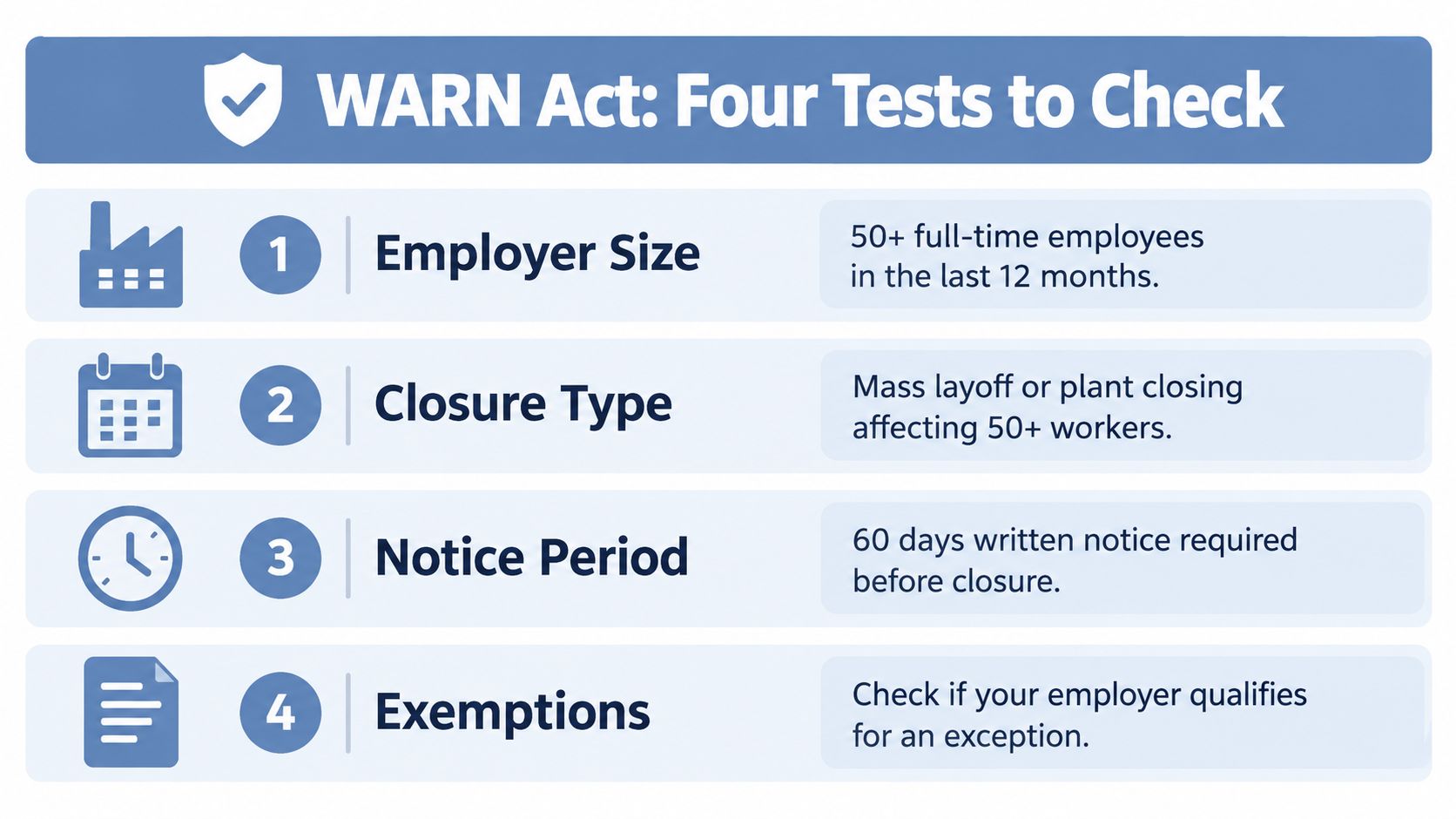
Check Employer Size and Employment Losses
Federal WARN generally covers employers with at least 100 qualifying employees and requires 60 calendar days of written notice before a covered closing or mass layoff. For a mass layoff, the usual test is 50–499 affected employees representing at least 33% of the site's workforce; the percentage test doesn't apply when 500 or more employees are affected. Employees who worked fewer than six months during the preceding 12 months, or average fewer than 20 hours weekly, generally aren't counted toward the relevant thresholds. The Department of Labor's WARN overview describes these coverage rules and exceptions.
Don't assume that being hourly means you're excluded. Also, not counting toward a threshold isn't necessarily the same as having no right to notice. Have someone review your status rather than ruling yourself out.
A plant closing requires a covered shutdown and the required employment loss. A mass layoff has a different threshold analysis. Ask which event occurred instead of relying on the label your employer chose.
Quick Check, Does Federal WARN Apply to Your Shutdown?
| Test | Rule of Thumb | What to Look Up |
|---|---|---|
| Employer coverage | The business must meet WARN's employer-size rules | Payroll headcount, tenure, and working hours |
| Covered event | A shutdown or layoff must meet employment-loss requirements | Affected workers and worksite location |
| Related dismissals | Earlier and later layoffs may need to be considered together | Termination dates and stated reasons |
| Notice and exceptions | Review written notice and any explanation for shortening it | Notices, emails, and closure announcements |
Investigate Earlier Layoffs and Claimed Exceptions
Related employment losses can be aggregated across 90 days unless the employer establishes separate and distinct causes. Certain temporary layoffs extending beyond six months can also count as employment losses under the Department of Labor's layoff coverage guidance. Save schedules and termination communications that help establish the sequence.
The recognized exceptions include unforeseeable business circumstances, faltering companies, and natural disasters. They aren't automatic permission to say nothing: employers must provide as much notice as practicable and explain the shortened notice period.
A valid exception can affect liability, so a notice shortfall isn't automatically a guaranteed paycheck. For a closer look at that distinction, review WARN Act pay in lieu of notice.
Final Paycheck, PTO, and What Bankruptcy Means for Wages
Start with a written accounting, not a general demand to “pay everything.” Identify the pay period, hours, commission transaction, leave balance, or agreement supporting each amount. A claim that's understandable on paper is easier to evaluate than a single estimated total.
Don't assume Mississippi requires every final wage, unused PTO balance, and severance amount to be paid on your last day. Payment timing and entitlement need separate review. Ask for the employer's stated payment date and the written terms governing commissions, leave payouts, and severance.
Keep the records supporting each category together.

Separate What You're Owed From What You Can Collect
An employer's inability to pay doesn't answer whether it owes you money. Conversely, establishing a valid debt doesn't guarantee that the business has funds available to satisfy it.
Build a compensation ledger with a row for each disputed item. Include when you earned it, the amount you calculate, the supporting document, and whether the employer disputes it. For commissions, preserve the compensation plan rather than relying only on your memory of what a manager promised.
Use claims for unpaid wages to prepare the questions you want answered about your compensation. Keep an ordinary payroll shortage separate from a disputed contractual benefit so neither gets lost in the other.
Bankruptcy Changes the Collection Process
Under Bankruptcy Code § 507(a)(4), qualifying wages, salaries, commissions, vacation, sick-leave pay, and severance earned within 180 days before the bankruptcy filing or cessation of business, whichever occurred first, may receive limited priority. That priority is capped per employee, doesn't guarantee payment, and remains subject to secured interests and higher-priority administrative claims, as the Congressional Research Service's employee-wage bankruptcy analysis explains.
That earlier trigger date matters. Write down when operations stopped and identify when each compensation item was earned. If you continued working after a bankruptcy filing, keep those wages separately identified.
Priority isn't a payment promise. Your records must establish both the debt and the dates supporting its treatment.
Ask whether a bankruptcy case has been filed. If it has, obtain the case information and determine whether you need to submit a proof of claim, using the deadline and instructions applicable to that case. Don't invent a deadline from the closure date, and don't assume payroll will submit your claim for you.
Unemployment, COBRA, and Reemployment Protections
Don't wait for the wage dispute to end before addressing household income and health coverage. These are separate tasks, and you can work on them while a lawyer evaluates possible claims.
Begin with the Mississippi Department of Employment Security's unemployment application process. Describe the separation accurately as a closure or lack of work when that's what happened. Let the agency determine eligibility rather than accepting a former manager's prediction that you won't qualify.
The benefits categories below are useful prompts, not a guarantee that every option remains available after every shutdown.
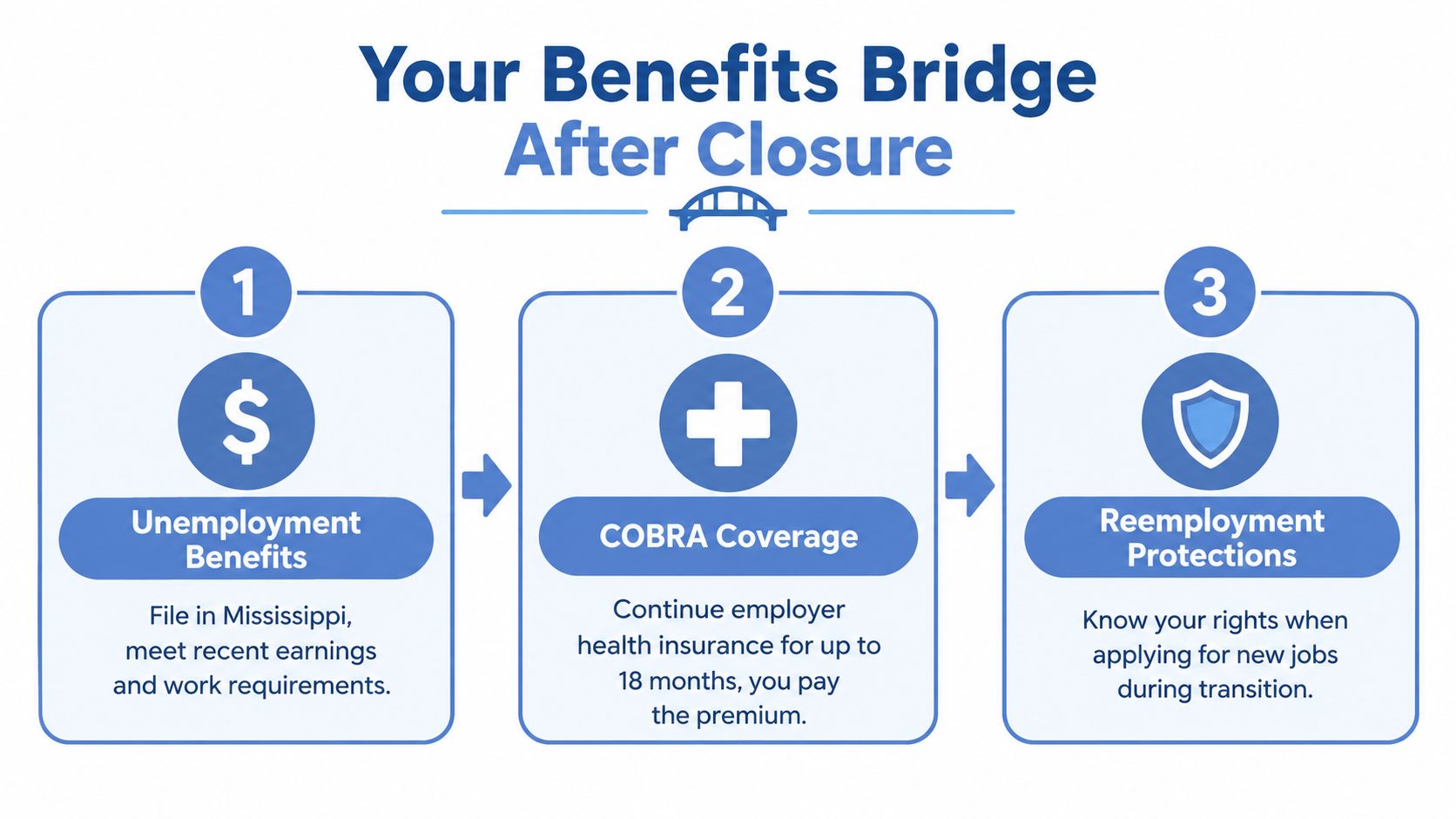
Apply for Income Support and Verify Health Coverage
Use Mississippi unemployment law to prepare for questions about the separation and your work history. Save your application confirmation, monitor agency communications, and respond to requests rather than assuming your initial submission finishes the process.
For health coverage, contact the plan administrator or insurer, not just the supervisor who announced the closure. Ask for written answers to these questions:
- Coverage status: What is the actual end date of my current insurance?
- Continuation options: Is COBRA continuation available under this plan after the shutdown?
- Election paperwork: Who will send the notice, and where should I direct questions?
- Cost and deadlines: What does the applicable notice require me to pay and submit?
Don't treat COBRA as automatic replacement insurance. Establish whether a group plan remains available and what continuation options apply before relying on coverage for upcoming care.
Keep any benefits video in perspective: your own plan documents and notices must guide your decisions.
Ask for Transition Assistance
A covered WARN notice must also go to the state dislocated-worker unit and appropriate local government, allowing access to retraining and reemployment assistance under the federal notice framework discussed earlier. Ask for the rapid-response contact instead of assuming assistance will reach you automatically.
If military service affects your return to employment, flag USERRA separately during your legal consultation. Bring service and employer communications so counsel can evaluate your circumstances, including whether the business ceased operations.
The practical order is straightforward: apply for income support, establish your insurance status, and request transition assistance. Don't make any of those tasks depend on an HR department that may no longer be operating.
Common Mississippi Traps Workers Should Avoid
The wrong legal assumption can send you toward an agency that doesn't exist or a claim Mississippi doesn't recognize. Be precise about the protection you're invoking.
Don't Search for a Mississippi Human Rights Commission
Mississippi does not have a general state human-rights commission serving as a private-employer discrimination agency. Employment-discrimination enforcement generally depends on federal protections and the Equal Employment Opportunity Commission.
An old legislative document can be misleading. The proposed Mississippi Commission on Human Relations legislation describes an agency lawmakers proposed creating, not proof of an operating commission.
If you believe the employer used the shutdown to conceal discriminatory selection decisions, preserve the facts supporting that concern. Identify who continued working, whether positions remained, and what decision-makers said. A closure announcement doesn't replace the need to evaluate the particular discrimination claim.
Don't Assume a Workers' Compensation Retaliation Claim Exists
Mississippi doesn't recognize a retaliation claim merely because you filed or pursued workers' compensation benefits. The Mississippi employment-law guide from Baker Donelson expressly identifies that limitation.
That doesn't mean every adverse action involving an injured worker is beyond review. It means counsel must identify an independent legal protection rather than relabel the event as a state workers' compensation retaliation claim.
Mississippi's targeted public-employee whistleblower law is also different. It protects covered public employees in specified circumstances involving information given to a state investigative body; it isn't a general private-sector retaliation rule. The distinction appears in Mississippi Code § 25-9-173.
Read the Fee Agreement Instead of Assuming a Rate
Don't treat 40%–50% as an established average or statutory contingency fee for Mississippi employment cases. The Mississippi Bar's economic survey doesn't establish that asserted statewide employment-case average.
Before hiring counsel, get written answers about:
- The fee calculation: What recovery forms the basis for the lawyer's fee?
- Case expenses: Who advances costs, and how are they deducted?
- Later proceedings: Does the agreement change for litigation or an appeal?
Ask which law protects you and which document controls the fee. Neither answer should depend on a slogan.
Your First 30 Days After a Mississippi Closure
Use this as an organizational schedule, not a legal grace period. A notice, benefit election, claim instruction, or proposed agreement can require attention sooner. Don't postpone an urgent issue just because it appears later on a checklist.
Keep the plan visible and mark each task completed.

Start With Preservation and Applications
Save your employment documents outside the company system using lawful access. Include the Summary Plan Description, closure communications, and the personal contact information of the people handling payroll and benefits.
Then complete the immediate administrative work:
- Apply for unemployment: Keep your confirmation and monitor follow-up requests.
- Request insurance information: Confirm your mailing address and ask for the applicable continuation paperwork.
- Contact transition services: Use the dislocated-worker contact associated with the closure.
- Create a deadline calendar: Enter dates from actual notices and agency communications, not internet assumptions.
Keep job-search records separately from your legal file. When you're ready to revise applications, GetTheCall's guide for job seekers on resume matching offers a practical way to align your resume with a position's stated requirements.
Reconcile Compensation and Investigate the Business Status
Follow up in writing on missing pay and disputed balances. Ask for an itemized accounting rather than accepting an unexplained lump sum.
Establish whether the employer has filed bankruptcy, merely stopped operating, or transferred some operations elsewhere. Save any response, including an admission that management doesn't yet know. Bring unresolved questions to counsel rather than trying to classify every claim yourself.
Review Offers Without Rushing
Before signing severance paperwork, identify the payment promised, the release language, and any stated signing deadline. Ask how the proposed agreement affects the claims you've identified.
Prepare a short chronology for a consultation: hiring, changes in compensation, earlier layoffs, the announcement, and your last day worked. Attach the strongest supporting documents instead of forwarding an unsorted inbox.
Your job during this period is to preserve options, not settle everything immediately. If money is missing, an agreement is waiting, or a deadline is unclear, move the consultation forward.
Getting Legal Help Without Losing Your Options
Choose a Mississippi employment attorney who can evaluate WARN, wage-and-hour, and relevant discrimination or retaliation issues together. You need someone to distinguish a potentially valid claim from a realistically collectible recovery, particularly if bankruptcy is involved.
Bring your chronology, compensation ledger, closure notice, benefit correspondence, and any severance agreement. Ask which issues require immediate action and whether separate bankruptcy assistance is needed.
Before agreeing to representation, read the written fee terms discussed above. Confirm how expenses are handled and whether the agreement changes depending on how the matter resolves.
Don't wait for an official announcement to make your own records complete. Schedule an early evaluation, keep responding to benefit administrators, and continue the unemployment process while legal review proceeds.
Nick Norris, P.A. offers Mississippi employees guidance on WARN Act notices, unpaid compensation, severance agreements, and related workplace claims after a company closure. Visit the office to request an evaluation, and have your closure notice, recent pay records, and any proposed release ready for review.
Leave a Reply