

Your supervisor has cut your shifts after you asked for a disability-related schedule change. Coworkers make jokes about the request, and you're worried that speaking up will cost you the hours you still have. For a Mississippi employee facing discrimination and harassment at work, the immediate question often isn't what to call it. It's how to protect your job, your records, and your options.
When Workplace Mistreatment Becomes a Legal Problem
Consider a hypothetical Mississippi employee whose manager dismisses sexual comments as harmless joking. The employee needs the paycheck, the manager controls assignments, and nobody explains whether there's another person who can receive a complaint. Staying quiet feels risky, but reporting feels risky too.
A different employee might face no offensive comments at all. Instead, a supervisor starts excluding them from training after learning about a disability, then cites their lack of training when denying a promotion. Workplace mistreatment can involve decisions, conduct, or both.
Neither situation requires the employee to arrive with a finished legal argument. The useful starting point is identifying what happened, who made the decisions, what explanation they gave, and whether the treatment relates to a protected characteristic or protected activity.
Unfair treatment needs a closer look
An unpleasant manager isn't automatically breaking employment law. But dismissing everything as a personality conflict can mean overlooking discriminatory decisions, a hostile work environment, or punishment for reporting misconduct.
Practical rule: Record the facts before worrying about the perfect legal label.
Waiting can make the situation harder to reconstruct. Messages may disappear, schedules may change, and witnesses may leave. Keep the distinction between what you observed and what you suspect, because both matter differently when someone evaluates your situation.
Federal complaint figures show how often these concerns overlap. In fiscal year 2024, the EEOC received 88,531 discrimination charges, up more than 9%, resolved 87,219, and secured more than $469.6 million through its administrative process; retaliation appeared in 42,301 charges and had been the leading allegation for 17 consecutive years, according to the EEOC's annual enforcement report.
That same report recorded harassment in 40.4% of charges, disability discrimination in 38.0%, race discrimination in 34.2%, and sex discrimination in 30.4%. Those categories overlap, so they aren't percentages to add together or estimates of how many workers experienced mistreatment.
- Separate the events: Identify the original conduct and any later punishment.
- Identify the decision-makers: Note who controlled hours, pay, assignments, or discipline.
- Look beyond the label: A complaint may raise several related legal questions.
For Mississippi employees, the practical task is matching those facts to federal workplace protections and an appropriate reporting route. Mississippi Employment Discrimination Claims is a useful related topic once you've identified the decisions or conduct that concern you.
How Mississippi Employees Map Protected Workplace Rights
Discrimination generally means unequal treatment or a biased employment decision tied to a protected characteristic. Harassment means unwelcome conduct connected to a protected characteristic that meets the applicable legal standard, such as conduct severe or pervasive enough to change working conditions, or conduct connected to a tangible job action.
The distinction matters. Denying a promotion because of race concerns an employment decision. Repeated racial intimidation concerns the working environment. An employee can experience both.
This map separates the concepts without treating every workplace disagreement as unlawful.

The federal entrance remains available
Mississippi does not have a general statewide human-rights commission that receives and decides private-sector employment-discrimination complaints. Think of that missing commission as a locked front door, not a building with no entrance. Federal law provides another route when the employee, employer, and conduct fall within its coverage.
The principal laws employees may need to consider include:
- Title VII: Addresses employment discrimination involving race, color, religion, sex, and national origin.
- The Americans with Disabilities Act: Addresses disability discrimination and qualifying accommodation issues.
- The Age Discrimination in Employment Act: Addresses qualifying age-discrimination claims.
- The Equal Pay Act: Addresses sex-based unequal pay for substantially equal work under its requirements.
These laws aren't interchangeable. A pay dispute, accommodation request, and religious-harassment complaint can require different questions about coverage, evidence, and procedure. The related explanation of protected-class discrimination can help you connect the treatment you're experiencing to the characteristic involved.
A proposal isn't an operating agency
A 1999 proposal would have created a nine-member Mississippi Commission on Human Relations, but the proposed Mississippi legislation isn't proof that such a commission became an operating enforcement body. Finding that proposal online shouldn't send you searching for a nonexistent general complaint process.
Specialized offices serve narrower purposes. For example, the Mississippi Department of Employment Security Equal Opportunity Department addresses nondiscrimination compliance within MDES operations. It isn't a replacement for a statewide private-sector discrimination agency.
The practical question is therefore more specific than whether Mississippi has employment protections. Ask which law covers your problem, whether it covers your workplace, and which process applies. An internal policy may offer additional workplace remedies, but it doesn't determine the full scope of federal rights.
Employer Duties and the Workers Compensation Limit
An employer's responsibilities and an employee's retaliation protections aren't the same question. Employers must comply with applicable discrimination laws, respond appropriately to harassment, apply policies consistently, and avoid unlawful retaliation. Whether particular conduct creates a legal claim still depends on the law involved and the facts.
In plain language, an employer shouldn't ignore discriminatory decisions or treat reporting discrimination as misconduct. Harassment responsibilities can depend on who committed the conduct, what the employer knew or should have known, and how the employer responded.
The distinction below is especially important in Mississippi.
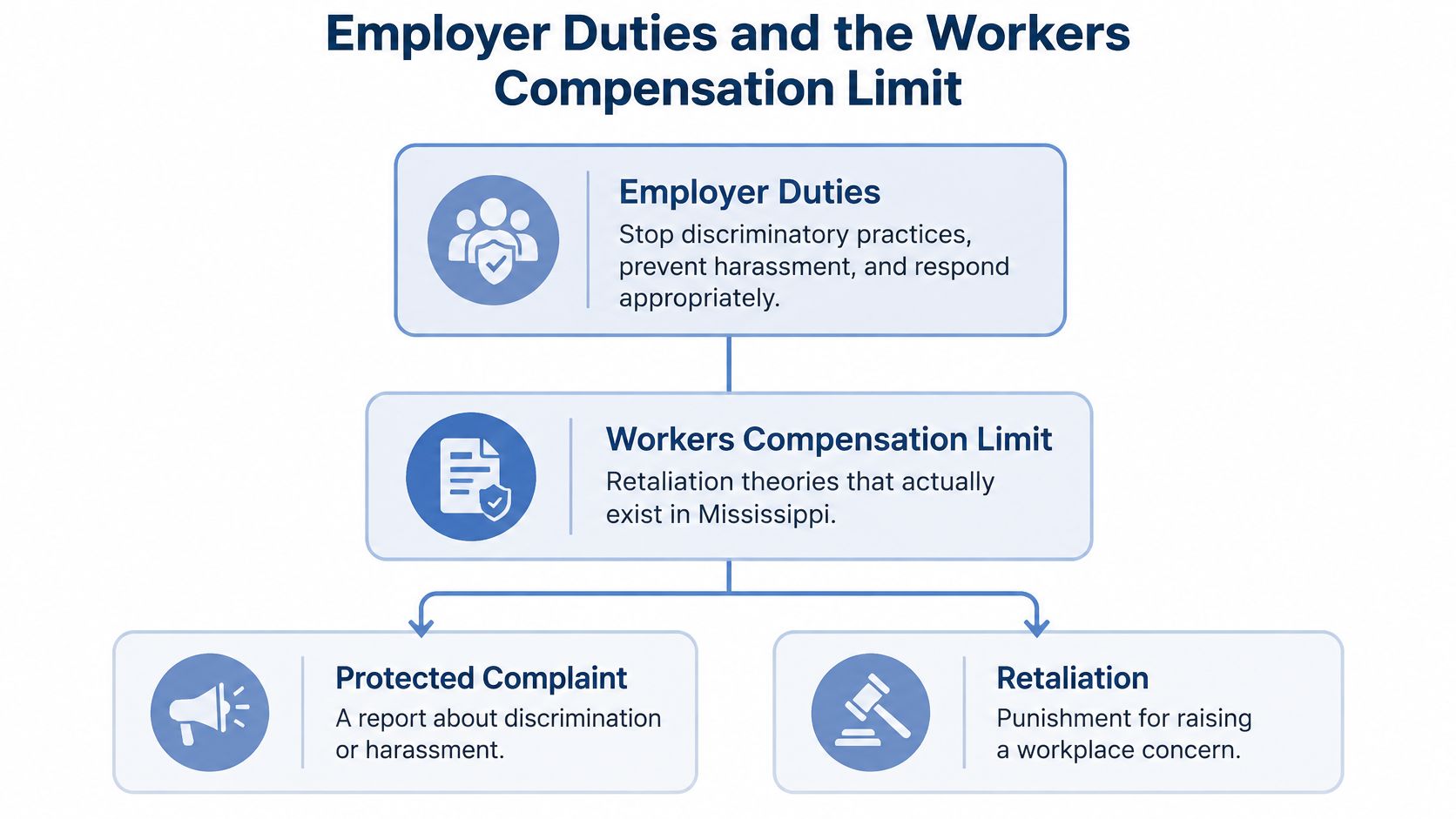
A workers' compensation filing isn't itself a retaliation claim
Mississippi does not recognize a retaliation claim under its Workers' Compensation Act merely because an employee filed a workers' compensation claim. The Mississippi Workers' Compensation Commission administers the system, and the Act generally applies to employers with five or more employees, but coverage doesn't create that separate retaliation remedy, as explained in the Mississippi employment-law guide.
That limit doesn't answer every question about an injured employee's treatment. A worker might also have a disability-related issue or have reported discrimination. Those facts require evaluation under their own protections, rather than being folded into a workers' compensation retaliation theory that Mississippi doesn't recognize.
The reason for an employer's action and the legal protection attached to your activity must be evaluated separately.
Other protected activity requires its own analysis
Reporting discrimination, participating in a discrimination investigation, and exercising rights under a separate federal law may raise different retaliation questions. Covered public employees may also have a distinct whistleblower issue when they provide information or testimony to a state investigative body.
The public-employee protection addresses actions directly caused by a qualifying disclosure. Potential actions include an unwarranted reprimand or poor evaluation, demotion, pay reduction, denied promotion, suspension, dismissal, or denial of employment.
- Discrimination reporting: Identify what unlawful treatment you reported and who received the report.
- Public-employee disclosure: Identify the investigative body and the information or testimony provided.
- Workers' compensation: Keep benefit eligibility separate from the absence of a filing-based retaliation claim.
Related topics such as Mississippi Workplace Retaliation, Mississippi Whistleblower Protections, and Mississippi Workers' Compensation Rights should be approached as distinct subjects. The same employment history may involve several issues, but one protection shouldn't be assumed to supply another.
Examples of Discrimination and Harassment at Work
Hiring and promotion problems don't always begin with an openly discriminatory rejection. The following hypothetical scenes show which details deserve attention, rather than predicting any employee's legal outcome.

A qualified worker loses a promotion after a manager says the team needs someone younger. Another employee requests a disability-related schedule adjustment, receives a refusal, and sees coworkers receive informal flexibility. Relevant records include the promotion criteria, manager's message, accommodation request, and comparable schedules.
Unequal pay presents a different question. Employees may perform substantially equal work while receiving different pay because of sex. Job duties and responsibility matter more than job titles alone, so keep available descriptions, assignment records, and your own pay information.
When mistreatment overlaps
Racial insults followed by exclusion from work communications can involve both harassment and decisions affecting job opportunities. If the employee complains and then loses desirable assignments, the later conduct deserves its own entry in the incident record.
Sexual comments, unwanted messages, or touching can occur alongside intimidation and bullying. The related sexual-harassment examples offer a closer look at conduct employees may struggle to describe.
For additional context on workplace conduct, the following video is available.
Broader survey findings help distinguish workplace harm from a rare or purely personal concern. An ILO, Lloyd's Register Foundation, and Gallup assessment interviewed nearly 75,000 employed people aged 15 or older across 121 countries and territories in 2021, finding that 22.8%, approximately 743 million workers, had experienced workplace violence or harassment, according to the global workplace assessment.
Psychological mistreatment affected 17.9%, physical violence 8.5%, and sexual violence or harassment 6.3%, while only 54% of affected people told someone, according to that assessment. These are global experiences, not findings that each incident satisfied a Mississippi employee's federal legal claim.
Software doesn't end the inquiry
An automated hiring screen or scheduling system can also deserve scrutiny if it excludes someone because of a protected characteristic or biased proxy. An employer can't treat software involvement as an automatic shield from responsibility.
- Preserve the output: Keep rejection notices, schedules, and stated reasons.
- Describe the impact: Explain what changed in your opportunity, hours, or treatment.
- Avoid assumptions: A disappointing automated result alone doesn't establish discrimination.
How to Report and Protect Your Record
Choose a reporting route by asking who controls the workplace and whether the employer offers a usable alternative. If the alleged harasser is a coworker, a supervisor or HR representative may be an appropriate contact. If the supervisor is involved, look for another designated recipient, a higher manager, or an owner or board where appropriate.
Anonymous and confidential aren't interchangeable. An anonymous channel doesn't identify the reporter, although surrounding facts may reveal their identity. A confidential process generally limits sharing, but an investigation may still require disclosure to people who need the information.
Mississippi Reporting Paths Compared
| Path | Best used when | What it does not do |
|---|---|---|
| HR or designated manager | An employer has an accessible complaint process | Guarantee your preferred result or replace federal deadlines |
| Anonymous or confidential channel | The channel genuinely exists and its limits are understood | Promise complete secrecy |
| State investigative body | A covered public employee has a qualifying disclosure | Protect every workplace complaint automatically |
| EEOC | A concern falls within applicable federal discrimination law | Make an internal complaint unnecessary in every situation |
| Workers' compensation process | You need to address a work-related injury claim | Create a Mississippi filing-based retaliation claim |
For help understanding what a workplace policy should contain, employee handbook advice from Benely provides useful policy context. Your employer's actual handbook remains the document to check for designated recipients and alternative reporting routes.
The Mississippi-focused guide on how to report workplace discrimination can help you prepare a clear account. Don't assume an internal investigation pauses a federal filing deadline. Ask promptly which deadline and process apply to your circumstances.
Preserve the original conduct and what happens afterward
Keep dated notes, relevant messages, schedules, pay records, witness names, and a copy of your complaint. Record later hour cuts, write-ups, exclusion, reassignment, demotion, or termination separately, including the employer's explanation. Preserve records you can lawfully access without taking unrelated confidential material.
From fiscal year 2018 through 2021, the EEOC received 27,291 sexual-harassment charges, and 43.5% included a concurrent retaliation charge, according to the EEOC's sexual-harassment data. Concurrent allegations aren't proof that retaliation occurred, but they explain why follow-up matters.
Recordkeeping reminder: An investigation into the original complaint shouldn't leave later treatment undocumented.
How to Choose Help from an Employment Attorney
The right level of help depends on what you need someone to do. Organizing your own records can clarify events. An employer's process may offer a way to stop conduct internally. The EEOC addresses covered federal discrimination complaints, while an attorney can evaluate your individual position and advise you through decisions that an agency or HR department doesn't make for you.
Dedicated representation becomes particularly useful when the alleged harasser controls the business, a deadline may be close, or discrimination and retaliation allegations overlap. Advice can also matter before you sign a severance agreement, respond to discipline, or make a decision about leaving.
Compare the role, not just the price
| Option | Practical role | Question to ask |
|---|---|---|
| Self-help with records | Organize events and preserve available evidence | Can I identify facts without filling gaps with assumptions? |
| Employer process | Give notice and seek workplace correction | Who receives the complaint if my manager is involved? |
| EEOC contact | Explore the applicable federal charge process | Which coverage rules and deadlines apply? |
| Employment counsel | Develop an individual legal strategy | What options fit my facts and goals? |
The Greater Jackson employment office publishing this guidance represents Mississippi employees statewide in discrimination, sexual harassment, retaliation, unpaid overtime, and wrongful-termination matters. Its work also includes the Family and Medical Leave Act, Worker Adjustment and Retraining Notification Act, Uniformed Services Employment and Reemployment Rights Act, and related Mississippi and federal workplace issues, from evaluation through negotiation, litigation, or appeal.
Understand the written fee agreement
The commonly quoted average or customary estimate for contingency representation is 40% to 50%. That range isn't a percentage fixed by Mississippi employment law, and it isn't a promise about what any particular attorney will charge.
The written agreement controls. The percentage can vary with settlement timing, discovery, trial, appeal, and complexity. Case expenses and any fee-shifting award are separate issues that should be explained rather than assumed to be included.
- Ask about stages: Does the percentage change as the matter progresses?
- Ask about expenses: Who advances costs, and how are they deducted?
- Ask about an unsuccessful outcome: Could you owe expenses without a recovery?
- Ask about fee awards: How would a court-approved attorney-fee award affect the agreement?
Bring your questions to the consultation before deciding whether to retain counsel. You should understand both the proposed work and the financial arrangement, not just the headline percentage.
Your Next Step as a Mississippi Employee
The most useful conclusion isn't that every workplace injury has a legal remedy. It's that the route must match the facts. A discrimination complaint, public-employee disclosure, accommodation issue, and workers' compensation claim can involve the same employee without creating identical protections.
For private-sector discrimination and harassment, Mississippi employees generally need to identify applicable federal rights rather than expect a general state human-rights commission process. The workers' compensation limit also makes it important not to describe every post-injury employment action as a filing-based retaliation claim.
Public employees should identify the recipient
Covered public employees who gave information or testimony to a state investigative body should preserve that distinction. Mississippi Code section 25-9-173 addresses qualifying disclosures and directly caused adverse actions, including unwarranted reprimands or poor evaluations, demotion, pay reductions, denied promotion, suspension, dismissal, and denial of employment, under the Mississippi public-employee reprisal statute.
The recipient, content, and timing of that disclosure matter. A general statement that you complained at work may leave out the details needed to assess the protection.
Prepare for a focused consultation
You don't need to assemble a perfect file before asking for help. Gather what you have and identify what's missing.
- A timeline: Include the conduct, complaint, employer response, and later changes.
- The policy: Bring the handbook or reporting procedure if available.
- Communications: Preserve relevant messages and the complaint itself.
- Employment records: Include schedules, pay information, evaluations, and write-ups.
- Names and roles: Identify decision-makers, witnesses, and complaint recipients.
For further reading, choose the subject closest to your concern: Mississippi Workplace Retaliation, Mississippi Whistleblower Protections, Mississippi Workers' Compensation Rights, or Mississippi Employment Discrimination Claims. Keep your immediate goal concrete: find out which protection may apply, what information matters, and whether you need to act before a deadline.
This information is educational, not individualized legal advice. A personalized evaluation can address the gaps that a general explanation can't resolve.
Nick Norris, P.A. helps Mississippi employees evaluate discrimination, harassment, and related retaliation concerns and develop a strategy based on their circumstances. Bring your timeline, available records, and questions to a personalized evaluation, and visit Nick Norris, P.A. to discuss your next step.
Leave a Reply