
WARN Act Violations A Guide for Mississippi Employees
So, what exactly is a WARN Act violation? It’s when a company that’s covered by the law lays off a large number of employees or shuts down a plant without giving them a proper 60-day written notice. This federal law isn't about preventing layoffs, but it is designed to give you and your family a critical heads-up. That 60-day window is supposed to give you time to adjust, start looking for a new job, and figure out any necessary training.
When an employer skips this step or doesn't give enough notice, they've broken the law. As a result, the employees who were let go might have a right to get back pay and benefits for the entire time they were kept in the dark.
What Happens When Layoff Notices Never Arrive
The shock of a sudden layoff is jarring. One day you’re at your desk, and the next, your job is gone with no warning. For workers across Mississippi, this experience can be incredibly disorienting, leaving them feeling financially exposed and wondering if what just happened was even legal.
Fortunately, a powerful federal law offers protection in these exact situations. The Worker Adjustment and Retraining Notification (WARN) Act serves as a mandatory heads-up, forcing certain employers to provide a 60-day notice before a mass layoff or plant closing.
Understanding Your Core Protection
Think of the WARN Act as a federally mandated buffer zone. It doesn't stop a company from making tough business decisions, but it does ensure those decisions don't pull the rug out from under you overnight. A violation happens when a company that meets the criteria simply ignores this rule, leaving you and your colleagues scrambling without that crucial time to prepare.
In real-world terms, this protection means you are owed money if your employer doesn't comply. The law spells out a clear remedy for employees who are affected:
- Back Pay: You can claim wages for every day of the 60-day period that you weren't given proper notice.
- Benefits: You're also entitled to the value of your benefits, like health insurance contributions, for that same violation period.
This law connects your personal experience of a sudden job loss to a powerful legal right. It acknowledges that workers deserve time to plan for their future when an employer makes a decision that will significantly impact their lives and livelihoods.
Why This Matters in Mississippi
While the WARN Act is a federal law, its protections are especially critical for workers in Mississippi. Our state doesn't have its own "mini-WARN" law to add extra layers of protection, nor is there a state agency you can turn to for help investigating these claims.
This means the federal WARN Act is your primary shield against an abrupt mass layoff. To enforce your rights, you have to file a lawsuit in federal court. If you suspect your rights were violated, talking to an employment lawyer is an essential first step. Most attorneys who take these cases work on a contingency fee, which is often 40-50% of the final settlement. That means you don't pay anything unless they win your case and recover money for you.
Does The WARN Act Cover Your Layoff?
Trying to figure out if your layoff is covered by the federal WARN Act can feel like navigating a legal maze. But once you understand the basic rules, it's actually pretty straightforward. Think of it this way: the WARN Act has a very specific set of criteria, and not every layoff or company qualifies.
To see if you're protected, you need to look at three things: your employer's size, the scale of the layoff, and your own employment status. If all three line up with the federal requirements, you might have a case.
What Counts as a Covered Employer?
First things first, the size of your company matters. The WARN Act is aimed at large employers, so it doesn't apply to small businesses or startups.
For the law to kick in, your employer must have either:
- 100 or more full-time employees.
- 100 or more employees (including part-time staff) who, combined, work at least 4,000 hours per week, not including overtime.
This is a hard and fast rule. A sudden, massive layoff at a company with only 80 employees, for example, simply won’t trigger the WARN Act. The law is designed to address major employment events that can ripple through a community.
What Makes a Layoff a Qualifying Event?
Next, the layoff itself has to be big enough to count. Letting a few people go here and there won't cut it. The WARN Act specifically targets two types of large-scale job loss events that require a 60-day notice.
The whole point of the WARN Act is to give workers and their families a cushion before a major economic blow. It’s focused on events that are significant enough to affect not just individuals, but the local economy as well.
A layoff qualifies if it's one of two things:
- A Plant Closing: This is when a company shuts down a single work site (permanently or temporarily) and causes 50 or more full-time employees to lose their jobs within a 30-day period.
- A Mass Layoff: This is a workforce reduction that isn't a full plant closing but results in job losses at a single site for either 500 or more full-time employees OR at least 33% of the full-time workforce (as long as that number is also at least 50 people).
These thresholds are strict. For instance, if a company with 300 full-time employees lays off 90 of them (30%), it's a huge blow, but it still wouldn't meet the 33% threshold for a mass layoff.
To make this easier to track, you can use this simple checklist.
WARN Act Coverage Checklist
Use this table to quickly check if your layoff might be covered by the federal WARN Act.
| Requirement | Threshold | Does Your Situation Match? |
|---|---|---|
| Employer Size | 100+ full-time employees OR 100+ employees working a combined 4,000+ hours/week. | ☐ Yes ☐ No |
| Plant Closing | 50+ full-time employees laid off in a 30-day period from a single site shutdown. | ☐ Yes ☐ No |
| Mass Layoff | 500+ full-time employees laid off, OR at least 50 if they make up 33% of the workforce. | ☐ Yes ☐ No |
If you checked "Yes" to the employer size and at least one of the layoff event types, your situation may fall under the WARN Act.
Who Is Considered an Affected Employee?
Finally, it’s not just about the numbers—it's about who is being counted. The law is very particular about which employees are included in the layoff totals.
Generally, you're considered an "affected employee" if you're terminated or laid off for more than six months. However, some workers are specifically excluded from the headcount when determining if a layoff meets the threshold.
This usually includes:
- Employees who worked for the company for less than six months out of the last 12.
- Part-time employees who averaged fewer than 20 hours per week.
The passage of the WARN Act in 1988 was a big deal, and one study found it nearly doubled the rate of advance layoff notices. One of its smartest features is an "aggregation rule." This rule looks at all layoffs over a 90-day period to see if they collectively meet the threshold. This stops companies from trying to get around the law by staggering a large layoff into several smaller ones. You can read a full analysis about the WARN Act's impact on clevelandfed.org.
Recognizing The Red Flags Of A Violation
It’s one thing to know the rules of the WARN Act, but it's another thing entirely to spot a violation in the real world. A violation isn't always as dramatic as showing up to find the doors chained shut. Often, an employer will provide a notice that looks official but doesn't actually meet the law's strict requirements.
Think of a proper WARN Act notice like a legally binding contract. It can't be a casual heads-up or a vague warning. It must be a formal, written document spelling out exactly when your job will end and whether the layoff is permanent or temporary. A last-minute email or a manager’s verbal warning just doesn’t cut it.
Let's dig into the common red flags that should make you question whether your layoff was handled correctly. Even if you got some kind of notice, it might not be the notice you're legally owed.
Common Warning Signs of a Violation
Spotting WARN Act violations often means paying attention to the details—or the lack thereof. Some employers bend the rules, while others break them outright, hoping no one will notice. Knowing what to look for can help you identify a problem right away.
Here are some of the most blatant red flags I see in my practice:
- Same-Day Notice: This is the most obvious violation. If you're handed a pink slip on your last day of work, your employer has almost certainly broken the law. You're entitled to a 60-day heads-up, period.
- Verbal-Only Warnings: A manager pulling the team aside to say "layoffs might be coming" is not a legal notice. The WARN Act is crystal clear: the notice must be in writing and delivered directly to you.
- Vague or Incomplete Information: A legitimate notice has to be specific. If the letter you received is missing a firm separation date, doesn't clarify if the layoff is temporary or permanent, or fails to provide company contact information, it likely fails the legal test.
Before you go any further, this decision tree can help you quickly determine if your situation is even covered by the WARN Act.
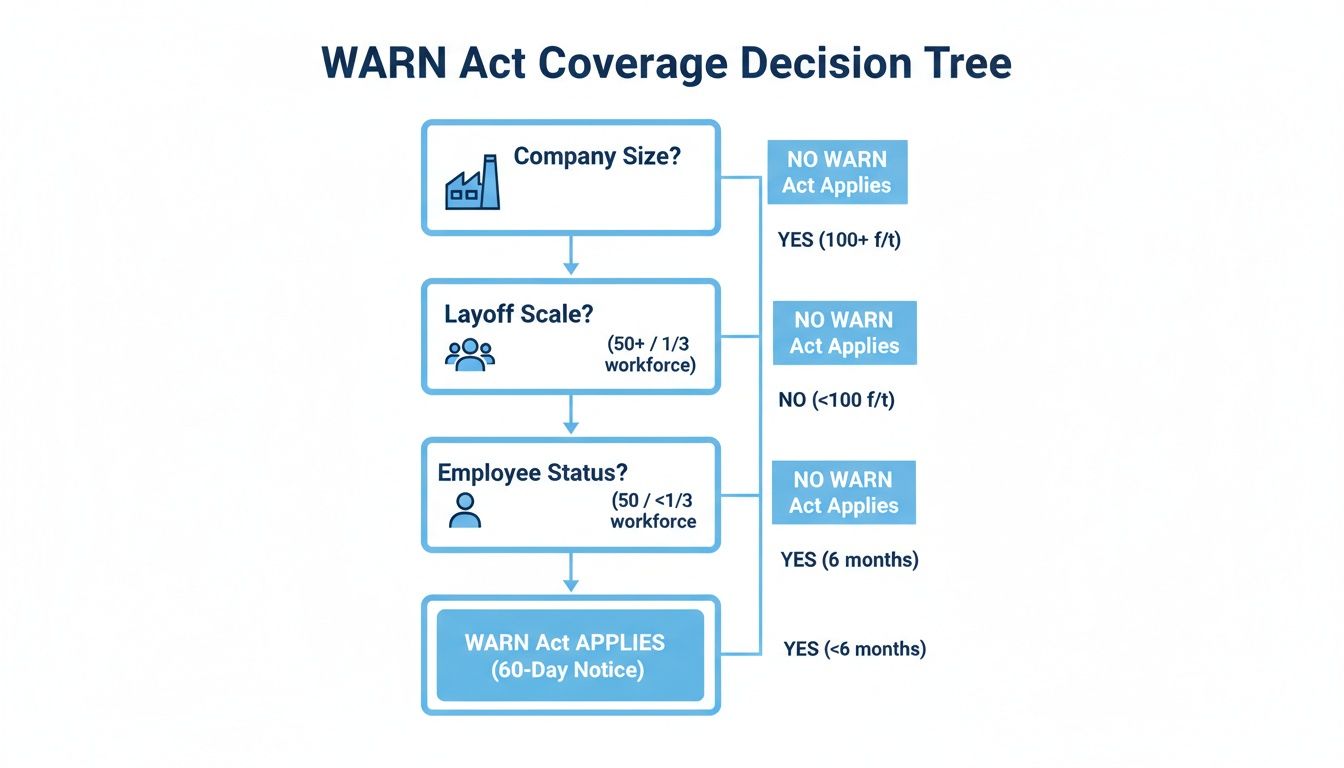
As you can see, coverage hinges on a few key factors: your employer's size, the number of people let go, and your own employment status.
More Subtle Violation Tactics
Beyond the obvious slip-ups, some employers get creative in their attempts to sidestep the WARN Act. These tactics are sneakier but no less illegal. One of the most common schemes I encounter is the "rolling layoff."
A rolling layoff is when a company intentionally staggers terminations over a 90-day period. Each individual round of layoffs is kept just small enough to fall below the WARN Act's technical thresholds, creating the illusion that no single event triggered the notice requirement.
But the law is wise to this trick. The WARN Act contains an "aggregation rule," which means regulators will look at the total number of employees laid off within any 90-day period. If that combined number crosses the line for a mass layoff or plant closing, the employer was on the hook to provide notice to everyone—including the people let go in the very first wave.
Another subtle violation involves an employer improperly claiming an exception to the rule, like an "unforeseeable business circumstance." While these exceptions are real, they are meant for truly sudden and unexpected disasters, not for shielding a company from the consequences of poor planning. After all, any termination is a serious event, and you can learn more about what is adverse employment action in our detailed guide on the topic.
The bottom line is this: if a layoff notice feels rushed, unclear, or strategically timed to keep the numbers down, trust your gut. It’s worth a closer look, because you could be entitled to significant compensation for the 60-day notice period you were denied.
What You Can Recover After A WARN Act Violation
Finding out your employer broke the law is one thing, but what does that actually mean for you and your bank account? The good news is the WARN Act isn’t just about symbolic penalties; it’s designed to put real money in your pocket to make up for the notice you should have received.
The core remedy is refreshingly simple. For every day of the required 60-day notice an employer fails to provide, they owe each laid-off employee back pay and benefits. If they gave you zero warning before showing you the door, you could be looking at a full 60 days of wages and benefits.
Calculating Your Potential Damages
Let's break down how to figure out what you might be owed. The whole point is to make you financially whole for the time you should have had to search for a new job.
Think of it this way: for every single day you were shorted on the 60-day notice, you're entitled to:
- Back Pay: This is calculated based on what you would have normally earned. If your company only gave you 10 days' notice, you have a claim for the other 50 days.
- Value of Benefits: Don't forget this part. It includes things like the health insurance premiums your employer used to cover, any 401(k) matching contributions, and other valuable perks you lost overnight.
Here’s a quick example. Let's say you earned $200 a day and your benefits package (health insurance, retirement contributions, etc.) was worth another $50 a day. A full 60-day violation could mean you’re owed $15,000 ($250 per day x 60 days). This calculation ensures you're compensated for the full financial picture, not just your base salary.
How Legal Representation Is Funded
The last thing you need after losing a job is the stress of paying a lawyer. Thankfully, you don't have to. Employment lawyers who handle WARN Act violations in Mississippi almost always work on a contingency fee basis.
This setup is a game-changer. It means you pay absolutely nothing upfront. Your attorney’s fee is simply a percentage of the money they win for you.
A contingency fee puts you and your lawyer on the same team. They don't get paid unless you do, whether that's through a negotiated settlement or a court victory. If for some reason your case is unsuccessful, you owe them zero in attorney's fees.
In Mississippi, contingency fees for these kinds of cases typically range from 40-50%. This approach takes the financial risk completely off your plate, empowering you to seek justice without the fear of racking up legal bills.
It's also important to know that the WARN Act is a federal law, so these cases land in federal court. Since Mississippi doesn't have a state agency to handle these claims, partnering with a lawyer who knows the federal system isn't just a good idea—it's the only way to hold your former employer accountable.
Your Action Plan After An Unlawful Layoff
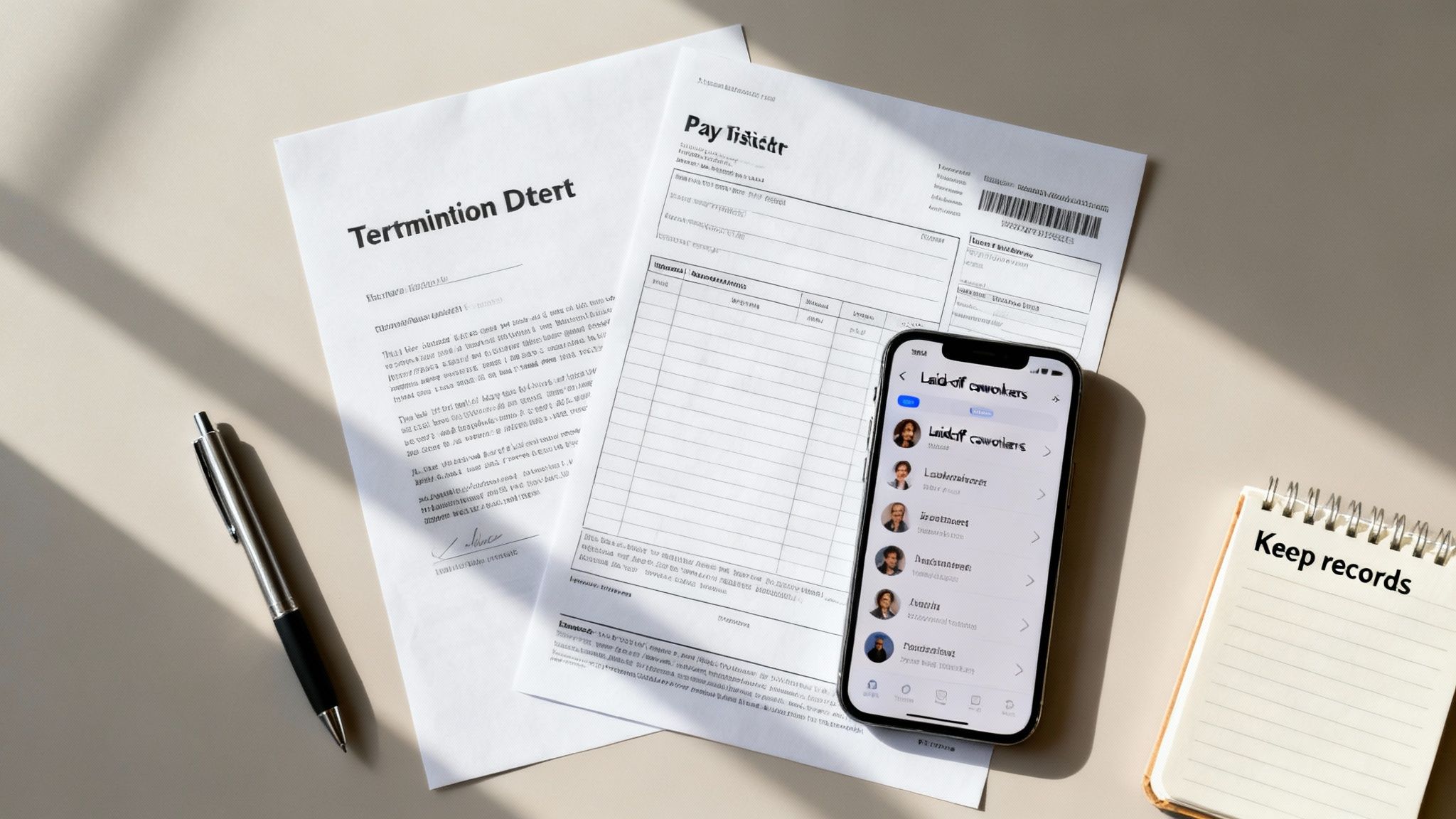
Realizing your layoff might have been unlawful is a tough spot to be in. It can feel overwhelming, but what you do next matters—a lot. Taking a few organized, strategic steps right away can make all the difference in protecting your rights and building a strong potential claim. The single most important thing you can do? Start keeping records. Immediately.
Document Everything Meticulously
From this moment on, think of yourself as the lead investigator on your own case. Every email, every letter, every text from the company is now a potential piece of evidence. Don't toss anything out, and don't assume something is irrelevant.
Your mission is to build a clear, undeniable timeline of what happened. Be sure to find a safe place to keep these items:
- Your Termination Letter: This is the official notice and the starting point for everything.
- Emails and Other Messages: Any communication you received from HR or management about the layoff is crucial.
- Pay Stubs: These are your proof of pay rate, which is how damages are calculated later on.
- Severance Agreements: Whatever you do, do not sign this without getting legal advice first. It almost certainly includes language that forces you to give up your right to sue.
Keep these documents organized. This paperwork is the foundation of your entire case—it proves the dates, your pay, and the circumstances surrounding your termination. A well-documented claim is a powerful one. For a deeper dive into what to look for, our employee termination checklist can give you more specific guidance.
Gather Coworker Information
At their core, WARN Act claims are often a numbers game. Proving a "mass layoff" or "plant closing" means showing that a certain number of people lost their jobs. While the company holds the official roster, you can start building your own.
Get in touch with the colleagues you know who were also let go. Try to collect names and contact details. This helps you get a sense of the scale of the layoff and connects you with others who can back up your story.
The heart of a WARN Act case is hitting those numerical thresholds. When you connect with coworkers, you're all working together to sketch out the true size of the layoff—a critical step in figuring out if the company broke the law.
With recent layoffs affecting over a million workers—a major spike from last year—understanding your rights is more important than ever. WARN Act violations open companies up to serious lawsuits under federal law (specifically, 29 U.S.C. § 2101). A quick look at a tool like WarnTracker.com shows just how often this happens.
Consult an Employment Lawyer Immediately
This is, without a doubt, the most important step you can take. Before your signature touches any company document—especially a severance agreement—you need to talk to a lawyer who lives and breathes employment law.
Why? Because that severance offer isn't just a friendly goodbye. It's a legal contract that almost always includes a "release," a clause where you sign away your right to take any legal action against the company, including a WARN Act claim.
An experienced attorney can look over your paperwork, tell you if you have a solid case, and map out your best options. The good news is that most of these lawyers work on a contingency fee basis. In Mississippi, this is often 40-50% of the recovery, meaning you pay nothing upfront. They only get paid if you win.
Since Mississippi doesn't have a state-level agency to handle these claims, your only real path to justice is filing a lawsuit in federal court. Getting a lawyer on your side ensures you don't accidentally sign away your right to the money you may be legally owed.
Why A Mississippi Employment Lawyer Is Essential
When your employer ignores the federal WARN Act, you can't just file a complaint with a state agency and hope for the best. That’s because Mississippi does not have a human rights commission or a similar department to investigate your claim.
The responsibility for holding that employer accountable falls entirely on you.
This puts Mississippi workers in a unique—and tough—spot. It means that getting legal help isn't just a good idea; it's practically a necessity. WARN Act cases are filed in federal court, a complex system with its own strict rules, deadlines, and procedures. Trying to navigate it alone is a recipe for frustration.
Navigating the Federal Court System
Think of an experienced employment lawyer as your guide through this intimidating process. Their first job is to give your case a thorough, honest evaluation. They'll dig into the details to confirm that the layoff and your former employer actually meet the specific thresholds for a WARN Act violation. This step is crucial—it saves you from wasting time and energy on a claim that doesn't have a legal leg to stand on.
If you have a valid claim, your attorney takes the wheel. They handle every single aspect of the case, which typically includes:
- Calculating Your Damages: They'll figure out exactly what you're owed, down to the last dollar. This isn't just your salary; it includes the full value of lost benefits like health insurance and retirement contributions.
- Filing the Lawsuit: Your lawyer will draft and file all the complex legal paperwork to get the lawsuit started in federal court, making sure every procedural box is ticked.
- Managing the Legal Battle: From there, they handle all the back-and-forth with the company's lawyers, gather evidence through a formal process called "discovery," and build the strongest possible case for you.
Your Advocate in Negotiations and in Court
A lawyer’s job goes way beyond paperwork. They are your champion, fighting to get you a fair settlement so you might not even have to see the inside of a courtroom. Many companies would rather settle WARN Act violations quietly to avoid the expense and negative attention of a public trial.
An employment lawyer levels the playing field. Companies have teams of attorneys protecting their interests; you deserve to have a dedicated professional protecting yours. Their goal is to ensure you receive the full compensation the law provides.
If the company refuses to offer a fair settlement, your lawyer is ready to take the fight to court, presenting the evidence and arguing your case. The best part? Mississippi employment attorneys almost always work on a contingency fee of 40-50%. You pay nothing upfront. Their fee only comes out of the money they win for you, so their success is tied directly to yours.
If you're thinking about taking legal action, it's a good idea to know how to prepare for your first talk with an employment lawyer to ensure that first meeting is as productive as possible.
Common Questions About WARN Act Claims In Mississippi
Getting laid off is tough enough without the nagging feeling that something wasn't right. If you're in Mississippi and suspect your employer didn't follow the rules, you're not alone. Let's walk through some of the most pressing questions people have about potential WARN Act violations.
How Long Do I Have to File a WARN Act Claim?
This is one of the most critical questions, and the answer is: not forever. There's a legal deadline, called a statute of limitations, for filing a lawsuit. The tricky part is that the federal WARN Act doesn't set a specific time limit. Instead, courts look to state law to find the most comparable deadline.
While the exact window can be complex to determine, the main point is simple: you have to act fast. If you wait too long, you could lose your right to collect any of the back pay and benefits you might be owed, no matter how strong your case is. That’s why speaking with an attorney as soon as possible is so important.
Think of the statute of limitations as a countdown clock on your legal rights. Once it hits zero, your opportunity to file a claim is gone for good. Don't let the clock run out by waiting.
What If I Was Offered a Severance Package?
A severance check can seem like a welcome relief when you've just lost your job, but it’s crucial to hit the pause button before you sign anything. That severance agreement is a legal contract written by your former company's lawyers with one primary goal: to protect the company.
Buried in the fine print of nearly every severance offer is something called a "release of claims." When you sign that, you're essentially signing away your right to sue the company for anything related to your employment, including a potential WARN Act violation.
Before you put pen to paper, have an experienced employment lawyer review the agreement. They can spot a potential WARN claim and help you understand if the severance money is a fair trade for giving up your legal rights. In many cases, an attorney can even negotiate for a better package on your behalf.
Can My Employer Retaliate If I Ask About My Rights?
Absolutely not. The law is very clear on this: it is illegal for an employer to punish you for asking questions or asserting your rights under the WARN Act. You are protected from retaliation.
What does retaliation look like? It can be more than just a direct threat. It might show up as:
- Suddenly getting a bad job reference that costs you a new opportunity.
- The company fighting your unemployment claim for no good reason.
- Management trying to intimidate you into not talking with other laid-off coworkers.
These protections are there so you can feel safe exploring your options. If you suspect you're being retaliated against, write down everything that happens and contact an employment attorney right away. It's also worth noting that since Mississippi does not have a human rights commission, handling these federal issues means going through the federal court system, which is not something you want to do without a skilled lawyer in your corner.
If you've been caught in a layoff in Mississippi and feel your employer didn't follow the law, you need someone who knows the ins and outs of federal employment regulations. At Nick Norris, P.A., our focus is on defending workers' rights and making sure companies play by the rules. Contact us today to figure out your next steps and get the experienced representation you deserve. Learn more at https://www.nicknorris.law.
This article has been reviewed for legal accuracy by Nick Norris. For employment law matters in Mississippi, consult with an attorney licensed to practice in your state.
Leave a Reply