

What Is Adverse Employment Action? Understand Your Rights
When you hear the term "adverse employment action," it might sound like dense legalese, but the concept is actually pretty straightforward. It’s any significant, negative action your employer takes that materially harms your job, your pay, or your future career prospects.
This isn't about petty workplace annoyances or a manager having a bad day. An adverse action is a tangible, harmful decision that would likely stop a reasonable person from speaking up about discrimination or harassment in the future.
What is Adverse Employment Action, Really?
Let’s break it down. Think of it less as a simple disagreement and more as a concrete, damaging event. It’s a formal step your employer takes that directly and negatively changes the fundamental terms of your employment.
The action has to cause real, serious harm to your job status. It's not about receiving tough but fair feedback or being asked to handle a task you don't enjoy.
The core question is simple: Did what my employer do leave me in a measurably worse position with my job, my income, or my career path? If so, you’ve likely been subjected to an adverse employment action.
What Does This Look Like in the Real World?
While getting fired is the most obvious example, these actions can be far more subtle. The key is whether the action has a material, negative impact.
Some of the most common forms include:
- Termination: The classic and most severe example.
- Demotion: Being pushed down the ladder to a role with less pay, fewer responsibilities, or diminished prestige.
- Cutting Pay or Hours: Any action that directly reduces your earnings.
- Unfair Negative Performance Reviews: A bad review can become an adverse action if it's the reason you're denied a raise, bonus, or promotion.
- Transfer to a "Dead-End" Position: Getting reassigned to a role with significantly less important duties or no real path for advancement.
The Most Common Reason for Adverse Action
Retaliation is, by far, one of the most frequent drivers behind these actions. This is when a company punishes an employee for doing something they have a legal right to do, like reporting discrimination or harassment.
The numbers don't lie. In 2021, retaliation claims were the most common charge filed with the US Equal Employment Opportunity Commission (EEOC), accounting for nearly 60% of all cases. You can find more retaliation statistics and employment law insights at Rekhi Wolk. This staggering statistic shows just how often employers resort to punishment when employees try to assert their rights.
Understanding the Legal Standard for an Adverse Action
Just because something bad happens at work doesn't automatically mean it's an illegal "adverse employment action." To cross that line and become something you can build a legal case around, an employer's action has to meet a specific legal standard, one that courts and agencies like the Equal Employment Opportunity Commission (EEOC) look for.
Think of it like clearing two critical hurdles. First, the action has to be harmful enough to be considered "materially adverse." Second, you have to show a "causal link" between your employer's illegal motive and that harmful action. Let's break down what those really mean.
What Is a Materially Adverse Action?
An action is considered "materially adverse" when it's more than just a trivial inconvenience or a minor annoyance. A boss being rude is unpleasant, but it's probably not illegal. Your boss cutting your pay, however, is a different story.
A materially adverse action creates a real, tangible, negative change in your job's terms, conditions, or privileges.
The core question to ask is this: Was the employer's action serious enough that it would discourage a reasonable employee from reporting discrimination or standing up for their rights?
If the answer is yes, you're likely looking at something that meets the "materially adverse" standard. The answer almost always depends on the specific context of your situation.
Discrimination vs. Retaliation: The Standard Changes
Interestingly, how strictly this standard is applied depends on the type of claim you're making. The bar is set at a different height for discrimination versus retaliation.
- For Discrimination Claims: In cases about discrimination (based on your race, gender, religion, etc.), the negative action typically has to be an "ultimate employment decision." This means it directly impacts the core terms of your job—things like getting fired, being denied a promotion, or having your pay cut.
- For Retaliation Claims: The standard is much broader and more protective for retaliation. Here, the action is considered materially adverse if it could reasonably dissuade a worker from complaining about discrimination in the first place. This wider net catches things that might not qualify in a discrimination case, like being shut out of important meetings or being reassigned to a dead-end project.
The Supreme Court's 2024 decision in Muldrow v. City of St. Louis really reinforced this. The Court clarified that an employee doesn't have to prove a "significant" level of harm—just that the change was disadvantageous. This makes it easier to challenge things like forced job transfers, even if your title and pay stay the same.
This decision tree gives you a simple way to think through whether an action was harmful enough to qualify.
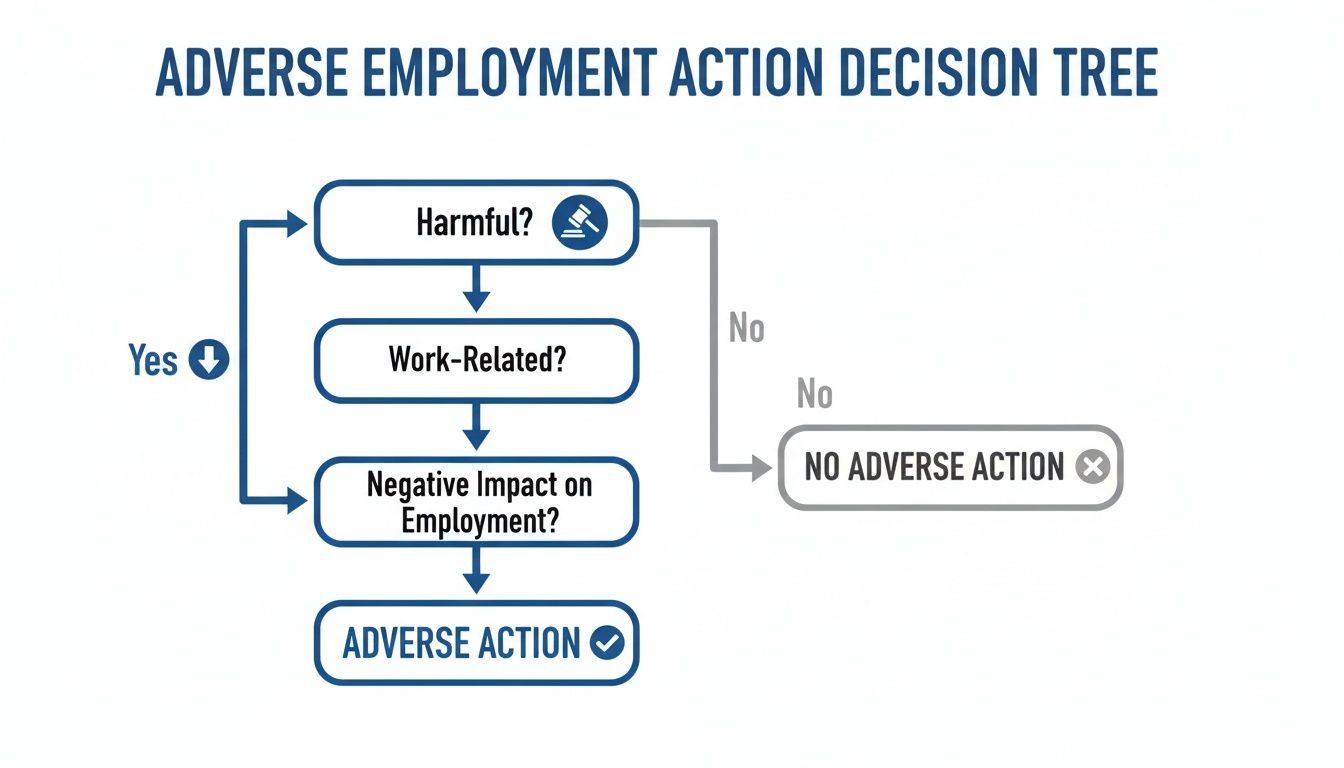
As the graphic shows, the very first step is always figuring out if the employer's action caused you real harm on the job.
Establishing the Causal Link
Showing that a materially adverse action happened is only half the battle. You also have to forge the causal link—the crucial connection between your protected activity (like filing a harassment complaint) and the negative action your employer took against you.
Say you report a major safety violation on Monday. On Wednesday, you're suddenly fired for a tiny mistake you made months ago. The suspicious timing creates a powerful inference that you were fired because you spoke up. That connection is the causal link.
Without that link, your employer will simply claim they had a legitimate, non-discriminatory reason for their decision. Your job—and your attorney’s—is to gather the evidence that proves their stated reason is just a cover story, or a pretext, for their illegal motive.
Recognizing Common Examples of Adverse Employment Actions

It's one thing to understand the legal theory behind an "adverse employment action," but it's another thing entirely to spot one in the wild. This is where knowledge becomes power. These actions aren't always as loud as a termination letter; sometimes, they're quiet, subtle shifts designed to punish you or push you out the door.
To really get a handle on what is adverse employment action, you have to see both the obvious and the hidden forms it can take. Knowing what to look for helps you connect the dots between what your employer is doing and the damage it's causing your career.
Obvious and Direct Actions
Some adverse actions are impossible to miss. They're the clear, final decisions that hit your job status, your wallet, and your ability to make a living. Honestly, these are often the most straightforward to prove because the harm is immediate and easy to measure.
Common examples of these direct hits include:
- Termination: This is the big one. Getting fired, laid off, or having your contract non-renewed for an illegal reason (like because of your race or because you complained about safety) is a classic, clear-cut case.
- Demotion: If you're suddenly moved to a lower-level role with less responsibility, fewer duties, or a less impressive title, it qualifies. The damage here is the loss of status, momentum, and future opportunities.
- Pay or Hour Reduction: Any move that directly cuts your income is a tangible adverse action. This could be a salary decrease, a lower hourly wage, or a significant drop in your scheduled hours.
These actions don't leave much room for debate. They are concrete, documented events that create an instant, material change to your job.
Subtle and Indirect Actions
This is where things get tricky, and where many employees get tripped up. Not all adverse actions are as blatant as a pink slip. Some are designed to be less direct—to make your work life so miserable that you feel you have no choice but to quit.
These more subtle moves can be just as harmful and are frequently used in retaliation cases because they are harder to prove. The employer is often hoping these actions will fly under the radar, but the law recognizes them as equally damaging.
The key legal question is often this: Would the action be enough to discourage a reasonable employee from reporting misconduct or asserting their rights? Many subtle actions easily clear that bar by creating an environment of fear and instability.
The challenge is to show how these seemingly smaller decisions add up to a significant, negative impact on your career.
Common Examples of Subtle Adverse Actions
Let's break down some of the less obvious ways an employer might take adverse action. Recognizing these is the first step in protecting yourself.
1. Negative Performance Reviews as a Weapon
Look, a single, fair critique of your work isn't an adverse action. But a suddenly negative, baseless performance review absolutely can be, especially when it feels like it came out of nowhere and is being used to justify other punishments.
- Example: You have years of great performance reviews. A week after you report harassment, your manager hits you with a review full of vague, unsubstantiated criticisms and puts you on a "performance improvement plan." This is a classic tactic used to build a paper trail for a future termination. You can learn more about this behavior in our guide to the signs of retaliation at work.
2. Exclusion and Isolation
Being intentionally frozen out of important meetings, projects, or email chains that are essential to doing your job can be a form of adverse action. If you're being denied the opportunities you need to contribute and grow, your career is being actively sabotaged.
3. Transfers to Undesirable Roles or Locations
Even if your pay and title stay the same, a forced transfer can be an adverse action. This is especially true if the new role has far less responsibility, fewer chances for advancement, or a punishing commute designed to make you resign.
4. Changes to Your Work Schedule
An employer can take adverse action by changing your shift in a way that creates a major personal hardship. For instance, being moved from a desirable day shift to an overnight one could wreck your family life and childcare arrangements, making it nearly impossible to keep your job.
5. Harassment and Hostile Work Environments
Sometimes, the harassment itself becomes the adverse employment action. Shockingly, recent data shows that one in five workers worldwide—about 23%—has faced violence or harassment at work. This includes psychological abuse and intimidation, which directly and negatively change your employment conditions. You can read more about these global workplace harassment findings on asisonline.org. When an employer allows or participates in this behavior, they are creating a work environment that is materially adverse to your career and well-being.
How Mississippi Law and At-Will Employment Intersect
When you work in Mississippi, your rights on the job are shaped by two big ideas that might seem to clash: our state's heavy reliance on federal law and the concept of "at-will" employment. Understanding how these two work together is the key to knowing when a negative workplace event crosses the line into an illegal adverse employment action.
First, you need to know something that makes Mississippi unique. We are one of only a handful of states that does not have its own human rights commission or a state-level agency to handle discrimination claims. This means if you're fired, demoted, or punished because of your race, gender, religion, or another protected status, you won't be turning to a state office. Your fight for justice will almost always start with the federal government.
For Mississippi workers, this puts the federal Equal Employment Opportunity Commission (EEOC) front and center. It also means that federal laws aren't just an afterthought—they're your primary shield against illegal treatment at work.
The "At-Will" Myth
You’ve likely heard someone say, "Mississippi is an at-will state." It's a phrase that gets thrown around a lot, but people often get the meaning wrong. "At-will" simply means your boss can let you go for a good reason, a bad reason, or even no real reason at all—as long as that reason isn't illegal.
This is where a lot of employers get into trouble. They think "at-will" gives them a free pass to make any decision they want, no questions asked. That couldn't be further from the truth.
Think of it this way: federal anti-discrimination and anti-retaliation laws are powerful exceptions that override the at-will rule. Your employer can’t fire you for a reason that violates these core federal protections.
So, while at-will employment is the general starting point, federal law carves out crucial, non-negotiable exceptions to protect your basic rights.
Federal Laws Are Your Shield
Since Mississippi employees must look to the federal system for protection, your defense against an illegal adverse employment action is built on a foundation of strong federal laws. These statutes make it illegal for a company to take any negative action against you because of who you are.
The table below breaks down the key federal laws that step in to protect workers here in Mississippi.
Key Federal Laws Protecting Mississippi Workers
This is a summary of the primary federal laws that protect Mississippi employees from adverse employment actions based on protected characteristics.
| Federal Law | Protects Against Discrimination Based On | Governing Body |
|---|---|---|
| Title VII of the Civil Rights Act | Race, color, religion, sex, and national origin. | EEOC |
| Americans with Disabilities Act (ADA) | A qualified individual's disability. | EEOC |
| Age Discrimination in Employment Act (ADEA) | Age (for individuals 40 years or older). | EEOC |
| Pregnancy Discrimination Act (PDA) | Pregnancy, childbirth, or related medical conditions. | EEOC |
These laws guarantee that even in an at-will state like Mississippi, your boss's decisions can't be fueled by illegal bias.
For instance, if an employer fires you right after finding out your age, the "at-will" doctrine offers them zero defense if the real reason was age discrimination. This is exactly why it's so critical to understand what is adverse employment action and to spot it when it happens. Recognizing an illegal act is the first step in using these federal shields to defend your career and your rights. But navigating the complex federal system is a challenge, and getting expert legal guidance is often the only way to level the playing field.
Building Your Case with Strong Evidence

If you believe you've been subjected to an illegal adverse employment action, the strength of your claim will come down to one thing: evidence. Meticulous documentation is the bedrock of a successful case. Without it, you're left in a "he said, she said" situation, which is incredibly difficult to prove.
The best thing you can do is start preserving information right away, even before you've picked up the phone to call a lawyer. Your mission is to build a detailed, factual record that connects the negative action you experienced to your employer's illegal motive.
Start Preserving Digital Communications Immediately
So much of our work life happens online, which means the most damning evidence is often digital. It’s absolutely critical to save every single relevant email, text message, or platform message (like Slack or Teams) you've received from supervisors, HR, or even coworkers. Never assume your employer will maintain these records for you—they can disappear in a flash, especially if you're suddenly locked out of the system.
Get into the habit of forwarding important work emails to a personal email address. For text messages, take clear screenshots that show the full conversation, including dates and times. This digital trail can be the smoking gun that proves timelines, retaliatory comments, or unfair directives.
Keep a Detailed Personal Journal
Your next most powerful tool is a simple journal. This isn't for venting (though you can do that elsewhere); it's for creating a factual log of what's happening to you at work. As soon as an incident occurs, write it down while the details are still fresh in your mind.
For each entry, make sure you include:
- The Date and Time: Pinpoint it as closely as you can.
- What Happened: Stick to the facts. Describe the conversation or action objectively.
- Who Was Involved: Note the names and job titles of everyone there.
- Who Witnessed It: If a colleague saw or heard what happened, write their name down.
This timeline is how you start to build that "causal link" we talked about earlier.
For instance, noting that you received a bogus performance improvement plan just two days after you formally reported harassment is a very strong indicator of retaliation. That's the kind of timing that makes investigators and lawyers sit up and take notice.
Collect and Organize Physical Documents
Finally, pull together all the physical paperwork you have related to your job. This means your offer letter, any contracts, the employee handbook, every performance review you've ever received (good and bad), and any disciplinary notices. These documents establish the official record of your employment.
When you lay it all out, a story often emerges. A stack of glowing performance reviews followed by a sudden, harsh write-up right after you took FMLA leave? That contrast speaks volumes and becomes a powerful piece of evidence. For more on this, take a look at our guide on how to report workplace harassment.
By taking these steps, you're not just collecting a pile of papers and screenshots. You are methodically constructing the foundation of your legal case, piece by piece, to protect your rights and hold your employer accountable.
When to Contact a Mississippi Employment Lawyer

Trying to navigate federal employment law and the EEOC process on your own can feel like you’re lost in a maze without a map. The rules are complex, the deadlines are strict, and you can bet your employer will have lawyers ready to defend their side of the story. This is why getting an experienced employment lawyer involved isn’t just a good idea—it’s often the most critical step you can take to protect your rights.
But how do you know when it’s time to make that call? While every case is different, some situations are clear red flags that you need professional legal advice immediately.
Clear Signals to Seek Legal Advice
If you recently took part in a legally protected activity—like reporting discrimination, asking for a reasonable accommodation, or using FMLA leave—and suddenly found yourself facing a negative consequence, it’s time to talk to an attorney. The timing of events is frequently the most powerful piece of evidence in an employment case.
You should seek legal help if you've experienced any of these scenarios:
- Sudden Termination: You're fired shortly after you reported illegal or unethical conduct.
- A Suspicious Demotion: Your title, duties, or pay get slashed right after you filed a complaint with HR.
- A Pattern of Exclusion: You’re suddenly and systematically being left out of important meetings or projects after speaking up.
- An Unfair Performance Review: You get hit with a negative review that feels completely baseless, especially right after you took a protected action.
These are classic examples of illegal retaliation, a key form of adverse employment action. Here in Mississippi, we don't have a state-level human rights commission, which makes a knowledgeable federal employment lawyer your most important ally. You can read more about why early legal support can change your job dispute outcome in our detailed article.
How an Employment Lawyer Can Help
A good attorney does much more than file paperwork. At Nick Norris, P.A., we start by digging deep into your situation, carefully reviewing the evidence you’ve collected to figure out the strength of your claim. From there, we handle all the legal filings and communications with the EEOC and your employer's legal team, making sure every deadline is met and every document is handled correctly.
Our job is to weave together the facts into a compelling story that connects your employer's actions to their illegal motives. We become your fierce advocate. This is particularly crucial when you consider how widespread workplace discrimination is. Unfair treatment hits different groups in vastly different ways; for instance, 25% of Black women report facing it, a rate more than double the 11% experienced by white men. It’s a stark reminder of how adverse actions can disproportionately damage careers.
Understanding the Contingency Fee Model
I find that many people put off calling a lawyer because they’re worried about the cost. That’s completely understandable. The good news is that most employment law firms, including ours, work on a contingency fee basis. What does that mean for you? Simply put, you pay no upfront costs or hourly bills.
Our fee is a percentage of the financial recovery we win for you, whether that comes from a settlement or a court award. The average contingency fee is 40-50%. If we don't win your case, you owe us absolutely nothing.
This approach levels the playing field, ensuring everyone has access to justice, not just those who can afford it. If you believe you’ve been subjected to an adverse employment action in Mississippi, you have options. Contact Nick Norris, P.A. today to understand your rights and get the dedicated legal representation you deserve.
Frequently Asked Questions
When you’re trying to figure out if what happened to you at work was illegal, the legal jargon can get overwhelming. Let's break down some of the most common questions Mississippi workers ask about adverse employment actions.
Is a Bad Performance Review an Adverse Action?
This is a classic "it depends" situation. By itself, a single bad performance review usually isn't enough to be considered a legally actionable adverse action. Courts often see them as just a manager's opinion, not something that tangibly harms your career.
But that negative review absolutely can become a crucial piece of the puzzle. If that review is the specific reason your boss gives for denying you a promotion, killing your chances for a raise, or firing you, then it’s no longer just an opinion. It becomes a direct link in the chain of events leading to a concrete negative outcome, making it powerful evidence in a discrimination or retaliation case.
How Does This Differ in a Retaliation Case?
The definition of an "adverse action" gets much broader when we’re talking about retaliation. This is a key distinction. For a typical discrimination claim, the action usually has to hit you in the wallet or directly affect your job status—think pay cuts, demotions, or termination.
In a retaliation case, the standard is different and more protective of the employee. The question becomes: would the employer's action be enough to scare a reasonable employee away from reporting discrimination in the future? This lower bar covers a wider range of conduct, like suddenly being left out of important meetings, getting micromanaged into the ground, or even being ostracized by the team if management is encouraging it.
What Is the Deadline for Filing an EEOC Claim?
Pay close attention here, because this is where many valid claims are lost. Mississippi doesn't have its own state-level agency for these types of complaints, so you have to go straight to the federal Equal Employment Opportunity Commission (EEOC).
The deadline is unforgiving. You have just 180 days from the day the adverse action happened to file your official charge with the EEOC. If you miss that six-month window, you almost certainly lose your right to sue in federal court forever. The clock is ticking from day one, which is why you can't afford to wait.
Given the tight 180-day deadline, seeking legal advice promptly is not just a good idea—it's necessary to preserve your legal rights and options. Waiting too long can permanently close the door to justice.
If you believe you have been subjected to an illegal adverse employment action, you don't have to face it alone. The legal process is complex, but an experienced attorney can help you navigate it. For a clear evaluation of your case and dedicated representation, contact Nick Norris, P.A. at https://www.nicknorris.law.
This article has been reviewed for legal accuracy by Nick Norris. For employment law matters in Mississippi, consult with an attorney licensed to practice in your state.
Leave a Reply