
Your Guide to Filing an Unpaid Wages Lawsuit
If you’ve put in the hours but your paycheck doesn't reflect it, you’re not just being short-changed—you're a victim of wage theft. An unpaid wages lawsuit is your legal recourse, the formal process you can use to get back the money you've rightfully earned. It's not that different from disputing a fraudulent charge on your credit card; it's about reclaiming what's yours.
What an Unpaid Wages Lawsuit Means for You

When an employer doesn't pay you correctly, it's not just a simple mistake. It's a direct violation of federal law. For those of us working in Mississippi, our primary protection comes from the Fair Labor Standards Act (FLSA). This is the federal law that establishes the ground rules for things like minimum wage, overtime pay, and proper record-keeping for employers.
So, an unpaid wages lawsuit is the action you take in federal court when your employer has ignored these rules. It’s a serious and effective way to hold them accountable and, most importantly, to recover your money. This isn't just about one missing paycheck; it's about upholding the standard for fair work and fair pay.
Why Federal Law Is Your Strongest Ally
Mississippi is a bit unique. Unlike many other states, we have very few state-level laws protecting workers from wage theft. This reality makes the federal FLSA absolutely critical. It becomes your primary, and often only, shield.
Because Mississippi doesn't have a state labor department to handle these kinds of claims, the path to getting what you're owed almost always leads to federal court.
An unpaid wages lawsuit isn't asking for a handout. It's a demand for the wages you have already earned through your labor. The FLSA gives you the legal power to make that demand.
Common Violations Leading to an Unpaid Wages Lawsuit
Wage theft isn't always as obvious as a completely missing paycheck. It often hides in the fine print of your paystub or in company policies that seem normal but are actually illegal. Recognizing the signs is the first step to standing up for your rights.
Here’s a breakdown of the most common ways employers violate the FLSA, leading workers to take legal action.
| Violation Type | What It Means for You | A Real-World Mississippi Example |
|---|---|---|
| Unpaid Overtime | Your employer doesn't pay you time-and-a-half for any hours you work over 40 in a single workweek. | A construction worker in Jackson regularly works 50 hours a week but is paid their standard straight-time rate for all hours, missing out on 10 hours of overtime pay each week. |
| Minimum Wage Violations | You are paid less than the current federal minimum wage for the hours you've worked. | A restaurant in Biloxi pays a dishwasher a flat salary that, when divided by their actual hours worked, comes out to less than the federal minimum wage. |
| Illegal Deductions | Money is taken from your paycheck for things like uniforms, tools, or cash register shortages, and this deduction pushes your hourly wage below the legal minimum. | A retail clerk in Tupelo has $20 deducted from their weekly check for a uniform, which causes their effective pay rate for that week to dip below the minimum wage. |
| Working "Off the Clock" | You are asked, or simply allowed, to perform job duties before clocking in or after clocking out, all without pay. | A nurse in Hattiesburg is expected to arrive 15 minutes early to review patient charts and stay late to finish notes, but is only paid for their scheduled shift hours. |
These aren't just unfair practices—they're illegal. And the impact is massive. It's estimated that U.S. workers lose $15 billion every year just from minimum wage violations alone. This data, highlighted by organizations like the National Employment Law Project, shows a widespread problem that hurts working families and gives unethical businesses an unfair advantage.
Ultimately, getting familiar with the FLSA is one of the most powerful things a Mississippi worker can do. It helps you spot when your rights are being violated and shows you the path to take action, ensuring employers can't profit from breaking the law.
Do You Qualify to File a Federal Wage Claim?
Before we can even talk about a lawsuit for unpaid wages, we have to get one core concept straight: your employee classification. Under the Fair Labor Standards Act (FLSA), the federal law governing these issues, workers are split into two groups: non-exempt and exempt. Your entire right to overtime pay hinges on which category you fall into.
Think of it this way: a non-exempt employee is not exempt from the FLSA's overtime rules, meaning they are covered and must be paid it. An exempt employee, as the name suggests, is exempt from those rules. Getting this distinction right is the first—and most important—step in any wage claim.
Non-Exempt vs. Exempt Employees
Most workers in Mississippi are non-exempt. These are typically folks paid by the hour who must be paid time-and-a-half for every hour they work over 40 in a single workweek. This includes almost everyone you can think of—construction workers, servers, administrative staff, retail clerks, and call center reps.
An exempt employee, on the other hand, is not legally entitled to overtime pay. But here’s the crucial part: an employer can’t just decide to make you exempt. To legally classify an employee as exempt, that person’s job must meet very specific and strict criteria related to both their salary and their day-to-day duties. This is where a surprising number of employers get it wrong.
Debunking the Salary Myth
There's a huge misconception out there that if you're paid a salary, you're automatically exempt from overtime. That's absolutely not true.
For an exemption to be legitimate, an employee generally has to pass two key tests:
- The Salary Basis Test: You must be paid a fixed salary that doesn't go up or down based on how many hours you work or the quality of your output.
- The Duties Test: Your main job responsibilities must fall squarely into what the law defines as executive, administrative, or professional duties. These definitions are narrow.
Let's take a real-world example. Imagine a salaried "manager" at a big-box store who spends 80% of their shift stocking shelves, running a register, and cleaning up. Even with the manager title, their actual duties don't meet the "executive" criteria. They are almost certainly misclassified and could be owed a lot of money in unpaid overtime.
Misclassification is one of the most common ways employers illegally deny workers the pay they've earned. They can't just slap a fancy title on you or put you on salary to avoid paying overtime. Under the law, what you actually do every day is what counts.
Other Red Flags for Mississippi Workers
Misclassification is a big one, but employers violate the FLSA in plenty of other ways. Knowing what to look for can help you figure out if you have a solid case for an unpaid wages lawsuit. If your employer has refused to pay you for hours worked beyond forty in a week, it’s a good idea to learn more about your rights to overtime wages in Mississippi.
Here are a few other illegal practices we see all the time:
- Calling You an "Independent Contractor": Some businesses try to dodge overtime, payroll taxes, and benefits by misclassifying their employees as independent contractors. The test is simple: if your employer controls the how, when, and where of your work, you are very likely an employee, no matter what your job title is.
- Running an Illegal Tip Pool: In restaurants, an employer can’t just do whatever they want with your tips. While tip pooling is allowed, it can only include employees who regularly get tips, like servers and bartenders. Forcing servers to share tips with managers or kitchen staff (like cooks and dishwashers) is illegal.
- Using "Comp Time" in the Private Sector: Offering you paid time off in the future instead of overtime pay for extra hours worked this week is illegal for most private employers. If you work 45 hours, your employer can't just give you five hours off next month; they must pay you for those five hours at the time-and-a-half rate on your next paycheck.
If any of these scenarios hit close to home, your employer could be breaking federal law. Understanding your classification and spotting these violations are the essential first steps toward building a strong case and getting back the money you worked for.
Gathering Proof for a Successful Lawsuit
Winning an unpaid wages lawsuit isn't just about being right—it's about proving you're right. Every piece of evidence you can gather acts as a building block for your case, creating a solid foundation that's tough for your employer to knock down.
While digging up old documents might feel like a chore, you probably have more proof than you think. Your goal is to paint a clear, undeniable picture of the hours you worked and the pay you were illegally denied. Your story is crucial, but pairing it with hard evidence is what truly gives it power.
Your Unpaid Wages Lawsuit Evidence Checklist
Think of this as your starting point for building a strong claim. The table below outlines the key documents and information that can make all the difference in a federal wage case here in Mississippi. Don't stress if your records are incomplete; the law anticipates that employers hold most of the official documents.
| Type of Evidence | Why It Strengthens Your Case | Where You Can Find It |
|---|---|---|
| Pay Stubs | This is the most direct proof of what you were actually paid, for which pay periods, and at what rate. It also shows any deductions. | Your employer is legally required to provide these. Check your online employee portal or ask for physical copies. |
| Personal Hour Logs | A consistent, personal record of your start/end times and breaks can directly challenge inaccurate company timecards. | This can be as simple as a notebook, a calendar, or even a spreadsheet. The key is to be consistent and detailed. |
| Digital Communications | Emails, text messages, or Slack/Teams chats can prove you were told to work off-the-clock, stay late, or handle tasks without pay. | Search your phone and email for any messages with supervisors or managers related to your hours, tasks, or pay. |
| Employee Handbook | This lays out the company's official rules on pay, overtime, and timekeeping. It can show if they broke their own policies. | You should have received one when hired. You might also find it on a company intranet or internal website. |
Gathering this evidence is your first, most powerful step toward getting what you're owed.
What if My Employer Has All the Records?
This is one of the most common worries I hear from Mississippi workers: "My boss has the official timesheets, so how can I possibly prove they're wrong?" It’s a completely valid fear.
Luckily, the law has an answer for this. In a federal lawsuit, we use a powerful legal process called discovery. This allows your attorney to formally demand that your employer hand over all relevant records—official timecards, payroll reports, and other documents that can expose the truth.
This is where your personal logs become so valuable. We can use your notes to challenge the company's "official" records and show a judge or jury what really happened.
Never assume your case is weak just because you don't have perfect records. A simple, handwritten log of your hours can be powerful evidence. The most important step is to start documenting everything you can, as soon as you can.
It’s also critical to know that federal law protects you from being punished for standing up for your rights. If your employer fires, demotes, or otherwise harasses you for questioning your pay, you may have a separate claim against them. You can learn more about your protections from illegal workplace retaliation to fully understand these rights.
The Federal Lawsuit Process Step by Step
Filing an unpaid wages lawsuit might sound intimidating, but it's a much more structured and logical process than you might imagine. In Mississippi, since we don't have a state-level agency to handle these claims, everything happens in the federal court system under the Fair Labor Standards Act (FLSA).
Think of it as methodically building a case, piece by piece. Each step is designed to bring the facts into the light, from putting your employer on notice to systematically uncovering and exchanging the evidence needed for a fair resolution. While every situation has its own unique details, they all follow the same basic path toward getting you what you're owed.
The Initial Steps: Consultation and Demand
Everything starts with a conversation. You'll sit down with an employment lawyer to discuss what happened, go over any records you have, and figure out if you have a strong claim. If you decide to move forward together, the first official move is usually sending a demand letter to your employer.
This isn't just a casual note; it's a formal letter that lays out the wage violations, calculates the back pay you're owed, and makes a clear demand for payment. It officially notifies your employer that you're serious and gives them a chance to fix the problem before a lawsuit is filed. Honestly, sometimes a well-drafted demand letter is all it takes to get the ball rolling on a fair negotiation.
Filing the Complaint and Serving the Employer
If the demand letter doesn't resolve the issue, the next step is to file an official Complaint in federal court. This legal document is what formally kicks off your unpaid wages lawsuit. It tells your side of the story in a structured legal format, identifying who is involved, the basis for your claim (the FLSA), the specific ways your employer broke the law, and what you're asking for in damages.
Once the Complaint is filed, a copy has to be officially delivered to your employer. This is called service, and it legally requires them to respond to your allegations, typically by filing their own document called an "Answer."
An unpaid wages lawsuit is a methodical process designed to level the playing field. It forces employers to address your claims and produce the very records—like official payroll data and timecards—that can prove your case.
The Discovery Phase: Uncovering the Facts
Get ready, because this is often the longest and most important part of the entire lawsuit. Discovery is the formal process where both sides are required to exchange information and evidence. The whole point is to prevent any "gotcha" moments at trial and make sure everyone is working with the same set of facts.
During the discovery phase, we'll likely engage in a few key activities:
- Interrogatories: We send the other side a list of written questions they have to answer under oath.
- Requests for Production: We formally demand specific documents, like official timecards, payroll reports, and company policy handbooks.
- Depositions: We get to question people from the company (and they get to question you) under oath, with a court reporter transcribing everything.
This is where all those notes and records you kept become your most powerful tool. They help your attorney ask the right questions and demand the exact documents needed to prove your case. This simple flowchart shows how the core pieces of evidence fit together.
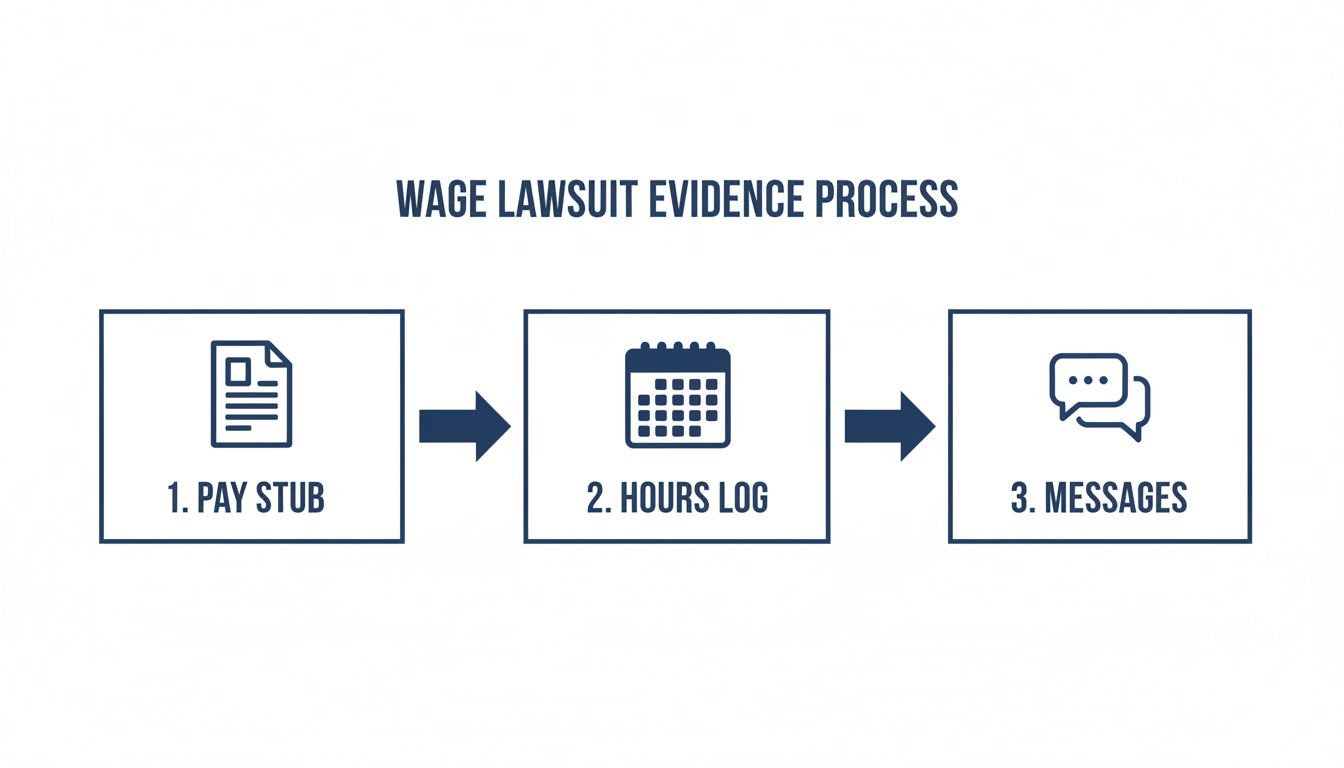
As you can see, basic documents like your pay stubs, your personal log of hours, and even text messages or emails can be combined to build a surprisingly strong and persuasive case.
Resolution Through Settlement or Trial
Finally, the case starts moving toward a conclusion. The vast majority of unpaid wages lawsuits end in a settlement. This is simply an agreement where your employer agrees to pay a certain amount of money to resolve the case without ever stepping foot in a courtroom. Settlements can happen through informal back-and-forth negotiations or a more formal process called mediation.
If a fair settlement can't be reached, the case will head to trial. There, both sides present their evidence and arguments to a judge or jury, who will make a final, binding decision. While going to trial is pretty rare, the best way to get a good settlement is to prepare a rock-solid case from day one, ready for anything.
What You Can Recover in Back Pay and Damages
When you win an unpaid wages lawsuit, it’s about more than just getting the money you’re owed. It’s about making things right. The federal Fair Labor Standards Act (FLSA) provides a strong legal path to recover not only your lost wages but also extra damages to punish the employer and compensate you for the trouble they caused.
The foundation of any award is back pay. This is simply the exact amount of money your employer wrongfully kept from you. If they stiffed you on overtime, it's the time-and-a-half pay you earned. If they paid you less than minimum wage, it’s the money needed to bring your hourly rate up to the legal floor.
Doubling Your Recovery with Liquidated Damages
But let's be realistic—getting paid late isn't the same as getting paid on time. The FLSA gets this. It recognizes the real-world stress and financial problems that come from a missing paycheck, like late fees on bills and the simple anxiety of not being able to make ends meet. That's why the law includes a powerful tool called liquidated damages.
Think of it as an automatic penalty. In nearly all successful FLSA cases, the court orders the employer to pay an additional amount equal to your total back pay. This effectively doubles what you recover. So, if you're owed $10,000 in back wages, the court can award you another $10,000 in liquidated damages. You walk away with $20,000.
This isn’t just to punish the company. It’s a way of compensating you for the very real economic damage you suffered because you didn't have your money when you earned it. A dollar today is worth more than a dollar tomorrow, especially when you have bills to pay.
The only way an employer gets out of paying liquidated damages is if they can prove to a judge that they acted in "good faith" and had solid, reasonable grounds for believing they weren't breaking the law. That’s a tough argument to win, which is why these "double damages" are so common.
Covering the Costs of Your Lawsuit
For most folks in Mississippi, the thought of paying for a lawyer is a non-starter. The FLSA was written with this in mind and includes a provision that completely levels the playing field.
If your claim is successful, the law forces your employer to pay your reasonable attorneys' fees and court costs. This is a huge deal. It means you can take on a large company without worrying about being crushed by legal bills. It also ensures that the money you win actually ends up in your pocket, not spent on the fight to get it.
This is exactly why nearly all employment lawyers in Mississippi take these cases on a contingency fee basis. Here’s what that means for you:
- No Upfront Costs: You don’t pay a dime out of pocket to get your case started.
- Payment Only if You Win: The attorney’s fee is simply a percentage of the final settlement or verdict. If there’s no recovery, you owe no fee. It's that simple.
- Typical Fees: Here in Mississippi, a standard contingency fee for wage cases is between 40-50% of the total amount recovered.
This setup makes sure that justice isn't just for those who can afford it. It gives every worker a fighting chance to hold their employer accountable. And these lawsuits work. Between 2021 and 2023 alone, legal actions recovered over $1.5 billion for more than half a million American workers whose wages were stolen. You can read the full research about these wage theft findings to see just how effective these claims are.
When Is It Time to Call an Employment Lawyer?

It can be tough to know exactly when a payroll problem crosses the line and requires legal help. But think of it this way: if wage theft is a fire, certain issues are like smoke signals. Ignoring them just gives the problem more time to spread. You deserve to know your paycheck will be right every single time.
Things like consistent payroll mistakes, being asked to work "off the clock," or not getting paid correctly for overtime aren't just minor clerical errors. They are serious red flags that often point to a bigger, systemic issue that probably won't resolve itself.
The Clock Is Ticking on Your Claim
One of the biggest reasons to act quickly is the law itself. The Fair Labor Standards Act (FLSA) sets a strict legal deadline, known as the statute of limitations, for filing a lawsuit to recover your wages.
In most cases, you have two years from the date your employer failed to pay you correctly to file a claim. If it can be proven that the violation was “willful”—meaning the employer knew they were breaking the law or acted with reckless disregard for it—that deadline extends to three years.
If you wait too long, you could lose the right to get your money back for good. Each week that goes by could represent another week of earned wages that you can no longer legally recover.
Don't Let Financial Worries Stop You
A lot of Mississippi workers hesitate to call a lawyer because they're worried about the cost, and that's completely understandable. The good news is that most employment lawyers remove this barrier by working on a contingency fee basis.
What does that mean? It means you pay nothing upfront. The attorney's payment is simply a percentage of the money they recover for you—typically between 40-50% in Mississippi—if they win your case.
This setup levels the playing field, ensuring your access to justice isn't determined by how much money you have. If you don't get a recovery, you don't owe any attorney's fees. Your first step is usually a consultation to go over your options, and it helps to know how to prepare for your first talk with an employment lawyer.
Clear Signs It's Time to Make the Call
If any of these situations sound familiar, it’s time to talk to a professional who can stand up for your rights:
- You're working more than 40 hours a week but not getting paid time-and-a-half.
- Your boss asks you to work before clocking in or after clocking out.
- Your pay stubs have frequent, unexplained deductions or errors.
- You're afraid to ask about your pay because you fear being fired or punished.
These aren't just annoyances; they are violations of federal law. Reaching out to an experienced employment lawyer is the single most effective step you can take toward getting the wages you rightfully earned.
Your Top Questions About Wage Lawsuits Answered
If you're thinking about taking legal action over unpaid wages, you’ve probably got a lot on your mind. Let's cut through the noise and get straight to the answers for the most common questions Mississippi workers ask.
What Does It Cost to Hire a Lawyer for My Wage Claim?
This is usually the biggest hurdle for people, so let's clear it up right away. In Mississippi, lawyers who handle these federal wage cases almost always work on a contingency fee.
What that means for you is simple: you pay zero upfront costs. Your attorney's fee is just a percentage of the money they win back for you, whether that's through a settlement or a court victory. If you don’t get paid, neither do they. Typically, that fee is between 40-50% of the total recovery.
Can I Be Fired for Suing My Employer?
In a word: no. The law that gives you the right to sue—the Fair Labor Standards Act (FLSA)—has powerful anti-retaliation rules built right in. Your employer is legally forbidden from firing, demoting, harassing, or taking any other negative action against you for filing a wage claim.
The FLSA is designed to protect workers who speak up. If your boss retaliates against you for demanding your rightful pay, that opens them up to a separate—and often more serious—legal claim.
This protection is what gives the law its teeth, ensuring you don’t have to choose between your job and the wages you've already earned.
How Long Do I Have to File a Lawsuit in Mississippi?
Time is not on your side here, and the clock is ticking. Because these are federal claims, there are strict deadlines, known as the statute of limitations.
- You generally have two years from the date your employer failed to pay you correctly to file a lawsuit.
- The deadline extends to three years if you can prove the violation was "willful"—meaning the employer knew they were breaking the law or acted with reckless disregard for it.
Every day you wait could be a day's worth of wages you can no longer legally recover. If you even suspect you're being shorted, the best move is to talk to an attorney right away to make sure you don't lose your rights.
If you believe your employer has violated federal wage laws, you don't have to face them alone. The team at Nick Norris, P.A. is dedicated to defending the rights of Mississippi workers and can help you understand your legal options and fight for the compensation you deserve. Contact us today for a consultation at https://www.nicknorris.law.
This article has been reviewed for legal accuracy by Nick Norris. For employment law matters in Mississippi, consult with an attorney licensed to practice in your state.
Leave a Reply