

What is exempt vs nonexempt employee? A Quick Guide to Overtime Rules
When people ask about the difference between an exempt and a nonexempt employee, it really comes down to one thing: overtime pay. In Mississippi, nonexempt employees are legally guaranteed overtime pay for any hours they work past 40 in a week. Exempt employees, on the other hand, are not.
This isn't just a label your employer picks. Your status is strictly defined by federal law—it has nothing to do with your job title, company policy, or the fact that you receive a salary.
Understanding the Basics of Employee Classification
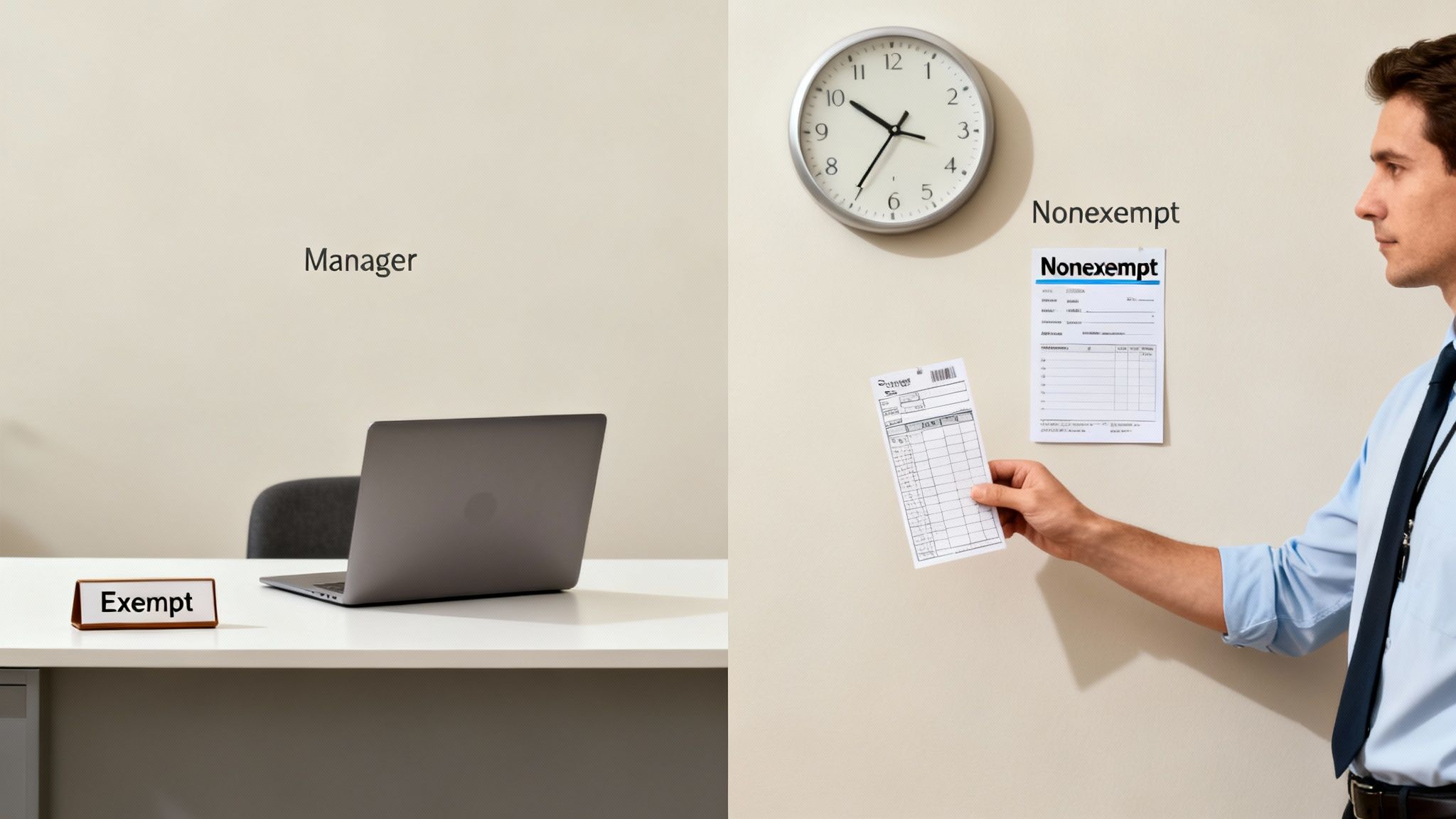
Here in Mississippi, our overtime protections come from the federal Fair Labor Standards Act (FLSA). This is the law that sets the ground rules for who gets paid extra for putting in long hours. An employee's status as exempt or nonexempt determines whether their employer must pay them time-and-a-half, keep meticulous records of their hours, and follow minimum wage laws.
The FLSA creates two very different paths for workers. Nonexempt employees get the full protection of the law—they’re guaranteed minimum wage and overtime pay at 1.5 times their regular rate for every hour worked over 40 in a workweek. Exempt employees don't get these overtime protections, but only if they meet very specific criteria related to their pay and job responsibilities.
To qualify as exempt, an employee must earn a minimum salary of $684 per week (which is $35,568 per year), though this number has been a hot topic and subject to regulatory updates.
Exempt vs Nonexempt At a Glance
Getting this classification wrong is a serious problem and can result in thousands of dollars in unpaid wages for an employee. It's crucial to look past your job title and understand what the law actually says. You can dive deeper into your rights by exploring our detailed guide on overtime wages.
To make it simple, here’s a quick summary of the fundamental differences.
| Characteristic | Nonexempt Employee | Exempt Employee |
|---|---|---|
| Overtime Eligibility | Eligible for overtime pay (1.5x regular rate for hours over 40) | Not eligible for overtime pay, regardless of hours worked |
| Payment Method | Typically paid an hourly wage, but can be salaried | Almost always paid a fixed salary that does not change weekly |
| Record-Keeping | Employer must track all hours worked | Employer is not required to track hours worked |
| Minimum Wage | Must be paid at least the federal minimum wage | Must meet a minimum salary threshold to qualify for exemption |
The key takeaway is that the rules are strict for a reason.
The most common mistake employers make is assuming that paying an employee a salary automatically makes them exempt. This is false. An employee must meet strict salary basis, salary level, and job duties tests to be legally exempt from overtime.
Comparing the Three Tests for Exempt Status

Figuring out if an employee is exempt isn't up to an employer's discretion. It's a legal determination that hinges on three specific tests laid out by the Fair Labor Standards Act (FLSA). To be lawfully classified as exempt from overtime, an employee has to pass all three of these tests.
If even one test isn't met, the law is clear: the employee is nonexempt and must be paid for every overtime hour they work. These three criteria—the Salary Basis Test, the Salary Level Test, and the Duties Test—are designed to work in tandem, setting a high bar that protects most workers' right to overtime pay. Let's break down exactly what each one entails.
The Salary Basis Test
The first hurdle is the Salary Basis Test. This one isn't about how much you're paid, but how you're paid. To pass this test, an employee must be paid a fixed, predetermined salary every pay period, whether that's weekly or less frequently.
Crucially, this salary can't be docked based on the quality or quantity of work performed. For instance, if an exempt employee finishes their work and leaves a few hours early on a Friday, their employer can’t just cut their pay for the time they missed. That salary is a guaranteed amount they can rely on.
This is a fundamental piece of the exempt vs. nonexempt puzzle. It reinforces the idea that exempt employees are compensated for the overall value and results they bring to the company, not for the specific hours they happen to be on the clock.
The Salary Level Test
Next up is the Salary Level Test, a simple, straightforward numbers game. This test establishes the absolute minimum salary an employee must earn to even be considered for an exemption.
Under the current federal regulations, an employee must be paid a salary of at least $684 per week, which comes out to $35,568 per year. If you earn a penny less than this, you are automatically nonexempt and entitled to overtime pay. It doesn't matter what your job title is or what responsibilities you have.
This salary threshold is a hard-and-fast rule. An employer can't call a manager making $30,000 a year an "exempt executive," even if they run an entire department. They fail the Salary Level Test right out of the gate.
While Mississippi follows this federal standard, it's worth noting that some states have set their own, higher salary minimums, so the rules can vary depending on where you work.
The Duties Test
Finally, we have the Duties Test. This is usually the most complicated and is where many misclassifications happen. This test ignores job titles completely and instead focuses on what an employee actually does day-to-day.
The FLSA outlines very specific categories of job duties that can qualify for an exemption. To be considered exempt, an employee's primary responsibilities must fit neatly into one of these "white-collar" classifications. These rules have been shaped over decades by the Department of Labor to protect workers from being wrongly denied overtime.
Here are the most common exemption categories you'll see:
- Executive Exemption: This isn't just for C-suite titles. To qualify, an employee's primary duty must be managing the business or a major department. They also have to regularly direct the work of at least two full-time employees and have the power to hire or fire people (or have their recommendations on these matters carry significant weight).
- Administrative Exemption: This applies to employees whose main job involves office work directly related to the company's management or general business operations. The key here is that their role must include exercising "discretion and independent judgment" on important matters.
- Professional Exemption: This one is split into two types. "Learned Professionals" are those in roles requiring advanced, specialized knowledge, typically gained through extensive schooling (think doctors, lawyers, or engineers). "Creative Professionals" are those whose work depends on invention, imagination, or artistic talent, like writers, actors, or musicians.
There are also specific exemptions for outside salespeople and some computer professionals. Misclassification often happens when an employee's real-world duties just don't match up with these strict legal definitions. For a more detailed breakdown of these classifications, you can explore our guide on overtime exemption rules.
Remember, passing just one or two isn't enough. An employee must satisfy the Salary Basis, Salary Level, and Duties tests to be legally classified as exempt.
Real-World Examples of Exempt and Nonexempt Jobs
Your job title can be a red herring. When it comes to figuring out if you're exempt or nonexempt, what matters isn't the title on your business card, but what you actually do day-in and day-out. Getting this right is the key to understanding your rights under the Fair Labor Standards Act (FLSA).
Let's break down some common jobs you’ll find here in Mississippi. Looking at them in context helps cut through the confusion and lets you focus on the duties that really define your status.
Common Nonexempt Positions
Nonexempt employees are the lifeblood of countless businesses. They handle the essential, hands-on work that keeps things running, but they typically don't have the kind of independent authority needed to be considered exempt. Their work is vital, but it's generally supervised and follows established routines.
Here are a few classic examples of nonexempt jobs and why they fit the bill:
- Administrative Assistants and Paralegals: These folks are indispensable for office support, but their work is almost always directed by someone else. They aren't making high-level, independent decisions, which is a requirement for the administrative exemption.
- Retail Sales Associates and Cashiers: While they’re on the front lines with customers, their main duties are operational—handling transactions and assisting shoppers. They don’t manage the business or exercise significant independent judgment.
- Most Hourly Laborers (Construction, Manufacturing): These jobs are all about performing specific, often manual, tasks. For this reason, they are almost universally classified as nonexempt and are entitled to overtime.
- Bookkeepers and Payroll Clerks: These employees are experts at applying established rules and procedures to financial data. However, they don't usually have the power to set major financial policies, landing them squarely in the nonexempt category.
The common thread here? The primary duties in these roles just don't meet the strict criteria for the executive, administrative, or professional exemptions. They are executing tasks, not setting strategy or managing departments.
Typical Exempt Positions
On the other side of the exempt vs. nonexempt employee divide are the jobs that meet all three FLSA tests: salary basis, salary level, and duties. These roles come with significant responsibility, discretion, and a direct hand in shaping business operations.
Think of positions like these, which are often correctly classified as exempt:
- Human Resources Managers: An HR manager who actually develops company-wide policies, directs a team, and has genuine authority to hire and fire easily passes the executive or administrative duties test.
- Physicians and Lawyers: These are classic "learned professionals." Their work demands advanced, specialized knowledge that comes from years of academic study, fitting neatly into the professional exemption.
- Senior Software Developers: A developer who designs complex software architecture and consistently uses independent judgment in their work will likely qualify under the computer professional exemption, assuming they also meet the salary requirements.
- High-Level Executives (CEO, CFO): It's in the title. These roles are inherently about managing the entire enterprise, directing other employees, and making crucial business decisions that define an executive.
This distinction plays out in major sectors like education, too. For instance, non-exempt staff account for a huge 28% of the higher education workforce—think office assistants, custodians, and food service workers. It just goes to show how critical it is to understand your classification. You can dig into more of these workforce trends in this CUPA-HR research on higher education staff.
When Job Titles Create Confusion
The real trouble starts when a job title sounds important, but the actual duties don't match up. An employer can't just slap a "manager" title on someone's business card and call it a day to avoid paying overtime. It all comes down to the work itself.
To see just how different two jobs with the same title can be, let's look at a couple of common scenarios.
Job Title vs. Actual Duties: Common Classification Scenarios
| Job Title | Likely Nonexempt Scenario (Duties) | Likely Exempt Scenario (Duties) |
|---|---|---|
| "Store Manager" | Spends most of the day working the cash register, stocking shelves, and cleaning—right alongside the hourly staff. They have very little say in hiring or business strategy. | Spends the majority of their time interviewing, hiring, and training employees; creates work schedules; manages the store's budget; and has the authority to fire people. |
| "Office Manager" | Their day is filled with answering phones, ordering supplies, and handling general clerical tasks. They have little to no real supervisory responsibility. | Directs the work of two or more administrative employees, establishes office policies, and uses independent judgment when negotiating contracts with vendors. |
As you can see, the title means very little. Two people can be called a "manager," but their rights under the law could be completely different. It's your actual responsibilities, not the words on your nameplate, that determine your classification.
What Happens When Your Employer Gets It Wrong?
Getting misclassified as an exempt employee isn't just a simple mistake on your paperwork. It’s a costly error that can strip you of thousands of dollars in rightfully earned wages. When your employer wrongly labels you as "exempt," they are essentially denying you overtime pay, and the law provides powerful tools to make you whole.
The most immediate and painful consequence is losing out on overtime. The law is crystal clear: if you’re a nonexempt employee, you must be paid time-and-a-half for every hour you work over 40 in a single week. Misclassification means all those extra hours you put in—the late nights and early mornings—go completely unpaid.
Getting Your Money Back: Unpaid Overtime
The primary legal remedy for this is called back pay. This is the process of going back and calculating every dollar of overtime you were illegally denied. You or your lawyer will figure out your regular hourly rate and then tally up all the hours you worked past the 40-hour mark for each week you were misclassified.
Let's break it down. Say your regular pay comes out to $20 an hour. Your overtime rate would be $30 an hour. If you consistently worked 10 hours of overtime a week for a full year, you'd be owed a staggering $15,600 in back pay ($30/hour x 10 hours/week x 52 weeks).
Doubling Down: The Role of Liquidated Damages
But the Fair Labor Standards Act (FLSA) doesn't stop there. It recognizes that being denied your wages causes real financial strain. To make up for that and to penalize employers for breaking the law, the FLSA includes a powerful tool called liquidated damages.
In plain English, liquidated damages are an additional penalty that is almost always equal to the amount of your unpaid back pay. This means you are typically entitled to double the money you were originally owed.
This isn't just a possibility; it's the standard rule. The only way an employer can escape paying liquidated damages is by proving to a federal judge that they acted in "good faith" and had solid, reasonable grounds for their mistake. That's a very high bar to clear. So, that $15,600 in back wages could easily become $31,200 once liquidated damages are added.
The Domino Effect: Record-Keeping Violations
Misclassification rarely happens in a vacuum. It often triggers other legal violations. For instance, the FLSA legally requires employers to keep meticulous time records for all nonexempt workers, detailing the exact hours worked each day and week.
When an employer misclassifies you as exempt, they usually stop tracking your hours. This isn't just lazy—it's a separate violation of federal law. This failure to keep records can actually strengthen your case. If the employer has no records, courts will often rely on your own credible testimony and estimates of the hours you worked.
In Mississippi, there isn't a state agency that handles these types of wage claims. Your only option is to file a lawsuit in federal court. A knowledgeable employment lawyer can guide you through this process, making sure every last dollar you're owed is accounted for. These cases are usually taken on a contingency fee basis, meaning the lawyer is paid a percentage of what you recover (often 40-50%), so you won't have to pay anything upfront.
How to Determine Your Employee Status
Figuring out if you’re an exempt or nonexempt employee can feel like navigating a maze, but it really just comes down to a few key questions. You can get a good sense of where you stand by walking through the same three-part test your employer is legally required to use.
If you hit a "no" on any of the crucial questions along the way, that’s a huge red flag. It strongly suggests you should be classified as nonexempt and are likely entitled to overtime pay. Remember, to be legally exempt, your job has to pass all three tests, not just one or two.
Step 1: Check the Salary Level Test
This first step is the most straightforward. It’s all about the numbers.
- The Big Question: Do you make a salary of at least $684 per week? That comes out to $35,568 per year.
If your salary is less than this, the inquiry ends right there. You are a nonexempt employee under federal law. It doesn’t matter what your job title is or what duties you perform—you must be paid overtime for any hours worked over 40 in a week. If you meet this salary threshold, then it’s time to move on to the next test.
Step 2: Verify the Salary Basis Test
This part isn't about how much you're paid, but how you're paid. To be considered exempt, you must receive a guaranteed, fixed salary that doesn't fluctuate based on the hours you work or the quality of your output in a given week.
Ask yourself:
- Is my weekly paycheck a predetermined amount I can rely on, no matter what?
- Does my boss ever dock my pay if I have to leave an hour or two early for an appointment or if there isn't enough work to do?
If your pay gets docked for partial-day absences or changes based on how much you produce, you almost certainly fail the Salary Basis Test. True exempt employees are paid for the value they bring to the job, not for the exact hours they punch on a timecard. Answering "no" to the first question or "yes" to the second points directly to a nonexempt status.
Step 3: Analyze Your Primary Job Duties
Here’s where things get tricky and where most misclassifications happen. Your job title means nothing here. What truly matters is what you spend your time doing every single day. Your primary duties have to fall squarely into one of the FLSA’s specific exemption categories.
- The Executive Exemption: Is your main job managing the company or a specific department? Do you regularly supervise the work of at least two other full-time employees? Crucially, do you have real power to hire, fire, or make recommendations on these matters that are taken seriously?
- The Administrative Exemption: Is your primary work office-based (non-manual) and directly related to the management or general business operations? Does your job demand that you exercise discretion and independent judgment on important issues?
- The Professional Exemption: Does your work require advanced, specialized knowledge, usually from extensive schooling (think doctors, lawyers, engineers)? Or, is your work creative and original in a recognized artistic field (like a novelist or painter)?
If your day-to-day responsibilities don't clearly fit into one of these strict categories, you're probably nonexempt.
This flowchart shows what can happen, financially, if it turns out you’ve been misclassified—from getting your back pay to potentially much more.
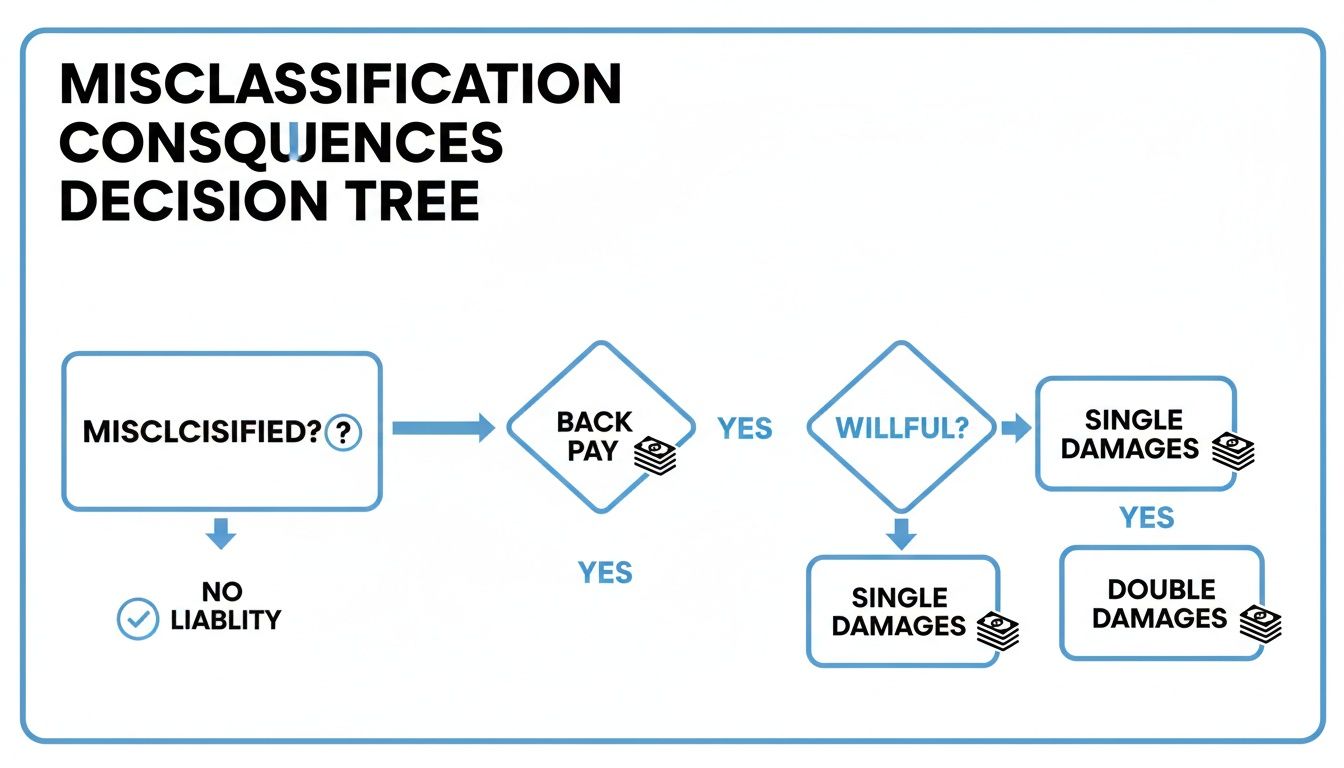
The key takeaway is that a misclassification claim can result in recovering not just the wages you're owed, but sometimes double that amount in damages.
What to Do If You Suspect Misclassification in Mississippi
That sinking feeling in your gut when you realize you might be misclassified as an exempt employee is a tough one. It's unsettling, but the most important thing to know is that you have a clear path forward to protect your rights. The first step isn't confrontation; it's organization. You need to build your case with solid evidence.
Your immediate focus should be on gathering every piece of documentation you can find related to your job and your hours. Think of it as creating a complete picture of your employment.
- Pay Stubs: These are non-negotiable. They show how you were paid—salary, hourly, etc.—and are foundational to any claim.
- Official Job Description: Get a copy of the official description from your employer. This document outlines what the company says you do.
- Personal Records: Any personal logs of your hours, emails you sent after your shift officially ended, or even simple notes about your day-to-day tasks can be incredibly persuasive.
With your documents in hand, it’s time for the most critical step: getting expert legal advice.
Consulting an Experienced Employment Attorney
This is one of those situations you absolutely should not handle on your own, especially here in Mississippi. Claims for unpaid overtime under the Fair Labor Standards Act (FLSA) go straight to federal court. Unlike other states, Mississippi does not have a human rights commission or a state-level Department of Labor to process wage and hour complaints. Legal representation isn't just a good idea; it's essential.
A seasoned Mississippi employment lawyer will cut through the confusion. They can review your pay structure and actual job duties, comparing them against the rigid FLSA tests to give you a definitive answer on your classification. Even more, they can calculate exactly what you're owed, which often includes back pay and liquidated damages. You can get more details on this in our guide to filing an unpaid wages lawsuit.
A qualified attorney also becomes your shield. They will manage all communication with your employer, which protects you from potential retaliation and ensures your claim is handled professionally. It takes the weight off your shoulders and puts it onto an expert who lives and breathes this area of law.
Understanding Legal Fees in Misclassification Cases
Worried about the cost? Don't be. Most people assume hiring a lawyer is financially out of reach, but that's not how these cases work. The vast majority of Mississippi employment firms take misclassification cases on a contingency fee basis.
This arrangement means you pay zero upfront fees. Nothing. The attorney only gets paid if they successfully recover money for you. Their fee is a pre-agreed percentage of the final settlement or court award, which is typically an average of 40-50%.
If you don’t win, you don’t pay any attorney's fees. It's a system designed to give every worker a fair shot at justice, regardless of their bank account.
Got Questions? We've Got Answers on Employee Classification
Sorting out the difference between exempt and nonexempt status can feel like navigating a maze. It’s confusing, and a lot of misinformation is floating around. Let's clear up some of the most common questions we hear from workers here in Mississippi.
"I'm on salary, so I'm automatically exempt, right?"
That’s probably the biggest myth out there, and the answer is a firm no. Simply receiving a salary doesn't make you exempt from overtime.
Think of it this way: being paid a salary is just one piece of a three-part puzzle. To be legally classified as exempt, your job must also pass the salary level test (meaning you earn a certain minimum amount) and the duties test (meaning your actual responsibilities fit into specific professional, administrative, or executive categories). Many salaried workers in Mississippi are misclassified because their day-to-day work doesn't meet those strict duty requirements.
"But my employer gave me a 'Manager' title. Doesn't that make me exempt?"
Not at all. Your job title means very little in the eyes of the law. What truly matters are your actual, daily responsibilities—not what's printed on your business card. The Department of Labor looks right past the title to see what you really do all day.
Let's say you're an "Office Manager," but 90% of your time is spent on routine clerical work like answering phones, ordering supplies, and filing. Even with that manager title, you're likely a nonexempt employee because your role doesn't involve significant management duties or the independent judgment required for an exemption.
An employer can't just slap a fancy title on a job to get out of paying overtime. If your main tasks are nonexempt, then you are a nonexempt employee and should be paid for your overtime hours.
"How long do I have to file a claim for my unpaid overtime?"
Time is definitely a factor here. Under the federal Fair Labor Standards Act (FLSA), you typically have a two-year window to file a lawsuit for unpaid overtime. That clock starts ticking from the date the violation occurred.
However, if you can show the employer's violation was "willful"—meaning they knew they were breaking the law or acted with reckless disregard for it—that deadline can be extended to three years. These time limits are strict, which is why it's so important to talk to an attorney as soon as you suspect something is wrong.
If you think you've been misclassified and denied the pay you rightfully earned, you don't have to take on your employer by yourself. At Nick Norris, P.A., we're committed to protecting the rights of Mississippi workers. Contact our team for the clear advice and strong representation you need.
This article has been reviewed for legal accuracy by Nick Norris. For employment law matters in Mississippi, consult with an attorney licensed to practice in your state.
Leave a Reply