

Overtime Exemption Rules: A Guide to Your Rights under overtime exemption rules
Overtime pay isn't a perk; for many workers, it's a right. The law that governs this is the Fair Labor Standards Act (FLSA), which sorts employees into two main camps: non-exempt (you get overtime) and exempt (you don't).
What determines which camp you're in? It’s not your job title or whether you get a salary. It all comes down to how much you're paid and, more importantly, what you actually do every day at work.
Understanding Your Pay Status Under the FLSA
Figuring out if you're exempt or non-exempt is one of the biggest factors impacting your paycheck. Think of it this way: a non-exempt employee is like being paid by the hour. You clock in, you clock out, and if you work more than 40 hours, you get paid a premium for that extra time.
An exempt employee, on the other hand, is more like being on a subscription plan. You're paid a flat salary to get the job done, whether it takes you 35 hours or 55 hours in a given week.
But an employer can't just decide to put you on the "subscription plan" to avoid paying overtime. Federal law has some very specific, non-negotiable rules. To legally classify an employee as exempt, they must pass all three of these tests:
- The Salary Basis Test: You have to be paid a fixed salary that doesn't get docked if you have a slow week or leave an hour early one day.
- The Salary Level Test: Your salary must meet a minimum weekly amount set by the federal government.
- The Job Duties Test: This is the big one. Your main day-to-day responsibilities must genuinely fall into one of the "exempt" categories, like executive, administrative, or professional work.
Fail even one of these, and you should be classified as non-exempt and earning overtime. It’s a crucial protection, and if you think you've been misclassified, you can learn more about what you might be owed by calculating potential unpaid overtime wages.
A lot of people find the differences between these two classifications confusing. Here is a quick table to help sort it out.
Exempt vs Non-Exempt Employee Quick Comparison
| Characteristic | Non-Exempt Employee | Exempt Employee |
|---|---|---|
| Overtime Pay | Eligible for overtime pay (1.5x regular rate) for hours worked over 40 in a week. | Not eligible for overtime pay, regardless of hours worked. |
| Payment Method | Typically paid an hourly wage, but can be salaried. | Must be paid a fixed salary that doesn't change based on hours worked. |
| Salary Minimum | No federal salary minimum (must be paid at least minimum wage). | Must meet a specific minimum salary threshold set by the FLSA. |
| Primary Focus | The number of hours worked. | The performance of specific job duties, regardless of hours. |
| Record Keeping | Employers must keep detailed records of all hours worked. | Employers are not required to track hours worked. |
Ultimately, this table shows that the rules are designed to protect employees who are paid for their time from being overworked without fair compensation.
The Ever-Changing Salary Threshold
That salary level test has been a major battleground. The U.S. Department of Labor (DOL) has tried to update the overtime rules several times, including a major push to raise the salary minimum. That one change was projected to make over 4 million workers newly eligible for overtime pay.
However, a federal court in Texas struck down that rule, which just goes to show how contested these issues are. It's a constant tug-of-war between worker protections and business costs, affecting a massive 120 million workers across the country.
The most important thing to remember is this: Your job title is basically meaningless. Your actual job duties and salary are what count. An "Assistant Manager" who spends 90% of their day running the cash register is almost certainly a non-exempt employee who should be getting overtime.
Knowing your rights is the first step. Getting misclassified can cost you thousands of dollars in lost wages over the years, so it's critical to understand where you stand under the law.
Passing the Three Key Tests for Exemption
For your employer to legally classify you as exempt from overtime, your job has to pass three specific tests laid out by the Fair Labor Standards Act. Think of it like a series of gates. To be considered exempt, you have to pass through all three.
If your job fails to clear even one of these gates, the law is clear: you are non-exempt and must be paid for every overtime hour you work. These aren't just suggestions; they are mandatory requirements. Understanding them is the first step in figuring out if you've been misclassified and are owed back wages.
This flowchart gives you a simple visual of how the exemption tests work, breaking down the decision process.
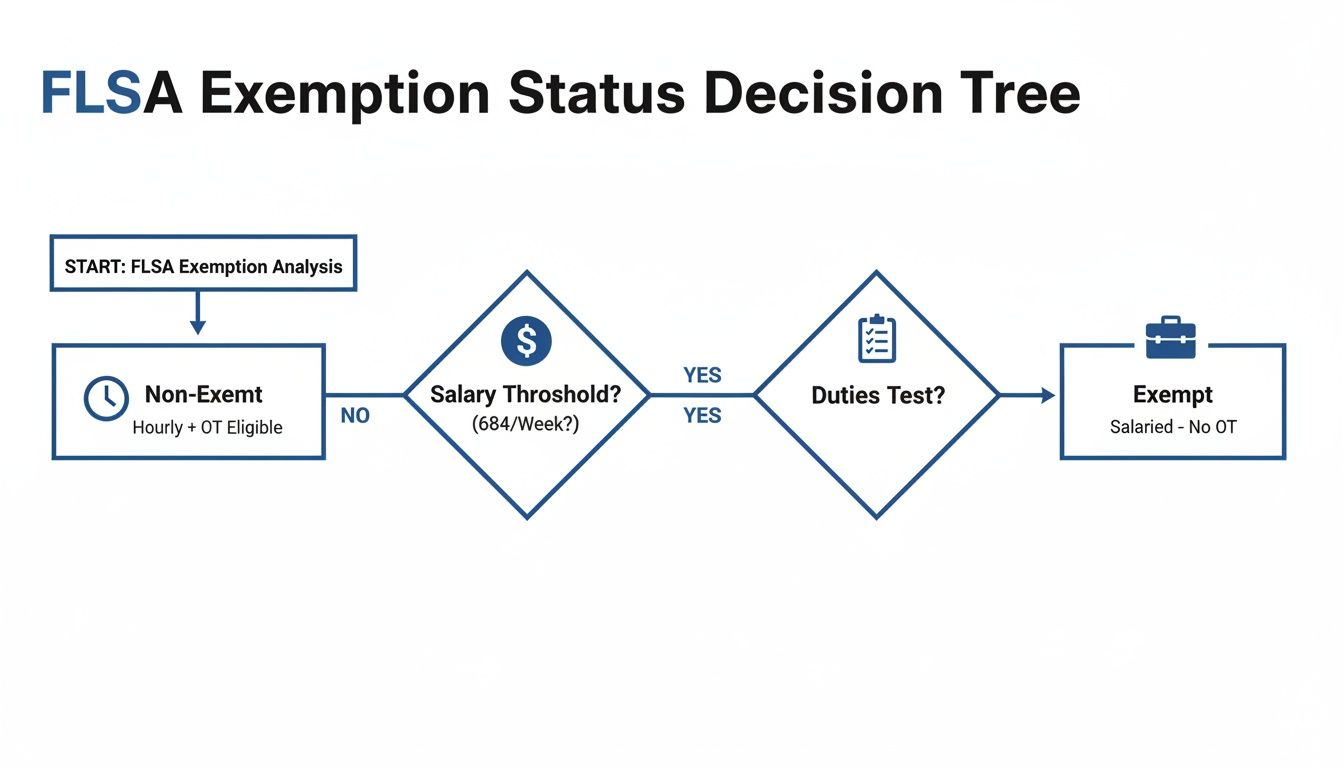
As you can see, if you fail either the salary test or the duties test, the path leads directly to non-exempt status, which means you're eligible for overtime pay.
Test 1: The Salary Basis Test
The first gate is the Salary Basis Test. This one isn't about how much you make, but how you're paid. To be exempt, you have to receive a predetermined, fixed salary every single pay period.
That fixed amount can't be chipped away at because of how much—or how well—you worked that week. Whether you put in 30 hours or 50, your base salary should not change.
Here’s a common mistake employers make: docking pay for partial-day absences. If you leave two hours early for a doctor's appointment, they generally can't subtract those two hours from your paycheck and still call you exempt. Making improper deductions like that can blow up your exempt status entirely.
Test 2: The Salary Level Test
Once you're through the first gate, you hit the Salary Level Test. This one is simple math. Your weekly salary has to meet a minimum dollar amount set by the U.S. Department of Labor.
Right now, the federal minimum salary threshold is $684 per week, which comes out to $35,568 per year. If you earn a penny less than this, you are automatically non-exempt and must be paid overtime, no matter how high-level your job duties seem.
It's crucial to know that this federal number is just the floor. While Mississippi follows the federal standard, some states have set their own, much higher minimums. For instance, in California, the exempt salary threshold for 2026 is projected to hit $70,304 a year.
The federal salary level is a moving target. It’s frequently challenged in court and subject to updates from new administrations. Always make sure you're looking at the current threshold to understand your rights.
Test 3: The Job Duties Test
The final—and by far the most complex—gate is the Job Duties Test. This is where the vast majority of misclassifications happen. Your job title is completely irrelevant; what matters is what you actually do day-in and day-out.
To be legally exempt, your primary responsibilities must fall squarely into one of the FLSA's "white-collar" exemption categories. The most common ones are:
- Executive Exemption: Your main job has to be managing the business or a department. This means you regularly direct the work of at least two full-time employees and have the power to hire, fire, or give recommendations on those decisions that carry real weight.
- Administrative Exemption: Your primary duty involves office or non-manual work directly related to the management or general business operations of the company. The key here is that you must exercise discretion and independent judgment on matters of significance. This is about more than just following procedures.
- Professional Exemption: This covers two types of roles. First are the "Learned Professionals" whose work requires advanced knowledge from prolonged, specialized schooling (think doctors, lawyers, accountants). Second are "Creative Professionals" whose work requires invention, imagination, or artistic talent (like writers, musicians, or actors).
If your job fails even one of these three tests—salary basis, salary level, or job duties—you are legally non-exempt. If you suspect your employer got it wrong, you could have a solid claim for unpaid wages. Talking to an employment lawyer is a smart move, as they typically work on a contingency fee basis. In Mississippi, that fee is often 40-50% of whatever you recover, meaning you pay nothing unless you win your case.
Decoding the Major Job Duty Exemptions
Your job title might say "manager," but that's just a label as far as federal law is concerned. The Fair Labor Standards Act (FLSA) looks right past the name on your business card and digs into the core of what you actually do every day. This is the heart of the matter—the Job Duties Test—and it's where most of the confusion and misclassification happens.
To be legally considered exempt from overtime, your main responsibilities have to fit squarely into one of the specific "white-collar" exemption categories defined by the law. If your day-to-day work doesn't match up, you should be classified as non-exempt and paid overtime, no matter what your title is or how much you make.

Let's break down what these common exemptions really mean out in the real world.
The Executive Exemption
This one is for true managers, not just employees with "manager" in their title. It's a three-part test, and you have to meet all three criteria to qualify.
- Your primary duty must be managing the business or a recognized department.
- You have to regularly supervise at least two or more other full-time employees (or their equivalent).
- You need to have real power to hire or fire, or your recommendations on hiring, firing, and promotions must carry significant weight.
A classic example of misclassification here is the "assistant manager" at a retail store. If that person spends 90% of their day ringing up customers, stocking shelves, and cleaning—the exact same work as the hourly staff—they aren't truly a manager. Their primary duty isn't management, so they likely don't qualify for this exemption.
The Administrative Exemption
This is easily one of the most misunderstood and misused exemptions. It’s not meant for administrative assistants or clerks doing routine office work.
To qualify, an employee’s job must involve:
- Office or non-manual work directly related to the management or general business operations.
- The primary duty must include the exercise of discretion and independent judgment on significant matters.
Here’s a simple way to think about it: are you following a detailed rulebook, or are you helping to write it? An employee who books travel by simply following a strict company policy is performing a routine, non-exempt task. But an office manager who researches vendors, negotiates contracts, and has the authority to decide on new office-wide procedures is a much better candidate for this exemption.
The real sticking point here is "matters of significance." This means you're not just following orders. You're analyzing different options, weighing potential outcomes, and making decisions that have a real impact on the business.
The Professional Exemption
This category is actually split into two very different types: "Learned Professionals" and "Creative Professionals."
The Learned Professional exemption is for jobs that require advanced, specialized knowledge, usually earned through extensive academic training.
- Think: Doctors, registered nurses, lawyers, accountants, and engineers.
- The Test: The work has to be mainly intellectual and demand consistent use of professional judgment. A paralegal who spends their day on routine legal research probably doesn't qualify, but the licensed attorney providing legal counsel and strategy almost certainly does.
The Creative Professional exemption is for jobs centered on invention, imagination, or artistic talent.
- Think: Musicians, writers, actors, and some high-level journalists.
- The Test: The work must be genuinely original and creative. A reporter who just rewrites press releases isn't a fit. But an investigative journalist who develops their own sources and creates original, in-depth stories might be.
Other Key Exemptions
Beyond those main three, a couple of other common exemptions pop up frequently.
- Computer Employee Exemption: This is for highly skilled tech workers like systems analysts, programmers, and software engineers. Their primary job has to involve complex tasks like systems analysis or designing and developing computer software. A help desk tech who just follows a script to troubleshoot common problems won't meet this standard.
- Outside Sales Exemption: This applies to employees whose main job is making sales and who do that work away from the employer's office. "Inside sales" staff who sell from their desk over the phone or email do not qualify for this specific exemption.
If you read through these descriptions and feel like your job duties don't truly match these strict definitions, there's a good chance you've been misclassified. Here in Mississippi, we don't have a state agency for wage claims, so your main path is through the federal Department of Labor.
Another strong option is to speak with an employment lawyer. Many attorneys take these cases on a contingency fee basis, which often averages 40-50% of the final settlement. This means you don't pay anything unless they successfully recover money for you.
Spotting Common Misclassification Red Flags
Knowing the official overtime rules is one thing, but seeing how they get twisted and misapplied in the real world is another story entirely. Most of the time, misclassification isn't a case of an employer trying to pull a fast one. It's usually a genuine misunderstanding of some very complicated federal laws. But even honest mistakes can end up costing you thousands in unpaid overtime.
The trick is to stop thinking about your job title and start focusing on what you actually do day in and day out. Too many employers fall into the same old traps, assuming that putting an employee on salary or giving them a fancy title automatically makes them exempt from overtime. This section is your field guide to spotting those common red flags.
The Salaried Employee Myth
This is probably the biggest and most stubborn myth out there: if you get a salary, you don't get overtime. That's just flat-out wrong.
Getting paid a salary only checks one of the three boxes required to be exempt—the Salary Basis Test. To be legally exempt, your job also has to meet the salary level test and, most importantly, the job duties test. An employer can't just flip you from hourly to salaried to get out of paying overtime. If your day-to-day work is non-exempt, you're owed overtime for every hour you work over 40 in a week, salary or not.
Inflated Titles Without Real Authority
Handing out impressive titles like "Assistant Manager" or "Team Lead" is another classic red flag. The FLSA couldn't care less about what's on your business card; it only cares about your actual responsibilities and power.
The Executive Exemption, for example, is incredibly specific. You have to primarily manage the business, direct the work of at least two full-time employees, and have real, meaningful say in hiring, firing, and promoting.
A Real-World Example: The 'Assistant Manager'
Meet Sarah. Her title is "Assistant Manager" at a local boutique. It sounds official, but she spends over 90% of her time doing the exact same things as the hourly sales associates: running the register, stocking shelves, and helping customers. She has zero authority to hire, fire, or even formally discipline anyone.
The Verdict: Sarah is almost certainly misclassified. Her primary duty is retail sales, not management. She should be non-exempt and getting paid time-and-a-half for all those extra hours she works during the holiday rush.
Routine Work Dressed Up as an "Administrative" Role
The Administrative Exemption is probably the most abused and misunderstood rule of them all. It’s meant for employees whose work is directly related to the management or general business operations and who use their own independent judgment on important matters. It’s not a catch-all for people who perform routine administrative or clerical work.
Here are a few tell-tale signs you might be misclassified under this exemption:
- You're just following a script. If your job boils down to following a detailed manual or set of procedures with no room to think for yourself, you likely don't meet the "independent judgment" test.
- You have no real power. You can't make significant decisions that affect the business, like negotiating contracts, setting company policy, or committing the company to major expenses.
- Your work is task-based. Your role is more about checking off a list of duties than it is about managing major projects or core business functions.
Think of it this way: an "HR Coordinator" who just processes pre-approved new-hire paperwork and schedules interviews based on a manager’s calendar is likely non-exempt. On the other hand, an "HR Manager" who develops the company's salary structure and has the authority to investigate and resolve employee disputes would likely be exempt.
If something feels off about your classification, it's worth asking questions. Many people worry about blowback, but it's illegal for your employer to punish you for inquiring about your pay. It's a good idea to know the common signs of retaliation at work.
Here in Mississippi, we don’t have a state-level labor department that handles wage claims. Your main options are to file a complaint with the federal U.S. Department of Labor or to talk with an attorney. Fortunately, employment lawyers in Mississippi typically take these cases on a contingency fee basis—usually around 40-50%—which means you don't pay any legal fees unless you win your case.
What to Do If You Suspect You Are Misclassified
That sinking feeling in your gut when you realize your paycheck doesn't match the hours you're putting in can be incredibly stressful. If the overtime exemption rules we've walked through just don't line up with your day-to-day reality, it might be time to act.
Your first move isn't confrontation—it's documentation. You need to become your own best advocate by creating a detailed record of your work life.

Honestly, the strength of any potential claim often comes down to the quality of the evidence you can present. A solid, factual record is your most powerful tool.
Start Your Documentation Process
Before you do anything else, start building a private record. It’s critical that you do not use company computers, phones, or email accounts for this. Keep your notes in a personal notebook, a secure app on your own phone, or send details to your private email address.
Here’s what you should be tracking:
- A Detailed Hours Log: For at least a few months, write down the exact time you start and stop work every single day. Make sure to note your lunch breaks and any time you spend working "off the clock," like responding to emails late at night or taking calls on the weekend.
- Pay Stub Collection: Save every pay stub. These are your employer's official records of what they paid you and for which specific pay periods.
- Job-Related Documents: Gather your official job description, your performance reviews, and the company handbook. These documents show what the company claims your duties are supposed to be.
- Relevant Communications: Save any emails, text messages, or memos from your supervisors that describe your job duties or assign you tasks. These communications often paint a much more accurate picture of your actual responsibilities than a formal job description ever could.
Keep your documentation strictly factual. Stick to dates, times, tasks performed, and who gave you the instructions. Leave out personal opinions or emotional commentary. This approach makes your records a far more credible and powerful tool down the road.
Filing a Federal Wage Claim
Once you have a few months of solid documentation, you have a direct path to file a claim at the federal level. Mississippi doesn't have its own state-level labor department to handle these types of wage issues. That makes your primary resource the U.S. Department of Labor's Wage and Hour Division (WHD).
You can file a complaint with the WHD regardless of your immigration status, and the entire process is confidential. An investigator will likely contact both you and your employer to get the facts, review your records, and determine if a violation of the overtime exemption rules has occurred. If the WHD agrees you're owed back wages, they will work to recover that money for you.
Consulting an Employment Law Attorney
Another powerful option is to speak with an employment law attorney who focuses on wage and hour disputes. A good lawyer can look at your specific situation, review your documentation, and give you a straightforward assessment of how strong your claim is. That professional guidance can be priceless.
Many people hesitate to call a lawyer because they worry about the cost, but most employment attorneys in Mississippi take these cases on a contingency fee basis.
What does that mean? It means you pay nothing upfront. The attorney only gets paid if they win your case, taking a percentage of the money they recover for you—typically around 40-50%. If you don't win, you don't owe them a fee. This setup allows employees to seek justice without a huge financial risk. If you decide to go this route, it's wise to understand how to prepare for your first talk with an employment lawyer to make that initial meeting as productive as possible.
Common Questions (and Myths) About Overtime Exemptions
Let's cut through the confusion. When it comes to overtime rules, there are a handful of questions and misconceptions that pop up again and again. Here are straight answers to some of the most common ones we hear from workers.
"I Get a Salary, So I'm Not Owed Overtime, Right?"
This is probably the single biggest myth out there, and the answer is a firm no. Simply being paid a salary doesn't automatically make you exempt from overtime. It only checks one box in the FLSA's required three-part test.
Think of it like a three-legged stool. To be legally exempt, your job has to stand on all three legs:
- The Salary Basis Test: You're paid a set salary that doesn't change based on hours worked. (This is the part most people know.)
- The Salary Level Test: That salary has to meet the current federal minimum weekly amount.
- The Job Duties Test: This is the big one. Your actual day-to-day responsibilities must fit squarely into one of the specific exempt categories (Executive, Administrative, Professional, etc.).
If your job fails any one of these tests, you are legally non-exempt and must be paid overtime for any hours you work over 40 in a week. An employer can't just slap a salary on a non-exempt job to get out of paying you fairly.
"My Job Title Is 'Manager,' but I'm Doing the Same Work as My Team. Am I Exempt?"
Your job title means nothing to the Department of Labor. What truly matters are your primary, day-to-day duties. The Executive exemption was created for people whose main job is actually managing, not for employees who have a manager title but spend their time on the front lines.
To qualify for this exemption, your job has to meet some pretty strict criteria. Your primary duty has to be management, you must regularly direct the work of at least two full-time employees, and you need to have real authority to hire, fire, or make recommendations that carry serious weight.
So, if you spend most of your shift running a cash register, stocking shelves, or dealing directly with customers right alongside your team, you are almost certainly misclassified. The title doesn't change the work, and you should be getting paid overtime.
An employer can't just hand you a "manager" title to get around the overtime rules. If your main function isn't genuine management, then in the eyes of the FLSA, you're not a manager—and you deserve to be paid for all your hours.
"Can My Boss Dock My Salary if I Miss a Few Hours of Work?"
In most cases, absolutely not. For your pay to meet the "salary basis" test, you must receive your full, guaranteed salary for any week you do any work at all. If an employer makes improper deductions from your salary, they can actually destroy your exempt status, which could make you eligible for back overtime pay.
For instance, if you're an exempt employee and you need to leave two hours early for a doctor's appointment, your employer generally can't dock your pay for those two hours. Deductions for partial-day absences are a big red flag.
There are, however, a few specific exceptions where deductions are allowed, like taking a full day off for personal reasons or facing penalties for violating major safety rules.
"How Long Do I Have to File a Federal Overtime Claim?"
This is critical because there's a ticking clock. The legal time limit, known as the statute of limitations, dictates how far back you can claim unpaid wages. Under the federal Fair Labor Standards Act (FLSA), you generally have two years from the date your pay was illegally withheld to file a claim.
This means you can typically recover back pay for the two-year period right before you file your complaint.
That window can get bigger, though. If you can show that your employer's violation was "willful"—meaning they knew they were breaking the law or acted with reckless disregard for it—the statute of limitations extends to three years.
Because of these deadlines, it’s vital to act quickly if you think you’ve been misclassified. Waiting too long could mean losing the right to claim money you've earned. Here in Mississippi, we don't have a state agency to handle these issues, so your main options are filing a complaint with the U.S. Department of Labor or getting legal help. An employment attorney can give you a clear path forward, and most work on a contingency fee basis (often 40-50%), so you don't pay anything upfront.
If you believe your employer has violated the overtime exemption rules and you're not being paid what you've earned, you don't have to face the situation alone. Nick Norris, P.A. is a Mississippi employment law firm dedicated to protecting the rights of workers across the state. Contact us for a clear evaluation of your case and firm advocacy to pursue the wages you are owed. You can learn more at https://www.nicknorris.law.
This article has been reviewed for legal accuracy by Nick Norris. For employment law matters in Mississippi, consult with an attorney licensed to practice in your state.
Leave a Reply