
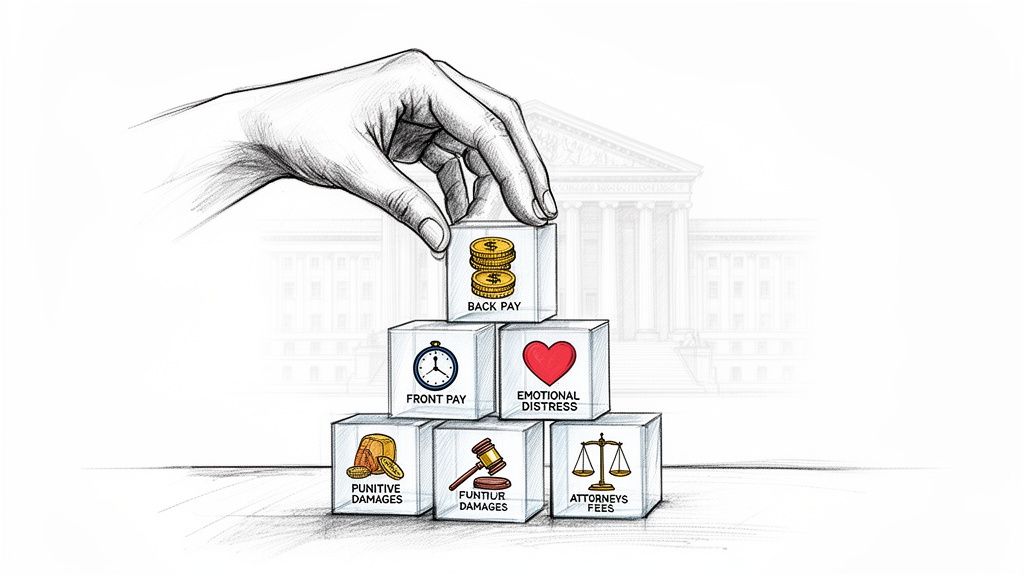
Wrongful Termination Settlement Amounts: Your Guide to Recovery
If you've been wrongfully terminated in Mississippi, you're probably wondering what a potential settlement might look like. There's no single "average" number. Instead, a settlement is built by adding up the specific damages you've suffered because of the illegal firing.
Every case is different, of course, but your compensation will generally cover lost wages, the money you'll lose while looking for a new job, emotional harm, and your legal fees. The final amount really boils down to the strength of your evidence and the unique facts of your situation.
Understanding the Components of a Settlement
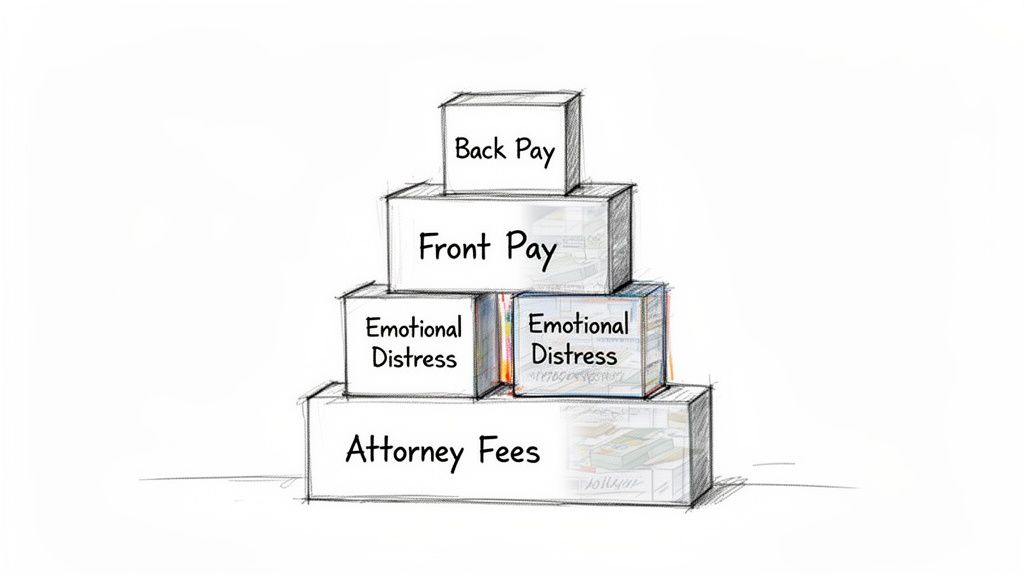
Being illegally fired can turn your world upside down, both financially and emotionally. A wrongful termination settlement is meant to make you whole again, but it's not some arbitrary figure pulled out of a hat. It’s calculated piece by piece, like building with blocks, where each type of damage adds to the final value.
Think of your potential settlement as a pyramid. Each block represents a different type of damage you can claim, and the strength of your evidence is the mortar holding it all together. The better your documentation and testimony, the stronger your claim—and the higher your potential settlement.
The Building Blocks of Your Claim
The main components that make up a settlement are legally recognized categories of damages. Knowing what they are is the first step in figuring out what you might be entitled to recover. The key elements include:
-
Back Pay: This is the most concrete part of a settlement. It covers all the wages, bonuses, and benefits you lost from the day you were fired until your case is resolved.
-
Front Pay: Sometimes, getting your old job back isn't an option. Front pay is designed to compensate you for the future earnings you'll lose while you search for a similar job.
-
Emotional Distress: This part of the settlement accounts for the real psychological harm—the anxiety, stress, depression, and sleepless nights—caused by being illegally fired.
-
Attorney's Fees: In many successful cases, the law requires your former employer to pay your legal costs. These are almost always handled on a contingency basis.
In Mississippi, most employment lawyers work on a contingency fee, which means you pay nothing upfront. The fee, often between 40-50%, is taken only from the money recovered for you.
When we talk about the components of a settlement, we're really talking about building a case for each type of damage. The table below breaks down what each component covers and what kind of proof is typically needed.
| Damage Component | What It Covers | Key Evidence Required |
|---|---|---|
| Back Pay | Lost wages, bonuses, commissions, and the value of lost benefits (health insurance, retirement contributions) from termination to settlement. | Pay stubs, W-2s, commission statements, employee handbooks, and records of benefit costs. |
| Front Pay | Projected future lost earnings if reinstatement is not feasible. This covers the time it will likely take to find a comparable job. | Expert testimony on job market conditions, your resume, job search records, and evidence of your efforts to find new work. |
| Emotional Distress | Compensation for mental anguish, anxiety, depression, insomnia, and other psychological harm caused by the termination. | Your testimony, medical records, therapy bills, and statements from family, friends, or mental health professionals. |
| Attorney's Fees | The legal costs and expenses incurred to pursue your case. Most statutes allow the winning employee to recover these fees. | Detailed billing records and invoices from your attorney outlining the work performed on your case. |
As you can see, each piece of the puzzle requires its own specific evidence to build a strong claim for fair compensation.
Why Every Case Is Different
While these components are standard, the final settlement figure can vary dramatically from one case to the next. Things like your salary, how blatantly your employer broke the law, and the quality of your evidence all have a huge impact.
For example, a high-earning executive with a clear "smoking gun" email proving discrimination will have a very different case than an entry-level worker who only has their word against their manager's. Feeling wronged isn't enough; you have to prove it. This is why careful documentation is so critical, as this helpful employee termination checklist explains.
How We Calculate What Your Case is Really Worth
Figuring out the value of a wrongful termination case isn't about pulling a number out of thin air. It’s a methodical process, much like an insurance adjuster assessing a claim. We have to look at every single loss you've suffered—tangible and intangible—and add them up piece by piece.
Each part of your claim has to be backed up by solid evidence. The stronger your documentation, the more leverage we have. Let's walk through the key components that build the foundation of a settlement demand.
Back Pay: The Money You're Owed
The easiest number to start with is back pay. Think of this as the bedrock of your settlement. It’s simply all the money you should have been paid from the day you were illegally fired until your case is resolved.
But it’s not just your base salary. We look at the full picture of your compensation, which includes:
-
Lost Wages and Salary: Every dollar you would have earned.
-
Bonuses and Commissions: Any performance-based pay you were on track to receive.
-
Lost Benefits: This is a big one people forget. We calculate the value of things like lost health insurance premiums, 401(k) matches, and vacation days.
To get this number right, we’ll gather your pay stubs, W-2s, and employment contract. The goal is to create an undeniable record of your direct financial losses.
Front Pay: Accounting for Future Losses
Back pay covers the past, but what about the future? That's where front pay comes in. It’s rare that going back to your old job—a process called "reinstatement"—is a realistic or healthy option. So, front pay is designed to be a financial bridge to get you back on your feet.
Think of it this way: your career was on a clear path, and the wrongful termination blew up the road ahead. Front pay compensates you for the time and earnings you'll lose while you search for a new job that pays what you were making before. This calculation isn't guesswork; it's based on factors like your age, your specific profession, and how strong the job market is for someone with your skills.
Emotional Distress Damages: The Human Cost of Being Fired
Losing your job illegally isn't just a financial hit; it’s a deeply personal and stressful event. Emotional distress damages are meant to compensate you for the real psychological harm caused by the employer’s actions. We're talking about anxiety, sleepless nights, depression, and the strain this puts on your family and relationships.
Proving this requires more than just saying you were upset. The strongest claims are backed by testimony from family and friends who saw the change in you, and especially by records from a doctor, therapist, or counselor who treated you for that stress.
This part of the settlement acknowledges that the damage went far beyond your wallet. The value here often depends on how outrageous the employer's conduct was and how well we can document the impact it had on your life.
Punitive Damages and Attorney’s Fees
In the most serious cases, an employer's behavior is so reckless or malicious that the court needs to send a message. Punitive damages aren't about paying you back for a loss; they are designed purely to punish the company and stop them from ever doing something similar again. These are reserved for the worst-of-the-worst situations involving discrimination or retaliation.
Finally, there’s the matter of legal fees. Thankfully, most federal employment laws have a crucial provision: if you win, the employer has to pay your attorney’s fees. This is what allows everyday people to take on big companies. Here in Mississippi, we typically work on a contingency fee of 40-50%, which means you pay nothing unless we win your case.
Nationally, the average wrongful termination settlement tends to land somewhere between $30,000 and $50,000. But this is just an average—cases involving high-earning individuals or severe discrimination can be much higher. For instance, a well-known case resulted in a $2.3 million award for a woman fired due to her pregnancy. That award included her lost wages, significant emotional distress damages supported by medical records, and punitive damages. With 95% of these cases settling before they ever see a courtroom, having an experienced negotiator is key to securing a fair outcome. You can explore more legal payout statistics to see how these numbers can vary.
Key Factors That Influence Your Settlement Amount
Ever wonder why some wrongful termination cases end with massive settlements while others get a fraction of that? It’s not random. The final number comes down to a handful of critical factors that lawyers and courts use to weigh the strength and value of a claim.
Think of it like building a case brick by brick. The more solid evidence you have, the stronger your foundation becomes, and the higher the potential value. Understanding these elements is the first step toward setting realistic expectations and fighting for what you’re truly owed.
The Strength of Your Evidence
This is, without a doubt, the single most important piece of the puzzle. A vague feeling that you were wronged won’t get you far. You need cold, hard proof that your firing was illegal.
Strong evidence is what separates a weak "he said, she said" argument from a case that puts real pressure on your former employer. The best evidence usually falls into one of these categories:
-
Written Documentation: This is the gold standard. Emails, text messages, performance reviews that suddenly turn negative right before you were fired, or internal memos can be undeniable.
-
Witness Testimony: A coworker who is willing to go on record about discriminatory comments or unfair treatment can be incredibly powerful. Their credibility can corroborate your entire story.
-
Direct vs. Circumstantial Evidence: Finding a "smoking gun" email where a manager explicitly states an illegal reason for firing you is rare, but it’s direct evidence and invaluable. More often, we build a case on circumstantial evidence—a clear pattern of behavior that points to an illegal motive.
Having a lawyer to help you gather and present this evidence makes a world of difference. A Nolo study found that employees with an attorney received a settlement or award 64% of the time, with an average payout of $48,800. Those who went it alone? They only succeeded 30% of the time and got a much smaller average of $19,200. The data is clear: cases with both witness and written proof had a 63% success rate. You can read more about these wrongful termination success rates and see just how critical solid evidence is.
The Employer's Conduct
What your employer did—and how they did it—matters. A lot. Was this a one-time, boneheaded mistake, or was it part of a malicious, calculated effort to push you out?
The more outrageous or egregious the employer's conduct, the higher the potential for significant damages, including emotional distress and, in rare cases, punitive damages.
If the company has a history of similar discriminatory behavior or tried to cover its tracks, its negotiating position gets a lot weaker. Juries and judges don’t look kindly on companies that act in bad faith, and evidence of intentional malice or retaliation almost always drives settlement values up.
Your Salary and Job Tenure
The financial math is straightforward. Your salary is the starting point for calculating economic damages like back pay and front pay. The higher your income, the greater your financial losses, and the larger your potential claim.
How long you were with the company also plays a big role. Firing a loyal, long-term employee is often viewed more critically. Plus, it’s usually harder for someone who has been in the same job for a decade or more to find a similar position, which can significantly increase the front pay portion of a settlement.
This diagram helps visualize how these factors build the core of a settlement.
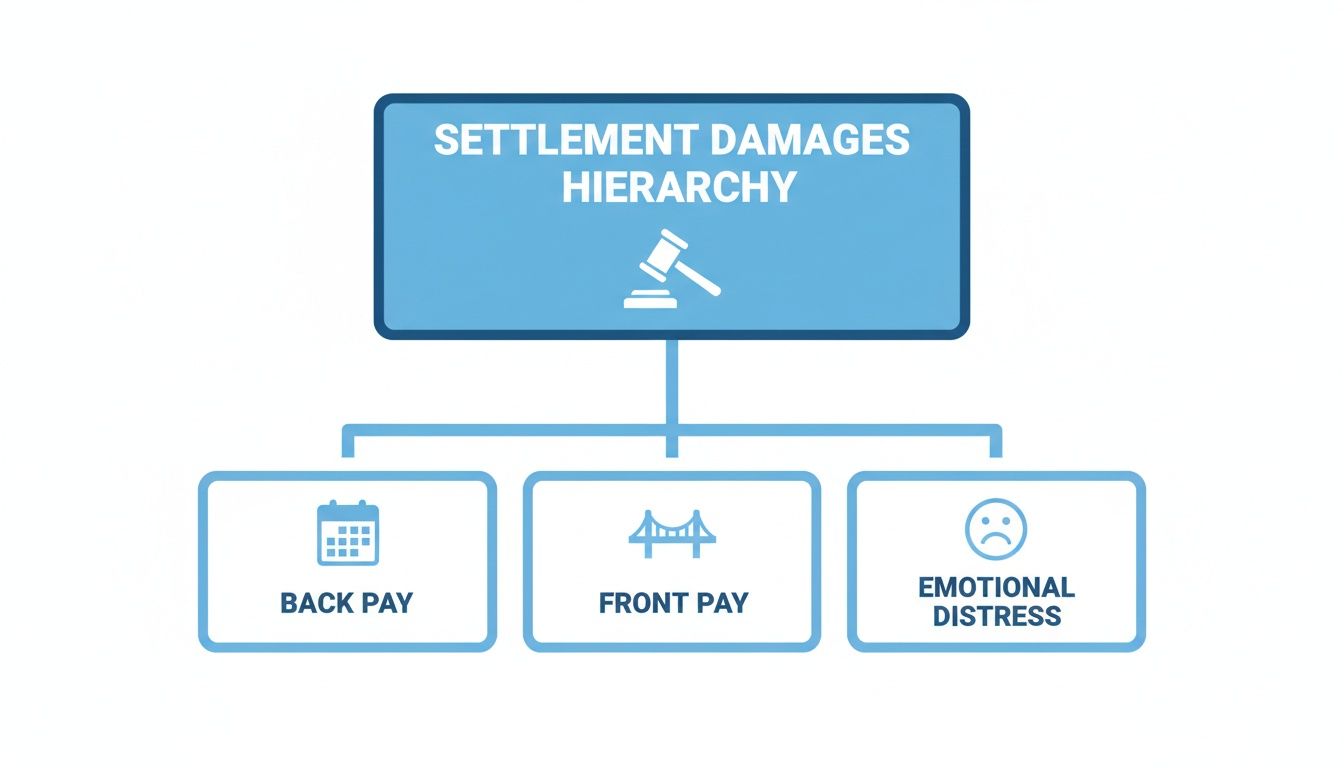
As you can see, back pay, front pay, and emotional distress are the main pillars, and their value is directly tied to the specifics we've been discussing.
Mitigation of Damages
Finally, what you do after being fired is also part of the equation. The law says you have a duty to "mitigate" your damages. In plain English, that means you can’t just sit at home and wait for a check—you have to actively look for a new job.
Keep a detailed log of your job search. Track every application you submit, every interview you have, and every networking event you attend. If your former employer can prove you weren’t making a good-faith effort to find new work, they can argue that your ongoing financial losses are partially your fault, which can lower your final settlement.
Each of these factors interacts with the others, creating a unique valuation for every wrongful termination case. Here's a quick summary of how they can swing the numbers.
Factors Impacting Wrongful Termination Settlement Value
| Factor | Potential Impact on Settlement | Example |
|---|---|---|
| Strength of Evidence | Increases | Finding a "smoking gun" email or text message from a manager proving discrimination. |
| Egregious Employer Conduct | Increases | The company has a documented history of similar illegal actions or actively tried to hide its wrongdoing. |
| High Salary | Increases | A top executive's lost wages (back and front pay) will be substantially higher than an entry-level employee's. |
| Long Job Tenure | Increases | Firing a loyal 20-year employee is viewed more critically than firing someone who worked there for 6 months. |
| Weak Evidence | Decreases | Your claim is based only on a "gut feeling" with no documents or witnesses to back it up. |
| Failure to Mitigate Damages | Decreases | You make no effort to find a new job for over a year after being terminated. |
As you can see, the value of a settlement isn't pulled out of thin air. It’s a calculated assessment based on the specific, provable details of your situation.
Understanding Wrongful Termination Claims in Mississippi
Losing a job is tough, and it can be especially confusing in an "at-will" employment state like Mississippi. In simple terms, the at-will doctrine means an employer can fire an employee for almost any reason—or even no reason at all—without breaking the law.
But here’s the crucial part: "at-will" does not mean "anything goes." It’s not a free pass for employers to act illegally. An employer is still breaking the law if they fire you for a discriminatory reason, as an act of retaliation, or for exercising your rights.
The Real Limits of At-Will Employment
While your boss can legally fire you for a silly reason, like not being a fan of their favorite football team, they absolutely cannot fire you for an illegal one. This is where powerful federal laws step in and override Mississippi's at-will status.
These laws strictly prohibit an employer from firing you based on who you are. This includes your:
-
Race or skin color
-
Sex, gender, or pregnancy status
-
Religion or national origin
-
Age (if you are 40 or older)
-
Disability or medical condition
On top of that, it is illegal for your boss to fire you for standing up for your rights. This is called retaliation, and it covers actions like reporting harassment, participating in a discrimination investigation (also known as whistleblowing), or asking for a reasonable accommodation for a disability.
Where Do You Go to File a Claim?
This is where Mississippi’s legal system is a bit different, and it's a detail that trips up a lot of people. In many states, you'd start by going to a state-level agency, like a "human rights commission," to file a complaint.
Mississippi does not have a human rights commission. This is a critical point. It means that for Mississippi workers, the fight against wrongful termination based on discrimination or retaliation almost always happens under federal law.
Since these are federal issues, your case will be handled by a federal agency: the Equal Employment Opportunity Commission (EEOC). The EEOC is the government body that investigates charges of discrimination against employers nationwide, making it the starting point for nearly all wrongful termination claims in Mississippi.
So, your first step will be to file a formal "Charge of Discrimination" with the EEOC.
The Clock is Ticking: Your 180-Day Deadline
Knowing you have to go through the EEOC brings us to the single most important rule you need to follow: the deadline. In Mississippi, you have a very short and strict window to take action after being fired illegally.
You must file your charge with the EEOC within 180 days of the day you were terminated. This isn't a guideline—it's a hard deadline called a statute of limitations.
If you miss this 180-day cutoff, you lose your right to pursue a claim forever. It doesn't matter how obvious the discrimination was or how much proof you have. Once that window closes, it's closed for good. This is precisely why it's so important to speak with a knowledgeable employment lawyer immediately if you believe you were fired illegally.
The Settlement Process: From Claim to Resolution
Knowing your rights is one thing, but understanding the actual path from filing a claim to getting a check in hand is what gives you real power. The surprising truth is that the vast majority of wrongful termination cases—over 95% by most estimates—never end up in a courtroom. They’re settled out of court through negotiation, which saves everyone the stress, time, and sheer unpredictability of a trial.
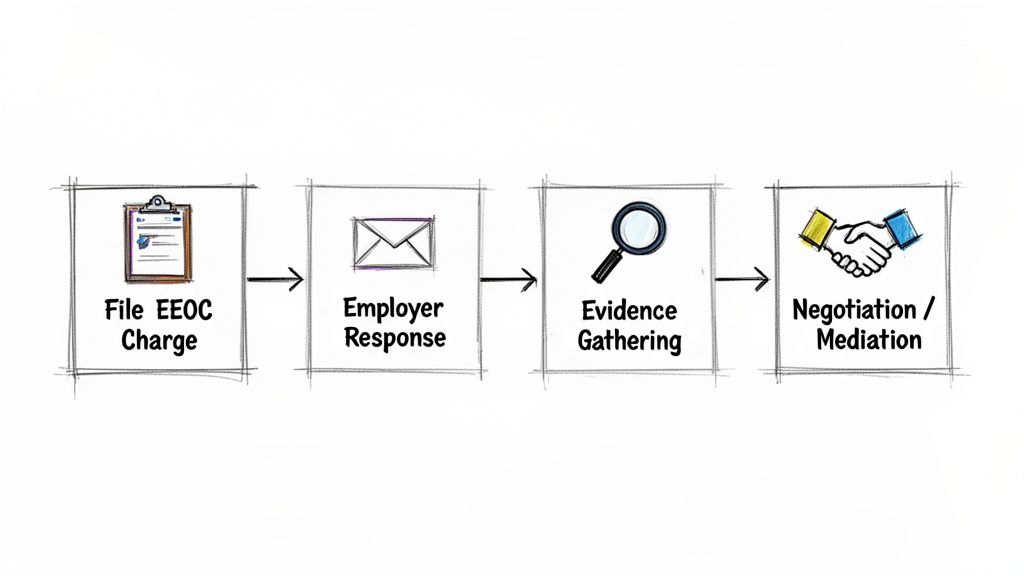
This whole journey follows a pretty clear, structured path that starts long before anyone even thinks about a lawsuit. It’s all designed to encourage a resolution, and it kicks off the moment you formally put your employer on notice. For us here in Mississippi, that means filing a claim with the Equal Employment Opportunity Commission (EEOC).
Kicking Off the Process: The EEOC Charge
Since Mississippi doesn't have its own state-level agency to handle these kinds of claims, the EEOC is where you have to start. Filing what's called a "Charge of Discrimination" is the official first move that gets the ball rolling. This isn't just filling out paperwork; it's a formal legal action that forces your former employer to respond.
Once you file the charge, the EEOC officially notifies your employer. They then have a chance to submit a written response to your allegations. This first exchange is a critical moment where both sides start to lay their cards on the table.
Gathering Evidence and Building Leverage
After those initial filings, we move into the evidence-gathering phase, which lawyers often call "discovery." This is where your attorney digs in to collect all the documents, witness statements, and communications needed to build a rock-solid case. Every email, performance review, or text message that backs up your story adds another layer of leverage.
The strength of your documented claim is the single most important factor during settlement talks. A well-supported charge shows the employer the financial and legal risks they face by not negotiating in good faith.
This evidence becomes the backbone of your negotiating position. It gives your lawyer the ammunition to prove your claim is valid and push back when the employer tries to downplay what happened or offer you a lowball settlement. Getting the first steps right is crucial, and you can learn more about how to file a wrongful termination claim in our detailed guide.
Negotiation and Mediation
With a strong case built, the focus shifts to trying to resolve the dispute. This can happen in a couple of ways: either through direct negotiations between your attorney and the company's lawyers, or through a more formal process called mediation.
Mediation brings in a neutral third-party—the mediator—to help guide the conversation. Their job is to help both sides find common ground and reach a settlement everyone can agree on. The EEOC actually offers mediation as a quick way to resolve charges. Throughout this entire stage, your lawyer is your advocate, strategically presenting the evidence and fighting for a fair wrongful termination settlement amount that truly covers your losses.
How Your Attorney Gets Paid
One of the first questions people have is, "How can I afford a lawyer?" It's a huge concern, but luckily, you don’t have to worry about paying for legal fees upfront. Employment lawyers in Mississippi, including us at Nick Norris, P.A., almost always work on a contingency fee basis.
What does that mean? It’s simple: your attorney only gets paid if they win your case and recover money for you. The fee is just a percentage of your final settlement or jury award. Here in Mississippi, that contingency fee is typically between 40-50%.
-
Shared Risk: Your lawyer is fully invested in winning. If you don't get paid, neither do they.
-
Payment from Settlement: All legal fees are simply deducted from the money recovered for you at the end.
This system levels the playing field, making sure that everyone can get skilled legal help, no matter their financial situation. It lets you go after justice without the stress of hourly legal bills, knowing your lawyer is motivated to get you the best outcome possible.
Your Wrongful Termination Questions, Answered
Losing a job illegally throws your life into chaos, and it’s completely normal to have a million questions running through your mind. Let’s cut through the noise and get you some straight, practical answers to what Mississippi workers ask most often about wrongful termination settlements.
How Long Does It Take to Get a Wrongful Termination Settlement?
I know you want a fast resolution, but the truth is, there’s no set timeline. A wrongful termination case can wrap up in just a few months, or it could stretch out for over a year. It really hinges on two things: the complexity of your case and the quality of your proof.
If you have a smoking gun—say, a clear paper trail of discrimination—your case might settle quickly, sometimes not long after we file a charge with the EEOC. But if the legal issues are tangled or your former employer digs in their heels and refuses to be reasonable, it's going to take longer. An experienced lawyer can often speed things up by building a powerful, organized case right from the start that shows the other side we mean business.
Are Wrongful Termination Settlements Taxable?
Yes, for the most part, you should expect to pay taxes on your settlement money. The IRS views it as income, and it's critical to understand how different types of damages are treated so there are no nasty surprises later.
-
Lost Wages (Back Pay & Front Pay): This is treated just like your old paycheck. You'll pay income and employment taxes on it.
-
Emotional Distress: This part is also usually taxable. The only exception is if the emotional pain is a direct result of a physical injury or illness.
-
Punitive Damages: These are always taxable, no exceptions.
-
Attorney's Fees: This is the tricky one. The portion of the settlement that covers your lawyer's fees might still be considered taxable income to you. You may, however, be able to deduct it.
Tax laws are a maze. That’s why I always advise clients to talk with a tax professional in addition to their legal counsel. We can work together to structure the settlement in the most tax-friendly way possible.
What Is the First Step If I Believe I Was Wrongfully Fired?
If you feel in your gut that something was illegal about your firing, what you do next is absolutely critical. Time is not on your side, so let’s get straight to the point.
First, become a document hoarder. Gather up everything related to your job: your employment contract, glowing performance reviews, the termination letter, and any texts, emails, or messages about your work or the firing. Don't delete a thing.
Next, while it’s all fresh, write down a detailed timeline of everything that happened leading up to your termination. Most importantly, call an experienced Mississippi employment lawyer immediately. You have a strict 180-day deadline to file a charge with the EEOC. Miss it, and your claim is likely gone forever. A lawyer will make sure that doesn't happen.
For more on this, take a look at our guide on how to prepare for your first talk with an employment lawyer.
Can I File a Claim If I Was Forced to Quit My Job?
Yes, absolutely. Even if you were the one who said, "I quit," you might still have a powerful case. It’s a legal principle called constructive discharge.
This happens when a company makes your working conditions so unbearable that any reasonable person would feel they had no other option but to leave.
Think of it this way: to win a constructive discharge claim, you have to prove the work environment was objectively intolerable, not just that you were personally unhappy. This is a very high legal bar to clear.
What does that look like in the real world? It could be constant, severe sexual harassment that management ignores, being demoted for a discriminatory reason, or facing a relentless pattern of racist abuse. Proving these cases requires solid evidence showing the employer either created the terrible conditions or knew about them and did nothing. Because of their complexity, you really need an attorney to evaluate whether your resignation could be treated as a firing.
If you’re a Mississippi worker who believes you were wrongfully terminated, you don’t have to figure this out on your own. At Nick Norris, P.A., we are dedicated to defending workers' rights. We can help you understand your legal options and fight for the justice you deserve. Contact us today for a consultation to get your case started. https://www.nicknorris.law
This article has been reviewed for legal accuracy by Nick Norris. For employment law matters in Mississippi, consult with an attorney licensed to practice in your state.
Leave a Reply