

What to Do When Fired in Mississippi A Practical Guide
The moment you hear the words “we’re letting you go,” your world can feel like it’s spinning. It’s a surreal mix of shock, confusion, and a sudden, sinking feeling about what comes next. The most important thing to do in that moment is breathe. Your immediate actions matter, and my advice is always the same: stay calm, listen carefully, and do not sign anything on the spot.
Right now, your priority is to gather information and protect yourself.
Your First Moves After a Termination
It’s completely normal for the termination meeting to feel like a blur. But how you handle yourself in those first few minutes—and immediately after—can make a huge difference for your financial future and any potential legal claims you might have later on.
This isn’t the time for an emotional reaction, even though that’s probably what you’re feeling. It’s time to be strategic. The goal is to walk out of that meeting with as much clarity as possible, setting a solid foundation for the next steps. This isn’t about picking a fight; it’s about self-preservation.
Navigating the Termination Meeting
Termination meetings are almost always short and incredibly awkward. This is your one chance to get information directly from the source, so you need to make it count. It’s natural to want to defend yourself, but I’ve seen it time and again—listening is far more powerful than talking here.
Grab a notepad if you can and jot down who is in the room, what they say, and the specific reason they give for letting you go.
Then, ask a few direct questions. Don’t let them be vague. You need specifics.
- When and how will I get my final paycheck? Mississippi law has rules about prompt payment, so get a firm date.
- Will I be paid for my unused vacation time or PTO?
- Can I have the reason for my termination in writing? This piece of paper can be incredibly important.
- What’s the procedure for returning company property like my laptop or keycard?
- When can I come back to get my personal belongings?
This is your game plan for the meeting itself. It’s simple, but it covers your bases.
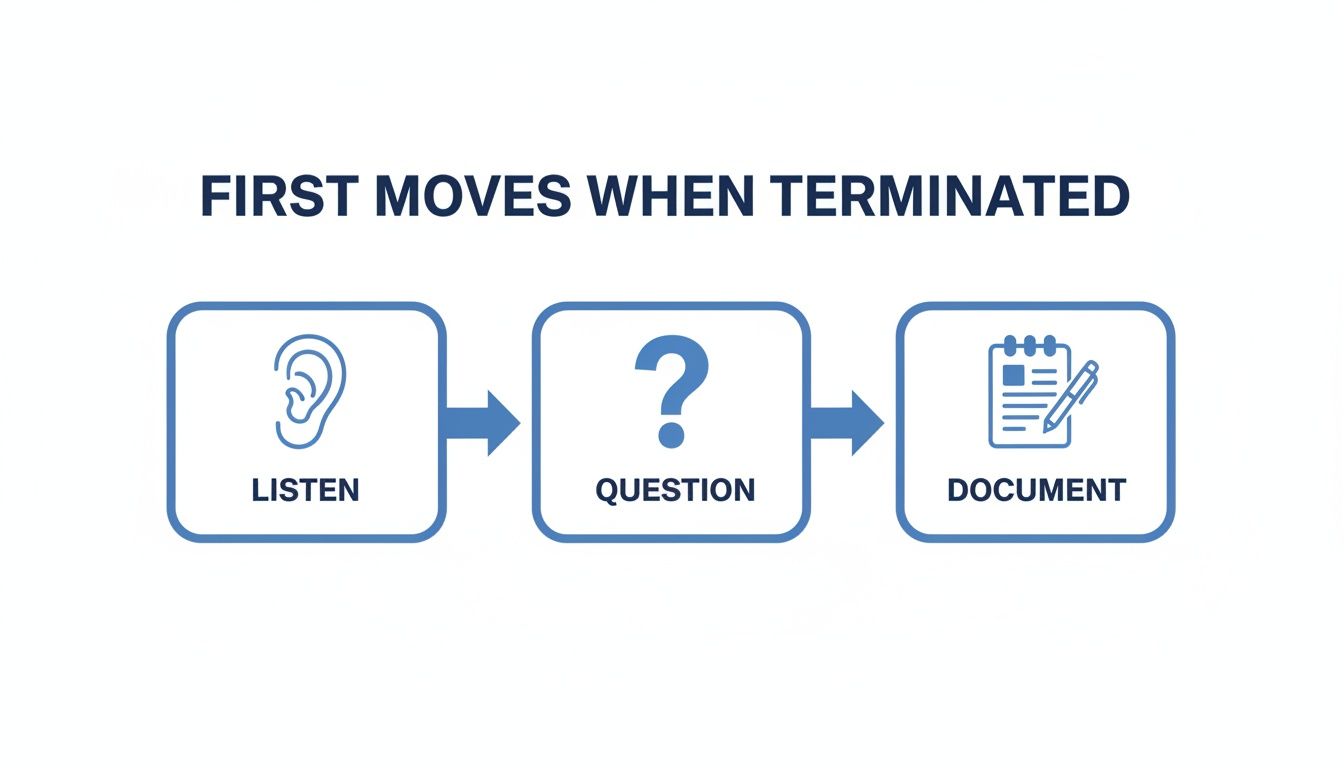
As you can see, the focus is entirely on absorbing information, asking for clarity, and creating a record. Arguing your case at this stage rarely, if ever, helps.
The Importance of Documentation
From this point forward, think of yourself as a record-keeper. As soon as you leave the meeting, find a quiet spot and write down everything you can remember. The date, the time, who was there, specific phrases they used—get it all down while it’s fresh. These notes can be invaluable later.
In my experience, a detailed account of the termination meeting written right after it happened is often a critical piece of evidence. Memories get fuzzy, but notes taken at the time provide a solid reference for dates, statements, and events that could become the centerpiece of a legal claim.
If they hand you any documents to sign—like a severance agreement or an exit form—just ask for a copy to take with you to review. It is almost never a good idea to sign legal documents under pressure, especially if they contain language that asks you to give up your right to sue the company.
Avoid Common Missteps
When you’re reeling from the shock, it’s easy to make mistakes that can come back to haunt you. The biggest one? Reacting with pure emotion. Don’t argue, make threats, or fire off angry emails or texts after you leave. Anything you say or write can be used against you and can do serious damage to your professional reputation.
Another mistake I see is forgetting about personal data. If you have personal files on your work computer, you’ve likely lost access to them the second that meeting ended. Your focus needs to be on ending things professionally and gathering the information you need to move on, whether that’s filing for unemployment or talking to a lawyer about your options.
Navigating Finances and Benefits in Mississippi

Once the initial shock wears off, your focus needs to pivot quickly to your finances. The steps you take in the first few days are critical—they can build a much-needed financial cushion while you plan your next career move. This means knowing your rights to final pay, getting your unemployment claim filed, and figuring out health insurance.
It’s a lot to handle, I know. But if you break it down into a few manageable tasks, the whole process becomes much less daunting. Let’s walk through exactly what you need to do financially after being let go in Mississippi.
Securing Your Final Paycheck
First things first: get the money you’re owed. This is your top financial priority.
Under Mississippi law, your employer must give you your final paycheck on or before the next regular payday. That check has to cover every hour you worked right up to your last day.
But what about unused vacation or paid time off (PTO)? This is where things can get a little tricky. Mississippi law doesn’t force companies to pay out unused PTO unless they have a specific policy or employment agreement that says they will.
- Dig Out Your Employee Handbook: Your best bet is to find the company’s written policy on paying out unused vacation or PTO when an employee leaves.
- Check Your Offer Letter or Contract: Any employment agreement you signed might also spell out how accrued leave is handled.
If the company has a written policy promising a payout, they have to stick to it. If they don’t, you could have a solid wage claim. This is a perfect example of why it’s so important to have your own copy of the employee handbook.
Filing for Unemployment in Mississippi
As soon as you can, get your unemployment claim filed. These benefits are a lifeline, designed to give you some temporary income while you’re job hunting. The place to go is the Mississippi Department of Employment Security (MDES).
To make the process smoother, gather these documents before you start your application:
- Your Social Security number
- Your driver’s license or state ID
- Your current mailing address and phone number
- Name, address, and phone number for your last employer
- The exact dates you worked there
- The reason you are no longer employed
Be completely honest about why you were terminated. MDES will contact your old boss to confirm the details, and any inconsistencies can delay or even sink your claim.
Even if you were fired for “cause,” you should always apply. The legal definition of “misconduct” that disqualifies someone from benefits is very specific, and your employer’s reason might not meet that high bar. Let MDES make the final call. As you weigh your options, it’s also smart to understand what a potential case might be worth; you can learn more by reading about wrongful termination settlement amounts in our detailed guide.
Managing Health Insurance Coverage
Losing your job usually means losing your health insurance, and that can be one of the most stressful parts of this whole experience. A top concern is finding health insurance without a job, but you do have options.
The most immediate choice is often COBRA. This federal law lets you stay on your former employer’s group health plan for a while, typically for 18 months. By law, your employer has 44 days after your termination to send you a COBRA notice. From there, you get a 60-day window to decide if you want to enroll.
Here’s the catch: COBRA is expensive. You’ll be on the hook for 100% of the premium plus a possible 2% administrative fee. While the cost is steep, it guarantees continuity of care, which is absolutely vital if you’re in the middle of medical treatment. You’ll need to carefully weigh that cost against your immediate healthcare needs and compare it with plans on the Health Insurance Marketplace before making a decision.
How to Gather and Preserve Critical Evidence
When you’ve just been fired, your memory and the documents you have on hand are your most valuable assets. Think of it like this: building a legal claim is like building a house. Without a solid foundation of evidence, even the strongest arguments will fall apart. This is why you need to move quickly to gather and save everything you can. It’s not just a good idea—it’s the most critical step you can take to protect yourself.
The moment you’re terminated, your access to company email, internal servers, and shared drives is almost certainly cut off. That means you have to rely on what you already have and what you can remember to piece together the full story. Your goal is to create a complete and accurate record of your employment, especially the events that led to your dismissal.
Create a Detailed Timeline of Events
First things first: write everything down. Don’t rely on your memory, which can get fuzzy under stress. Start a timeline that lays out the key moments of your employment, but put a magnifying glass on the last six months to a year before you were let go.
For every important event, make sure you note:
- The date and time it happened.
- Who was there or involved in the conversation.
- What was said or done—be as specific as you can.
- Any witnesses who saw or heard what happened.
- How it made you feel or how it affected your work.
This timeline becomes your personal narrative of what happened. For instance, if you were fired a week after reporting harassment, your timeline should pinpoint the exact date you made the report, who you spoke to, their reaction, and any weird or hostile behavior that followed. Every little detail helps paint a much clearer picture for a lawyer later on.
Find and Secure Your Documents
With your timeline in hand, it’s time to hunt for the paper trail. Strong documentation can completely change the game. We’ve seen it time and again: cases with both witness testimony and written evidence have the highest success rate at 63%. Compare that to just 50% for cases with only documents and a mere 28% for those relying on witness testimony alone. The proof is in the paper.
Your mission is to collect any document that tells the story of your job and why it ended. Keep everything organized and safe, whether in a physical folder or a secure digital one that only you can access.
The most convincing cases are never just a “he said, she said” battle. They’re built on a collection of documents that, when pieced together, reveal a clear pattern. A single glowing performance review from three months before a sudden “performance-related” firing can be a game-changer.
Start digging through your personal email, your home computer, and any hard copies you might have brought home. You’re looking for anything and everything related to your job performance, your interactions with management, and official company policies.
Key Evidence to Preserve After Termination
Gathering evidence can feel like a huge task, but it’s absolutely essential. The table below breaks down the types of documents that can be incredibly helpful. Think of it as a checklist to get you started. Each item is a piece of the puzzle.
| Evidence Category | Specific Examples | Why It’s Important |
|---|---|---|
| Employment Records | Offer letter, employment contract, job descriptions, employee handbook. | These documents define the terms of your employment and outline the company’s own rules and procedures. |
| Performance Documents | Performance reviews, written warnings, letters of commendation, emails praising your work. | This evidence establishes your track record as an employee and can directly challenge claims of poor performance. |
| Communications | Emails, text messages, Slack/Teams messages, voicemails, or notes from meetings. | These records provide a real-time account of conversations and can prove what was said, by whom, and when. |
| Pay and Benefits | Pay stubs, commission statements, bonus information, benefits enrollment forms. | These documents verify your compensation and are critical for any wage-related disputes or calculating damages. |
Taking the time to gather these materials is one of the most powerful things you can do for yourself right now. If you’re wondering how an attorney uses these pieces to build a case, you can read our guide on how to prove wrongful termination in Mississippi.
A well-documented case gives you leverage and provides a lawyer with the tools they need to give you a real, honest evaluation of your situation. It transforms your claim from just a personal story into a fact-based, compelling argument.
Was Your Firing Illegal? Understanding Your Rights Under Federal Law

You’ve probably heard that Mississippi is an “at-will” employment state. This gets thrown around a lot, and it essentially means an employer can fire you for a good reason, a bad reason, or no real reason at all.
But “at-will” doesn’t mean “anything goes.” It’s a common misconception. The doctrine has very real and powerful limits, and it absolutely does not give employers a free pass to break federal law.
Even here in Mississippi, it is illegal for an employer to fire you for a discriminatory reason or as an act of retaliation. Understanding these protections is the first step in figuring out if your termination was just unfair, or if it was actually unlawful.
The tricky part? Employers almost never admit to an illegal motive. They’ll offer a legitimate-sounding reason for your dismissal—things like “poor performance,” “downsizing,” or “company restructuring.” Your job, and the job of a good employment lawyer, is to look past the official story and examine the real context and timing of your firing.
Discrimination Based on Who You Are
The foundation of federal employment protection is the idea of a protected class. Laws like the Civil Rights Act of 1964, the Americans with Disabilities Act (ADA), and the Age Discrimination in Employment Act (ADEA) make it illegal to fire someone based on their:
- Race or color
- Religion
- Sex (this includes pregnancy, sexual orientation, and gender identity)
- National origin
- Disability
- Age (specifically if you are 40 or older)
An illegal firing isn’t always a smoking gun. It might look like a manager making off-hand comments about your age shortly before you’re let go. It could be a company that only lays off female employees during a “restructuring.” The key is finding the evidence that connects the termination to your status as a member of a protected group.
Retaliation for Speaking Up
Federal law also protects you from being fired in retaliation for engaging in legally protected activities. This is one of the most common forms of illegal termination I see. It happens when an employer punishes you for asserting your rights or standing up for the rights of others.
So, what counts as a “protected activity”? It covers a lot of ground.
- Reporting Harassment or Discrimination: For example, you’re fired just weeks after filing an internal complaint about sexual harassment or racial discrimination.
- Participating in an Investigation: You served as a witness in a coworker’s discrimination case and suddenly find yourself out of a job.
- Requesting a Reasonable Accommodation: You asked for a simple modification to your workspace for a disability or for a schedule change to observe a religious holiday.
- Reporting Illegal Activity (Whistleblowing): You told a supervisor or a government agency about illegal or unsafe practices at your company.
Timing is everything in these cases. If you were a solid employee for years and were suddenly fired two weeks after reporting your boss for harassment, that’s a massive red flag. Wrongful termination lawsuits have surged, with discrimination and retaliation being the most common causes. Many experts believe the true number of illegal firings is much higher than reported, as many people never take action. You can explore more data about wrongful termination statistics to get a better sense of the landscape.
Violations of Specific Federal Acts
Beyond broad discrimination and retaliation protections, several other powerful federal laws offer job security in very specific situations. Getting fired in a way that violates one of these acts can be illegal.
Family and Medical Leave Act (FMLA)
The FMLA gives eligible employees the right to take up to 12 weeks of unpaid, job-protected leave per year for certain family and medical reasons. It is flat-out illegal for your employer to fire you for taking or even just requesting FMLA leave.
- Real-World Scenario: Imagine you take approved FMLA leave to care for a sick parent. The day you return, your boss says your position has been “eliminated.” A week later, you see they’ve hired someone new to do the exact same job. That’s a potential FMLA violation.
If you are eligible for FMLA and your employer interferes with your right to take leave or retaliates against you for using it, you may have a strong legal claim. The law exists to ensure you don’t have to choose between your job and your family’s health.
Uniformed Services Employment and Reemployment Rights Act (USERRA)
USERRA protects the jobs of military service members. It ensures that people who take leave for military service can return to their civilian jobs without losing their position, seniority, or benefits. Firing someone because of their military obligations is a clear violation of this law.
Because Mississippi does not have its own state-level agency to investigate these claims, your main path for relief is through the federal Equal Employment Opportunity Commission (EEOC). Filing a charge with the EEOC is a required first step before you can file a lawsuit in federal court for most discrimination or retaliation claims.
When to Consult a Mississippi Employment Lawyer
Knowing when to call a lawyer after being fired is a tough judgment call. While not every termination is illegal, some situations are blaring red flags that something is legally wrong. My best advice? Trust your gut. If the whole situation feels off, it probably is.
Reaching out to an attorney might seem like a huge, intimidating step, but it’s often the smartest thing you can do. A consultation isn’t a commitment to file a lawsuit; it’s just a chance to get a professional, unbiased opinion and see what your real options are.
Clear Signs It’s Time to Call an Attorney
Some things just scream “get legal advice.” If you find yourself in one of these scenarios, don’t wait.
- You Were Offered a Severance Agreement: Never, ever sign a severance package without having an employment lawyer look it over. These agreements almost always contain a waiver, meaning you give up your right to sue the company in exchange for that money. An attorney can tell you what rights you’re signing away and can often negotiate for a better deal.
- You Suspect Discrimination: Were you fired because of your race, gender, religion, disability, national origin, or age (40+)? If you even have a suspicion that’s the case, it’s time to talk to a lawyer.
- The Firing Smells Like Retaliation: Did you get fired right after you reported harassment, asked for FMLA leave, filed a workers’ comp claim, or blew the whistle on something illegal? That timing is a classic sign of unlawful retaliation. In fact, retaliation is a massive issue—around 60% of all charges filed with the EEOC now include a retaliation claim. A quick look at recent employment law statistics shows just how common this has become.
- The Reason They Gave You Doesn’t Add Up: If the company’s explanation for firing you is vague, contradicts your great performance reviews, or just feels like a cover story, a lawyer can help you figure out what’s really going on.
Navigating Strict Legal Deadlines
This is critical: you do not have unlimited time to act. Employment law is full of unforgiving deadlines, legally known as statutes of limitations. For most federal discrimination and retaliation cases, you can’t just go file a lawsuit. You first have to file a formal Charge of Discrimination with the Equal Employment Opportunity Commission (EEOC).
Here in Mississippi, you only have 180 days from the day you were fired to get that EEOC charge filed. If you miss that deadline, your right to seek justice is likely gone forever. Since Mississippi doesn’t have its own state agency for these claims, the federal EEOC is the only game in town.
Waiting too long is the single most common—and heartbreaking—mistake I see. Evidence gets lost, people’s memories fade, and those legal clocks just keep ticking. Calling a lawyer quickly is the best way to protect your rights before it’s too late.
How Can You Afford a Lawyer When You’ve Just Lost Your Job?
This is the first question on everyone’s mind. The good news is that most Mississippi employment lawyers, myself included, work on a contingency fee basis.
What does that mean? It means you don’t pay anything upfront. The lawyer only gets paid if they win money for you, whether that’s from a settlement or a jury verdict. The fee is simply a percentage of what you recover, which in Mississippi typically ranges from 40-50%. This system levels the playing field, making sure anyone can get expert legal help, not just those who can afford to write a big check.
Preparing for Your Consultation
To get the most out of your first meeting with an attorney, a little prep work goes a long way. Pull together all the documents and evidence you’ve gathered so far. Bring your timeline of events, recent performance reviews, any relevant emails or text messages, your employee handbook, and of course, the termination letter or severance agreement.
The more organized you are, the faster an attorney can understand your situation and give you solid advice. For a complete checklist, you can read our guide on how to prepare for your first talk with an employment lawyer. Coming in prepared helps us see the path forward much more clearly.
Common Questions About Being Fired in Mississippi

It’s completely normal to have a flood of questions running through your head after being fired. Getting straight answers is the first step toward figuring out your next move and protecting your rights. Let’s tackle some of the most common concerns we hear from Mississippi workers.
Where Do I File a Discrimination Claim?
This is a huge point of confusion for many people in our state. Unlike a lot of other places, Mississippi does not have a human rights commission or any similar state agency that handles workplace discrimination complaints.
Because of this, your only path is to file a Charge of Discrimination directly with the federal Equal Employment Opportunity Commission (EEOC). The clock is ticking from the moment you’re fired—you have a strict deadline of 180 days to get this charge filed. Filing with the EEOC isn’t just a suggestion; it’s a mandatory first step before you can even think about filing a lawsuit in federal court.
How Much Does an Employment Lawyer Cost?
Worrying about legal fees is understandable, especially when you’ve just lost your income. The good news is that almost all employment lawyers in Mississippi handle cases on a contingency fee basis.
This means you don’t pay anything out of pocket. The lawyer’s fee is simply a percentage of the money they win for you, whether it’s from a settlement or a verdict. This system levels the playing field, making sure anyone can get quality legal help.
That percentage is typically between 40-50% of whatever you recover. If your lawyer doesn’t win the case, you don’t owe them a dime in attorney’s fees.
What Should I Do About My Last Paycheck?
Your former employer has to give you your final paycheck no later than the next regular payday. That check must cover every single hour you worked up to your termination.
What about unused vacation or PTO? In Mississippi, the law doesn’t force employers to pay it out. Your right to that money comes down to the company’s own written policy, which you can almost always find in the employee handbook or your original employment agreement.
As you navigate these immediate issues, you’ll also have to think about your job search. Knowing how to explain being fired in an interview is a critical skill. If you handle that conversation well, you can reframe the situation and keep the focus on what you bring to the table.
If something about your firing feels wrong, or if you just need to understand your rights as an employee in Mississippi, Nick Norris, P.A. is here to help. Reach out to our office for a consultation to get the clarity you need to protect your future. https://www.nicknorris.law
This article has been reviewed for legal accuracy by Nick Norris. For employment law matters in Mississippi, consult with an attorney licensed to practice in your state.
Leave a Reply