

Master Your Payroll: how to calculate overtime pay
Figuring out your overtime pay starts with a simple rule: you should be paid 1.5 times your regular rate of pay for every hour you work over 40 in a single workweek. But as many workers find out, the "simple" part can get complicated fast. The real key is understanding if you're eligible in the first place and then calculating your correct regular rate—which often includes more than just your base hourly wage.
Are You Owed Overtime Pay in Mississippi?
Before diving into the math, you have to know where you stand legally. Here in Mississippi, your right to overtime is almost always determined by a federal law: the Fair Labor Standards Act (FLSA). This is the law that sets the nationwide standard for overtime, and it applies to nearly every employer in the state.
The core idea of the FLSA is pretty clear: if you are a "covered, non-exempt" employee, you must get paid for overtime when you work more than 40 hours in a workweek. That pay has to be at least one and a half times what you normally make per hour.
This brings up two critical questions every worker should be asking:
- Does the FLSA cover my job?
- Am I a "non-exempt" employee?
For most people, the answer to the first question is yes. The trickier part is figuring out your status as either non-exempt or exempt.
The Critical Difference: Non-Exempt vs. Exempt
Simply put, non-exempt employees get overtime pay. This is the default classification for most workers, whether you're paid by the hour or on a salary.
Exempt employees, however, are not legally entitled to overtime. For an employer to classify you as exempt, you have to meet a very strict, two-part test based on how much you're paid and the specific duties you perform. If your job doesn't meet every single requirement of that test, you are legally non-exempt and must be paid for any overtime hours.
You can get a complete breakdown of these classifications by reading more about the overtime exemption rules.
One of the biggest mistakes I see workers make is assuming that being paid a salary automatically means they can't get overtime. That's completely false. Employers misclassify salaried workers all the time, leaving them owed thousands in unpaid overtime.
The rules around who qualifies as exempt have changed dramatically. As of July 1, 2024, the salary threshold to even be considered for exempt status jumped to $43,888 per year. On January 1, 2025, it’s set to increase again to $58,656. These new Department of Labor rules mean that millions of workers who were previously (and often incorrectly) denied overtime are now eligible.
Nailing Down Your "Regular Rate of Pay"
Before you can figure out your overtime, you have to find your "regular rate of pay." This is the cornerstone of the whole calculation, and it's where a lot of the confusion—and mistakes—happen. It’s easy to think this is just your hourly wage, but federal law is much broader. It requires employers to include almost every type of payment you get for your work.
Getting this number right isn't just important; it's everything. A mistake here, whether it’s on purpose or by accident, means every single overtime hour you work will be underpaid.
What Actually Goes Into Your Regular Rate?
The Fair Labor Standards Act (FLSA) has a specific definition for the regular rate. It's not just your hourly wage. It’s your total pay for the week (minus a few specific exceptions) divided by the total hours you actually worked.
Think of it as your true hourly rate. Here’s what must be included in that total:
- Your Base Hourly Pay: This one is the most obvious part.
- Non-discretionary Bonuses: These aren't surprise gifts. They're bonuses you were promised for hitting certain targets, like production goals, quality metrics, or even perfect attendance. If it's an incentive announced beforehand, it counts.
- Commissions: Any commissions you earn from sales are treated as wages and have to be folded into the calculation.
- Shift Differentials: That extra dollar or two per hour you get for working the night shift or a weekend? That has to be included, too.
The rule of thumb is pretty simple: if a payment is tied to your work, performance, or hours, it almost certainly needs to be part of your regular rate calculation.
I see this all the time: an employer offers a "$100 weekly bonus" for perfect attendance. That $100 isn't just a separate gift. It has to be added to your total weekly earnings before your overtime rate is calculated for that week. Missing this step is one of the most common ways workers get shorted on their pay.
What Doesn't Count Toward Your Regular Rate
Now, not every check from your employer gets thrown into the pot. The law specifically excludes certain types of payments from the regular rate calculation.
These typically include things like:
- Truly Discretionary Bonuses: Think of a surprise Christmas bonus that wasn't announced or promised ahead of time. If the amount and the decision to pay it are entirely up to the boss, it's likely excluded.
- Gifts: Small, one-off gifts for a special occasion, like a birthday or holiday, that aren't tied to your performance.
- Pay for Time Off: Money you get for vacation days, holidays, or sick leave isn't included in the week's calculation because it's not payment for hours actually worked during that specific workweek.
- Expense Reimbursements: If your boss pays you back for gas mileage, a new tool you had to buy, or a client lunch, that’s just reimbursement, not wages.
Understanding this distinction is critical. If you think you're being underpaid, your first move should be to grab your pay stubs. Add up every bit of compensation for a single workweek, and then you’ll be ready to calculate the real regular rate that determines what you're truly owed.
Getting the Overtime Pay Math Right
Once you've nailed down your "regular rate of pay," it's time to do the math. The concept of "time-and-a-half" sounds simple enough, but how it's applied can get tricky depending on how you're paid. Getting this right is the only way to ensure you’re collecting every dollar you've earned for those extra hours.
Let's break down the formulas with some real-world examples.
Remember, your total weekly pay isn't just about your base wage. It's a combination of everything you earn, including non-discretionary bonuses and commissions. This diagram shows how it all comes together.
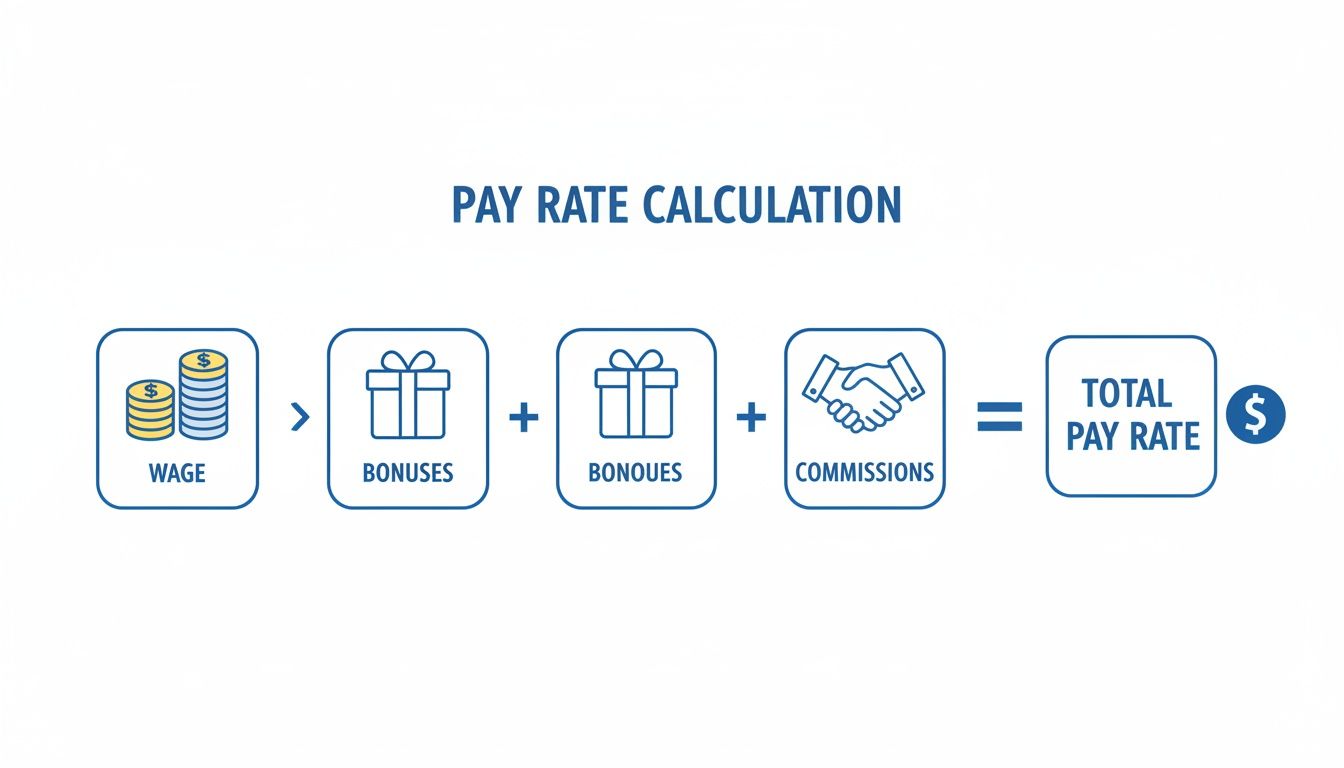
This is a critical point many people miss. Your overtime pay isn't calculated from your hourly wage alone. It must include those other earnings to find your true regular rate before that 1.5x multiplier is applied.
The Standard Calculation for Hourly Workers
This is the most straightforward and common scenario for workers in Mississippi. This formula is the foundation of overtime pay.
- First, figure out your overtime rate by multiplying your regular rate by 1.5.
- Next, multiply that overtime rate by the number of overtime hours you worked.
- Finally, add that overtime amount to what you earned for your first 40 hours (your straight-time pay).
Let's look at an example:
An employee named Alex makes $16 an hour and worked 45 hours in one week.
- Regular Pay (40 hours): $16/hour × 40 hours = $640
- Overtime Rate: $16/hour × 1.5 = $24/hour
- Overtime Pay (5 hours): $24/hour × 5 hours = $120
- Total Weekly Pay: $640 + $120 = $760
How to Calculate Overtime for Salaried, Non-Exempt Employees
This is where a lot of confusion—and wage theft—happens. Many salaried employees are incorrectly told they aren't eligible for overtime. But if your job role is classified as non-exempt, your employer is legally required to pay you for those extra hours.
The key is to convert your weekly salary into an hourly "regular rate."
Here’s a salaried example:
Jamie earns a salary of $800 per week for a standard 40-hour workweek. This week, things got busy and Jamie worked 50 hours.
- Find the regular rate: $800 salary ÷ 40 hours = $20/hour
- Find the overtime rate: $20/hour × 1.5 = $30/hour
- Calculate overtime pay: $30/hour × 10 overtime hours = $300
- Calculate total pay: $800 salary + $300 overtime = $1,100
To see how these different calculations stack up, here is a quick comparison table.
Overtime Calculation Examples
| Pay Structure | Calculation Steps | Example Total Pay |
|---|---|---|
| Hourly | 1. Calculate regular pay (40 hrs x rate). 2. Calculate overtime rate (rate x 1.5). 3. Calculate overtime pay (OT hrs x OT rate). 4. Add regular pay + overtime pay. |
$760 (45 hours at $16/hr) |
| Salaried Non-Exempt | 1. Find regular rate (salary / 40 hrs). 2. Calculate overtime rate (rate x 1.5). 3. Calculate overtime pay (OT hrs x OT rate). 4. Add salary + overtime pay. |
$1,100 (50 hours on an $800 salary) |
These examples show that no matter how you're paid, the principle remains the same: any work over 40 hours must be compensated at a premium rate.
These precise calculations have a long history. When the Fair Labor Standards Act (FLSA) first established the 40-hour workweek and the 1.5x overtime rate back in 1938, it was a direct response to widespread unemployment. The law worked, successfully reducing average work hours and protecting workers from exploitation—a history detailed in this strategic guide from UKG.
For Mississippi employees who were paid straight time for their overtime hours, the math for back pay is often as simple as multiplying their regular rate by 0.5 for each overtime hour worked.
Understanding these formulas is your first step toward protecting your rights and recovering any unpaid overtime wages you might be owed.
Common Overtime Calculation Mistakes Employers Make

Knowing how to calculate overtime pay is one thing, but making sure your employer gets it right is a whole different ballgame. The hard truth is that errors—whether they’re honest mistakes or not—happen all the time. These slip-ups can cost you a serious chunk of your hard-earned money.
Being able to spot the red flags is the best way to protect yourself from wage theft.
One of the most frequent problems I see is misclassifying an employee as exempt. An employer might put you on salary, give you an impressive title like "shift supervisor," but still have you doing the same work as the hourly folks. If your actual job duties don't pass the strict federal tests for exemption, you're owed overtime pay, period. It doesn’t matter what your title is or how you’re paid.
Another classic mistake is leaving certain types of pay out of the "regular rate" calculation. Your employer might figure your time-and-a-half pay using only your base hourly wage, conveniently forgetting about that production bonus you hit last week or the extra cash you get for working the night shift. This illegally pushes your overtime rate down, shorting your paycheck every single time you put in extra hours.
Paying Straight Time for Overtime
This one is about as blatant as it gets. Paying your standard hourly rate for every hour you work, even those over 40, is called paying "straight time for overtime." It's a direct violation of the Fair Labor Standards Act (FLSA). The law couldn't be clearer: non-exempt employees must be paid a premium of 1.5 times their regular rate for overtime.
Simply put, if you work 48 hours in a week, those last eight hours must be paid at a higher rate. An employer who pays you the same hourly wage for all 48 hours is breaking the law and keeping money you rightfully earned.
For Mississippi workers, the formula is straightforward: (regular rate x 1.5) x overtime hours. With the Department of Labor estimating that 4 million workers were reclassified under the new $58,656 salary threshold in 2025, getting payroll right is more critical than ever. While some have discussed allowing "comp time" instead of cash, federal law still requires actual payment for overtime hours.
Other Costly Errors to Watch For
Beyond the major violations, a handful of other sneaky payroll errors can slowly eat away at your income. Keep a close eye on your pay stubs for these common issues:
- Averaging Hours Across Two Weeks: This is a big no-no. An employer can't take your 50-hour week and average it with a 30-hour week to dodge paying overtime. The calculation must be based on a single, fixed workweek.
- "Unauthorized" Overtime: Your boss might get upset that you worked extra hours without permission, but they still have to pay you for them. If you worked the time, you get the pay. It's the company's job to enforce its policies and prevent unwanted work, not to withhold your wages.
- Fumbling Holiday Weeks: Let's say you work 42 hours during a week with a paid holiday. You are absolutely entitled to overtime pay for the two hours you actually worked over 40. Holiday pay itself doesn't count as "hours worked," but any time you're on the clock past 40 still triggers the overtime requirement.
If you think there's an error on your paycheck, the first thing to do is gather your pay stubs and any records you have of your hours. From there, an employment law attorney can help you figure out exactly what you're owed.
Think You're Owed Overtime Pay? Here’s What to Do Next
That sinking feeling when you look at your paycheck and the numbers just don't add up is stressful. If you suspect you've been shorted on overtime, it's easy to feel confused and powerless. But remember, federal law is on your side, and the steps you take now can make a huge difference in getting the money you earned.
Your first move? Become your own best advocate through documentation. Don't just rely on the company's time clock—it could be inaccurate or, in some cases, intentionally manipulated.
Start your own personal time log today. It doesn't have to be fancy; a simple notebook or a spreadsheet on your phone will do the job. Just be diligent about recording the exact time you clock in and out every day, including any unpaid lunch breaks.
At the same time, save every single pay stub. These are your primary evidence of what you were actually paid. Hang on to any emails, texts, or company memos about your work hours, pay rates, or overtime policies. This trail of evidence is the bedrock of a solid claim.
Taking the First Formal Step
With your records organized, you have a powerful, official channel for help. The U.S. Department of Labor’s Wage and Hour Division (WHD) is the federal agency in charge of enforcing the Fair Labor Standards Act—the very law that guarantees your overtime pay.
You can file a confidential complaint directly with the WHD. Your employer is legally prohibited from retaliating against you for doing so. An investigator will look into your claim, and if they find a violation, they can compel your employer to pay your back wages.
A key point for Mississippi workers: Unlike some other states, Mississippi doesn't have a state-level agency for wage claims. This makes the federal Department of Labor your primary administrative resource for resolving overtime disputes outside of legal action.
When It's Time to Call an Attorney
The WHD is a great starting point, but some situations just need more firepower. If your employer is pushing back hard, if other coworkers are in the same boat, or if you're facing any kind of retaliation for speaking up, it's time to talk to an employment lawyer.
An experienced attorney can cut through the noise, assess the strength of your case, and lay out your best options. They know exactly what evidence is needed and can take over all the stressful communication with your employer.
Most importantly, they can file a federal lawsuit to recover not just your unpaid wages, but potentially additional damages and have your attorney's fees covered. To see what that process looks like, you can read our guide on filing an unpaid wages lawsuit.
Worried about the cost? Most employment law firms work on a contingency fee basis. This means you owe them nothing upfront. They only get paid if they win your case, usually taking a percentage of the settlement. In Mississippi, this fee typically runs between 40-50%, which makes expert legal help accessible when you need it most.
Overtime Pay: Your Questions Answered
Even when you know the basics, the real world of overtime pay can get tricky. Let's tackle some of the most common questions and situations that pop up for workers here in Mississippi.
Can My Employer Force Me to Work Overtime?
The short answer is yes. In most situations, an employer can legally require you to work overtime, and there’s no federal cap on how many hours an adult can be asked to work in a week.
The critical part for them, and for you, is that they must pay you for it. As long as you're a non-exempt employee, every hour you work over 40 in a workweek must be paid at 1.5 times your regular rate. Keep in mind that refusing to work mandatory overtime could be seen as insubordination, which might be grounds for termination.
Is Overtime Calculated Daily or Weekly?
Overtime is strictly a weekly game under federal law. The official term is a "workweek," which is just a fixed, recurring block of 168 hours (seven straight 24-hour periods).
This means that even if you pull a marathon 12-hour shift one day, you don't automatically get overtime pay. The clock for overtime only starts ticking after you've actually worked more than 40 hours within that established workweek. While some states have their own daily overtime rules, Mississippi sticks to the federal weekly standard.
This is a point people often misunderstand. Your employer can’t average your hours across two weeks to sidestep overtime. If you work 50 hours one week and 30 the next, they still owe you 10 hours of overtime pay for that first week. Each workweek stands on its own.
Do Holidays or Sick Days Count Toward My 40 Hours?
No, they don't. The FLSA is very specific about this: overtime is based on hours you were actually on the clock and working. Any paid time off—whether it's for a vacation day, sick leave, or a company holiday—doesn't count toward the 40-hour threshold.
Here’s a quick example: Let’s say you worked four 8-hour days (32 hours) and also got paid for one 8-hour holiday. Your paycheck will show 40 hours of pay, but your "hours worked" for overtime purposes is only 32. Because you didn't physically work over 40 hours, no overtime is due.
I'm a Salaried Employee. Do I Get Overtime?
It's entirely possible, and this is probably the biggest myth in all of wage and hour law. Simply being paid a salary doesn't automatically mean you're ineligible for overtime.
For an employer to legally deny you overtime, your job has to pass two strict tests: a salary basis test (you have to earn more than a set amount) and a duties test (your job responsibilities must genuinely fall under executive, administrative, or professional categories). If you don't meet both of those criteria, you are considered non-exempt and are owed time-and-a-half for any hours you work over 40, salary or not. Misclassifying salaried employees is a common and costly mistake many companies make.
If you’ve looked at your paychecks and suspect you're not getting the overtime pay you've earned, you don't have to figure it out on your own. At Nick Norris, P.A., our team is committed to defending the rights of Mississippi workers. We can review your situation, explain your options, and help you fight for the wages you are rightfully owed. Visit us online to learn more or to schedule a consultation.
This article has been reviewed for legal accuracy by Nick Norris. For employment law matters in Mississippi, consult with an attorney licensed to practice in your state.
Leave a Reply