

How to Sue for Unpaid wages: A Mississippi Employee’s Guide
It's a gut-wrenching feeling—you open your paycheck, and the numbers are wrong. That money you were counting on, the money you earned, simply isn't there. Your first reaction might be a mix of anger and panic, but what you do next is absolutely critical.
Taking calm, deliberate steps right from the start can make all the difference in getting paid what you're owed. This is about building a solid foundation of proof and giving your employer a formal, professional chance to make things right before you have to take things further.
Your First Moves When Your Paycheck is Short
When you discover you've been underpaid, resist the urge to fire off an angry email or storm into your boss's office. Instead, channel that energy into methodical action. The goal here is twofold: give your employer the benefit of the doubt that it’s an honest mistake, while simultaneously creating a paper trail that will be invaluable if it’s not.
This early stage isn't about confrontation. It’s about clarification and documentation. Think of it as putting together a case file—one that shows you acted reasonably and professionally from the very beginning.
Below is a quick-reference table to guide your immediate actions. Following these steps helps ensure you're building the strongest possible case from day one.
Immediate Actions for Unpaid Wages in Mississippi
| Action Step | Why It's Important | Example/Tip |
|---|---|---|
| Gather All Pay Documents | Creates a factual basis for your claim, moving it beyond a "he said, she said" dispute. | Collect pay stubs (both correct and incorrect), your offer letter, and any written pay agreements. |
| Document Your Hours | Your personal records can challenge inaccurate company timesheets. | Keep a daily log in a notebook or a simple spreadsheet. Note start/end times and breaks. |
| Find Relevant Communications | Emails or texts can prove agreed-upon hours, overtime, or pay rates. | Search for texts like, "Can you stay late tonight?" or emails confirming a bonus. |
| Calculate What You're Owed | Having a specific, accurate number makes your demand clear and professional. | Use a calculator: (Correct Hourly Rate x Hours Worked) – Amount Paid = Wages Owed. |
| Draft a Formal Demand Letter | Creates official proof that you notified your employer and tried to resolve the issue. | Use a professional tone. State the facts, show your math, and set a firm payment deadline. |
| Send via Certified Mail | Provides undeniable legal proof that your employer received your formal complaint. | The green return-receipt card you get back from the post office is a powerful piece of evidence. |
By taking these steps methodically, you demonstrate that you are serious and organized, which often encourages employers to resolve the issue quickly to avoid further complications.
Gather Your Critical Evidence
Before you even think about talking to HR, your first job is to become a detective. You need to gather every piece of paper and digital communication related to your pay. Evidence is everything. Without it, your claim is just your word against theirs.
Start pulling these items together immediately:
- Pay Stubs: Collect every single pay stub you can find, especially the ones showing the wrong amount. Just as important are older stubs that show your correct, agreed-upon pay rate. These are your most direct pieces of evidence.
- Personal Time Records: Do you jot down your hours in a notebook? Keep a spreadsheet? Use a time-tracking app? These personal records are incredibly valuable for cross-referencing and disputing the company’s official timecards if they’re inaccurate.
- Electronic Communications: Dig through your old emails, text messages, and Slack or Teams chats. You're looking for any conversation about your pay rate, your hours, a promotion, or an agreement to work overtime. A simple text message from your manager asking you to cover a shift is solid proof you were working.
- Employment Documents: Find your original offer letter or any formal employment contract you signed. These documents are the bedrock of your agreement and should spell out your salary or hourly wage in black and white.
Once you have everything, organize it chronologically. This timeline will make it much easier to clearly explain the problem and will be a huge head start if you end up needing to speak with an attorney.
Write a Formal Demand Letter
With your evidence organized, it’s time to put your request in writing. This isn’t just any email—it’s a formal demand letter. The purpose is to officially notify your employer of the wage shortfall and formally request the payment you are due.
Think of this letter as a critical piece of evidence. It proves you made a good-faith attempt to resolve the problem directly and professionally before escalating it.
Keep your letter clear, factual, and professional. This is not the place for emotion or accusations. Stick to the facts you’ve documented.
A strong demand letter should always include:
- A Clear Opening: Start by stating the letter’s purpose—that it is a formal demand for unpaid wages.
- The Specifics: Clearly list the pay periods involved, the hours you worked, your correct rate of pay, and the exact dollar amount you are owed. Show your calculations so they can see how you got the number.
- Reference Your Proof: Briefly mention the evidence you’ve gathered. For example, "As documented in my timesheets from May 1st to May 15th…"
- A Firm Deadline: Give the company a reasonable deadline to pay you, like 10 or 14 business days.
- A Professional Closing: Conclude by stating that if the wages are not paid by your deadline, you will be forced to pursue all available legal remedies to recover them.
Key Takeaway: Always send this letter via certified mail with a return receipt requested. This costs a few extra dollars at the post office, but it provides you with a legal document proving exactly when your employer received your complaint. This can be crucial for meeting important deadlines. To learn more about these timelines, you can check out our guide on the employment law statute of limitations. It creates a powerful paper trail that is nearly impossible for an employer to dispute.
Navigating Your Rights Under Federal Law
If you're dealing with unpaid wages in Mississippi, your first instinct might be to look for a state agency to help. But here’s something most people don’t realize: Mississippi is one of just a handful of states without its own department of labor to handle wage claims.
This means your strongest, and often only, protection comes directly from federal law.
The law you need to know is the Fair Labor Standards Act (FLSA). This is the federal rulebook for minimum wage, overtime, and employer record-keeping. For almost any Mississippian facing a wage issue, the FLSA is the primary legal tool you'll use to get back the money you've rightfully earned. Getting a handle on how it works is the first real step in building your case.
At its core, the FLSA is straightforward. It requires most employers to pay the federal minimum wage and provide overtime—at one-and-a-half times the regular rate—for any hours worked over 40 in a single workweek. When your boss doesn't follow these rules, it's not just a payroll error; it's a violation of federal law.
Two Paths to Justice Under the FLSA
So, you've confirmed your employer has broken FLSA rules. What's next? You generally have two ways to proceed: you can file a complaint with a federal agency, or you can take your employer to court yourself. Each route has its own pros and cons.
- Filing a Complaint with the Department of Labor (DOL): You can report the violation to the U.S. Department of Labor's Wage and Hour Division (WHD). This is the government agency tasked with enforcing the FLSA.
- Filing a Private Lawsuit: You can hire a lawyer and sue your employer directly in federal court. This approach often gives you more control and can result in a better financial outcome.
Deciding which path to take really depends on your specific situation, how comfortable you are with the legal system, and what you're ultimately trying to achieve.
The decision tree below gives you a good visual of the initial thought process once you spot a wage problem.
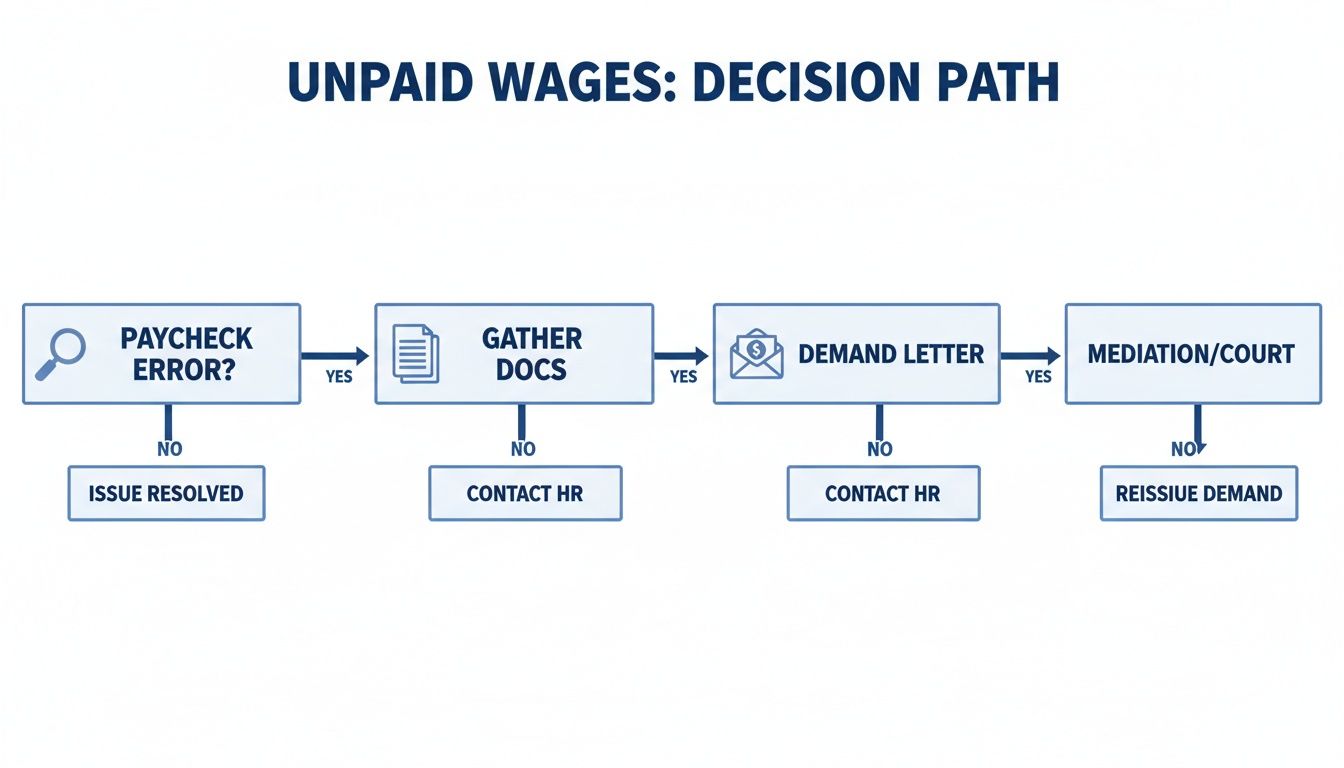
As you can see, a strong claim doesn't start with a lawsuit. It starts with identifying the error, gathering your proof, and making a formal demand before things escalate.
Comparing Your Options: The DOL vs. A Federal Lawsuit
Let's dig into the key differences between filing a WHD complaint and pursuing your own lawsuit. Thinking through this will help you figure out the best strategy for your case.
The DOL Wage and Hour Division (WHD) Complaint
This route is free, and you don't technically need a lawyer to get started. The WHD is supposed to investigate, look at your employer’s records, and decide if a violation happened. If they agree you're owed money, they'll try to recover your back wages.
The downside? The process can be incredibly slow—we're talking months, sometimes even years. You have virtually no control over the investigation, and the WHD might just decide your case isn't a priority. Most importantly, they typically only recover your actual unpaid wages, not the additional "liquidated damages" (which can double the amount) you could win in a lawsuit.
The Private Federal Lawsuit
Filing your own lawsuit puts you in the driver's seat. An attorney is there to represent your interests, not the government's. This is the path that allows you to seek not just your back pay but also liquidated damages, which is essentially a penalty against the employer that can double your total recovery.
The main hesitation for most people is the cost. But here's the good news: nearly all employment lawyers, including our firm, handle these cases on a contingency fee basis. This means you don't pay anything upfront. The attorney’s fee is simply a percentage of the money recovered for you, usually 40-50%. If you don’t win, you don't owe any attorney fees.
The results speak for themselves. In a single recent fiscal year, the WHD recovered $259 million in back wages for nearly 177,000 workers. That averages out to about $1,465 per person—real money that people were owed. These figures, highlighted in a report on HR Dive, show that standing up for your rights under the FLSA can have a serious financial impact.
While a DOL complaint has its place, a private lawsuit often provides a more direct and financially rewarding path, especially for people with significant claims or who want to make sure their case gets the attention it deserves. An experienced attorney can look at the details of your situation and help you build the most effective strategy.
Calculating the Full Amount You Are Owed
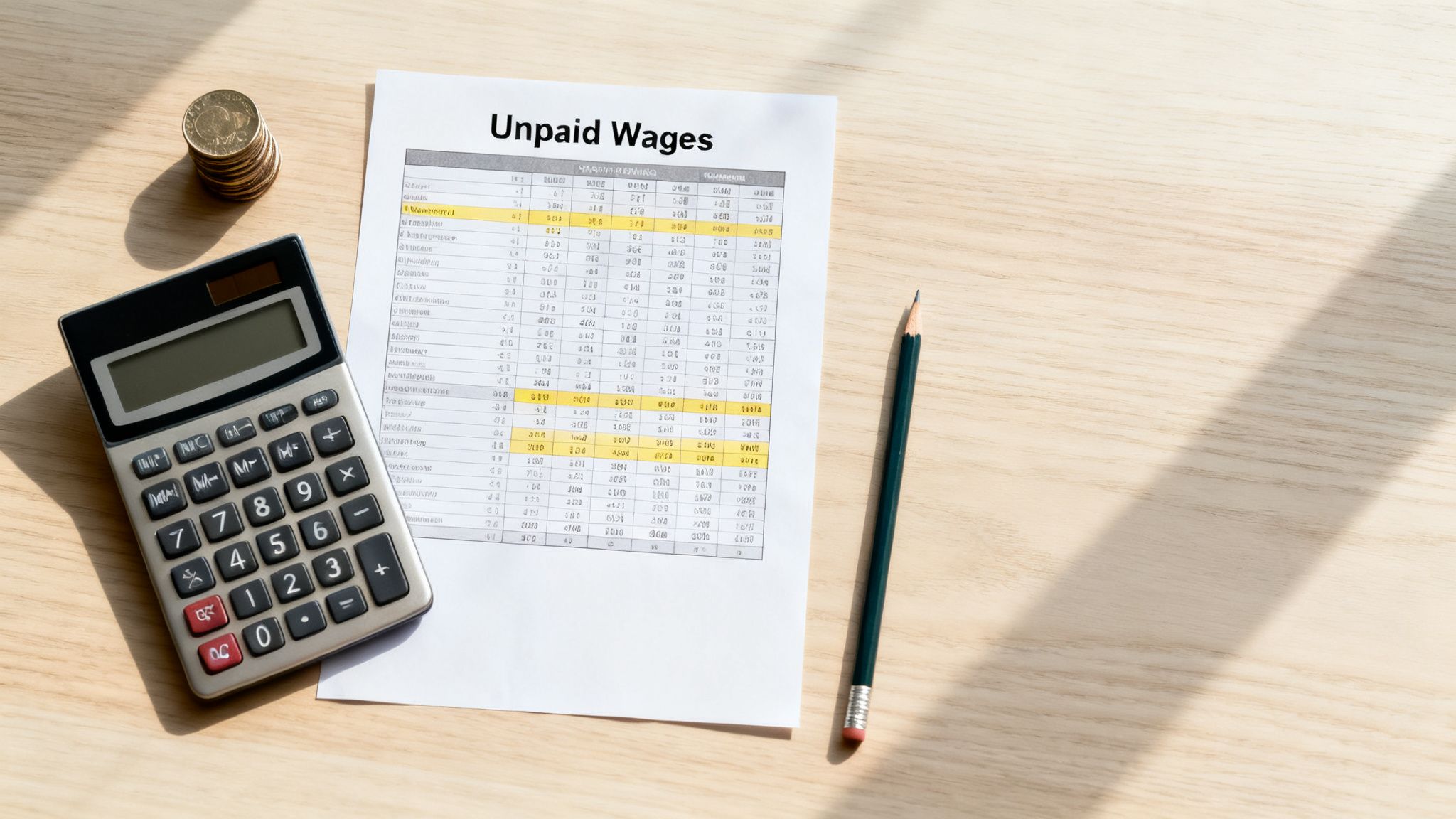
When your employer shorts your paycheck, it’s natural to focus on the exact dollars and cents you're missing. But that’s often just the starting point. Federal law, specifically the Fair Labor Standards Act (FLSA), gives employees powerful leverage that can potentially double what your employer has to pay.
Understanding the full, potential value of your claim is critical. It shapes your entire strategy, gives you a much stronger hand in negotiations, and makes sure you don’t walk away leaving money you're legally entitled to on the table.
Beyond Your Base Pay
First things first, let's tally up the back wages—the actual money you earned but never received. This isn't just about a single missed check; wage theft comes in many forms.
I see these issues all the time:
- Minimum Wage Violations: If your hourly rate ever dipped below the federal minimum, you’re owed the difference for every single hour you worked.
- Unpaid Overtime: For any week you worked over 40 hours, your employer was legally required to pay you 1.5 times your regular rate for those extra hours. You can claim every cent of that unpaid premium.
- Illegal Deductions: An employer can’t just deduct the cost of broken tools or a customer walking out on a bill if it pushes your earnings below the minimum wage. Those are unlawful deductions.
- Misclassification: This is a big one. If an employer calls you an "independent contractor" just to dodge overtime laws, you can fight back and claim the wages you should have been paid as a proper employee.
It’s incredibly important to be meticulous here. To get a complete picture of your earnings, it helps to understand how to calculate total compensation. Don't let any detail slip through the cracks.
The Power of Liquidated Damages
Now, here’s where an unpaid wage claim gets its teeth. The FLSA includes a penalty called liquidated damages, designed to make you whole for the financial strain and disruption caused by not being paid on time.
In most successful claims, liquidated damages are an amount equal to your total unpaid back wages. In plain English, this doubles your recovery. If you're owed $5,000 in unpaid overtime, you can sue for that $5,000 plus another $5,000 in liquidated damages, bringing your total claim to $10,000.
An employer can only get out of paying liquidated damages if they can prove to a court they acted in "good faith" and had solid, reasonable grounds for thinking they weren’t breaking the law. That's a very high bar to clear. A simple mistake in payroll or claiming they "didn't know the law" almost never holds up.
Putting It All Together: A Real-World Example
Let’s walk through a common scenario. Imagine a maintenance worker in Jackson, Mississippi, who gets a flat salary but consistently works 50 hours a week without any overtime pay. After digging into their pay stubs and work records, here’s how the math breaks down:
- Calculate the Back Wages: They figure out they're owed 10 hours of overtime per week going back two years. Once they calculate their true hourly rate, the unpaid overtime adds up to $7,800. If you need help with these calculations, our guide on how to calculate overtime pay provides a detailed breakdown.
- Add Liquidated Damages: Since the employer deliberately misclassified them to avoid paying overtime, they have a strong claim for liquidated damages. That adds another $7,800 to the pot.
- Factor in Attorney's Fees and Costs: The FLSA also has a "fee-shifting" provision. This means if you win, the law forces your employer to pay your reasonable attorney's fees and court costs.
Suddenly, a claim that started as $7,800 in missing pay has ballooned into a legal case worth over $15,600, not even counting the attorney's fees. This is exactly why a proper calculation is the most critical first step you can take.
Gathering the Evidence You Need to Win
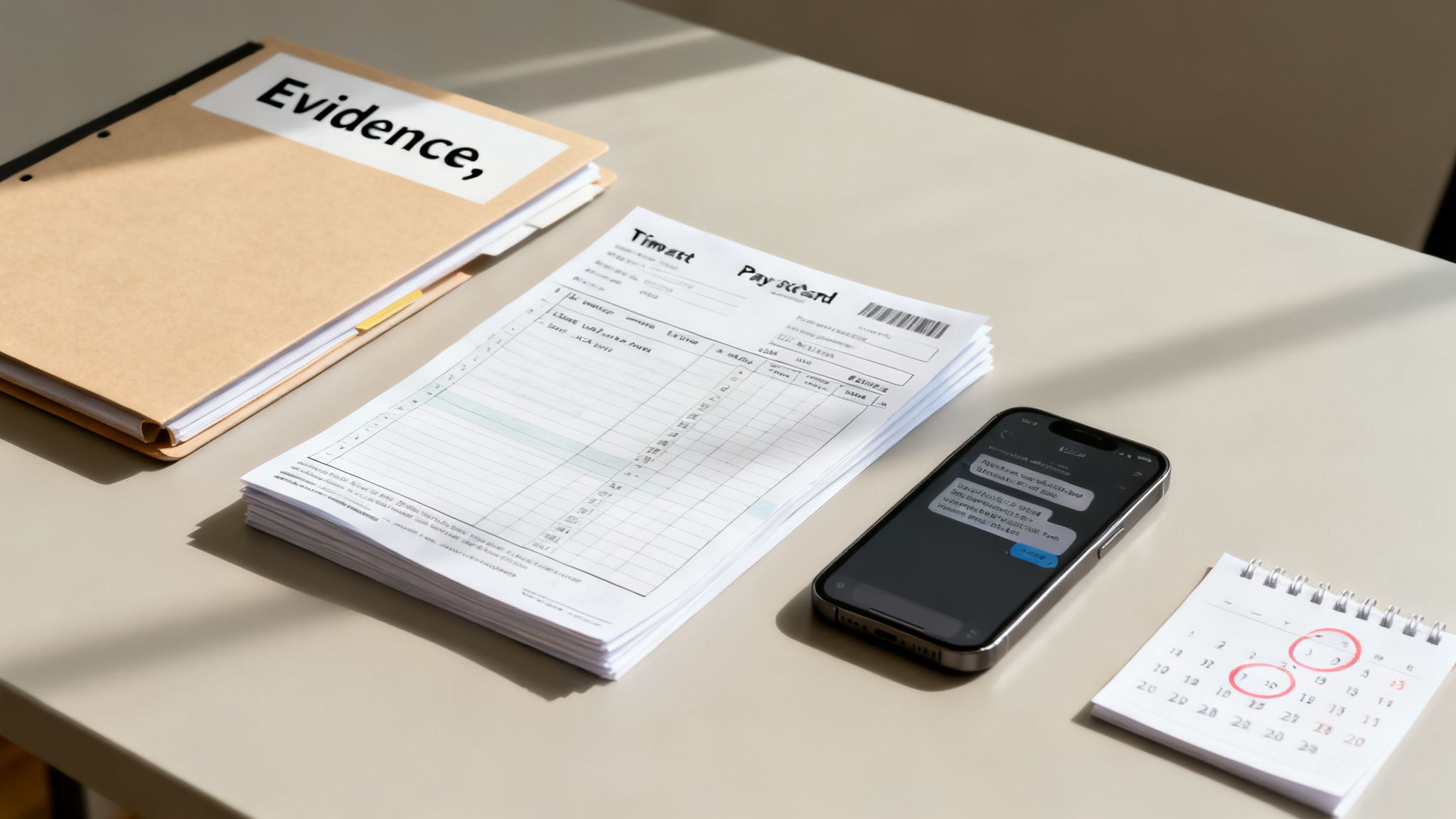
When you're fighting for unpaid wages, a strong case isn't built on feelings or frustration—it’s built on proof. The legal system places the burden of proof on you, which is a formal way of saying it's your job to prove you were shorted. Your word alone, no matter how honest, is rarely enough to win.
Think of it like you're building a case file. Every document, email, and text message helps paint a clear picture for a judge or attorney. Putting in the work to collect and organize this information from the start shows you’re serious and can make a world of difference down the road.
The Essential Paper Trail
Some documents are the bedrock of any wage claim. These are the "must-haves" that establish the facts of your employment and pay. Without them, you’re trying to argue your case with one hand tied behind your back.
Start by tracking down these key items:
- Pay Stubs: This is your best friend in a wage dispute. Collect every single one you can find—especially the incorrect ones, but also older ones that show your proper pay rate.
- Employment Contract or Offer Letter: This is the document that proves what your employer agreed to pay you. It lays out your salary or hourly rate in black and white.
- Bank Statements: Your bank records are a clean, undeniable history of what your employer actually deposited into your account.
- Timesheets or Timecards: These are gold. Even if you think your employer's records are wrong, they are a critical piece of the puzzle.
This paper trail creates the official story of what your employer says they paid you. Your next job is to find the evidence that tells your side of the story.
Uncovering Unofficial Proof
The most damning evidence isn’t always on a formal company document. So much of our work communication happens through texts and emails, and these informal messages can completely change the game.
For instance, a simple text from your boss asking, "Hey, can you work through lunch to get this done?" is powerful proof when your timesheet shows you took a full hour break.
Your personal records can be just as powerful as official company documents. A detailed daily log of your hours kept in a simple notebook can effectively challenge an employer's inaccurate payroll records in court.
You have to dig deeper than the obvious. Look for evidence that fills in the gaps:
- Emails with Your Manager: Search your inbox for any conversations about your hours, pay rate, bonuses, or getting overtime approved.
- Text Messages: Don't delete those texts! Messages with supervisors or even coworkers about your schedule can be surprisingly useful.
- Personal Calendar Entries: Did you jot down extra shifts or work-related meetings in your personal calendar? Those entries can help rebuild an accurate timeline.
- Personal Logs or Diaries: If you were keeping notes about your hours or the pay dispute as it was happening, that contemporaneous record is incredibly persuasive.
Once you’ve collected your evidence, the next step is navigating the legal process. Understanding the proper procedures and knowing exactly how to file court documents are crucial for moving forward. A well-organized file makes everything that follows—from talking to a lawyer to presenting your case—infinitely smoother.
Why You Shouldn't Go It Alone: Bringing in an Employment Lawyer

Sure, you can technically file a basic complaint with the Department of Labor by yourself. But suing an employer in federal court for unpaid wages is a whole different ballgame. The legal system is loaded with procedural landmines, tight deadlines, and—most importantly—experienced corporate lawyers whose entire job is to poke holes in your claim.
Trying to face a company's legal team alone is like stepping into a boxing ring without a single day of training. You might be in the right, but you don't know the rules of the fight. A seasoned employment lawyer is your trainer and your cornerman, leveling the playing field with the strategy you need to win.
From Simple Claim to Winning Strategy
The first thing a good lawyer does is a deep-dive analysis of your case. They look far beyond just the missing paycheck. They're scrutinizing evidence, spotting potential legal hurdles, and figuring out the full scope of what you're owed under the Fair Labor Standards Act (FLSA).
But their role doesn't stop there. They become the project manager for your entire case.
- Handling All the Paperwork: Federal court has very specific, unforgiving rules for how to draft a complaint, respond to motions, and submit evidence. One small mistake can get your case thrown out. Your lawyer handles all of it.
- Managing Communications: The moment you hire an attorney, your employer's lawyers have to go through them. This immediately cuts off any attempts by your employer to pressure or intimidate you directly.
- Navigating Discovery: This is the formal evidence-gathering phase. Your lawyer will take the lead on depositions, document requests, and written questions (interrogatories) to build the strongest case possible.
This kind of professional management ensures your claim is presented correctly and powerfully from day one.
Key Insight: Simply having a lawyer in your corner often signals to an employer that you're serious and won't be easily brushed aside. This alone can dramatically increase your chances of getting a fair settlement offer early on, because most companies want to avoid a long, expensive court battle they know they'll probably lose.
Finding the Hidden Value in Your Case
In my experience, an unpaid wage violation is often just the tip of the iceberg. A trained employment lawyer knows how to spot other legal issues you might not even realize exist. What looks like a simple overtime dispute could be masking a much bigger problem.
For example, did your boss suddenly slash your hours right after you sent that demand letter? That smells like illegal retaliation—a separate and often more valuable claim. Or maybe they misclassified you as an "independent contractor" all along just to dodge paying overtime. That's another major FLSA violation. A lawyer connects these dots to maximize what you can recover, potentially turning a simple back-pay issue into a far more substantial case.
This is especially true right now. Federal agencies are getting more aggressive. The Equal Employment Opportunity Commission (EEOC) recently filed 143 lawsuits in a single fiscal year, which is a more than 50% jump from the year before. You can read more about these enforcement trends that are favoring employee plaintiffs on globallegalinsights.com.
How Can You Afford a Lawyer? The Contingency Fee Model
The number one thing that holds people back is the fear of legal bills. Here's the good news: almost every credible employment lawyer handles unpaid wage cases on a contingency fee basis.
This setup means you pay absolutely nothing upfront. Zero. Your attorney invests their own time and resources to build and argue your case. They only get paid if they win for you, taking a pre-agreed percentage of the final settlement or court award. In Mississippi, this fee typically falls between 40-50%.
The contingency model perfectly aligns your lawyer's interests with yours—they don't get paid unless you do. This gives them every incentive to fight for the largest possible recovery. If, for some reason, your case isn't successful, you owe them nothing for their time. This system ensures every worker in Mississippi, regardless of their financial situation, can get high-quality legal help to fight for the money they've rightfully earned.
To get the most out of that first meeting, take a look at our guide on how to prepare for your first talk with an employment lawyer.
Got Questions About Your Mississippi Wage Claim? You're Not Alone.
When you're trying to figure out how to get the pay you're owed, a million questions can run through your head. The whole process can feel overwhelming, but getting straight answers is the first step to taking back control. Let's tackle some of the most common questions we hear from workers in Mississippi.
How Long Do I Have to File a Lawsuit?
Time is not on your side here, so it's crucial to act fast. Under the federal Fair Labor Standards Act (FLSA), you typically have a two-year window from the day your employer failed to pay you correctly. This is known as the statute of limitations, and it's a hard deadline.
However, that deadline can sometimes be extended to three years. To get that extra year, you have to show that your employer’s violation was “willful”—meaning they knew what they were doing was illegal or showed reckless disregard for the law. Proving willfulness adds another layer of complexity, so the safest bet is always to assume you only have two years and get the ball rolling quickly.
Can I Get Fired for Suing My Boss?
In a word: no. The FLSA has strong anti-retaliation rules built right in. It is flat-out illegal for your employer to fire you, demote you, cut your hours, or punish you in any way for filing a wage claim. Those protections also cover you if you cooperate with an investigation or testify against your employer.
If your boss does retaliate, you may have an entirely separate—and often more powerful—lawsuit on your hands. A retaliation claim can open the door to recovering additional damages for things like lost wages, emotional distress, and even punitive damages meant to punish the company for their illegal behavior.
A Note from Experience: Honestly, retaliation claims are often easier to prove than the original wage violation. Think about it: if you complain about your pay on Monday and get a surprise negative performance review on Wednesday, that timeline tells a very clear story to a judge or jury.
What if My Employer Called Me an "Independent Contractor"?
This is a classic move some employers use to sidestep minimum wage and overtime laws. But here's the thing: what they call you doesn't matter nearly as much as the reality of your job.
The law uses an "economic realities test" to figure out your true status. If your employer controls the important parts of your work—like your schedule, what you do, and how you do it—you're almost certainly an employee, no matter what your contract says. An experienced employment lawyer can analyze your situation and determine if you've been misclassified. If you have, you can go after all the back pay and damages you're entitled to, just like any other employee.
How Can I Afford a Lawyer?
This is the number one worry for most people, and the answer is usually a huge relief. The vast majority of employment attorneys who handle these cases work on a contingency fee basis.
What does that mean for you?
- You pay absolutely nothing upfront.
- The lawyer’s fee is simply a percentage of the money they recover for you, typically between 40-50% in Mississippi.
- If you don't win your case, you owe zero attorney's fees for their time and effort.
This setup levels the playing field. It means the lawyer’s interests are perfectly aligned with yours—they only get paid if you do. It ensures that every single worker, regardless of what's in their bank account, can get high-quality legal help to fight for the wages they rightfully earned.
If your employer is holding back your hard-earned pay, you don't have to take it lying down. At Nick Norris, P.A., we stand up for Mississippi workers and make sure employers are held accountable. To get a confidential review of your specific situation, reach out to us today by visiting our website.
This article has been reviewed for legal accuracy by Nick Norris. For employment law matters in Mississippi, consult with an attorney licensed to practice in your state.
Leave a Reply