
Can I Get Fired for Being Sick in Mississippi?
In Mississippi, the answer to “can I get fired for being sick?” is a classic case of “it depends.” The short answer is yes, you can be fired for being sick, but not always legally.
It’s a frustrating reality, but because Mississippi is an “at-will” employment state, your boss can fire you for almost any reason—or no reason at all. However, that power isn’t unlimited, and the firing can’t violate federal law. This is where things get tricky, creating a real conflict between an employer’s freedom and your rights as an employee.
The At-Will Rule vs. Federal Protections
Getting sick shouldn’t mean losing your job, but to understand your rights, you first have to get your head around the core concept of at-will employment. The easiest way to think about it is like a subscription service: both you and your employer can cancel the arrangement at any time, for any reason, without notice. Under this rule, an employer can legally fire you for calling in with a cold.
But that’s not the whole story. Powerful federal laws act as a shield for employees, creating crucial exceptions to the at-will doctrine. These protections are in place to stop employers from firing people for reasons that are discriminatory or retaliatory. The real question is figuring out whether your situation is just an unlucky outcome of the at-will rule or an illegal violation of federal law.
This decision tree gives you a bird’s-eye view of the pathways to determine if your job is protected when you’re out sick.
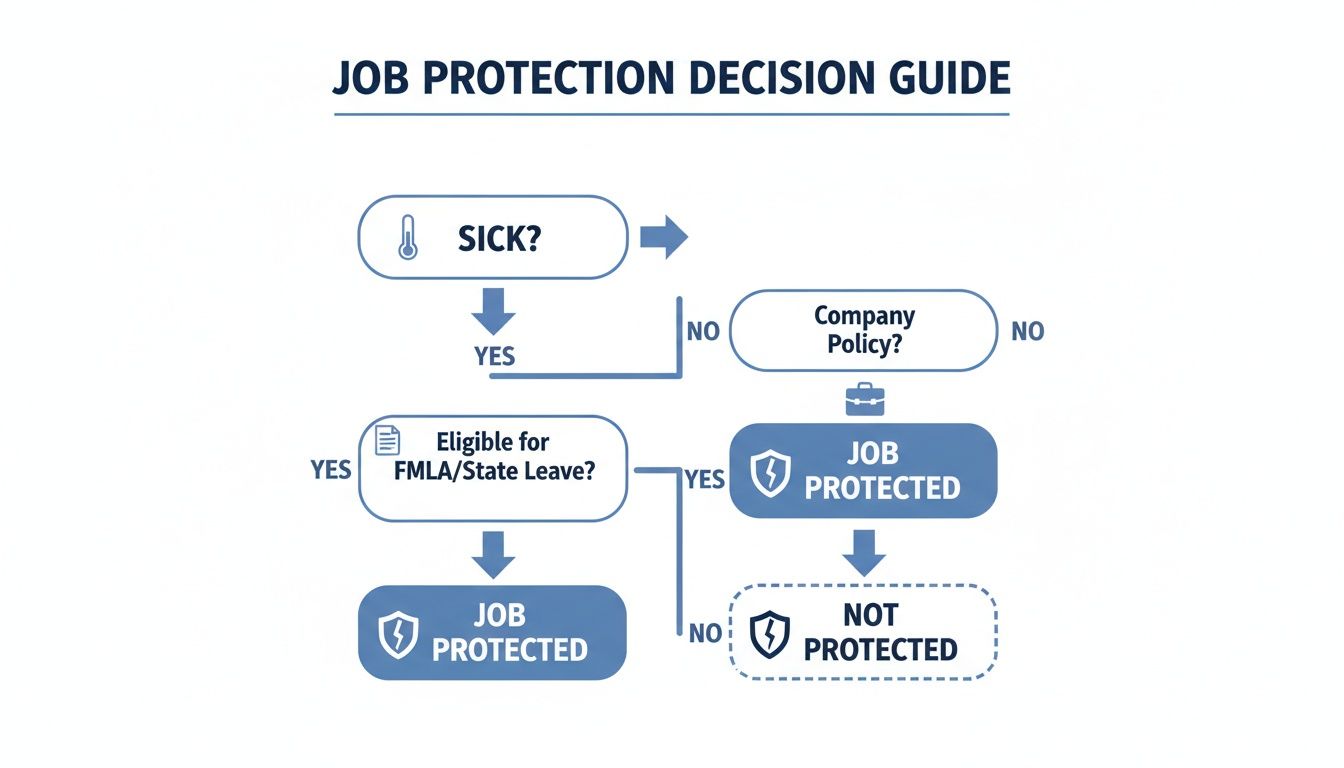
As the chart shows, whether your job is safe often comes down to whether your illness is serious enough to qualify for protection under specific laws like the Family and Medical Leave Act (FMLA) or the Americans with Disabilities Act (ADA).
When Firing for Sickness May Be Legal vs. Illegal
The line between a legal and illegal firing can feel incredibly blurry. It usually comes down to the why behind your termination. Were you let go simply because you missed a day of work, or was it because your absence was tied to something legally protected, like a serious health condition or a disability? Getting this distinction right is the first step in protecting yourself.
An employer can fire you while you are on sick leave, but they cannot fire you because you took legally protected sick leave or due to an underlying disability.
To help you see the difference more clearly, let’s walk through a few common scenarios. This table breaks down when a termination for sickness might be a standard at-will decision versus when it could cross the line into illegal territory.
When Firing for Sickness May Be Legal vs Illegal
This table outlines common scenarios to help you understand the difference between a legal termination under Mississippi’s at-will doctrine and a potentially illegal one protected by federal law.
| Firing Scenario | Generally Legal (Under At-Will) | Potentially Illegal (Protected by Law) |
|---|---|---|
| Missing a few days for a common cold or flu | Your employer can terminate you for attendance issues if you have no contract or federal protection. | Your company has a clear sick leave policy that you followed, but you were fired anyway while others were not. |
| Requesting time off for a serious medical issue | Your condition is not considered “serious” under the FMLA, or you are not eligible for FMLA leave. | Your absence is covered by the FMLA, and you were fired in retaliation for requesting or taking job-protected leave. |
| Needing schedule changes due to a health condition | Your illness is temporary and doesn’t qualify as a disability under the Americans with Disabilities Act. | Your medical condition is a recognized disability under the ADA, and your employer refused to provide reasonable accommodations. |
| Having frequent, unpredictable absences | Your attendance has become unreliable, and you are not covered by FMLA or the ADA, impacting business operations. | Your absences are directly related to an ADA-protected disability, and the employer made no effort to engage in an interactive process. |
Ultimately, context is everything. An employer has a right to expect their employees to show up for work, but they can’t use that as a smokescreen to get rid of someone for a reason that the law specifically forbids.
Understanding At-Will Employment in Mississippi
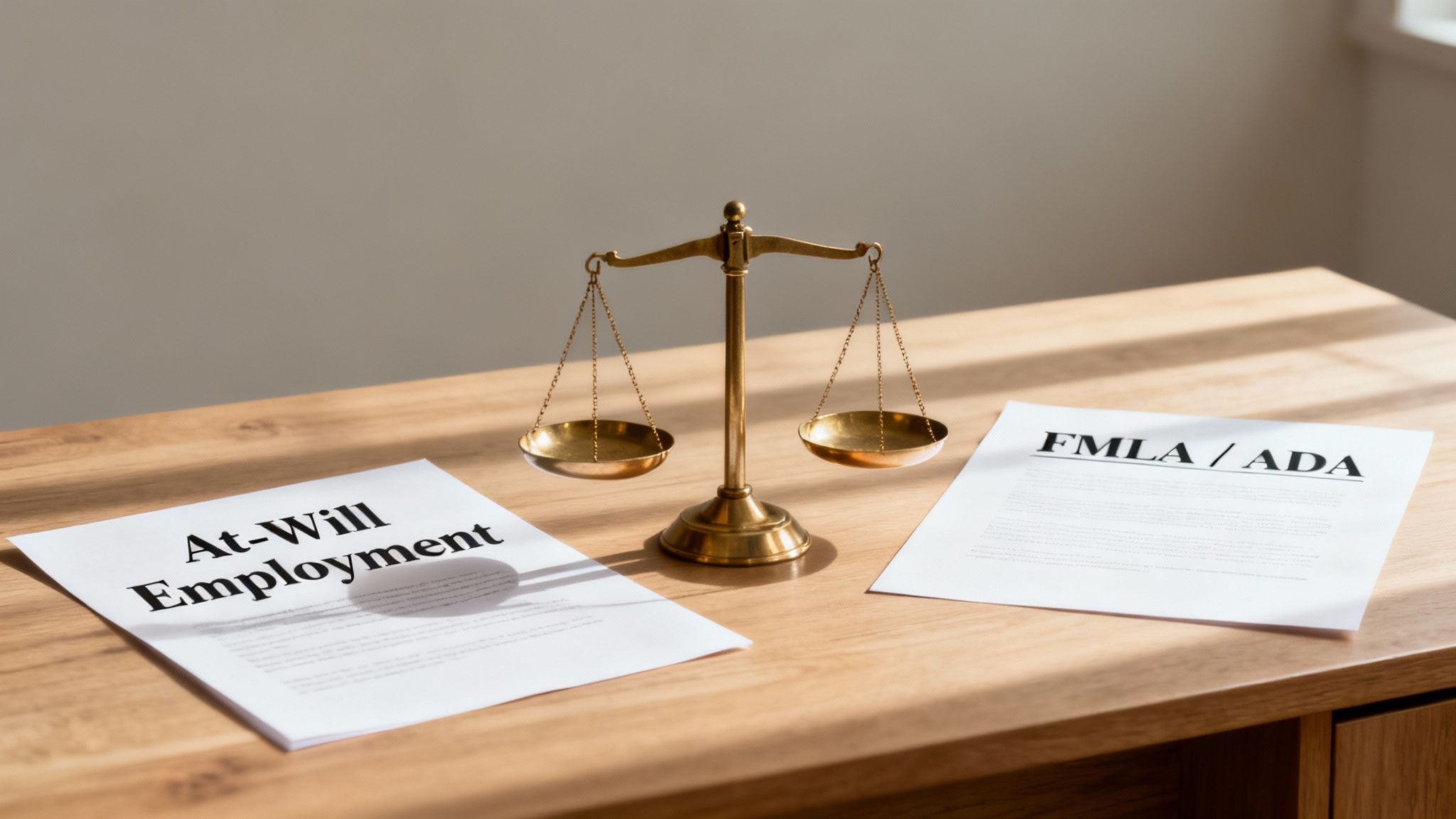
Before we can answer whether you can get fired for being sick, we have to talk about the fundamental rule that governs most jobs in Mississippi: at-will employment. This legal doctrine is the bedrock of the employer-employee relationship here.
Think of it this way: both you and your employer can end the working relationship at any time, for almost any reason, or even for no reason at all. It’s a two-way street. You’re free to quit on the spot for a better job, and your boss can let you go because of a company restructuring or simply because they feel it isn’t working out.
This gives employers a lot of leeway. But—and this is a big but—”at-will” doesn’t give them a blank check to fire you for an illegal reason.
The key takeaway is this: At-will employment allows a firing for any legal reason, but it does not permit a firing for an illegal one. This distinction is where your rights are born.
The Limits of At-Will Power
So, while your boss can legally fire you for calling out with a 24-hour bug, they can’t fire you if it violates federal law. For example, they can’t use your absence as a pretext to discriminate against you because of your race, religion, or gender.
Similarly, an employer can’t fire you as retaliation for exercising a protected legal right. This is where federal laws become so critical—they serve as the primary shield for sick employees in Mississippi. Because our state offers very few specific protections, these federal statutes create the powerful exceptions that keep at-will employment from becoming an unchecked power.
This reality puts a lot of Mississippi workers in a vulnerable position. It’s a surprising fact that the United States is the only wealthy nation without a federal mandate for paid sick leave. While twelve states have taken matters into their own hands and passed paid sick day laws, Mississippi isn’t one of them. This leaves most workers entirely dependent on their employer’s goodwill or the safety net of federal law. You can dig into more data on national paid sick leave policies from the National Partnership for Women & Families.
Laws like the Family and Medical Leave Act (FMLA) and the Americans with Disabilities Act (ADA) are your strongest lines of defense against being wrongfully fired for a serious health issue.
Your Shield Against Unfair Termination
While Mississippi is an “at-will” state, giving employers a lot of leeway, that’s not the end of the story. Powerful federal laws act as a critical shield, carving out specific protections that stop a company from firing you just because you’re sick. When your health puts your job on the line, these laws are your first line of defense.
Think of it this way: “at-will” is the general rule, but these federal statutes are the exceptions that can override it. Even if your company handbook doesn’t mention them, these laws apply. Understanding how they work is the first step toward protecting yourself.
We’ll focus on the big three federal shields that come into play when illness affects your job: the Family and Medical Leave Act (FMLA), the Americans with Disabilities Act (ADA), and the Uniformed Services Employment and Reemployment Rights Act (USERRA).
The Family and Medical Leave Act (FMLA)
The FMLA is one of the most important lifelines for employees dealing with a serious health problem. It grants eligible employees up to 12 weeks of unpaid, job-protected leave each year. “Job-protected” is the key phrase here—it means your employer can’t fire you for taking this approved time off and must give you back the same or a very similar job when you return.
But there are some hoops to jump through. Not everyone is covered by FMLA. To qualify, you must meet all of these criteria:
- Company Size: Your employer must have 50 or more employees working within a 75-mile radius.
- Time on the Job: You need to have been with the company for at least 12 months.
- Hours Logged: You must have worked a minimum of 1,250 hours during the 12 months right before you need the leave.
FMLA isn’t for a simple cold or a stomach bug. It’s meant for what the law calls a “serious health condition,” which typically involves hospitalization or ongoing treatment from a doctor. To get into the nitty-gritty of what qualifies and how to request leave, check out our in-depth guide on employee rights under FMLA.
The Americans with Disabilities Act (ADA)
Next up is the ADA. This law protects qualified people with disabilities from being discriminated against at work. If your illness is a long-term or chronic condition that significantly impacts a major part of your life (like walking, thinking, or working), it could be legally considered a disability under the ADA.
The real power of the ADA is its requirement for “reasonable accommodations.” This isn’t about getting special treatment; it’s about your employer having a legal duty to work with you to find a practical solution so you can keep doing your job.
A reasonable accommodation is simply an adjustment that creates an equal opportunity for you to succeed. This could mean anything from a modified work schedule and unpaid leave to changes to your desk setup or job duties.
An employer can’t just throw up their hands and fire you because your disability makes things a bit harder. They are required to have a good-faith conversation with you—an “interactive process”—to see what accommodations might work. The only way out for them is if the accommodation would cause the company “undue hardship.” If they fire you without even trying, it could be a clear case of disability discrimination.
Protections for Service Members
Finally, we have the Uniformed Services Employment and Reemployment Rights Act (USERRA). This law is specifically designed to protect the jobs and benefits of military service members. It ensures that when you take leave for military duty, your job and health insurance are protected. If you’re fired or disciplined because of an illness or injury that happened or got worse during your military service, USERRA might be your strongest legal tool.
These federal laws aren’t just polite suggestions; they are concrete, legally binding rules. If your situation is covered by the FMLA, ADA, or USERRA, your boss’s power to fire you for being sick is seriously curtailed. The key is figuring out which shield applies to you.
Spotting Wrongful Termination and Retaliation

Getting fired when you’re sick just feels wrong. But the crucial part is figuring out if it was just an unfortunate, legal firing under at-will rules or if it crossed the line into something illegal.
The difference almost always boils down to two things: timing and motive. A termination becomes wrongful when the real reason for it violates a law, like the FMLA or ADA.
Think about it this way: you formally request FMLA leave on Monday, and on Tuesday, you’re suddenly fired for a tiny mistake you made a month ago. That kind of timing is a massive red flag. The same goes for being let go right after telling your boss you have a serious medical condition that might qualify as a disability.
In these cases, it’s not hard to connect the dots. The firing likely wasn’t about your performance at all—it was a reaction to you using your legally protected rights.
What Does Illegal Retaliation Look Like?
Retaliation is basically punishment. It’s when your employer takes negative action against you, not because of your work, but because you did something you were legally allowed to do—like taking medical leave or asking for an accommodation. And it isn’t always as obvious as getting fired.
Sometimes, retaliation is more subtle. It’s designed to make your work life so miserable that you just give up and quit. Here are a few classic examples of what that can look like:
- A Sudden Demotion: You get back from protected medical leave only to find you’ve been moved to a lower-level job.
- Cutting Your Hours or Pay: Your shifts are slashed, or you’re reassigned to a lower-paying role right after you asked for a simple ADA accommodation.
- Mysterious Bad Reviews: Out of the blue, you get your first-ever poor performance review just days after filing your FMLA paperwork.
- Being Iced Out: You’re suddenly excluded from key projects or team meetings you’ve always been a part of.
If any of these things happen as a direct result of you exercising your rights, it could be illegal. The first step is learning what qualifies as wrongful termination to see if your employer’s actions fit the pattern.
The Connection Between Absences and Getting Fired
Even with federal protections, frequent absences can put your job on the line if they aren’t covered by laws like the FMLA or ADA. The numbers don’t lie—there’s a clear link between how many sick days an employee takes and their risk of being let go.
A study on job termination risk revealed that employees with high rates of sickness—more than 15 days a year—were 1.6 times more likely to be fired than co-workers with low absence rates. The risk was even more pronounced for younger employees.
This is exactly why knowing your rights is so critical. An employer can fire you for missing too much work under at-will employment, but they cannot use legally protected absences as the reason. The challenge is often proving that your protected leave was the real trigger for their decision. You can dig into the findings connecting sick leave and job security to understand the trends, but your specific case will depend on the facts.
Your Action Plan After Being Fired
That moment when you’re told you’ve been fired is a whirlwind of shock and confusion. If you think it’s because you were sick, it’s easy to let emotion take over. But the first few hours and days are critical, and acting with a clear head can make all the difference in protecting your rights.
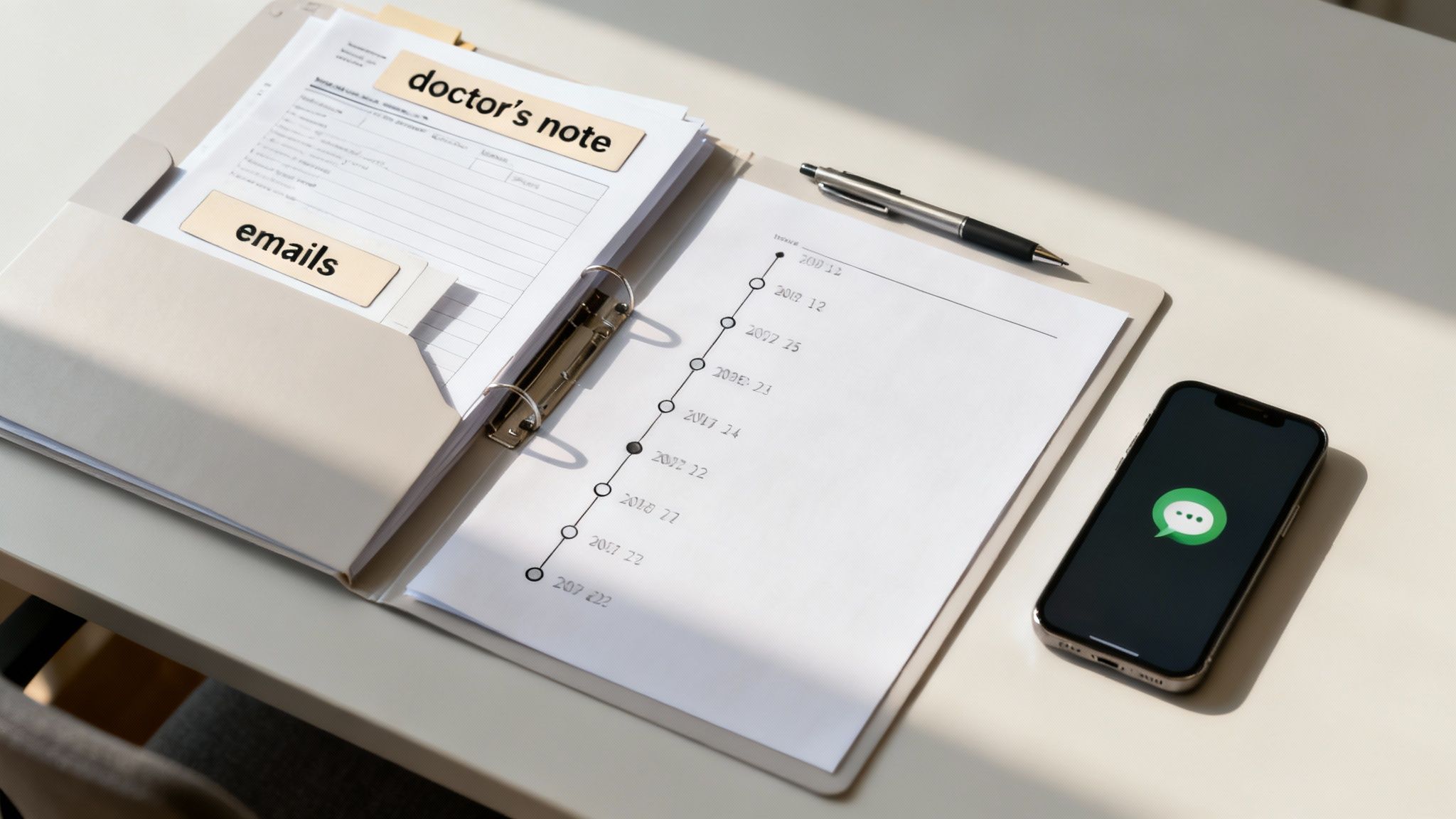
Think of it this way: your first job is to become the chief archivist of your own story. You need to start gathering every piece of paper and digital message that relates to your job, your illness, and your firing. This isn’t just about finding the termination letter; it’s about building a complete picture.
Gather Your Evidence
It’s time to put on your detective hat. The goal here is to find anything and everything that helps tell the story of what happened. You’re looking for proof of your illness, your communication with the company, and your track record as an employee.
Start building a file with these key items:
- Medical Documentation: This includes every doctor’s note, medical record, test result, or diagnosis related to your condition.
- Company Communications: Dig up every email, text message, or internal chat you sent to your boss or HR about being sick, needing time off, or requesting an accommodation.
- Employment Records: Find your employee handbook, your original employment contract or offer letter, and all of your performance reviews—especially the ones where you received positive feedback.
- Termination Documents: Keep the official termination letter, any severance agreement they offer, and any other paperwork they gave you on your way out.
This collection of documents is the bedrock of any potential claim. For a more detailed list, our employee termination checklist is an invaluable resource to make sure you don’t miss a single crucial piece of evidence.
Document Everything in a Timeline
Once you have your documents, the next step is to create a detailed timeline. Our memories play tricks on us, especially under stress, so writing everything down is essential.
Start from the very beginning—the day your health issues first appeared—and list every important event in chronological order, right up to the moment you were fired.
Crucial Tip: Details are your best friend here. Note the exact date you told your manager about your health condition, the day you asked for FMLA forms, and who said what during the termination meeting. The more specific you are, the stronger your record will be.
Whatever you do, don’t sign anything without talking to an attorney first. This is especially true for severance agreements. Signing one could mean you’re giving up your right to sue, even if you have a strong case.
Contact an Employment Lawyer
With your evidence organized and your timeline written down, it’s time to get a professional legal opinion. Mississippi does not have a human rights commission or state agency that handles these kinds of wrongful termination claims, so your case will likely involve federal agencies. Navigating that system is incredibly difficult without an expert guide.
An experienced employment lawyer will listen to your story and analyze your evidence to see if your firing breaks federal laws like the FMLA or ADA. They can lay out your options, which almost always starts with filing a formal complaint—called a charge of discrimination—with the U.S. Equal Employment Opportunity Commission (EEOC).
This is a mandatory step you must take before you can ever file a lawsuit. A good attorney will handle this complex process for you, making sure every detail is correct and every deadline is met.
How an Employment Lawyer Can Make a Difference
Going up against a former employer on your own, especially after being fired for getting sick, can feel like an uphill battle from the start. This is where an experienced Mississippi employment lawyer can truly level the playing field. They step in as your guide and advocate, navigating a legal system that’s often confusing and intimidating.
One of their first jobs is to dive deep into the details of your case, figuring out if your rights under federal law were violated.
From there, an attorney takes the entire burden off your shoulders. They handle all the stressful communications with your ex-employer and manage the mountain of legal paperwork. Most importantly, they will prepare and file a formal claim with the U.S. Equal Employment Opportunity Commission (EEOC), which is a mandatory first step before you can ever file a lawsuit.
Removing the Financial Barrier to Justice
I know what you’re thinking: “How can I afford a lawyer when I’ve just lost my job?” It’s a valid concern, but it shouldn’t stop you from getting the help you need. Most reputable employment lawyers in Mississippi work on a contingency fee basis.
This is a game-changer for people who have been wronged.
It means you pay absolutely nothing upfront. The lawyer’s fee, which is a percentage of what you recover—usually 40-50%—is only paid if they win your case through a settlement or a court verdict. If you don’t win, you don’t owe them a dime for their time.
This fee structure gives everyone a fair shot at justice, no matter their financial situation. It lets you focus on your health and your case without worrying about how you’re going to pay the legal bills piling up.
Common Questions About Sickness and Job Security
Trying to figure out your rights when you’re sick can be a real headache, especially when you’re dealing with Mississippi’s at-will employment rules. Let’s cut through the confusion and get straight to some of the most common questions people have when their health and their job are on the line.
Does My Employer Have to Pay Me for Sick Days in Mississippi?
In a word, no. There’s no Mississippi state law that requires private companies to offer paid sick leave.
Unless you have an employment contract or a company handbook that specifically lays out a paid sick leave policy, any time you take off for an illness will probably be unpaid. It all comes down to what your company decides to offer, not what the state makes them do.
What if My Firing Was Based on FMLA Protected Absences?
Now, this is where things get serious. Let’s say you were fired for having too many absences, but some of those days off were legally protected under the Family and Medical Leave Act (FMLA). In that situation, the firing could be illegal.
An employer is not allowed to use FMLA-approved leave as a black mark against you or count it toward any disciplinary action. An experienced employment attorney can dig into your attendance records and FMLA documentation to see if your protected leave was unfairly used as the reason for letting you go.
Can I Still Be Fired if I Have a Doctor’s Note?
Surprisingly, yes. A doctor’s note is crucial for documenting why you were out, but it doesn’t give you automatic job protection in an at-will state like Mississippi. The note itself doesn’t legally prevent your employer from firing you.
A doctor’s note explains your absence, but it doesn’t create a legal force field around your job. Your protection comes from federal laws like the FMLA or ADA, not the note alone.
Your employer can still terminate you for attendance issues. The real protection kicks in if your illness is serious enough to be covered by the FMLA or if it qualifies as a disability under the Americans with Disabilities Act (ADA). In those cases, your employer has to consider things like reasonable accommodations before making a move.
If you think you were fired unfairly just for being sick, you don’t have to fight this battle on your own. At Nick Norris, P.A., we offer dedicated, knowledgeable representation to help Mississippi workers understand their rights and get the justice they deserve. Contact us today for a confidential evaluation of your case.
This article has been reviewed for legal accuracy by Nick Norris. For employment law matters in Mississippi, consult with an attorney licensed to practice in your state.
Leave a Reply