
Understanding Your Employee Rights Under FMLA in Mississippi
When a serious family or medical issue pops up, the last thing you should have to worry about is whether you'll still have a job. The Family and Medical Leave Act (FMLA) is a federal law designed to be a crucial safety net in these exact moments. Think of it as a 'pause button' on your employment, giving you job-protected time off so you can focus on what truly matters.
If an employer in Mississippi has denied your leave or punished you for taking it, our Mississippi FMLA lawyer can review your situation for free.
Your Core Employee Rights Under FMLA Explained

The FMLA sets a national standard for compassionate leave, so these protections aren't specific to Mississippi—they apply to eligible employees all across the country. It's the baseline of protection for workers navigating health crises or major family milestones.
Signed into law way back on February 5, 1993, the FMLA allows eligible employees to take up to 12 weeks of unpaid, job-protected leave each year for specific, qualifying reasons. This landmark law covers private-sector employers with 50 or more employees within a 75-mile radius, plus all public agencies and schools. All told, it protects about 56% of the American workforce. As organizations like the Policy Center for Maternal Mental Health point out, this kind of leave is vital for family well-being.
What “Job-Protected” Really Means
At its heart, "job-protected" leave means your employer can't fire you just for taking FMLA-approved time off. That’s the absolute cornerstone of your rights. But it goes deeper than that, creating a couple of key guarantees that offer real stability when life feels anything but stable.
These guarantees aren't just suggestions; they are legally required and form the foundation of your security while you're on leave.
The FMLA was created to help employees balance their work and family responsibilities by allowing them to take reasonable unpaid leave for certain family and medical reasons. It seeks to accomplish this in a manner that accommodates the legitimate interests of employers.
To help you get a clear picture of what the FMLA offers, here’s a quick summary of your fundamental rights.
FMLA at a Glance: Key Protections for Mississippi Employees
This table breaks down the essential protections the FMLA provides to eligible employees.
| FMLA Right | What It Means for You |
|---|---|
| Job Restoration | When you return from leave, your employer must give you back your original job or an "equivalent" one. An equivalent job has the same pay, benefits, responsibilities, and working conditions—no demotions allowed. |
| Health Insurance | Your employer has to keep your group health insurance active under the same terms as if you were still working. You'll still need to pay your usual share of the premium, but your coverage continues uninterrupted. |
| Protection from Retaliation | It is illegal for your employer to interfere with or deny your FMLA rights. They can't hold your leave against you in performance reviews, pass you over for a promotion, or use it as a basis for any disciplinary action. Period. |
These protections are what ensure that caring for your health or your family doesn’t mean sacrificing your job and the benefits you depend on.
Are You Eligible for FMLA? Here's How to Know for Sure
The FMLA is a fantastic protection for workers, but it doesn't cover everyone. Before you can take advantage of your rights, you have to clear a few hurdles set by federal law. Think of it as a two-part qualification: first, your employer has to be covered by the law, and second, you have to meet a specific set of criteria.
It’s crucial to understand these rules from the get-go. If you or your employer don't meet even one of the requirements, you won't be eligible for FMLA leave.
First Things First: Does Your Employer Qualify?
The very first question to ask is whether you work for a covered employer. The FMLA doesn't apply to every single business, so this is the starting point.
Here’s who the law considers a "covered employer":
- Private companies that have 50 or more employees on the payroll for at least 20 weeks out of the year.
- All public agencies, no matter their size. This includes federal, state, and local government jobs.
- All schools, both public and private, from elementary through high school. They're covered regardless of how many people they employ.
So, if you work for a small family-owned shop in Mississippi with only 15 employees, they likely aren't required to offer FMLA. On the other hand, if you work for a local school district or a large manufacturing plant in Tupelo, you can be almost certain they are covered.
The Three-Part Test for Your Own Eligibility
Once you've confirmed your employer is covered, the spotlight turns to you. To be an "eligible employee," you have to check three specific boxes.
1. How Long You've Worked There
You need to have been with your employer for at least 12 months. The good news is these months don't have to be back-to-back. If you worked for a company for six months, left for a while, and came back later for another six months, you’ve met the 12-month requirement.
2. The Hours You've Put In
This one is a biggie. You must have worked at least 1,250 hours for your employer in the 12 months right before you need to take leave.
This 1,250-hour rule is critical because it averages out to about 24 hours a week. This means many part-time employees won't qualify, even if they've been with the company for years. It's also important to remember that paid time off—like vacation or sick days—doesn't count toward this total. It's based on actual hours worked.
3. Where You Work
Finally, your job site must have 50 or more employees either at that location or within a 75-mile radius. This rule can be tricky, especially for people working in Mississippi’s more rural areas.
A Real-World Example: The 75-Mile Rule in Action
Let's break down how that location rule works.
Picture a nurse who works at a small satellite clinic in a rural Mississippi town. The clinic itself only has 10 employees. At first glance, it seems like she wouldn't qualify.
But the clinic is owned by a large hospital system, and the main hospital—which employs hundreds of people—is just 40 miles away in Jackson. Because her employer has well over 50 employees within that 75-mile radius, she meets this requirement.
If, on the other hand, that little clinic was a standalone business or its parent company was 100 miles away, she wouldn't be eligible for FMLA. This geographic test is often the final piece of the puzzle. Getting all three of these employee requirements right is the key that unlocks your protections under the FMLA.
What Situations Qualify for FMLA Leave?
The Family and Medical Leave Act isn't for calling in sick with a common cold. It's designed to protect your job during significant, often challenging, life events. Think of it as a safety net for when you or your family need you most.
The law clearly lays out a handful of specific situations where you're covered. These reasons generally fall into four buckets: growing your family, caring for a loved one, managing your own serious health issue, or needs related to a family member's military service.
Welcoming a New Child
This is probably the most well-known reason for taking FMLA leave. It covers time off for the birth and care of a newborn, and it's not just for mothers. Fathers are equally entitled to this time to bond with their new child.
The law also extends the same protection to parents who are welcoming a child through adoption or foster care. You have one year from the date the child is placed in your home to take this leave, giving you crucial time to bond and adjust. These situations can be complex, so for more detail on related issues, you can learn about your rights regarding pregnancy discrimination at work in our detailed guide.
Caring for a Family Member with a Serious Health Condition
You can also take FMLA leave to care for an immediate family member who is dealing with a serious health condition. The law is very specific about who counts as "immediate family" here.
This includes your:
- Spouse
- Child (biological, adopted, foster, stepchild, or legal ward under 18, or an adult child who can't care for themselves due to a disability)
- Parent (biological, adoptive, step, or foster parent, or anyone who acted in loco parentis—in the place of a parent—to you as a child)
It's important to note that the FMLA doesn't cover caring for in-laws, siblings, or grandparents unless one of them legally acted as your parent when you were a minor.
Managing Your Own Serious Health Condition
Of course, your own health matters just as much. FMLA leave is available when you’re unable to work because of your own serious health condition. Again, this is for more than just a passing bug.
So, what does the law consider a "serious health condition"? It typically involves:
- An overnight stay in a hospital or other medical facility.
- Being unable to work for more than three straight days while also getting ongoing medical treatment.
- A chronic condition that requires periodic treatments, like asthma or diabetes.
- Pregnancy, which includes everything from prenatal appointments to recovery after childbirth.
Recovering from major surgery, undergoing chemotherapy, or attending regular physical therapy after an accident are all perfect examples. The bottom line is that the condition must prevent you from performing the essential duties of your job.
Since 1993, the FMLA has been a lifeline for American families, supporting them through over 460 million instances of leave. But because the leave is unpaid and eligibility rules exclude nearly 44% of workers, many people still face financial hardship when they need support the most.
Special Provisions for Military Families
Recognizing the unique pressures on military families, the FMLA includes two specific types of leave just for them.
Qualifying Exigency Leave: This gives you up to 12 weeks of leave for various issues that pop up when your spouse, child, or parent is a military member on covered active duty. You could use this time to attend military ceremonies, arrange for new childcare, or spend time with the service member during their short-term rest and recuperation leave.
Military Caregiver Leave: This is a much longer leave provision, offering up to 26 weeks of unpaid leave in a single 12-month period. It’s specifically for caring for a covered servicemember who has a serious injury or illness. The servicemember must be your spouse, child, parent, or next of kin. This extended time is critical for families supporting our nation’s wounded warriors.
How to Properly Request Your FMLA Leave
Knowing you have a right to FMLA leave is the first step. The next is actually getting it approved. The process isn't meant to be a minefield, but you do need to follow a few key steps to get it right. Doing so protects your rights and makes sure you and your employer are on the same page from the very beginning.
Think of it this way: you wouldn't just tell your boss you "might need some time off" if you had a major surgery scheduled. You'd give them clear details and follow the company's procedure. Requesting FMLA leave is a lot like that—it requires a formal heads-up.
FMLA is there to help you handle major life events without risking your job. This could be anything from welcoming a new baby to caring for a sick parent or even dealing with your own serious health issues.
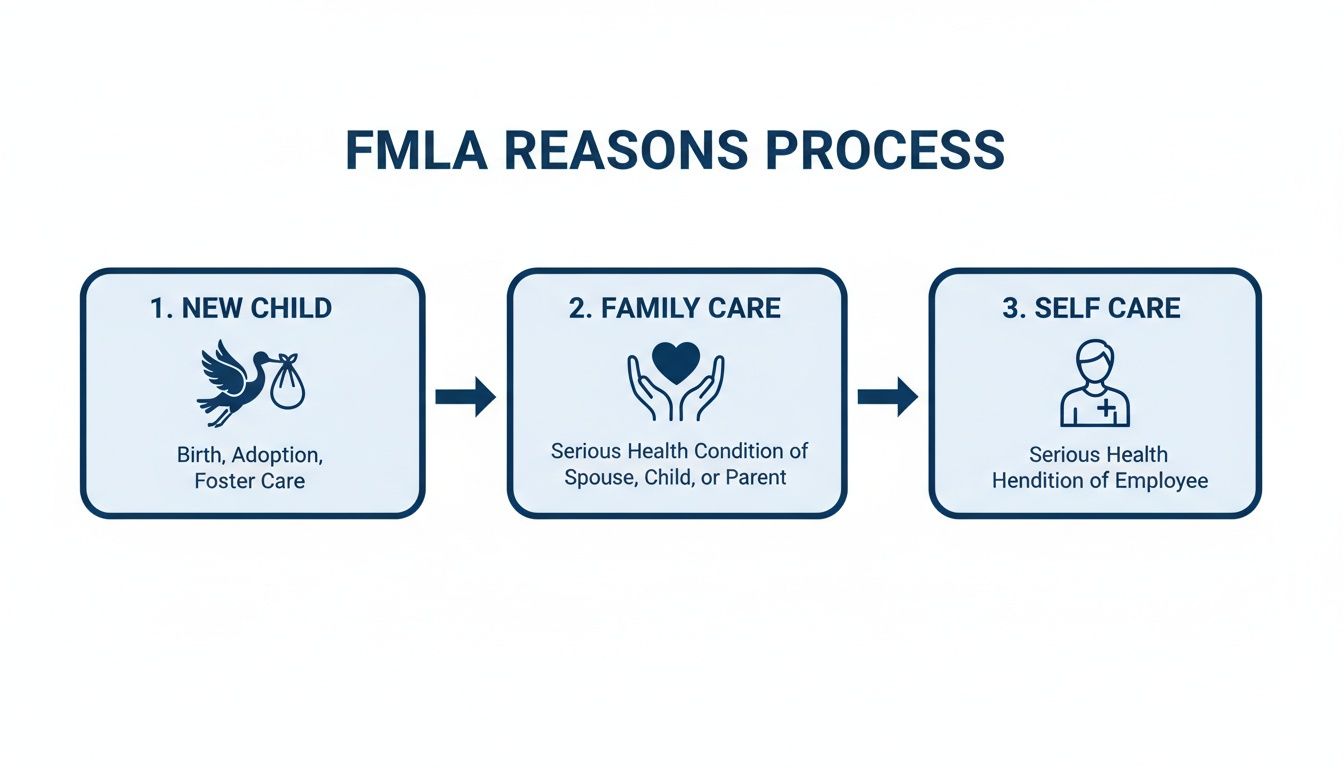
As you can see, the law is designed to give you breathing room when life gets complicated.
Timing is Everything: Giving Your Employer Notice
The first move is always yours: you have to tell your employer you need leave. How and when you do this is critical.
If your need for leave is foreseeable, the rules are straightforward. Think of a planned surgery, a scheduled C-section, or the final stages of an adoption. In these cases, you must give your employer at least 30 days' advance notice.
But life is often unpredictable. If your need for leave is unforeseeable—a sudden illness, a car accident—the standard is simply to give notice as soon as practicable. For most people, that means calling in the same day or the very next business day after you realize you need the time off.
Here's a key point: You don't have to utter the magic words, "I need FMLA." Just explain the situation. Saying something like, "My father was just hospitalized and I need to be there," or "My doctor scheduled me for surgery next month," is enough to trigger your employer's FMLA obligations.
What Your Employer Can Ask For
Once you've given notice, the ball is in your employer's court, but they can—and likely will—ask for more information. Expect to fill out your company's official FMLA request form.
If your leave is for a serious health condition (your own or a family member's), your employer has the right to ask for a medical certification. This is simply a form for your doctor (or your family member's doctor) to fill out.
This certification typically needs to include:
- When the health condition started.
- How long it's expected to last.
- Basic medical facts to justify the need for leave.
- A statement confirming you can't perform your job duties, or that your family member needs your care.
You usually have 15 calendar days to get this form completed and returned to your employer.
Your Employer's Response Timeline
The law doesn't just put deadlines on you; your employer has a strict timeline to follow, too. They can't just leave you hanging.
Within five business days of you asking for leave, your employer must provide you with two documents:
- Notice of Eligibility: This paper tells you whether or not you even qualify for FMLA based on things like how long you've worked there and the hours you've put in.
- Rights and Responsibilities Notice: This is an important document that spells out the rules of the road—things like whether you'll need to provide medical certification or how to handle your health insurance premiums.
After they have enough information to make a call—usually after they receive your medical certification—they have another five business days to give you a final Designation Notice. This is the official piece of paper that says your FMLA leave is either approved or denied. It's a good idea to document everything along the way—every email, phone call, and form—to create a clear record that protects you.
What to Do If Your Employer Violates Your FMLA Rights

It’s one thing to know your rights under the FMLA, but it's another thing entirely to get your employer to respect them. Unfortunately, violations are all too common.
Maybe your boss denied a valid leave request, pressured you to come back to work early, or even punished you for taking time off you were legally owed. When this happens, you need to know what to look for and what to do next. The first step is recognizing when your employer has crossed the line.
Recognizing FMLA Violations
FMLA violations aren't always as blatant as being fired on the spot. They can be much more subtle, but they're just as illegal. Most violations fall into two main categories: interference and retaliation.
Interference is when your employer does anything to stop or discourage you from using your FMLA rights.
- For example: Your manager tells you that taking leave for your upcoming surgery would be "bad for the team" and hints it might impact your annual bonus. That's illegal interference.
Retaliation is when your employer takes negative action against you because you took FMLA leave.
- For example: You return from leave after recovering from a serious health issue, only to find you've been demoted to a lower-paying job with fewer responsibilities. That's a classic case of retaliation.
Being fired for using FMLA is one of the most serious violations and can form the basis of a separate legal claim.
Other common violations include failing to give you your old job back (or an equivalent one), using your FMLA leave as a negative mark on a performance review, or changing your duties to something less desirable when you return. If you're wondering whether something feels like illegal punishment, our guide offers more examples of the common signs of retaliation at work.
Your Options for Seeking Justice in Mississippi
If you believe your FMLA rights were violated, you have a direct path to seek justice. One key thing to know is that Mississippi does not have a state-level human rights commission to handle these types of claims. That means your fight will happen at the federal level.
You are not alone in this process. Federal law provides a direct path for employees to hold employers accountable for FMLA violations. Your primary options involve filing a federal complaint or pursuing a private lawsuit.
Here are the two main avenues you can take:
- File a Complaint with the U.S. Department of Labor (DOL): You can file a complaint with the DOL's Wage and Hour Division (WHD). The WHD will investigate your claim. If they find your employer broke the law, they can take action on your behalf to recover lost wages and get your job back.
- File a Lawsuit in Federal Court: You also have the right to hire a lawyer and file a private lawsuit directly in federal court. This approach often allows you to seek a wider range of damages, including lost pay, legal fees, and sometimes "liquidated damages," which can actually double the money you receive.
Why Legal Guidance Is Essential
Trying to navigate federal employment law on your own is incredibly difficult. An experienced employment law attorney is your best asset for building a strong case, as they know exactly what kind of evidence is needed to prove FMLA interference or retaliation. They'll handle the communications with your employer and the courts, letting you focus on what matters.
Speaking of evidence, start gathering everything you can, right away.
- Any emails or texts about your leave request.
- Copies of performance reviews from before and after your leave.
- Notes on conversations or statements from coworkers who saw what happened.
- All the official FMLA paperwork you submitted and received.
An attorney will help you organize this information and present it in the most powerful way. Best of all, most employment lawyers work on a contingency fee basis, meaning you don't pay anything upfront. They get paid a percentage of the final settlement or award, which is typically between 40-50%. This makes expert legal help accessible, so you can fight for your rights without taking a financial risk.
Seeking Justice and Damages for FMLA Violations
When an employer illegally denies your FMLA leave or retaliates against you for taking it, the law isn't just a set of rules—it's a pathway to making things right. A successful claim can help you recover financially from the harm you've suffered, ensuring you aren't left holding the bag for your employer’s unlawful actions.
The whole point of these legal remedies is to restore what you lost. This means you can pursue compensation for any direct damages you incurred. We're talking about lost wages, bonuses, and benefits if you were wrongfully fired, demoted, or had your hours slashed. It also covers any real out-of-pocket expenses, like the cost of hiring a caregiver because you were unfairly denied leave.
Understanding Your Potential Recovery
The FMLA has a particularly powerful tool for holding employers accountable: liquidated damages.
Think of it as a penalty for bad behavior. If a court determines your employer didn't have a good-faith, reasonable belief that their actions were legal, they can be ordered to pay an amount equal to your actual damages. In simple terms, this provision can effectively double your financial award.
How Can You Afford to Fight Back?
The thought of a federal lawsuit can be intimidating, especially when you're worried about legal bills piling up. But there’s good news. Most experienced employment lawyers in Mississippi handle FMLA cases on a contingency fee basis.
This arrangement means you pay zero attorney’s fees upfront.
Instead of an hourly rate, the attorney receives a percentage of the final settlement or award if they win your case—typically ranging from 40-50%. This structure gives everyone a fair shot at justice, regardless of their financial situation.
The most important thing you can do right now is act quickly. To build a strong case and protect your rights, you need a skilled employment lawyer on your side who lives and breathes federal claims. Knowing how to prepare for your first talk with an employment lawyer will help you get the most out of that initial, crucial conversation.
Common Questions About FMLA in Mississippi
It's natural to have a lot of questions when you're thinking about taking FMLA leave. Let's break down some of the most common concerns Mississippi workers have, with clear, direct answers.
Can My Employer Fire Me for Taking FMLA Leave?
Absolutely not. The heart and soul of the FMLA is job protection. It is illegal for your employer to fire you simply for taking the leave you are entitled to.
When you come back, they have to put you back in your original job or an "equivalent" one. This isn't a loophole for them to demote you. An equivalent position has to offer the same pay, benefits, responsibilities, and be in the same location.
Do I Get Paid During FMLA Leave?
This is a big one. FMLA leave itself is unpaid. The law's main job is to make sure you have a job to come back to, not to provide income while you're out.
However, you often have the option to use your paid time off during your FMLA leave to keep money coming in. Your employer can require you to do this, or you can choose to. This means you can use your banked:
- Vacation days
- Sick time
- Personal time off (PTO)
Using your paid leave at the same time as FMLA is a smart way to maintain your income while ensuring your job is protected.
The unpaid nature of FMLA is a real hurdle for many families. It's a tough reality that only 43% of American workers have access to paid medical leave for their own health, and just 27% have it for family care. When you factor in eligibility rules that exclude 44% of the workforce—especially part-time workers and those at the smaller businesses common here in Mississippi—you see a major gap. You can read more about these disparities and how they affect American workers compared to the rest of the world.
Can My Employer Ask for My Medical Diagnosis?
No. Your employer has no right to demand your specific medical diagnosis. That's private information.
What they can do is ask for a medical certification from your doctor. This is a formal document that confirms you have a serious health condition that requires you to be off work.
The certification is just to verify the medical need for your leave and give an idea of how long you'll be out. It should not—and does not need to—contain your private diagnosis. Your medical privacy is protected.
What’s the Difference Between Continuous and Intermittent Leave?
FMLA is designed to be flexible. Depending on your situation, you can take your leave in a couple of different ways.
Continuous leave is pretty straightforward: you take all your time off in one single block. A classic example is taking six weeks off in a row to recover from a major surgery.
Intermittent leave is different. You take it in smaller, separate chunks of time as you need it. This could look like taking off a few hours every Tuesday for physical therapy or a couple of days each month when a chronic illness flares up. This flexibility is one of the most powerful features of your FMLA rights.
If your employer has denied a valid FMLA request, punished you for taking leave, or refused to give you your job back, you don't have to fight them on your own. At Nick Norris, P.A., we are dedicated to defending the rights of workers across Mississippi. We can provide the clear guidance and strong representation you need to get justice. Contact our Mississippi FMLA attorney today to see how we can help protect your job and your rights.
This article has been reviewed for legal accuracy by Nick Norris. For employment law matters in Mississippi, consult with an attorney licensed to practice in your state.
Leave a Reply