

You’ve finished a long shift, clocked out, and are ready to head home. Just as you’re about to walk out the door, your manager asks you to spend “just a few minutes” cleaning up or finishing one last task. Or maybe you find yourself answering work emails and texts from your couch long after your workday is supposed to be over.
Sound familiar? This is called working off the clock, and it’s a surprisingly common—and illegal—practice where you’re performing job duties without getting paid for your time. Those “few minutes” here and there add up, and it’s money that belongs in your pocket, not your employer’s.
Understanding Your Right to Fair Pay in Mississippi
In Mississippi, your right to be paid for every minute you work is protected by a powerful federal law: the Fair Labor Standards Act (FLSA). Think of the FLSA as the nationwide rulebook for fair pay. It sets the ground rules for minimum wage, overtime pay, and, most importantly, what actually counts as work.
The core principle is straightforward. If you’re a non-exempt employee (meaning you’re eligible for overtime), your employer must pay you for all the time you are “suffered or permitted” to work.
What Actually Counts as “Work”?
This is where things can get a little fuzzy for employees. “Work” isn’t just the main tasks in your job description. It’s any activity you perform that benefits your employer, whether it happens at your desk, on a sales floor, or from your phone at home.

Here are a few classic examples of work that absolutely must be paid:
- Pre-Shift Duties: Firing up computers, putting on mandatory protective gear, or prepping your station before your shift officially begins.
- Post-Shift Tasks: Staying late to clean up, finish paperwork, run reports, or lock up the building after you've already clocked out.
- Working Through Breaks: If you're asked to answer phones, help a customer, or do any work during what's supposed to be an unpaid meal break, that break time becomes paid time.
- Off-the-Clock Remote Work: Responding to work-related texts, taking calls from a supervisor, or answering emails after hours.
To make this clearer, let's break down what activities generally require compensation versus those that don't.
Paid vs Unpaid Time A Quick Comparison
The line between a quick, non-work-related chat and a compensable task can be confusing. This table offers a simple guide to help you distinguish between the two based on federal law.
| Activity | Generally Compensable (Must Be Paid) | Generally Non-Compensable (Not Paid) |
|---|---|---|
| Travel | Travel between job sites during the workday. | Normal daily commute from home to work. |
| Breaks | Short rest breaks (usually 5 to 20 mins). | Bona fide meal breaks (30+ mins, fully relieved of duties). |
| Waiting Time | Time spent "engaged to wait" (e.g., a receptionist waiting for calls). | Time spent "waiting to be engaged" (e.g., arriving early by choice). |
| Training | Mandatory meetings or training required by the employer. | Voluntary training taken on your own time for career advancement. |
| Pre/Post-Shift | Putting on/taking off required, specialized gear or prepping equipment. | Changing into a basic uniform that could be worn to/from work. |
Keep in mind, every situation is unique, and these are general guidelines. The key takeaway is that if the activity is for your employer's benefit and they know (or should know) you're doing it, it's almost always considered paid work.
A Problem That’s More Common Than You Think
The expectation to be "always on" has made working off the clock a massive issue. Technology has blurred the lines between our work lives and our personal time, making it easier than ever for unpaid work to slip through the cracks.
The problem is widespread. A recent survey revealed that a shocking 46% of American workers admit to staying plugged into work while on vacation, essentially working for free when they should be resting. This startling trend, detailed in ELVTR's full report, shows just how deeply this issue runs in our modern work culture.
Under federal law, your employer can’t just turn a blind eye. If a manager knows you’re working—or even has a good reason to believe you are—they have a legal duty to make sure you’re paid for it. This holds true even if you weren't explicitly asked to do the work.
At the end of the day, your time is your most valuable asset. Whether it’s five minutes setting up before your shift or 30 minutes answering emails after you get home, that time belongs to you. The law is on your side to ensure you get compensated for it.
Recognizing Hidden Work in Your Daily Routine
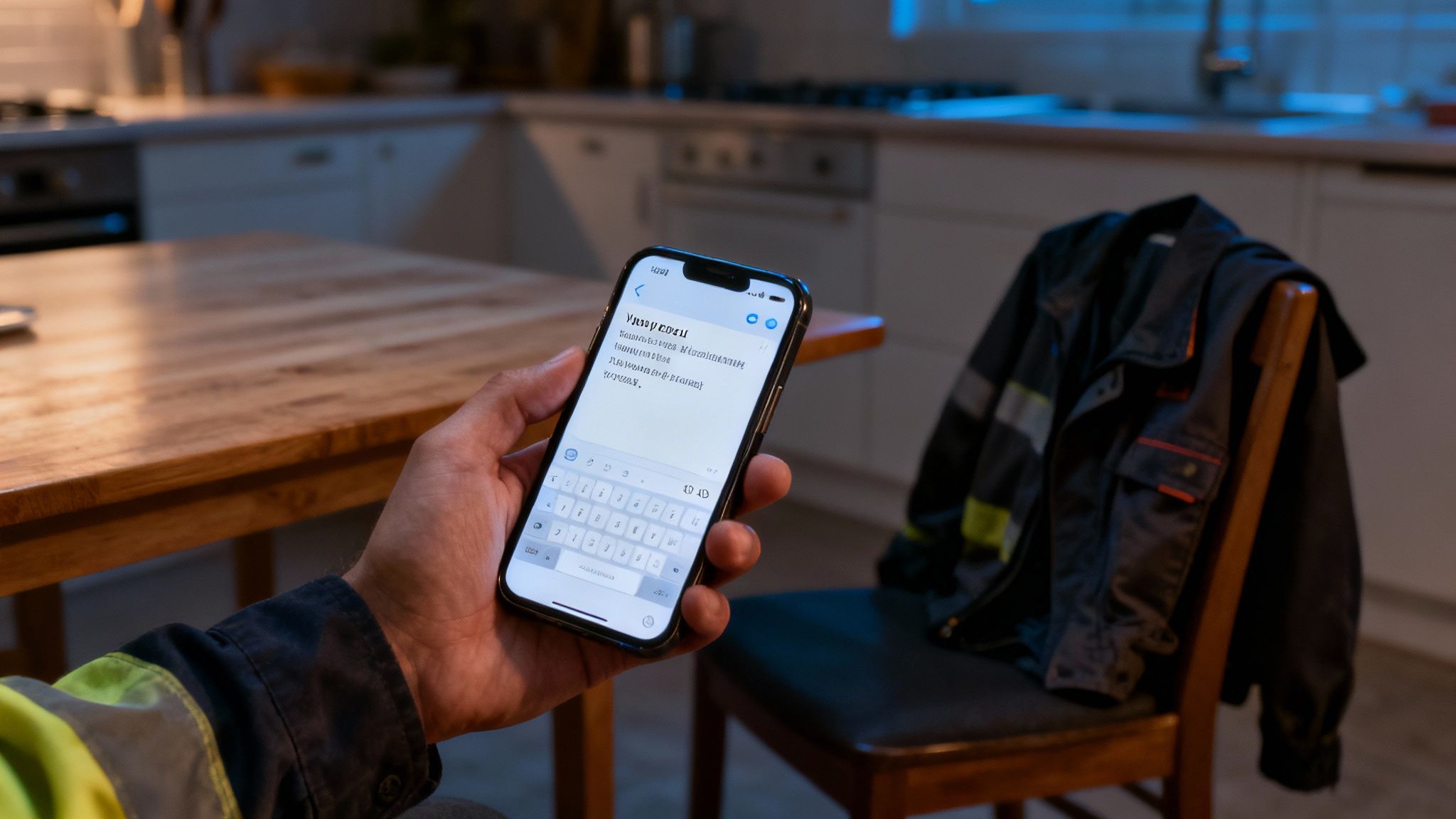
Wage theft isn't always as obvious as a boss telling you to clean up after punching out. Far more often, it’s subtle. It hides in the small, everyday tasks that quietly erase the line between your job and your personal life. Spotting this hidden labor is the first, most crucial step toward getting back the wages you've earned.
The truth is, many workers in Mississippi are unknowingly working off the clock every day. A few minutes here and there might not seem like a big deal, but they add up fast. Before you know it, you've lost hours of unpaid time over weeks and months. It's time to pull back the curtain and see what these activities actually look like.
The Blurring Lines of Modern Work
In our always-on world, your workplace isn't just a building anymore—it's your smartphone, your laptop, and anywhere else a message from your boss can find you. This constant connection has opened up brand-new ways for unpaid work to sneak into your life.
Think about that text from your manager that buzzes in right as you're sitting down for dinner. Firing off a quick reply feels harmless, but it's work. You're coordinating, solving a problem, or planning for your employer's benefit, and federal law is clear: you have to be paid for that time.
Here are some of the most common ways people end up doing unpaid work without even realizing it:
- After-Hours Communication: Answering work texts, emails, or calls from managers or coworkers after your shift is officially over.
- Pre-Shift Prep: Coming in early to fire up computers, log into a dozen different software programs, or get specialized equipment ready before you're allowed to clock in.
- Post-Shift Wind-Down: Sticking around after you've clocked out to finish paperwork, tidy your workspace for the next shift, or drop off company tools.
- Working Through "Unpaid" Breaks: Getting pulled away from your lunch to answer a quick question, help a customer, or join a "brief" team huddle. If you aren't completely free from your duties, that break time needs to be paid.
On-Call Time: A Common Trap
Another area that trips people up is "on-call" time. If you're required to stay on your employer's property—or so close by that you can't really use the time for yourself—you're working.
Here's a good way to think about it: if your "on-call" rules are so restrictive that you can't go to the grocery store, catch a movie, or just live your life, then that time isn't truly yours. It belongs to your employer, and you should be paid for it. The core legal question is always whether the time is spent mainly for the employer's benefit or the employee's.
Under the Fair Labor Standards Act (FLSA), the standard is straightforward: if your employer knows or has reason to believe you're working, you must be paid. This applies whether you're at the worksite, at home, or answering a text on your phone.
Real-World Examples in Mississippi
Let's ground this in a few scenarios that Mississippi workers see all the time. These examples show just how easily unpaid work can become a normal, expected part of the job.
- The Restaurant Server: Your shift ends at 10:00 PM, and you clock out. Then, your manager asks you to stick around and roll silverware for the morning crew. Those extra 20 minutes are work time and must be paid.
- The Healthcare Worker: You get to the clinic 15 minutes early every day to review patient charts and get ready for rounds before your shift officially starts. That essential prep time is compensable work.
- The Office Administrator: You take a stack of files home to organize after clocking out because you couldn't get to it during the day. Even if it was your idea, if your manager is aware you do this to keep up with the workload, that time is considered work.
- The Retail Employee: The store requires you to attend a 15-minute team huddle before the doors open. Because it's mandatory and benefits the store, you must be paid for that meeting, even if it happens before you clock in.
In every one of these cases, an employee is performing tasks for their employer outside of their paid hours. Learning to recognize these patterns is the most powerful thing you can do. Your time is valuable, and the law protects your right to be paid for every single minute of it.
How Federal Law Protects Your Paycheck
Even though Mississippi doesn't have its own state-level laws for minimum wage or overtime, you're not on your own. A powerful federal law, the Fair Labor Standards Act (FLSA), steps in to provide a strong safety net for nearly every worker in the state.
Think of the FLSA as a worker's bill of rights for your pay. It sets the ground rules that employers have to follow, and it's the very reason that working off the clock is illegal. No matter what a company handbook says or what a manager tells you, this law establishes a baseline of rights you are owed. Getting familiar with these protections is the first step toward getting paid what you’ve rightfully earned.
Your Right to Overtime Pay
One of the cornerstones of the FLSA is your right to overtime. The law couldn't be clearer: for most employees, any time you work beyond 40 hours in a single workweek, you must be paid at one and a half times your normal hourly rate.
This isn’t a suggestion—it's the law. It doesn't matter if you didn't get the overtime "pre-approved" or if your company has a strict policy against it. If your employer knows you're working, or even has reason to believe you are, they are legally on the hook to pay you for it.
What Does "Hours Worked" Actually Mean?
So what counts as "work"? The FLSA is broad here. It covers all the time you're required to be on duty or at your workplace, plus any extra time you are "suffered or permitted" to work.
That phrase—“suffered or permitted”—is everything. It means if your boss didn’t explicitly ask you to stay late but saw you finishing up a project and didn't stop you, that time counts. Your employer can’t just turn a blind eye to get free labor. The responsibility is on them to prevent you from working if they don’t want to pay for the time.
The legal standard isn't whether your employer asked you to work, but whether they knew or should have known you were working. This prevents employers from benefiting from your unpaid labor by simply looking the other way.
Are You a Non-Exempt Employee?
These powerful FLSA protections, especially the overtime rules, apply to what are known as "non-exempt" employees. This covers the vast majority of workers, particularly those paid by the hour in fields like retail, construction, food service, and healthcare support. Put simply, they are not exempt from federal wage laws.
On the other hand, "exempt" employees are typically salaried professionals in executive, administrative, or professional roles who meet very specific job duty and salary tests. They aren't entitled to overtime. The problem is, employers frequently misclassify employees as exempt to get out of paying overtime. Knowing where you stand is crucial.
You can learn more about exempt vs non-exempt employee status in our detailed guide to figure out which category you fit into. At the end of the day, federal law provides a strong foundation to ensure your time is valued and you're paid fairly for every minute you put in.
Building Your Case: How to Document Unpaid Hours
When an employer doesn't pay you for time you've worked, it's more than just unfair—it's a direct violation of the law. But to get back the wages you're owed, you need to do more than just say you worked extra hours. You need to prove it. The single most powerful thing you can do right now is start building a rock-solid case, and that begins with careful documentation.
Think of yourself as the chief investigator on your own case. Your job is to create a detailed, undeniable record of every minute of unpaid work. Memories get fuzzy over time, but a written log is a powerful piece of evidence that can stand up in court. This documentation is the bedrock of any successful wage claim.
Start Your Personal Time Log Today
Your first and most important step is to create your own private log of all the hours you work. Don't trust your employer’s official time clock or software, especially if that’s where the problem is happening in the first place. A simple notebook, a spreadsheet on your home computer, or even a notes app on your phone will do the trick.
For every single time you work off the clock, jot down these crucial details:
- Date: The exact day the unpaid work happened.
- Start and End Times: Get specific. Don’t just write "about half an hour." Instead, note "Stayed from 5:01 PM to 5:27 PM."
- Total Unpaid Time: Do the math and calculate the exact duration.
- Description of Tasks: What, specifically, were you doing? For example: “Finished cleaning the grill after I was forced to clock out,” or “Responded to 15 work emails from my manager on my phone at home,” or “Had to boot up all computer systems before my shift was allowed to start.”
- Who Asked You to Work: Did a particular supervisor or manager tell you to do the work? Write down their name.
- Witnesses: If any of your coworkers saw you working, make a note of who was there.
This personal log quickly becomes your most valuable piece of evidence. It transforms a general complaint into a concrete, detailed timeline that’s hard to ignore.
Gather All Supporting Evidence
Beyond your personal time log, it's time to gather any other proof you can find. This supporting evidence helps back up what you’ve written in your log, making your case even more compelling. Think outside the box—what else might prove you were on the job?
Your employer is legally required to keep accurate time and pay records. But when they don't, the courts often give the employee the benefit of the doubt. If you can show your employer's records are wrong or incomplete, a court is much more likely to accept your own reasonable estimate of the hours you worked.
Hold on to absolutely everything. This could include:
- Texts and Emails: Any message from a boss asking you to come in early, stay late, or finish something after hours is golden. Save it.
- Digital Timestamps: Can you screenshot your computer login times? Do you have access to software activity logs or file histories that show you were active? These digital footprints are powerful.
- Photos and Videos: A quick, time-stamped photo of a locked door showing what time you actually got to leave can speak volumes.
- Coworker Statements: This can be tricky, as people are often afraid to get involved. But if a trusted coworker is willing to state they saw you working, their confirmation can be incredibly valuable.
All this evidence helps paint the full picture. Let's face it, today's work culture often blurs the lines, and the pressure to work unpaid hours is real. In fact, 40% of full-time U.S. employees report working over 50 hours a week, and a lot of that extra time is uncompensated. You can read more about these troubling work-life balance statistics on Lifehackmethod.com. By meticulously collecting your proof, you're not just building a case for yourself—you're standing up for your rights.
Your Legal Pathways to Recover Stolen Wages
So, you’ve meticulously documented your unpaid hours. What’s the next step? The good news is that the Fair Labor Standards Act (FLSA) provides powerful, clear-cut pathways for Mississippi workers to get back the money they've earned. You have options, and understanding them is the key to moving forward.
First things first, you need to be aware of the clock—the legal one. The FLSA has a statute of limitations, which is a firm deadline for filing a claim. For most off-the-clock work cases, you have two years from the day of the wage theft to take action.
There's a crucial exception, though. If your employer’s violation was willful—meaning they knew they were breaking the law or acted with reckless disregard for it—that window extends to three years. An experienced attorney can help you figure out which timeline applies to your situation.
Filing an Administrative Complaint
One route you can take is filing a complaint with the U.S. Department of Labor's Wage and Hour Division (WHD). This administrative process kicks off when you report the violation, and the WHD may decide to investigate on your behalf.
An official investigation often involves the agency digging into your employer's payroll records and interviewing other employees. If they confirm a violation, they can supervise the payment of your back wages. While this is a perfectly valid option, the reality is that the process can drag on for a long time. The agency is often swamped with cases, which might limit the personal attention your claim gets.
Taking Your Case to Federal Court
Your other main option is to file a lawsuit directly in federal court. This approach often gives you a more direct and powerful way to recover everything you're owed. It's also important to know that Mississippi does not have a human rights commission or state-level agency that handles these wage claims, making federal court the primary battlefield for these disputes.
This is where all that detailed documentation you’ve collected becomes your greatest asset. A lawsuit lets you formally present your evidence to seek not just your back pay but potentially much more.
Under the FLSA, a successful claim can result in you recovering not only your unpaid wages but also an equal amount in liquidated damages. This effectively doubles the money you are owed, serving as a penalty against the employer for failing to pay you properly in the first place.
The Power of Liquidated Damages
Think of liquidated damages as the law’s way of compensating you for the financial stress and harm you suffered by not being paid on time. Maybe you fell behind on bills or couldn't make a purchase you were counting on. This provision is meant to make you whole.
Let’s say your employer owes you $5,000 in unpaid overtime. A successful lawsuit could mean you receive:
- $5,000 in back pay
- $5,000 in liquidated damages
- Total Recovery: $10,000
It’s a powerful tool designed to hit employers where it hurts and strongly discourage them from playing games with your pay.
The flowchart below shows how systematically documenting your hours builds a rock-solid case for pursuing these legal options.
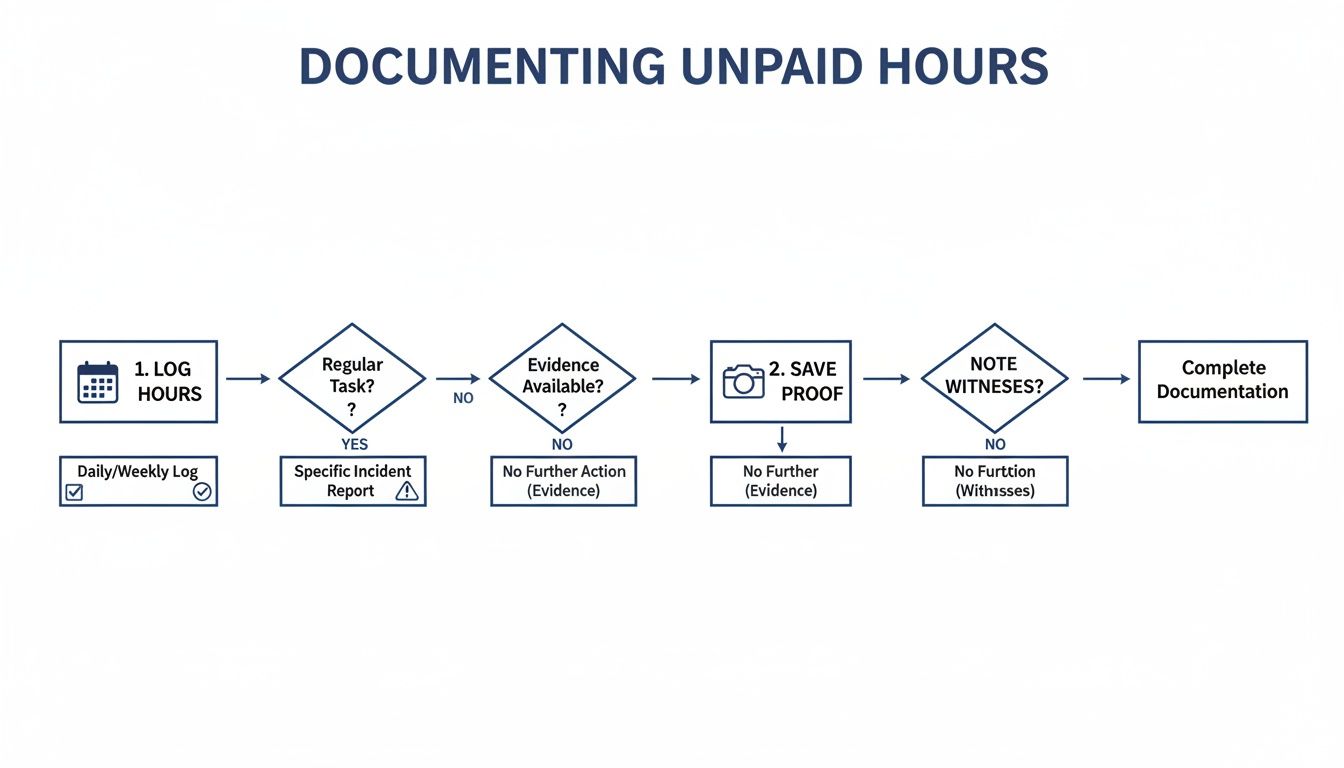
As you can see, logging your hours, saving proof, and noting who can back up your story creates a strong foundation for any action you decide to take.
You Are Protected from Retaliation
A lot of workers are understandably afraid to speak up. What if they get fired? The FLSA was written with this fear in mind and includes strong anti-retaliation protections. It is flat-out illegal for your employer to fire, demote, harass, or punish you in any way for filing a complaint about working off the clock or for participating in an investigation.
This protection is especially critical for people with non-traditional schedules. Around 40% of U.S. workers pull shifts at night or on weekends, and these schedules often blur the lines, leading to uncompensated work like answering after-hours calls. These workers are particularly vulnerable, which is why federal laws enforced by firms like Nick Norris, P.A. are so vital. You can find more workforce scheduling trends at PRB.org.
If you think you have a case, you can get a clearer picture by reading our guide on what to expect from an unpaid wages lawsuit in Mississippi. Chasing down your stolen wages isn't just about the money—it's about holding your employer accountable and standing up for your rights.
Why You Should Speak with a Mississippi Employment Lawyer

Trying to handle a wage claim for working off the clock can feel like you're navigating a maze blindfolded. You absolutely have the right to file a complaint on your own, but bringing in an experienced employment lawyer is almost always the strongest play you can make.
An attorney completely levels the playing field. They live and breathe this stuff—they know exactly what evidence you need for a federal lawsuit and how to shut down the common excuses employers use to avoid paying up. This is especially important because Mississippi does not have a human rights commission or a state-level agency to take on these claims. Your primary path to justice is federal court, and that's not a place you want to go alone.
What About the Cost?
Let's get the biggest worry out of the way: the cost of hiring a lawyer. I get it. The good news is that most Mississippi employment attorneys take these cases on a contingency fee basis, which is designed to remove that financial roadblock.
Here’s what that means for you: no upfront costs. Your lawyer’s payment is simply a percentage of the money they recover for you, usually somewhere between 40-50% of the final settlement or court award. If you don't win your case, you owe them nothing for their time. It's that simple.
This arrangement means you can fight for your wages without taking a financial gamble. It also means your lawyer is deeply invested in winning your case—they only get paid if you do.
Getting the Most Out of Your Claim
A good lawyer does far more than just fill out forms. They take your documentation and build an airtight case, negotiate firmly with your employer, and shield you from any illegal retaliation. Their goal is to fight for every single dollar you're owed, which includes not just your back pay but also potential liquidated damages that can actually double what you recover.
Think of an attorney as your advocate, someone who ensures your story gets heard and your rights are defended against your employer’s legal team. They’ll map out a clear strategy to get you the full compensation you earned. To get a better sense of the process, you can learn how to prepare for your first talk with an employment lawyer and take that crucial first step.
Common Questions About Unpaid Work in Mississippi
Let's tackle some of the most frequent questions we hear from Mississippi employees about working off the clock. These are the tricky situations that often leave people wondering what their rights really are.
My Boss Says Overtime Wasn't Approved. Can They Refuse to Pay Me?
Absolutely not. The law is very clear on this. Under the Fair Labor Standards Act (FLSA), if an employer knows—or even just has reason to believe—you're doing work, they have to pay you for it. Period.
Your company can certainly have a rule requiring you to get overtime approved beforehand. They can even discipline you for breaking that rule, maybe with a write-up. But what they can't do is use their internal policy as an excuse to withhold wages for hours you've already put in. Once you've done the work, that money is legally yours.
I'm a Salaried Employee. Can I Still Be Forced to Work Off the Clock?
This is where things get murky for a lot of people. The answer hinges on one crucial detail: whether you are legally classified as "exempt" or "non-exempt."
If you're a non-exempt salaried employee, you are absolutely protected by overtime laws. Any time you work over 40 hours in a week, you're owed overtime pay.
However, if you're a properly classified exempt employee—meaning your job fits the strict salary and duties tests for an executive, administrative, or professional role—then your employer doesn't have to pay you overtime. The problem is, many employers misclassify their workers to dodge paying overtime. It's always a good idea to have an experienced attorney review your actual job duties to see if that "exempt" label is actually correct.
Your title or being "salaried" doesn't automatically mean you aren't owed overtime. What truly matters are your day-to-day job responsibilities.
What Happens If I'm Fired for Reporting Unpaid Work?
The FLSA has your back here with powerful anti-retaliation rules. It is flat-out illegal for your employer to fire you, demote you, harass you, or punish you in any way for filing a complaint about working off the clock or helping with an investigation.
If your employer does retaliate, you may have a separate legal claim against them. This could lead to getting your job back, recovering lost wages, and potentially other damages. If you even suspect you're facing retaliation for standing up for your rights, you need to speak with an employment lawyer right away to protect yourself.
Are you being asked to work for free? The legal system is tough to navigate on your own, but you don't have to go it alone. For a clear strategy on how to get back the wages you rightfully earned, contact the team at Nick Norris, P.A. for a consultation.
This article has been reviewed for legal accuracy by Nick Norris. For employment law matters in Mississippi, consult with an attorney licensed to practice in your state.
Leave a Reply