

Mississippi At-Will: can employer fire you without reason and your rights?
Yes, in Mississippi, your employer can fire you without giving a reason. This is because Mississippi operates under the “at-will” employment doctrine.
At its core, this legal principle means either you or your employer can end the working relationship at any time, for nearly any reason—or for no reason at all. But that simple answer doesn’t even begin to tell the whole story. The employer’s power here has some very real, very important legal limits.
If your firing crossed a legal line, you may have grounds to pursue a claim for wrongful termination in Mississippi.
Understanding At-Will Employment In Mississippi
The idea of at-will employment can be unnerving. It feels like your job security hangs by a thread, completely dependent on your boss’s mood. It helps to think of it as a two-way street: just as you are free to quit on the spot without giving two weeks' notice, your employer can let you go without having to build a formal case against you.
This approach gives businesses the flexibility to adapt to shifting market demands or internal restructuring without getting bogged down in legal paperwork for every personnel change. In other words, an employer doesn’t need to prove "just cause" to fire someone. But this flexibility is not unlimited.
The Limits Of At-Will Employment
While your boss can fire you for a silly reason—like not liking your favorite football team—they absolutely cannot fire you for an illegal reason. This is the most critical part of at-will employment to understand. A strong framework of federal laws acts as a safety net, protecting employees from being fired for discriminatory motives or as punishment for exercising their legal rights.
This is where the simple "yes" to "can an employer fire you for no reason?" becomes dangerously misleading. The real question isn't whether your employer gave a reason, but whether their actual, unstated reason broke the law. You can explore our detailed guide to learn more about what qualifies as wrongful termination and see if your situation fits the criteria.
The core principle is this: "no reason" is legal, but an "illegal reason" is not. An employer can't just hide behind the at-will doctrine to justify a firing that is fundamentally discriminatory or retaliatory.
The difference between a "bad" reason and an "illegal" one can be confusing. The table below helps clarify how the common perception of at-will employment stacks up against the legal reality.
At-Will Employment The General Rule vs The Legal Reality
| Common Misconception | The Legal Reality |
|---|---|
| "My employer can fire me for literally anything." | True, as long as the "anything" isn't an illegal reason, like your age, race, religion, or because you filed a workers' comp claim. |
| "My boss has to give me a reason for firing me." | No, in Mississippi, an employer is not required to provide a reason. A termination with "no reason" is perfectly legal. |
| "Since I don't have a contract, I have no rights." | Not true. Even without an employment contract, you are protected by a host of federal anti-discrimination and anti-retaliation laws. |
| "It was unfair, so it must be wrongful termination." | Unfairness alone doesn't make a firing illegal. The termination must violate a specific law to be considered "wrongful." |
This table shows that while the at-will rule gives employers significant leeway, it's not a free pass to ignore employee rights. There are firm boundaries, and crossing them has serious legal consequences.
Wrongful Termination Is More Common Than You Think
The distinction between a legal firing and an illegal one matters because wrongful terminations happen far more often than most people realize. While official lawsuit filings have climbed over the years, many experts believe the actual number of unlawful firings could be five to ten times higher than what gets reported.
Why the gap? Many employees never file a claim because they're afraid of retaliation, can't afford a lawyer, or simply don't know their rights were violated in the first place. You can read the full research about these wrongful termination statistics to see the data.
This reality check underscores just how important it is to understand the exceptions to at-will employment. Think of these exceptions as the "wild cards" in the deck—they can completely change the game and ensure employers are held accountable when they cross a legal line. Knowing these protections is the first step to defending your rights as a Mississippi worker.
When a Firing Crosses the Legal Line

While the at-will doctrine gives employers a lot of leeway, it isn't a blank check. Federal laws draw a very clear line in the sand, establishing firm rules about what constitutes an illegal reason to fire someone. Think of these laws as a shield for employees.
This is where the difference between an unfair firing and an unlawful one comes into play. It’s a crucial distinction. Losing your job might feel unfair, but it only becomes illegal when the real reason behind the decision is tied to who you are as a person or because you engaged in a legally protected activity.
So, while your boss can fire you for a silly or even a "bad" reason, they absolutely cannot fire you for an illegal one. These illegal motives generally fall into two main buckets: discrimination and retaliation.
Illegal Discrimination Based on Protected Status
Federal law makes it crystal clear: an employer cannot fire you because of certain personal traits. These are known as protected characteristics, and they are the bedrock of anti-discrimination law. Your employer isn't allowed to let these factors play any role in their decision to let you go.
The whole point is to ensure people are judged on their work, not their identity.
Here are the most common federally protected characteristics:
- Race or Color: Firing someone because of their race or the color of their skin is a blatant violation of Title VII of the Civil Rights Act of 1964.
- National Origin: You cannot be terminated for your country of origin, your ancestry, or even for having an accent.
- Religion: This protects your religious beliefs and your right to ask for reasonable accommodations, like adjusting your schedule for religious observances.
- Sex: This is a broad category that includes not just your gender but also your gender identity, sexual orientation, and pregnancy status.
- Age: The Age Discrimination in Employment Act (ADEA) steps in to protect workers who are 40 years of age or older from being fired because of their age.
- Disability: Under the Americans with Disabilities Act (ADA), an employer can't fire you for a physical or mental disability, particularly if you can do your job with a reasonable accommodation.
- Genetic Information: It is illegal for an employer to use your genetic information—like the results of a genetic test or your family's medical history—as a reason for termination.
If you suspect you were let go because of one of these traits, your firing might not just be unfair; it could be illegal.
How Discrimination Plays Out in Real Life
Sometimes the legal definitions feel a bit abstract. It’s often easier to see how discrimination happens by looking at real-world scenarios. The timing of a firing can be a huge red flag that points to an illegal motive.
Take these examples:
- Pregnancy Discrimination: An employee with a history of great reviews announces she is pregnant. A few weeks later, her manager tells her the position is being "eliminated" for "restructuring." But then, the company hires someone new for a role that looks almost identical.
- Age Discrimination: A company decides it needs "new energy" and lays off several of its most senior employees, who all happen to be over 50. They are quickly replaced with younger, less-experienced workers.
- Religious Discrimination: An employee asks for Saturdays off to observe his Sabbath, a change the company could easily manage. The request is denied, and he’s later fired for "not being a team player."
In every one of these situations, the employer will likely offer a perfectly neutral-sounding reason for their decision. But the surrounding circumstances strongly suggest the real reason was illegal discrimination.
Unlawful Retaliation for Protected Activities
The other major category of illegal termination is retaliation. This is when an employer punishes you for exercising your legal rights. These laws are in place so you can speak up about problems at work without being terrified of losing your job.
Retaliation is essentially the employer’s way of saying, "How dare you." It's a punitive action taken because you stood up for your rights, and it is strictly against the law.
When you engage in a "protected activity," the law gives you a shield. If you were fired shortly after taking one of these actions, you could have a strong case for retaliation.
Common examples of protected activities include:
- Reporting sexual harassment or any other type of discrimination to HR.
- Participating in a workplace investigation (whether you were the one who complained or just a witness).
- Filing a complaint about not being paid correctly for your hours or overtime.
- Asking for a reasonable accommodation for a disability or a religious practice.
- Taking legally protected leave under the Family and Medical Leave Act (FMLA).
- Reporting illegal activity or safety violations by your company (also known as whistleblowing).
So, if you're asking "can an employer fire you without reason" right after you reported harassment, the answer is a hard no if their true motivation is to get back at you. The timing between your action and your termination is often the smoking gun in these cases. An employer who fires you a week after you file a formal HR complaint is creating a very suspicious timeline.
The At-Will Rule Isn't Bulletproof: Powerful Exceptions You Need to Know
Even with all the federal laws against discrimination, Mississippi courts have gone a step further, creating their own important exceptions to the at-will doctrine. These aren't about who you are, but about what your employer asked you to do or what they promised you.
Think of these as state-level shields. They're designed to stop employers from hiding behind the at-will rule to justify unethical or illegal actions. So, even if your firing doesn't look like discrimination at first glance, you might still have a case if your boss sacked you for refusing to break the law or for using a right you're legally entitled to.
The Public Policy Exception
Here’s a scenario: your manager tells you to dump a barrel of hazardous waste into a nearby river to cut disposal costs. You know it’s against the law, so you refuse. The next day, you’re out of a job, told you’re "not a team player." This is a textbook example of a wrongful termination protected by the public policy exception.
This legal concept is all about protecting the public good. It basically says an employer can't fire you for a reason that would violate the law or harm the community.
In Mississippi, the public policy exception usually applies in two key situations:
- Refusing to Commit an Illegal Act: You can't be legally fired for refusing to follow an order that would force you to break the law. This protects your right to choose your integrity over your job.
- Exercising a Statutory Right: An employer is barred from firing you as payback for exercising a specific right given to you by state law. The most common example? Getting fired right after you file a legitimate workers' compensation claim for an on-the-job injury.
This exception is a vital check on an employer's power. It makes sure the at-will rule can't be twisted into a weapon to force employees into illegal acts or punish them for using the very legal protections the state created for them.
The Implied Contract Exception
Most people in Mississippi don't have a formal, signed employment contract. But that doesn't mean a contract doesn't exist. Sometimes, an employer’s own words, actions, or company documents can create a binding agreement. We call this an implied contract.
When an implied contract exists, it can completely change the game. It can override the at-will rule, meaning your employer might actually need "good cause"—a legitimate, provable reason—to let you go. This isn't a single piece of paper but an agreement pieced together from the history of your employment.
So, what could create an implied contract?
- Specific promises of job security from a manager. For instance, being told something like, "As long as your performance stays this strong, you'll have a job with us for years to come."
- An employee handbook that spells out a clear, step-by-step disciplinary process. If the manual says termination only happens after three written warnings, the company could be legally bound to follow that procedure.
- A long track record of glowing performance reviews and regular promotions, which can create a reasonable expectation that your job is secure.
These cases are never simple and always hinge on the specific details. But if your employer made clear promises or set up specific rules and then completely ignored them when they fired you, they may have broken an implied contract. These Mississippi exceptions prove that even though an employer can fire you "without a reason," their power is far from absolute.
What to Do The Moment You’re Fired
Being let go is a shock to the system. In those first few moments, your head is spinning, and it's easy to feel disoriented and overwhelmed. But what you do right then and there can make all the difference in protecting your future. The key is to stay calm and be strategic.
It’s tempting to argue or demand answers, but that rarely helps. Your best move is to listen, take mental notes of who is in the room and what they’re saying, and maintain your professionalism.
Before you walk out the door, make one simple, respectful request: ask for the reason for your termination in writing. An employer in Mississippi doesn't have to give you one, but their answer—or their refusal—is a valuable piece of the puzzle.
Gather Your Evidence—Fast
Once the termination meeting is over, the clock starts ticking. You will likely be locked out of your company email and computer access almost immediately. This gives you a very narrow window to collect the documents that tell the true story of your time with the company.
Think like an investigator. Your goal is to grab anything that proves you were a good employee or contradicts the company's story for letting you go. Before you lose access, prioritize finding these items:
- Positive Performance Reviews: These are gold. They directly challenge any sudden claims of poor performance.
- Praise from Your Boss or Clients: Find those emails where your manager or a happy customer complimented your work. They build a powerful track record.
- Your Offer Letter or Contract: This document outlines the terms of your employment and any promises that were made to you.
- The Employee Handbook: This is the company's rulebook. It contains critical information about their official termination and disciplinary procedures.
- Pay Stubs: Simple verification of your employment history and salary.
- Key Communications: This is crucial. Save any emails or messages related to a protected status (like telling HR you're pregnant) or a protected activity (like a formal complaint you filed).
This is a now-or-never moment. Once you leave, getting these records can become incredibly difficult, often requiring legal action. For a more exhaustive list, check out our guide on what to do after being fired.
Write It All Down
As soon as you can, sit down and write out everything you remember. Your memory is sharpest right after an event, and stress can make details fade quickly.
Create a timeline. Note the date and time you were fired, who was there, and a play-by-play of what each person said. This immediate, personal account can become one of your most powerful tools.
It’s a tough thing to do, but putting your story on paper is the first step toward regaining control. It helps you process what happened and organize your thoughts for what comes next.
This flowchart shows how exceptions to at-will employment can be a lifeline.
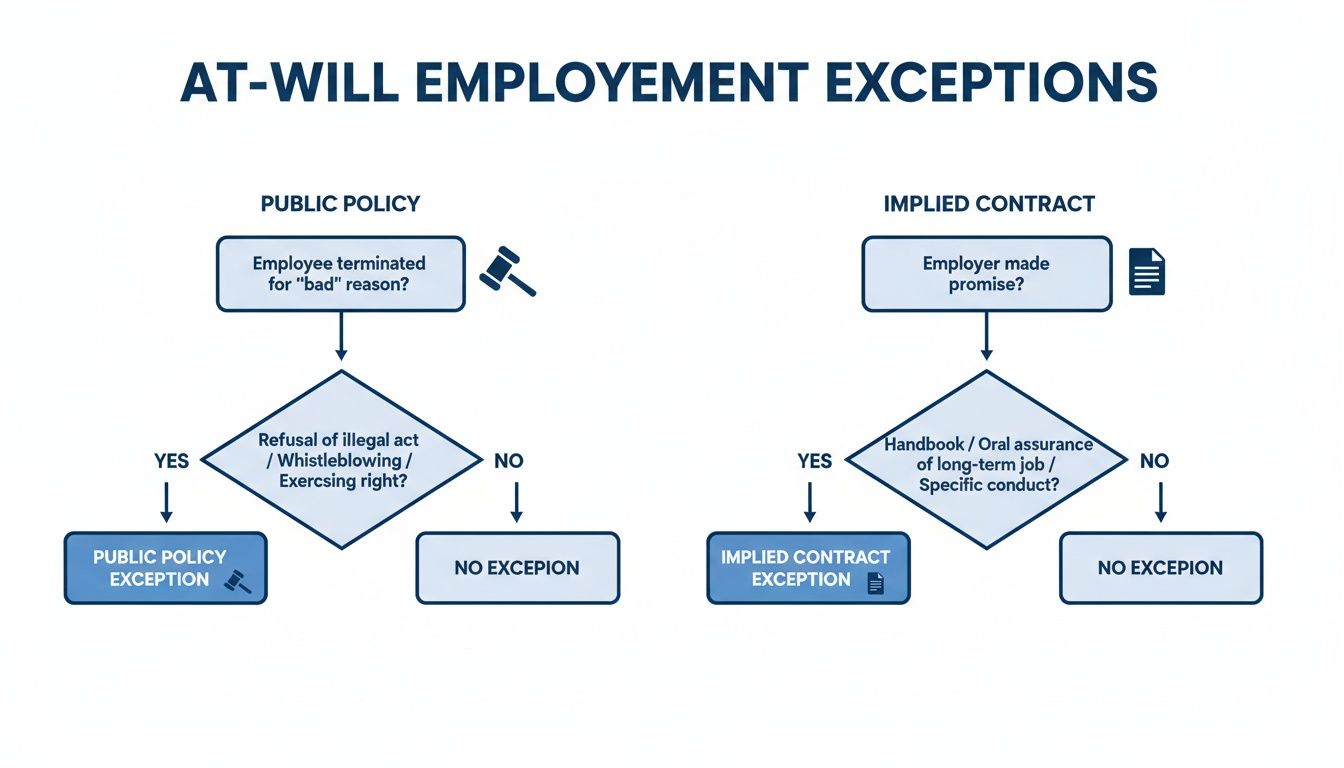
Even if your situation doesn't fit a classic discrimination case, you can see how state-level protections for things like implied contracts or public policy can still offer a path forward.
Know Your Next Moves
If you believe you were fired for a discriminatory reason in Mississippi, you have to follow a specific process. It starts with the U.S. Equal Employment Opportunity Commission (EEOC). A key fact to know is that Mississippi does not have a human rights commission, so the federal EEOC is your one and only stop.
Deadlines are everything here. You have a strict 180-day window from the day you were fired to file a charge with the EEOC. If you miss that deadline, your right to sue is likely gone forever.
Trying to take on a former employer by yourself is a tough, confusing road. This is when getting legal advice is so important. An experienced employment lawyer can look at the evidence you’ve gathered, lay out your real-world options, and guide you through the EEOC process.
Many people worry about the cost, but most employment attorneys work on a contingency fee basis. This means you don’t pay them anything upfront. They only get paid a percentage of the money they recover for you—usually 40-50%—and only if you win. It's a way to get expert legal help without any out-of-pocket financial risk.
Navigating the Path to Justice with the EEOC
If you have a gut feeling that your firing was more than just unfair—that it was illegal—the steps you take next are absolutely crucial. In Mississippi, holding a former employer accountable isn't as simple as just filing a lawsuit. There's a specific path you have to follow, and it starts with a federal agency.
A critical piece of information for Mississippi workers is that our state does not have its own human rights commission or any state-level office to handle workplace discrimination. This means your first and only stop to get the ball rolling is the U.S. Equal Employment Opportunity Commission (EEOC).
The Clock Is Ticking: Your 180-Day Deadline
When it comes to filing a claim, time is working against you from day one. In Mississippi, you have a strict 180-day window from the date the discrimination happened—in this case, the day you were fired—to file an official charge with the EEOC.
This isn't a friendly suggestion; it's a hard-and-fast deadline. If you miss that 180-day cutoff, you lose your right to sue for discrimination in federal court forever. It’s one of the most unforgiving deadlines in employment law, which is why moving quickly is so important.
What Happens After You File with the EEOC?
Filing a charge with the EEOC kicks off a formal administrative process. This isn't a lawsuit yet. Think of it as a mandatory first step—you have to complete this level before you can advance to the courthouse.
Here’s a rough sketch of what happens:
- The Investigation: The EEOC notifies your old employer about your charge and starts looking into it. They’ll likely ask for documents and interview you, your former managers, and other people involved.
- A Shot at Mediation: Sometimes, the EEOC will offer both sides a chance to try mediation. It’s a voluntary process where a neutral party helps you and your former employer see if you can reach a settlement without a full-blown investigation.
- The Finding: Once the investigation is over, the EEOC will issue a determination. They might find there’s "reasonable cause" to believe discrimination took place, or they might conclude there isn't enough evidence to prove your claim.
If you’re ready to begin, it's a good idea to know exactly what you're getting into. You can learn more in our detailed guide on how to file a discrimination complaint.
No matter what the EEOC finds, the process almost always ends with them sending you a "Dismissal and Notice of Rights" letter. Most people just call it a Right to Sue letter.
This letter is your golden ticket to the courthouse. Once it's in your hands, another timer starts: you have just 90 days to file a lawsuit in federal court. This is another non-negotiable deadline. Successfully clearing these administrative hurdles is the only way to get your case in front of a judge and seek justice for an illegal firing.
How an Employment Lawyer Can Champion Your Case
Taking on a former employer by yourself can feel like a David vs. Goliath battle. This is where a seasoned employment attorney steps in, not just as a legal advisor, but as your champion, dedicated to leveling the playing field and fighting for your rights.
A lawyer’s first job is to listen. They’ll sit down with you, go through your story, and meticulously review the evidence you’ve gathered. With a trained eye, they can spot things you might miss—subtle patterns of discrimination, questionable timing that screams retaliation, or a policy that was only ever enforced against you.
Building a Powerful Case on Your Behalf
This is where an attorney's real power comes into play. They have legal tools at their disposal that you simply don’t, namely a formal process called discovery. This allows them to legally demand documents from your ex-employer, like internal emails, performance reviews of other employees, or notes from HR investigations. Often, the smoking gun that proves your case is buried in these files.
Your lawyer is your strategic guide through the complex EEOC process. They will prepare and file your charge, handle all communications with investigators, and ensure every critical deadline is met, protecting you from procedural missteps that could derail your case.
This guidance is absolutely critical. Remember, Mississippi doesn’t have its own state-level agency, so the federal EEOC is your primary path for filing a claim. Having a lawyer present your case effectively from day one can make all the difference.
Making Justice Accessible Through Contingency Fees
Many people hesitate to call a lawyer because they think they can't afford it. The good news is, most employment attorneys work on a contingency fee basis, a system designed to give everyone access to justice, no matter their bank account balance.
Here’s how it typically works:
- You pay zero upfront costs to hire the attorney and get your case started.
- You owe no legal fees whatsoever if your case is not successful.
- The attorney’s fee is a percentage of the settlement or verdict they win for you, usually between 40-50%.
This model removes the financial risk from your shoulders entirely. It also means your lawyer is fully invested in winning your case—they only get paid if you get paid.
When you partner with a dedicated employment attorney from Nick Norris, P.A., you’re not just hiring legal help. You’re gaining a powerful ally committed to holding your former employer accountable and fighting for the justice you deserve.
Got Questions About Being Fired in Mississippi? We’ve Got Answers.
Losing a job is confusing and stressful, and it's natural to have a lot of questions running through your head. Let's tackle some of the most common ones we hear from workers in Mississippi, connecting the dots from the legal concepts to what they mean for you.
What if My Employer Lied About Why They Fired Me?
This happens more often than you might think. Legally, this is called "pretext"—it’s when an employer makes up a legitimate-sounding reason for firing you to cover up an illegal one. Maybe they said it was "budget cuts," but you suspect the real reason was your age or that you just announced you were pregnant.
Uncovering a pretext is the key to winning many wrongful termination cases. Your goal is to prove the reason they gave you was a sham. Things like a history of glowing performance reviews, emails with conflicting information, or suspicious timing can be powerful evidence to expose the real, unlawful motive behind your termination.
Can My Boss Fire Me for Talking About My Salary with Coworkers?
In almost all cases, no. Federal law, specifically the National Labor Relations Act (NLRA), protects your right to discuss things like pay, benefits, and working conditions with your colleagues. This is considered a "concerted activity," a basic right that allows employees to work together to improve their situation.
Firing an employee for talking about their pay is a classic form of illegal retaliation. An employer can’t enforce a "pay secrecy" rule—your right to have these conversations is protected by law.
I Was Fired Right After Filing a Workers' Comp Claim. Is That Legal?
Absolutely not. This is a textbook example of the public policy exception to at-will employment that we talked about earlier. Mississippi law is very clear: it is illegal for an employer to fire you as payback for filing a legitimate workers' compensation claim.
In these situations, timing is everything. If you were let go just days or weeks after reporting your injury and starting the claims process, it raises a huge red flag. This close timing strongly suggests your employer had a retaliatory motive, and you should talk to a lawyer right away.
If I Win a Wrongful Termination Lawsuit, What Kind of Compensation Can I Get?
A successful lawsuit can help you recover damages to compensate you for your losses and, in some cases, to punish the employer for their actions. An experienced attorney can give you a better idea of what your specific case might be worth, but potential compensation often includes:
- Back Pay: The wages, salary, and benefits you lost from the date you were fired.
- Front Pay: An estimate of the future wages you will lose while you search for a new job.
- Emotional Distress Damages: Compensation for the anxiety, stress, and mental anguish the illegal firing caused.
- Punitive Damages: These are meant to punish employers who acted with extreme carelessness or malice and to discourage other companies from doing the same.
If you feel you’ve been fired for an illegal reason, you shouldn’t have to fight this battle on your own. At Nick Norris, P.A., we are committed to standing up for the rights of workers across Mississippi. We can give you the straightforward advice and tough representation you need to move forward.
Contact us today for a consultation to explore your options and protect your future. https://www.nicknorris.law
This article has been reviewed for legal accuracy by Nick Norris. For employment law matters in Mississippi, consult with an attorney licensed to practice in your state.
Leave a Reply