

How to File a Discrimination Complaint
Figuring out how to file a discrimination complaint starts with one critical question: Was what happened to you actually illegal? It's a tough but necessary first step to determine if your experience meets the legal definition of discrimination before you go any further.
Do You Have a Discrimination Claim in Mississippi?

Let's get one thing straight: unfair treatment at work isn't always illegal discrimination. It’s a hard truth, but having a bad boss or being treated poorly doesn't automatically give you a legal case. For the law to step in, the mistreatment has to be directly tied to your membership in a "protected class."
Here in Mississippi, we rely on federal laws enforced by the Equal Employment Opportunity Commission (EEOC). These laws lay out exactly who is protected and what kind of actions are forbidden.
What Is a Protected Class?
Think of a protected class as a group of people who share a common characteristic that legally shields them from being targeted. Federal laws have carved out several of these categories, and if you fall into one, you have legal grounds to act if you're treated differently because of it.
The main protected classes under federal law include:
- Race or Color: Being treated unfairly because of your race (e.g., Black, White, Asian) or even traits associated with race, like hair texture.
- National Origin: This covers discrimination based on where you or your family came from, your ancestry, or even your accent.
- Religion: It's not just about major organized religions. This also protects sincerely held moral or ethical beliefs.
- Sex: A broad category that covers your gender, sexual orientation, gender identity, and pregnancy status.
- Age: This protection is specific—it only applies to people who are 40 years of age or older.
- Disability: This protects qualified employees with a physical or mental impairment that significantly impacts a major life activity.
Simply being a member of one of these groups isn't enough, though. You also have to prove you suffered an adverse employment action. This is a legal term for a significant negative event at work—think being fired, demoted, passed over for a promotion, or having your pay slashed. For a deeper dive, you can read our guide on what constitutes an adverse employment action.
The bottom line is that the mistreatment has to be because of your protected status. For instance, if your boss is a jerk to everyone equally, you're likely dealing with a bad manager, not illegal discrimination. But if they only seem to micromanage or discipline the employees over 40, you might be looking at a potential age discrimination claim.
Your First Move: Reporting the Issue Internally
Before you even think about calling a government agency, your first stop should almost always be within your own company. Check your employee handbook. Most businesses have a formal process for reporting harassment and discrimination, and it’s incredibly important that you follow it.
Why? Reporting the problem to HR or your manager officially puts the company on notice. It gives them a legal opportunity to fix the situation. What they do next—or fail to do—becomes a critical piece of your potential case.
When you make your report, always do it in writing. An email is perfect because it creates a timestamped paper trail. Stick to the facts: what happened, when and where it happened, who was involved, and if anyone else saw it. Leave the emotion out of it for now. This clear, professional documentation will be your best friend if you need to take things further.
Gathering Evidence to Build a Strong Case
Once you've reported the discrimination internally, your focus has to shift. Now, it's all about building a fortress of evidence. Let me be blunt: a successful claim isn't won on feelings or suspicions. It’s won on proof. The strength of your case, from this point forward, hinges almost entirely on the quality of the evidence you can gather and how well you organize it.
Think of yourself as a meticulous record-keeper of your own experience. Your goal is to weave together a clear, factual story that shows a pattern of illegal behavior, connecting the unfair treatment you've endured directly to your protected status (like your race, gender, or age).
The Most Powerful Types of Evidence
Evidence isn't just one thing; it comes in many forms. You need to collect anything and everything that backs up your claim. The more varied and concrete your proof, the harder it will be for your employer to deny what happened.
Here are the key items I always tell my clients to find and preserve:
- Digital Communications: This is gold. Save every single relevant email, text message, Slack or Teams chat, and even social media posts. They are often your most powerful evidence because they're timestamped and capture a person's exact words.
- Performance Records: Pull together all your performance reviews, any awards or commendations you've received, and emails from your boss praising your work. This is your shield against the inevitable "poor performer" excuse they might try to use after you complain.
- Pay Stubs and Job Descriptions: These are non-negotiable for pay discrimination claims. They also help show if you were being assigned duties far outside your role as a form of punishment or marginalization.
- Company Policies: Get a copy of the employee handbook. Pay close attention to the sections on anti-discrimination policies and the official complaint procedures.
Remember, the burden of proof is on you. An investigator wasn't there to see it. They won't know what you experienced unless you can show them. Your job is to paint a vivid picture with undeniable facts.
Creating Your Chronological Record
One of the most effective tools you have is a detailed, running timeline of events. This document will become the backbone of your complaint, making it easy for you, your attorney, and any investigator to understand exactly what happened and when.
Get a notebook or start a password-protected file on your personal computer or phone. Do not, under any circumstances, keep this log on a company device.
For every single incident, no matter how small it seems, log the following:
- Date and Time: Be as precise as you can.
- Location: Where did it happen? In the breakroom? During the weekly team meeting via Zoom?
- People Involved: List everyone who was there—their full names and job titles.
- What Happened: Write down a factual, blow-by-blow account. Use direct quotes if you remember them. Stick to the facts: "He said…" not "He was being a jerk."
- Your Response: What did you do or say? Did you walk away? Did you tell them to stop?
- Witnesses: Crucially, who else saw or heard this? Write down their names.
This timeline does more than just keep you organized; it uncovers patterns. A single off-color joke might be dismissed by HR as a one-off mistake. But a timeline showing a dozen of these "jokes" over six months? That starts to look a lot like a hostile work environment. It's the cumulative weight of these actions that often builds the strongest cases. For more on this critical first step, you can get more details on how to report workplace discrimination effectively.
Gathering Information Ethically and Safely
While you need to be a detective for your own case, you have to do it the right way. Never secretly record conversations. Depending on the state, this can be illegal and will get your evidence thrown out, potentially damaging your entire claim. Likewise, don't take confidential company documents that have nothing to do with your own employment.
Stick to materials you have a right to access—your own emails, your performance reviews, and company-wide memos. If you forward work emails to a personal account for safekeeping, be discreet and aware of your company's IT policies. The key is to be smart and focus solely on documenting what happened to you. By carefully collecting and organizing your proof, you elevate your complaint from a simple accusation to a well-supported, credible claim that demands to be taken seriously.
Don’t Miss the Clock: Understanding Your Filing Deadline
When it comes to filing a discrimination complaint, time is not on your side. In fact, the single biggest mistake that can derail a strong case is missing the filing deadline. This isn't a soft suggestion; it's a hard-and-fast rule. Blow past the statute of limitations, and you lose your right to have the EEOC investigate, no matter how compelling your evidence is.
For anyone working in Mississippi, this deadline is absolute. The federal Equal Employment Opportunity Commission (EEOC) gives you just 180 days from the date of the discriminatory act to file your charge. Six months might sound like a long time, but it disappears quickly when you're gathering documents, recalling events, and dealing with the stress of the situation.
This is why you have to get organized from day one.
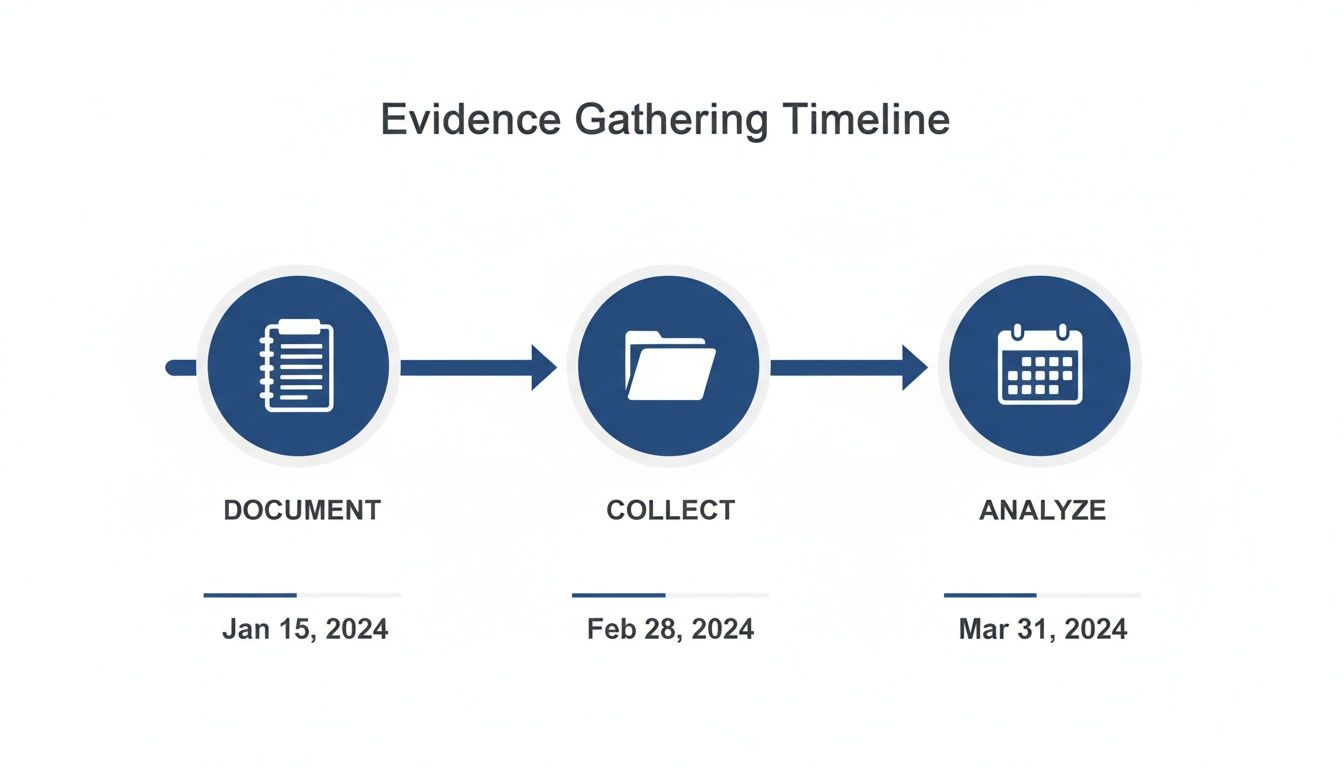
As you can see, documenting, collecting, and analyzing your proof needs to happen fast. You can't afford to wait. Building a solid case within that tight 180-day window is a race against the clock.
Why Mississippi’s 180-Day Deadline Is Non-Negotiable
You might see information online mentioning a 300-day deadline. Be careful here. This is a common point of confusion, and in Mississippi, it's a mistake that could be fatal to your claim.
That longer, 300-day window only exists in states with their own Fair Employment Practices Agency (FEPA)—basically, a state-level version of the EEOC. These agencies have "work-sharing" agreements that extend the federal deadline.
Here's the critical takeaway: Mississippi does not have a state-level FEPA or a human rights commission. This means the shorter, 180-day federal deadline is the only one that applies to you. There are no extensions and no state agency to fall back on.
Waiting too long is the number one reason I see valid discrimination claims get dismissed. The 180-day rule is completely unforgiving. File on day 181, and the EEOC is legally barred from helping you.
Pinpointing Your Deadline: How to Calculate the 180 Days
Knowing your exact filing deadline means figuring out when the 180-day countdown officially began. The clock starts ticking on the day the discriminatory act happened.
-
For a single act, like a wrongful termination or being passed over for a promotion, the calculation is pretty clear. The clock starts on the day you were fired or officially told you didn't get the job.
-
For ongoing harassment, the math works a bit differently. Here, the deadline is based on the last incident of harassment. This is often called a "continuing violation." So, if you've been dealing with a pattern of hostile comments, the 180-day window starts from the most recent one, not the first.
Let’s walk through an example. Say you were fired on June 1st, and you believe it was due to your age. You would have until roughly November 28th of that year to get your EEOC charge filed. If you show up in December, it’s too late.
But what if your manager made discriminatory jokes every week from January until your last day in June? In that case, your deadline would be calculated from that last incident in June. Each new act effectively reset the clock for the entire pattern of behavior.
Because these calculations can get tricky, the best advice I can give is to act with urgency. Don't wait until you're nearing the end of that six-month period. Start preparing your complaint the moment you believe you have a claim. Your rights literally depend on it.
Discrimination Complaint Filing Deadlines Federal vs State
To be crystal clear, here’s how the filing deadlines break down. In Mississippi, only the federal EEOC deadline applies. Other states have a different process because of their state-level agencies, which is why you can't rely on general advice you find online.
| Filing Body | Deadline | Applicable To |
|---|---|---|
| EEOC (in Mississippi) | 180 days | Employees in states without a state-level Fair Employment Practices Agency (FEPA), like Mississippi. |
| EEOC (in states with FEPAs) | 300 days | Employees in states that have a state-level agency with a work-sharing agreement with the EEOC. |
The bottom line is simple: if you work in Mississippi, you have 180 days from the last discriminatory act. Period. Don't let conflicting information from other states cause you to miss this critical, unchangeable deadline.
Filing Your Complaint with the EEOC

You've organized your evidence and have that crucial 180-day deadline on your calendar. Now it's time to move forward. Knowing how to file a discrimination complaint with the Equal Employment Opportunity Commission (EEOC) can feel intimidating, but the process is more straightforward than you might think.
It all starts with an "inquiry." Think of this as officially raising your hand. You can initiate this by phone, in person at an EEOC office, or, most conveniently, through their online public portal. This first step isn't the formal charge just yet—it's your way of telling the agency you believe you have a case.
Your Initial Contact and the Intake Interview
Once you’ve submitted your inquiry, the EEOC will schedule what’s called an intake interview. This is a pivotal phone call with an EEOC staff member who needs to hear the basics of your story. Their main job at this stage is to see if your situation is something they have the legal authority—or jurisdiction—to investigate.
To make this call as smooth as possible, have these details ready:
- Your info and your employer's info. Be prepared with the company’s full legal name, address, and contact number.
- The kind of discrimination you experienced. Was it based on your race, age (if you're 40 or older), disability, sex, national origin, or another protected status?
- Key dates. They'll absolutely need to know when the discriminatory acts happened, especially the date of the most recent incident.
- A quick summary of the events. You don't need to lay out every single detail, just the core facts of what happened.
This interview is essentially a screening. If the agent agrees that your complaint falls under the laws they enforce, they will guide you through preparing and filing the formal "Charge of Discrimination."
Crafting a Powerful Charge Narrative
The Charge of Discrimination is the official document that gets the ball rolling. While it contains basic information, the heart of it is your written narrative describing what happened. This is where all that hard work you did creating a detailed timeline will pay off immensely.
Your goal here is to be clear, concise, and factual. It can be tempting to pour out every frustration, but an investigator needs a straightforward account they can follow easily. A chronological summary works best. Start from the beginning and walk them through the key incidents that show a pattern of illegal behavior.
A strong narrative is built on facts, not feelings. Instead of writing, "My manager was incredibly hostile," you should write, "On May 15, my manager stated in front of three colleagues that he 'didn't want someone my age' leading the project." The second version is specific, provable, and far more compelling.
What to Include in Your Formal EEOC Complaint
When you sit down to draft the narrative for your official charge, think of yourself as a builder laying a foundation. Every piece of information should support your central claim: you were treated unfairly because of your protected status.
Make sure your statement clearly answers these questions:
- The "What": State the specific adverse actions, like termination, demotion, harassment, or being passed over for a promotion.
- The "When": Attach specific dates to every incident you mention.
- The "Who": Name the people involved and their job titles.
- The "Why": This is the most critical part. You must connect the dots between the action and your protected class. For instance, "I believe I was terminated because of my race (African American)."
Once filed, your employer gets a copy of this charge and is legally required to respond to your allegations. By keeping your account factual and organized, you establish a credible, professional tone from the very beginning. This gives the EEOC investigator a solid, clear roadmap to follow as they launch their investigation.
What to Expect After You File Your Complaint
Filing your formal Charge of Discrimination with the EEOC is a huge step, but it's really the start of a new chapter, not the end of the story. The federal government doesn’t move quickly, so it’s important to understand what’s coming down the road. Knowing the process can help you stay prepared and cut down on the anxiety that comes with waiting.
Once you’ve officially filed your charge, the EEOC has 10 days to notify your employer. This is when the company gets a copy of your complaint, giving them their first formal look at the allegations. This single action is what kicks the entire investigation into gear.
The First Moves: Mediation and Your Employer’s Response
Before digging into a full-blown investigation, the EEOC will often suggest mediation. Think of it as a chance for you and your employer to sit down with a neutral third party and try to work things out. It's a completely voluntary and confidential process, and it can be a much faster and less confrontational path to a resolution.
If everyone agrees to give it a shot, the investigation is put on hold. If mediation doesn't work out, or if one side simply says no, the process moves on. At that point, your employer must provide a formal written response to your complaint, known as a "Position Statement," along with any evidence they have to support their side.
The Heart of the Investigation
Now the real work begins. The EEOC investigator steps in as a neutral fact-finder, and they have broad authority to gather information. Their only goal is to figure out if there's reasonable cause to believe discrimination actually happened.
During this phase, the investigator might:
- Ask both you and your employer for more details through written questions (often called Requests for Information, or RFIs).
- Interview you, the person you accused, and any coworkers who might have seen or heard something relevant.
- Conduct an on-site visit to the workplace, though this isn't as common.
- Dig into documents like payroll records, your personnel file, and official company policies.
Your full cooperation here is absolutely critical. Be sure to respond to the investigator's requests quickly and completely. This is your opportunity to hand over the evidence you’ve been carefully collecting and make sure they understand exactly what happened. You can get a better feel for this by reading our in-depth guide on the typical workplace investigation process.
An EEOC investigation is a marathon, not a sprint. It often takes 10 months or more to complete. Your best tools during this time are patience and persistent, professional follow-up.
How It All Ends: Possible Outcomes
After the investigator has all the facts, the EEOC will make its official finding. It typically goes one of two ways. You'll either get a "cause" finding, meaning the agency believes discrimination likely occurred, or a dismissal, sometimes called a "no cause" finding. But a dismissal doesn’t mean your fight is over.
It's helpful to remember you're not going through this alone. In a recent fiscal year, the EEOC handled 88,531 new charges of discrimination and recovered around $664 million for victims. You can find more workplace discrimination trends and data on diversity.com.
If the EEOC finds "cause," its first step is to try and work out a voluntary settlement with your employer in a process called conciliation. If that fails, the agency could file a lawsuit for you, but honestly, that’s pretty rare.
What’s far more common is that, regardless of the finding, the EEOC will send you a Dismissal and Notice of Rights. Most people just call this the "Right to Sue" letter. This letter is your ticket to the courthouse. Once you have it, you have 90 days—and not a day more—to file a lawsuit in federal court. This is a hard deadline, and it’s the moment you absolutely need to speak with an employment attorney if you haven’t already.
Deciding When to Hire a Mississippi Employment Lawyer

While you absolutely can file an EEOC charge by yourself, knowing when to bring in a legal professional can completely change the outcome of your case. It’s about knowing when to shift gears from self-advocacy to having an expert in your corner. An experienced Mississippi employment lawyer does a lot more than just fill out paperwork; they bring a trained, strategic eye to your situation right from the start.
A good attorney will dissect your evidence, spot the weak points before your employer does, and help you frame your story in the strongest possible legal terms. They’ll also handle all the back-and-forth with the EEOC investigator, making sure your case doesn't get lost in the shuffle and that every request for information is answered correctly and strategically. Frankly, that alone can be a massive weight off your shoulders.
And when it comes to settlement talks? That’s where their experience really pays off. An employer is far more likely to come to the table with a serious offer when they know you have a knowledgeable attorney fighting for you. They know the true value of your case and can negotiate skillfully to get you a fair result, preventing you from accidentally accepting a lowball offer out of desperation.
What About the Cost?
Let’s talk about the elephant in the room: lawyer fees. This is the number one reason people hesitate, but it shouldn't be. In Mississippi, the vast majority of employment discrimination lawyers work on a contingency fee basis. This system is specifically designed to level the playing field, giving everyone a shot at justice, no matter what their bank account looks like.
Put simply, you pay zero attorney's fees upfront. Nothing. The lawyer’s fee is contingent on winning your case and securing a financial recovery for you, either through a negotiated settlement or a court award.
A contingency fee means your lawyer's success is directly tied to your success. They only get paid if you get paid, which aligns their interests completely with yours.
This model lets you get high-quality legal help without any out-of-pocket risk. The typical contingency fee for an employment lawyer in Mississippi usually falls between 40% and 50% of whatever you recover. This percentage covers the attorney's time, their expertise, and the significant financial risk they take on by fronting all the costs of your case with no guarantee of ever being paid.
The Point of No Return: When You Absolutely Need a Lawyer
There are a few moments when hiring an attorney goes from being a smart move to an absolute necessity. The big one is when the EEOC issues your Right to Sue letter.
Once that letter is in your hands, a countdown starts. You have just 90 days to file a lawsuit in federal court. This is a hard, non-negotiable deadline.
Trying to navigate the federal court system on your own is not a DIY project. An attorney is essential for drafting a proper lawsuit, following all the complex procedural rules, and actually litigating your case. If you've been working on how to file a discrimination complaint and that letter shows up in your mailbox, your very next call should be to an employment lawyer. They are your best—and often only—chance at turning that letter into a successful legal action.
Frequently Asked Questions About Filing a Discrimination Claim
When you're thinking about how to file a discrimination complaint, you're bound to have questions. It’s a stressful situation, and the process can seem confusing. Let's walk through some of the most common concerns I hear from employees in Mississippi.
Can I Get Fired for Filing a Complaint?
The short answer is a hard no. It is absolutely illegal for your employer to retaliate against you for filing an EEOC charge or participating in an investigation.
Retaliation isn't just about being fired. It can be any negative action—a demotion, a cut in hours, a transfer to an undesirable shift, or even sudden, unexplained harassment—that happens because you stood up for your rights. If you experience retaliation, you can file a new, separate charge with the EEOC. Frankly, these retaliation claims are often more straightforward and easier to prove than the initial discrimination case.
What Should I Do if My Employer Offers Me a Settlement?
It’s not unusual for an employer to offer a quick settlement, hoping to make the problem go away quietly. Before you even think about signing anything, my strongest advice is to stop and speak with an employment lawyer.
A settlement offer might seem tempting, especially if you're out of a job. But an experienced attorney can tell you if the offer is truly fair, negotiate for better terms, and make sure you aren't accidentally signing away critical legal rights for a lowball amount. This is a classic mistake you don't want to make.
Does the EEOC File a Lawsuit on My Behalf?
This is a major point of confusion for many people. While the EEOC has the power to sue employers, it only does so in a tiny percentage of cases each year. Out of tens of thousands of charges, they only take on a select few.
For the vast majority of cases, the EEOC will finish its investigation and issue a letter called a "Notice of Right to Sue." This is the key that unlocks your ability to take your case to court. Once you receive that letter, a strict 90-day clock starts ticking for you to file a lawsuit in federal court. In Mississippi, this is especially critical because there is no other court option, making that federal deadline your one and only shot.
If you're dealing with workplace discrimination and aren't sure what to do next, Nick Norris, P.A. offers dedicated and knowledgeable representation for employees all across Mississippi. We're here to help you understand your rights and fight for the fair outcome you deserve. You can reach out to us to protect your interests at https://www.nicknorris.law.
This article has been reviewed for legal accuracy by Nick Norris. For employment law matters in Mississippi, consult with an attorney licensed to practice in your state.
Leave a Reply