
What Is a Protected Class Explained for Mississippi Workers
When you hear the term "protected class," it might sound like complex legal jargon. But the idea behind it is actually quite simple.
Think of it as a legal shield. Federal laws have created these shields to protect employees from being treated unfairly based on characteristics that are fundamental to who they are—things like their race, gender, religion, or age. It’s the bedrock of anti-discrimination law in the United States.
What a Protected Class Really Means for You
At its heart, the concept of a protected class is about fairness. It exists to make sure your boss bases decisions on your skills, your work ethic, and your performance—not on personal biases or stereotypes. These protections are primarily enforced by the U.S. Equal Employment Opportunity Commission (EEOC).

This isn’t about giving certain groups an unfair advantage. It's about leveling the playing field. For example, if two equally qualified people apply for a promotion, it is illegal for the manager to deny one of them the job just because they're over 40 or because of their national origin. Skills and experience should be the only things that count.
The specific application of these protections in court often comes down to legal principles like statutory interpretation, which is how judges and lawyers figure out exactly what Congress intended when writing these laws.
Why This Is Crucial for Mississippi Workers
This is especially important here in Mississippi. Since Mississippi does not have a state-level human rights commission or a comprehensive anti-discrimination law of its own, your most powerful protections come directly from federal law. This means that for Mississippi workers, understanding your federal rights isn't just a good idea—it's absolutely essential. The EEOC is the primary agency that will investigate your discrimination complaint.
A protected class is not about special treatment; it is about the right to equal treatment. It ensures that fundamental aspects of your identity cannot be used against you in the workplace.
Recognizing whether you belong to one of these federally protected groups is the critical first step in figuring out if you've been a victim of illegal discrimination. These laws are your tools for holding an employer accountable. In the sections that follow, we'll break down each specific protected class and give you real-world examples of what discrimination actually looks like on the job.
Federal Law: Your Shield in the Workplace
At the federal level, a powerful set of laws acts as a shield, protecting employees from being treated unfairly based on who they are. When we talk about a “protected class,” we’re really talking about these specific, personal characteristics that an employer can’t legally use to make decisions about your job.
Let's walk through what these protections look like in the real world.
Race and Color
This is the bedrock of employment protection. It’s flat-out illegal for an employer to make any decision about your job—hiring, firing, promotions, pay, or even day-to-day tasks—based on your race or skin color.
Think about it this way: a manager can't stick minority employees with the worst shifts while saving the better ones for others. It also means an employer has a duty to stop any environment where racial slurs or so-called "jokes" are tolerated.
Religion
This one has two important sides. First, your boss cannot discriminate against you because of your sincerely held religious beliefs. This isn’t just about major world religions; it covers less common and non-traditional beliefs, too.
Second, your employer has to make a reasonable accommodation for your religious practices, as long as it doesn’t create an “undue hardship” for the business. This could be something like adjusting your schedule so you can attend a religious service or allowing you to wear religious attire, like a yarmulke or a headscarf.
Sex and Gender
Discrimination based on sex is illegal. The most obvious example is paying a woman less than a man for doing the exact same work, but the law goes much deeper than that.
This category also includes crucial protections for:
- Pregnancy: You cannot be fired, passed over for a job, or demoted just because you are pregnant.
- Sexual Harassment: This covers any unwelcome sexual conduct that makes your workplace hostile or intimidating. It's illegal.
- Sexual Orientation and Gender Identity: Federal law now clearly protects LGBTQ+ employees from being targeted or treated differently because of their sexual orientation or gender identity.
National Origin
Where you were born, your ancestry, your culture, or even your accent can't be used against you. An employer can’t refuse to hire you because you’re from another country or because you have an accent, provided it doesn't get in the way of you doing your job.
This also means you can't be harassed about your heritage or forced into an "English-only" rule at all times unless speaking English is absolutely essential for the job.
Other Key Federal Protections
The foundation of modern workplace protection in America was established through Title VII of the Civil Rights Act of 1964, which initially protected workers from discrimination based on five core characteristics: race, color, religion, sex, and national origin. Since that landmark legislation, federal protections have gradually expanded. The Age Discrimination in Employment Act (ADEA) was added, followed by the Americans with Disabilities Act (ADA) and genetic information protections, creating the robust framework we have today. You can read more about the expanding landscape of U.S. discrimination laws to see how these protections evolved.
These additional federal shields include:
-
Age (40 and Older): The Age Discrimination in Employment Act (ADEA) specifically protects workers who are 40 years of age or older. It's illegal for an employer to treat you less favorably because of your age, which often comes up when experienced, older workers are pushed out in layoffs or passed over for promotions in favor of younger employees.
-
Disability: Under the Americans with Disabilities Act (ADA), an employer can’t discriminate against a qualified person with a disability. More than that, they have a legal duty to provide reasonable accommodations—like special equipment, a modified schedule, or other adjustments—that allow a disabled employee to perform their essential job duties.
-
Genetic Information: It might sound like science fiction, but it's a real protection. The Genetic Information Nondiscrimination Act (GINA) makes it illegal for your boss to use your genetic information—like your family medical history or results from a genetic test—when making any employment decisions.
What Workplace Discrimination Actually Looks Like
It’s one thing to know the textbook definitions of protected classes, but it's another thing entirely to spot discrimination when it’s happening to you. In the real world, it’s rarely a single, dramatic event. More often, discrimination is a subtle, corrosive pattern of unfair treatment that shows up in hiring, promotions, daily interactions, and even layoffs, leaving you questioning what just happened.
Let's move past the legal jargon and look at some concrete examples of how illegal discrimination can play out in a Mississippi workplace.

Seeing these scenarios can help you connect the dots between your legal rights and what you're experiencing on the job. This is where the law gets real.
Common Scenarios of Workplace Discrimination
While discrimination can take endless forms, I’ve seen some patterns emerge time and time again in my practice. See if any of these situations sound familiar.
-
Discriminatory Hiring: You’re clearly the most qualified person for the job—you’ve got the skills, the experience, everything. But during the interview, the hiring manager keeps making awkward comments about your age or asks if you have kids. You don’t get the offer, and later find out they hired someone with far less experience. This could very well be age or sex discrimination.
-
Unequal Pay: A female employee finds out through a casual conversation that a male coworker with the exact same job title and less seniority is making significantly more money. She has stellar performance reviews, but her requests for a salary adjustment are brushed aside. This is a classic red flag for sex-based pay discrimination.
-
Biased Layoffs or Promotions: A company has to downsize, and you notice a clear trend: nearly all the employees being let go are over 50. Meanwhile, younger, less-tenured staff keep their jobs. Or perhaps a manager consistently passes over experienced older workers for promotions, favoring junior employees instead. That could easily be age discrimination.
If you've ever had that gut feeling that a decision at work had nothing to do with your performance and everything to do with who you are, you might be right.
Workplace discrimination is any employment decision—from hiring to firing—that is based on an individual's membership in a protected class rather than on their qualifications, skills, or job performance.
Harassment as a Form of Discrimination
Discrimination isn't just about big career moments like getting hired or fired. It can also be the kind of daily harassment that slowly turns your workplace into a toxic environment.
This behavior crosses the line into illegal harassment when putting up with the offensive conduct becomes a condition of keeping your job. It's also illegal if the conduct is so severe or pervasive that any reasonable person would find the environment intimidating, hostile, or abusive. If you're facing this kind of behavior, sending a formal cease and desist letter for harassment can be an important first move.
Those relentless "jokes," slurs, or offensive comments about your religion, race, or gender can poison your professional life. That is not something you just have to "put up with." You can learn more about where the legal lines are drawn by reading our detailed guide on what constitutes a https://nicknorris.law/2025/12/30/hostile-work-environment-definition/.
It’s one thing to feel like you’ve been treated unfairly at work. It’s another thing entirely to know if that unfair treatment gives you grounds for a legal claim. The law requires more than just a gut feeling—it needs a clear line connecting specific events to prove illegal discrimination was the likely cause.
Think of it like building a sturdy legal case. You need three solid pillars to hold it up. If even one is missing, the whole thing is likely to collapse.
The Three Pillars of a Discrimination Claim
To get a sense of whether you have a case, ask yourself three simple questions. If you can confidently answer "yes" to all three, it’s a strong signal that you should talk to an attorney.
-
Are you a member of a protected class? This is the bedrock of your claim. As we discussed, the mistreatment has to be linked to your race, religion, sex, age (if you’re 40 or over), disability, or another legally protected characteristic.
-
Did you experience a negative employment action? This means something significant and harmful happened to you on the job. The action must have had a real, damaging impact on your career, pay, or work environment.
-
Is there a direct link between the two? This is often the hardest part to prove. You need to show that your protected status was a key reason—a motivating factor—behind why you were targeted.
What Counts as a "Negative Employment Action?"
This is a legal term, but it’s not as complicated as it sounds. It simply means something more serious than a minor inconvenience or a manager being rude. We're talking about tangible, adverse career events.
Common examples include:
- Wrongful Termination: Getting fired because of your race, gender, or another protected trait.
- Demotion: Being pushed into a lower-level role with less pay, fewer responsibilities, or a damaged reputation.
- Failure to Hire or Promote: Getting passed over for a job or a promotion you were qualified for, especially if it went to someone less qualified who isn't in your protected class.
- Unequal Pay: Earning less than your colleagues for doing the same or substantially similar work.
- Hostile Work Environment: Being forced to endure harassment so severe or persistent that it makes your workplace unbearable.
Connecting Your Protected Status to the Harm
After identifying your protected class and the negative action, the real work begins: linking them together. This is where you move from a feeling of being wronged to having a foundation for a legal claim.
The strength of a discrimination claim often rests on the evidence that connects the employer's action to the employee's protected status. This link must be more than a coincidence; it needs to suggest a discriminatory motive.
This evidence is often circumstantial, meaning you have to piece it together. It can look like:
- Suspicious Timing: You tell your boss you're pregnant, and you're suddenly "laid off" a week later.
- Inappropriate Comments: Your supervisor makes jokes about your age right before denying you a promotion that went to a younger, less-experienced employee.
- Inconsistent Treatment: You notice that only employees of a certain national origin are written up for being late, while others get a pass for the same behavior.
- Shifting Explanations: Your manager gives you one reason for firing you, but the story changes when HR gets involved.
If you can connect these dots, that’s a powerful sign that your situation warrants a legal review. To learn more about what to do next, our guide on how to report workplace discrimination walks you through the entire process.
Filing a Discrimination Claim with the EEOC
So, what do you do if you believe you've been a victim of workplace discrimination? Knowing the right steps to take is absolutely critical, and for workers here in Mississippi, that path leads directly to the federal government's main enforcement agency: the Equal Employment Opportunity Commission (EEOC).
Because Mississippi does not have its own dedicated agency to handle these issues, the EEOC is your single most important ally for investigating a claim and holding an employer accountable under federal law.
The Critical 180-Day Deadline
This is where things get serious. From the moment the discriminatory act happens, a countdown begins. You have a very strict 180-day deadline to file an official charge with the EEOC.
If you miss that window, you could lose your right to seek justice forever. That’s why it’s so important to act quickly and not let time slip away.
Filing this charge is the mandatory first step. It’s how you officially put the government—and your employer—on notice that you believe your rights have been violated. Once filed, the EEOC can begin its investigation. We walk through the entire process in our guide on how to file a discrimination complaint with the EEOC.
To build a valid claim, you need to connect three core elements, as this chart shows.
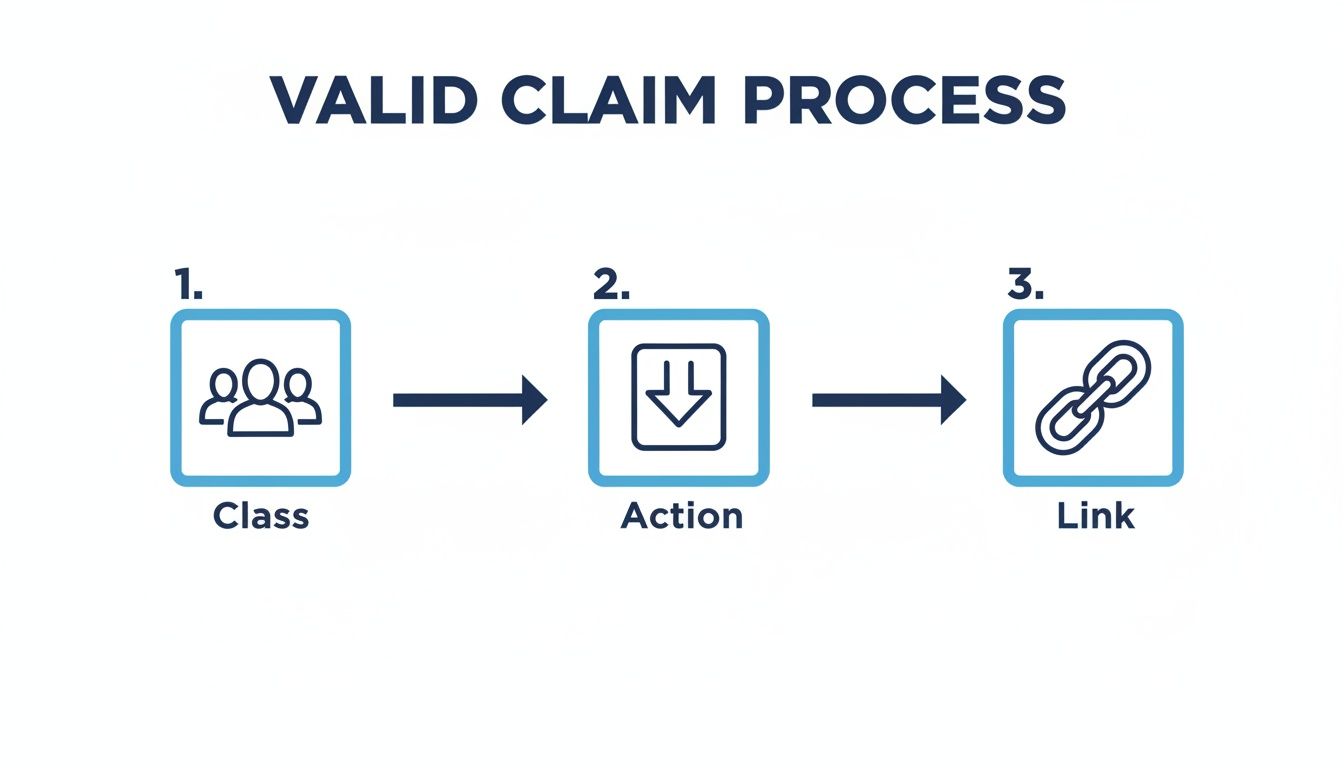
As you can see, a strong case links your status as a member of a protected class to a negative action your employer took, all backed by solid evidence.
What Happens After You File
After you submit your charge, the EEOC will typically take a few steps. They might start a formal investigation, which can involve interviewing you, your colleagues, and management, as well as requesting documents from the company.
The agency may also recommend mediation. This is a voluntary and confidential process where a neutral third party helps you and your employer sit down and try to work out a solution together.
If the EEOC investigation finds reasonable cause to believe discrimination took place, they will try to reach a settlement. If they can't, or if they don't find enough evidence to proceed, the agency will close its file and issue you a document called a "Notice of Right to Sue."
This "Right to Sue" letter is your green light. It doesn't mean you've won or lost your case—it's the official key that unlocks the courthouse doors, giving you permission to file a lawsuit in federal court.
These issues are far from rare. Looking at national data from 2016 to 2022, Texas led the country with 10.2% of all EEOC charges, followed by Florida at 8.7% and Georgia at 6.0%. These numbers show that workplace discrimination is a persistent problem, making experienced legal guidance more important than ever. You can explore more employment law statistics to see just how common these violations are across the country.
Why You Need an Experienced Mississippi Employment Lawyer
When you're facing an employment discrimination claim, it can feel like you're standing alone against a giant. Your employer has a legal team on their side, and trying to navigate that fight by yourself is a surefire way to get overwhelmed. Bringing in a skilled attorney is the most powerful move you can make to even the odds.
An experienced Mississippi employment lawyer isn't just an advisor; they're your advocate. They live and breathe the strict federal deadlines and know exactly how to uncover the critical evidence that can make or break a case—evidence you might not even realize exists. More importantly, they know how to negotiate with force and precision on your behalf. Since Mississippi does not have a human rights commission, every single action has to be perfectly aligned with federal rules, a complex process your lawyer handles from start to finish.
Making Justice Accessible
I hear it all the time: "I can't afford a lawyer." It's a valid concern, but it's also one of the biggest myths in this area of law. The reality is that most dedicated employment lawyers, our firm included, operate on a contingency fee basis.
So, what does that mean for you? It means you pay absolutely nothing upfront. Not a dime.
Our fee is simply a percentage of the money we win for you, whether that comes from a negotiated settlement or a court verdict. For these kinds of complex cases, a typical contingency fee is between 40-50%.
This arrangement completely removes the financial barrier to getting justice. It allows a legal professional to fight for you without adding a mountain of financial stress when you're already out of work.
Having a professional in your corner does more than just increase your chances of a fair outcome—it ensures your story is heard, respected, and taken seriously. If you believe your rights have been violated, please don't try to face this alone.
Answering Your Questions About Discrimination in the Workplace
It's completely normal to feel confused and overwhelmed when you think you're facing discrimination at work. Let's walk through some of the questions we hear most often from workers here in Mississippi.
I Think I'm Being Discriminated Against. What's My First Step?
Before you do anything else, start writing things down. Keep a detailed, private journal of every single incident. Note the date, time, exactly what was said or done, and who was there to see it. It’s also wise to hold off on quitting your job in the heat of the moment, as leaving can sometimes make it harder to build a strong case later on.
Can I Be Fired for Complaining About Discrimination?
Absolutely not. Firing an employee for reporting what they believe in good faith is discrimination is against the law. This is called retaliation, and it's a serious offense that gives you grounds for a separate legal claim. The law is designed to protect you when you stand up for your rights.
In Mississippi, your strongest protections against workplace discrimination are rooted in federal laws, which are enforced by the EEOC. Because Mississippi doesn't have its own state-level agency for these issues, knowing your federal rights is everything.
My Company Is Small, with Fewer Than 15 Employees. Do I Still Have Rights?
This is a crucial detail. Federal laws like Title VII—the one that covers race, religion, sex, and national origin—typically only apply to businesses with 15 or more employees. However, other laws have different employee minimums, and there can be exceptions. Don't assume you're out of options. The best way to know for sure is to discuss the specifics with an experienced attorney.
If you're facing a situation at work that just doesn't feel right, you don't have to navigate it on your own. Contact Nick Norris, P.A. for a confidential consultation to explore your options and get the powerful advocacy you deserve. Learn more by visiting us at https://www.nicknorris.law.
This article has been reviewed for legal accuracy by Nick Norris. For employment law matters in Mississippi, consult with an attorney licensed to practice in your state.
Leave a Reply