

Non compete agreement enforceability in Mississippi: Is Yours Enforceable?
Getting hit with a non-compete agreement can feel like someone just put a roadblock in the middle of your career path. But here in Mississippi, those agreements aren’t always the dead end they seem to be. The whole question of non-compete agreement enforceability comes down to one simple idea: is it “reasonable”?
If a contract is so restrictive that it unfairly stops you from making a living, Mississippi courts will often refuse to enforce it.
Understanding Non-Compete Enforceability in Mississippi
When you sign a non-compete, you’re essentially promising to limit your future job prospects. Mississippi law gets that, but it also insists on a fair balance. The employer has a right to protect their business, but you have a right to work in your chosen field. That’s where the legal test of “reasonableness” comes in.
Think of it like putting a fence up. A reasonable fence protects the employer’s actual property—things like their secret recipes, confidential client lists, or specialized training they gave you. An unreasonable fence, on the other hand, tries to block off the whole street, preventing anyone from moving freely. Courts see overly broad non-competes the exact same way.
The Three Pillars of Reasonableness
To decide if that “fence” is fair, Mississippi courts look closely at three key parts of the agreement. For a non-compete to hold up, it has to be reasonable on all three fronts.
- Legitimate Business Interest: The employer needs a good, solid reason for the restriction. They can’t just stop you from working for a competitor out of spite. The goal has to be about protecting something specific, like trade secrets or the deep customer relationships you built on their dime. Preventing normal, everyday competition is not a good enough reason.
- Geographic Scope: The physical area the non-compete covers has to make sense. It should be limited to the region where the employer actually operates and where you working for a competitor could actually hurt them. For instance, a statewide ban for a business that only serves the Jackson metro area is almost guaranteed to be thrown out.
- Time Limitation: The length of the restriction can’t be excessive. While there’s no magic number, courts get very suspicious of non-competes that last longer than two years. Anything beyond that requires some pretty extraordinary circumstances to justify.
A non-compete is not an unbreakable chain. It’s a contract that has to pass strict legal tests, and many of them fail because they are designed to punish former employees rather than genuinely protect a business.
To help you quickly assess your situation, here’s a checklist summarizing what Mississippi courts typically look for when evaluating these agreements.
Mississippi Non-Compete Reasonableness Checklist
This table provides a quick summary of the factors Mississippi courts use to determine if a non-compete agreement is legally enforceable.
| Factor | Generally Considered Reasonable | Potentially Unreasonable and Unenforceable |
|---|---|---|
| Business Interest | Protects specific trade secrets or customer goodwill you developed. | Seeks to eliminate ordinary competition or punish you for leaving. |
| Geographic Area | Limited to the specific territory where you actually worked for the employer. | Covers areas where the employer has no business presence or you never worked. |
| Time Duration | 1-2 years is common and often seen as acceptable. | Anything over 2 years is highly suspect and often struck down. |
| Scope of Work | Restricts you from performing the exact same job for a direct competitor. | Prevents you from working in an entire industry in any capacity. |
Ultimately, a non-compete that overreaches on any of these points is vulnerable to a legal challenge.
If you want to see what these documents typically look like, checking out a non-compete agreement template can be a good starting point. Just remember, while these agreements are common in at-will employment, they still have to follow the rules. You can find out more about the limits of at-will employment in our article on https://nicknorris.law/2026/01/28/exceptions-to-at-will-employment/.
The Legal Test for a Fair Non-Compete
For a non-compete agreement to hold up in a Mississippi court, it can’t just be a one-sided demand from an employer. It has to pass a specific, two-part test designed to balance the company’s needs with your right to earn a living.
The entire analysis of non-compete agreement enforceability kicks off with a fundamental question: Does the employer have a legitimate business interest worth protecting? This isn’t about stopping you from getting a new job because you’re good at what you do. An employer can’t legally prevent you from working for a competitor just to avoid normal, everyday competition.
They need to prove there’s something special at stake, something they have a right to keep safe.
What Counts as a Legitimate Business Interest?
Think of a “legitimate business interest” as the company’s “secret sauce”—the unique elements that give them an edge. A Mississippi court will generally only recognize a valid interest if the non-compete is narrowly tailored to protect one of these things:
- Trade Secrets: This is confidential, proprietary information that isn’t public knowledge. Think customer lists, secret formulas, or unique internal processes that drive their success.
- Customer Goodwill: This comes into play when an employee is the company to certain clients. If you’ve built such strong relationships that customers would follow you to a new firm, your former employer has a protectable interest in that goodwill.
- Specialized Training: If a company invests a significant amount of money and resources into providing you with truly unique, extraordinary skills (not just standard on-the-job training), they can argue for protection against a competitor immediately poaching that investment.
If an employer can’t point to one of these specific interests, the non-compete often crumbles right there.
The Three Dimensions of Reasonableness
Okay, let’s say the employer does have a legitimate interest. That’s only half the battle. The agreement itself must also be reasonable in how it restricts you. This is the second, crucial part of the legal test. A non-compete that tries to use a cannon to swat a fly will be shot down as overly broad and unfair.
Mississippi courts will scrutinize the agreement across three key dimensions:
- Geographic Scope: Where are you prohibited from working? The restricted area has to be limited to where the company actually operates and, more specifically, where you worked for them. Banning an employee from working anywhere in Mississippi when they only serviced clients in Tupelo is a classic example of an unreasonable restriction.
- Time Duration: How long does the ban last? While there isn’t a magic number set in stone, any restriction lasting more than two years is immediately viewed with suspicion by the courts and is often deemed unenforceable.
- Scope of Prohibited Activities: What kind of work are you barred from doing? The agreement can’t forbid you from working in an entire industry. It must be limited to preventing you from performing the specific job functions that would directly harm your former employer’s protected interest.
This flowchart helps visualize how a court weighs these factors to determine if a non-compete is truly enforceable.
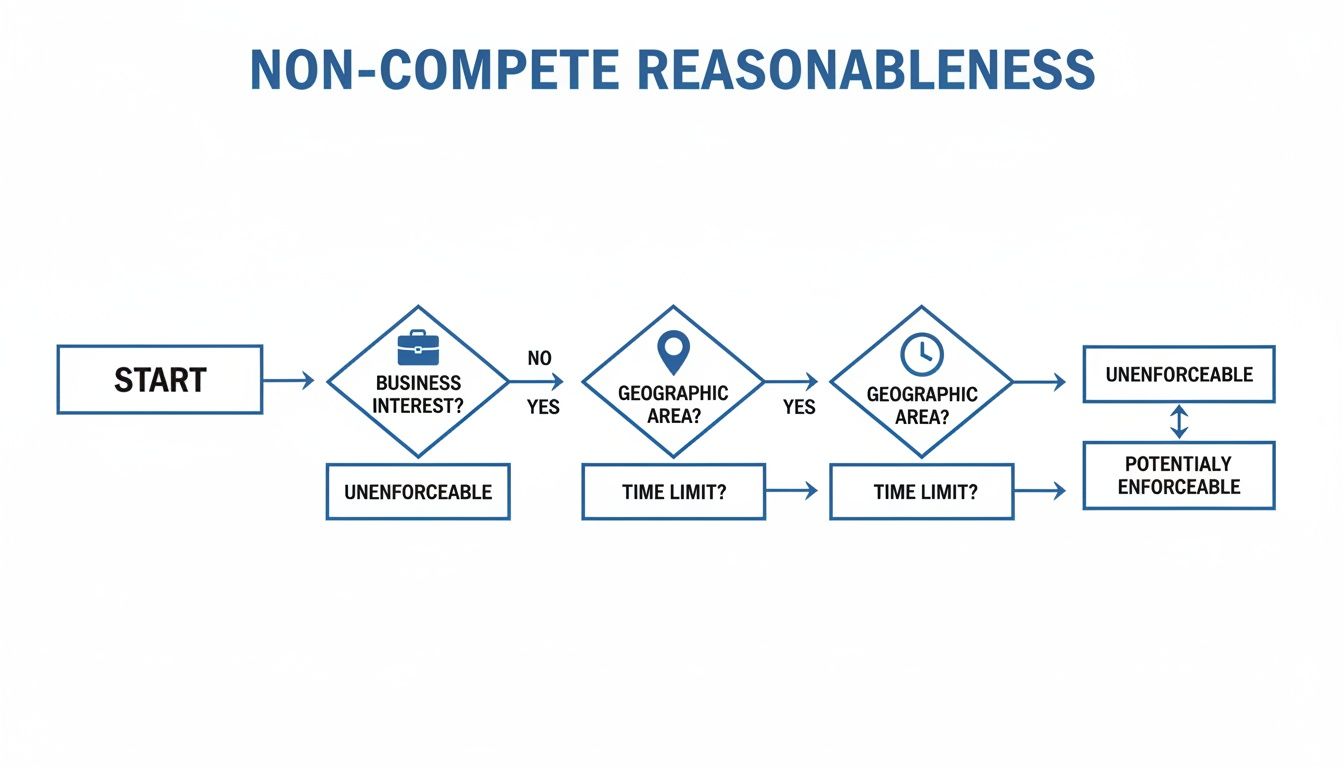
As you can see, the non-compete has to clear every single one of these hurdles—a valid business interest, reasonable geography, and fair time limit—to be considered legally sound.
Crucial Point: In Mississippi, a judge has the power to “blue pencil,” or rewrite, an unfair non-compete. They don’t have to throw the whole thing out. If a five-year ban is unreasonable, a court can simply change it to one year. If a statewide restriction is too broad, they can shrink it to just the three counties you actually worked in.
This ability to modify an agreement is a game-changer. It means even a poorly written non-compete can be tweaked by a judge and made enforceable against you. This is precisely why trying to navigate a non-compete on your own is so risky—you could end up legally bound to a modified agreement you never saw coming.
Common Flaws That Can Invalidate a Non-Compete
While most legal battles over non-competes focus on the “reasonableness” of their time and geographic limits, some agreements are dead on arrival. They have fatal flaws baked right in—technical errors that can get them thrown out before a judge even starts weighing the finer points. These are the kinds of issues that can give you a clean, quick win.
One of the most common—and often overlooked—of these knockout punches is a lack of what lawyers call “consideration.” Simply put, a contract isn’t a contract unless both sides get something of value. For a non-compete, your employer has to give you something specific in exchange for your signature.
If you sign the agreement as part of a new job offer, the job itself is usually considered valid consideration. But what happens when you’re already an employee? That’s where things get tricky.
The Critical Role of Consideration
Let’s say you’ve been with your company for a few years. One morning, your boss drops a non-compete on your desk and tells you it’s a new requirement. If you sign it without getting anything new in return—no raise, no bonus, no promotion—that agreement might be completely worthless.
Just being allowed to keep the job you already have isn’t enough in Mississippi. The law is clear: a new promise from you requires a new promise from your employer.
- What counts as valid consideration? A promotion, a pay increase, a one-time bonus for signing, or access to new confidential information or specialized training.
- What usually doesn’t count? Simply continuing to work under the exact same terms you already had.
Employers make this mistake all the time. It’s a fundamental error that can become a powerful tool for getting out from under an otherwise restrictive agreement.
When an Employer’s Own Actions Void the Deal
Sometimes, the employer is their own worst enemy. A non-compete can become unenforceable not because of what’s written in it, but because of how the company behaved. Courts expect a certain level of fairness, and if an employer acts in bad faith, they can lose the right to enforce the contract.
This is often referred to as the “unclean hands” doctrine. For example, if you were fired for an illegal reason—say, for reporting unsafe working conditions—a court is highly unlikely to turn around and reward your former employer by enforcing their non-compete against you.
A non-compete is supposed to be a shield to protect a business from unfair competition, not a sword to punish a former employee. When an employer is the one who ends the relationship without a good reason, like during a mass layoff, their argument for needing protection from you suddenly gets a lot weaker.
Picture this scenario: A company lays off a key salesperson due to budget cuts. That person, now out of a job, needs to support their family and finds a new position with a competitor. The old employer then tries to stop them from working.
In a situation like that, trying to enforce the non-compete feels less about protecting business interests and more about kicking someone when they’re down. The employer created the problem by terminating the employee, so trying to block their ability to earn a living elsewhere is often seen as fundamentally unfair.
This line of thinking is gaining momentum. All over the world, new laws are making it harder for companies to enforce non-competes after they lay someone off. For a closer look at these evolving rules, you can explore more insights about international non-compete issues. The key takeaway is simple: how and why you left your job can make all the difference.
Real-World Scenarios with Mississippi Non-Competes

The legal tests and court standards are one thing, but what really matters is how these non-compete rules work in the real world. Let’s walk through a few common situations I see in my practice. These stories bring the abstract ideas of “reasonableness” and “legitimate business interest” to life, showing how they apply to actual jobs right here in Mississippi.
Scenario 1: The Barista’s Statewide Ban
Maria works as an hourly barista at a popular coffee shop in Gulfport. She’s great at her job, but she isn’t involved in the company’s finances, marketing strategy, or secret coffee bean blends. One afternoon, her manager hands her a non-compete, telling her that if she quits, she can’t work for any other coffee shop in the entire state for two years.
This agreement is a textbook example of overreach and is almost certainly unenforceable. Why? The employer has no legitimate business interest to protect. Maria’s latte art skills are her own; they aren’t a trade secret.
On top of that, a statewide ban for a local coffee shop job is geographically absurd, and a two-year restriction is far too long for her role. This isn’t about protecting the business—it’s about trying to intimidate an employee.
A key takeaway here is that an employer cannot use a non-compete agreement just to stop ordinary competition. If an employee doesn’t have access to confidential information or unique client relationships built on the company’s dime, there is likely nothing for the non-compete to legally protect.
Scenario 2: The Salesperson Fired in Retaliation
James is a star salesperson for a Jackson-based medical supply company. He needs to take legally protected medical leave for a serious health issue. When he returns to work, he’s abruptly fired. A week later, he lands a great job offer from a direct competitor, but then he gets a threatening letter from his old employer. They’re reminding him of his one-year, three-county non-compete.
This situation smells like retaliation. While the non-compete’s terms—a limited time and geographic scope—might look reasonable on paper, the context of his firing changes everything.
The fact that the company fired him right after he used a protected right completely undermines their position. It looks a lot less like they’re protecting their business and a lot more like they’re punishing him for taking medical leave. An experienced attorney would argue the employer acted in bad faith, which could make the agreement unenforceable. The focus shifts from the contract’s text to the employer’s questionable behavior.
If you find yourself in a similar spot, it’s crucial to understand your rights. You can learn more by reading our guide on what to do when you are fired from a job.
Scenario 3: The Technician and the Vague Agreement
Sarah is a skilled HVAC technician for a large company in Hattiesburg. Her non-compete says she can’t “engage in any business activities that compete with the company” for one year within the Pine Belt region. She finds a better-paying job with a new company that specializes in commercial refrigeration—a service her old company barely touched. Of course, her former employer tries to stop her anyway.
The fatal flaw here is the vague language. What on earth does “engage in any business activities” actually mean? Does it stop her from working in a completely different specialty like commercial refrigeration? This kind of overly broad, catch-all phrasing is a major red flag. A non-compete has to be specific about what an employee is restricted from doing, and that restriction must tie directly to the work they actually performed.
In Sarah’s case, we could make a strong argument that the agreement is too ambiguous to enforce. Another strategy would be to ask the court to interpret the clause narrowly, which would allow her to continue her work in a specialty that doesn’t truly compete.
These examples all drive home one critical point: the specific facts of your situation matter more than anything. The reason you left your job, the nature of your work, and the exact words in that contract all play a huge role in the outcome.
Why Many Non-Competes Are Just Scare Tactics
When a company puts a non-compete agreement in front of you, it feels like an ironclad contract. Most people assume that once they sign, they’re legally locked in. But here’s something most employers don’t want you to know: a surprising number of these agreements are little more than “scarecrow contracts.” They’re designed to look intimidating and keep you from leaving, but they wouldn’t actually stand up in court.
Companies are banking on the fact that you’ll be too afraid of a long, expensive legal fight to ever call their bluff. It’s a strategy that works far too often, freezing talented employees in place even when the agreement they signed is fundamentally flawed.
The Intimidation Game
At its core, this is a psychological play. Your former boss sends over a formal, legal-looking document, and your gut reaction is to fear the worst and simply comply. That’s exactly what they want.
This dynamic allows companies to get away with imposing completely unreasonable restrictions, knowing they’ll likely never be challenged. They successfully limit competition without ever having to prove their non-compete is fair or necessary.
And this isn’t just a Mississippi problem. It’s happening everywhere. For instance, a recent Italian study found that while about 16% of private-sector employees are under a non-compete, a massive two-thirds to three-fourths of those agreements are probably unenforceable. Despite that, 54.3% of those workers were still convinced a court would side with the company. You can read more about these findings in this piece of academic research into non-compete enforceability.
The lesson here is simple but powerful: your signature on a non-compete doesn’t automatically make an unfair contract legal.
The Legal Landscape Is Shifting
Thankfully, the tide is starting to turn. Both judges and lawmakers are waking up to the damage that over-the-top non-competes inflict on workers and the economy. There’s a growing recognition that these agreements are often just tools to keep wages down and block innovation, rather than to protect legitimate business secrets.
This shift is creating real momentum in favor of employee rights. The old idea that the company always holds all the cards is being challenged every day.
Once you understand that many companies are bluffing with a weak legal hand, you can find the confidence to question your agreement. Pushing back against a non-compete is far from a lost cause, especially when its terms are designed to punish you rather than protect the business.
This context is everything. It means that if a threatening letter from a former employer lands in your inbox, your first move shouldn’t be to panic. It should be to critically analyze the actual non-compete agreement enforceability.
Why This Matters for You in Mississippi
Here in Mississippi, we don’t have a state-level human rights commission where you can file a complaint. That means your options are more direct—you have to be ready to stand up for yourself when an employer gets aggressive with a non-compete.
Realizing that many of these contracts are just scare tactics is your first step. It shifts you from a position of fear to one of empowerment. Knowing that the document trying to dictate your career might be legally toothless gives you the leverage to pursue new opportunities without being unfairly tied down. The key is getting a real, honest assessment of the agreement’s strengths and weaknesses before you make your next move.
Your Action Plan for Facing a Non Compete Issue

Staring down a non-compete agreement can feel completely overwhelming. It’s easy to feel trapped. But having a clear, step-by-step plan can make all the difference in protecting your career and your right to earn a living.
The most important first step is a mental one: do not assume the agreement is automatically enforceable. Many non-competes are written to be intentionally broad, relying more on intimidation than solid legal footing. Your second step is to become an expert on your own agreement. Read it—really read it—and start pinpointing the specific restrictions it places on your future.
Key Details to Document Immediately
To figure out the real-world non-compete agreement enforceability in your specific situation, you need to gather the facts. Creating a detailed timeline and collecting your documents isn’t just busy work; it’s a critical part of building your case.
- Review the Contract: Get specific. What is the exact geographic scope? How long is the time restriction—one year, two years? What precise job duties are you prohibited from performing?
- Document Your Departure: Write down exactly how you left the company. Were you laid off in a restructuring? Did you resign for a better opportunity? Was it a wrongful termination? The “why” behind your exit can absolutely impact how a court views the contract’s fairness.
- Compile Employment Records: Pull together your pay stubs, the original offer letter, performance reviews, and any emails or documents related to when you signed the non-compete. This paper trail is vital evidence.
When a non-compete is hanging over your head, learning some effective strategies for a discreet job search also becomes a crucial part of your action plan.
Seeking a Professional Legal Evaluation
Finally, and this is the most important piece of advice I can give you: get a professional legal evaluation before you make any career moves. Do not resign or accept a new job offer based on your own reading of the contract. The stakes are simply too high, and what’s enforceable can change dramatically from one state to the next.
This isn’t just about individual careers, either. Overly strict non-competes have been linked to broader negative impacts, like a 16-19% decrease in new patent filings over 10 years in some areas. It’s a clear sign of why a detailed legal review is so essential.
In Mississippi, you can’t just file a complaint with a human rights commission—because we don’t have one. Your path to relief requires direct, informed legal action, which makes professional guidance indispensable.
At Nick Norris, P.A., our job is to analyze your agreement, find the weaknesses, and develop a personalized strategy. We typically work on a contingency fee basis, where the average fee is between 40-50%. This means you don’t owe us anything unless we win your case. Time is always a factor, so understanding the deadlines for taking action is critical. You can learn more about this in our article on the employment law statute of limitations.
Frequently Asked Questions About Mississippi Non-Competes
It’s natural to have a lot of questions—and “what ifs”—when you’re staring down a non-compete agreement. The language can be dense and the implications for your career can feel huge. Let’s clear up some of the most common issues Mississippi employees run into.
Can My Employer Force Me to Sign a Non-Compete After I’ve Already Started Working?
Yes, they can ask, but there’s a big string attached. For a non-compete signed after you’ve started a job to be valid, your employer has to give you something new of value in exchange for your signature. Lawyers call this consideration.
Just letting you keep the job you already have isn’t enough. That new consideration needs to be something tangible, like a pay raise, a promotion, a special training opportunity, or a bonus tied directly to signing the agreement. If they just dropped it on your desk one day without offering anything in return, the contract is likely on very shaky legal ground and you should have it reviewed.
What Happens If a Judge Decides My Non-Compete Is Unreasonable?
Mississippi courts don’t usually take an all-or-nothing approach. Instead of just throwing out the entire agreement, judges here can “blue-pencil” it. This means they can literally cross out or rewrite the parts they find unfair.
For example, a judge could take an over-the-top three-year restriction and reduce it to one year. Or, they might shrink a statewide ban down to cover only the handful of counties where you actually did business for the company.
This is exactly why having an experienced attorney is so important. A good lawyer can argue for the most favorable edits, giving you the freedom you need to get back to work.
Should I Tell My New Employer About an Old Non-Compete?
This is a tricky situation that requires a careful approach. Before you say anything to a potential new boss, your very first step should be to get a legal opinion on whether the non-compete is even enforceable.
Once you know where you stand legally, you can decide how to handle the conversation. Hiding the agreement is risky; if your old company sues, they will often name your new employer in the lawsuit, which is a mess no one wants. Since Mississippi has no human rights commission to mediate these types of employment disputes, you’re on your own to resolve it. An attorney can help you map out the best way to approach this conversation, protecting your new job and your career.
If you’re dealing with a non-compete and feel stuck, don’t guess about your next move. Nick Norris, P.A. offers clear-headed advice and strong advocacy for workers across Mississippi. Contact us today for a personalized evaluation of your case.
This article has been reviewed for legal accuracy by Nick Norris. For employment law matters in Mississippi, consult with an attorney licensed to practice in your state.
Leave a Reply