

If you’ve been punished for reporting government fraud in Mississippi, it can feel like your world has been turned upside down. But you are not without powerful federal protections. The False Claims Act retaliation damages are specifically designed to make you whole again and to hold your employer accountable. These remedies include getting your job back, recovering double back pay with interest, and being compensated for all the other harms you’ve suffered along the way.
There is a clear path to justice, and it’s important you understand your rights.
Understanding Your Rights as a Mississippi Whistleblower

When you step up to report fraud against the government, you're taking a significant personal and professional risk. The law gets that. That’s precisely why the federal False Claims Act (FCA) contains a robust anti-retaliation provision, codified in 31 U.S.C. § 3730(h), to shield whistleblowers just like you.
This part of the law makes it flat-out illegal for an employer to fire, demote, harass, or discriminate against you in any way for lawful actions you took to advance an FCA case. This protection covers everything from investigating potential fraud and helping the government to filing a lawsuit yourself.
An FCA retaliation case goes directly to federal court. This gives you a direct route to seek justice without getting bogged down in administrative processes first. If you can prove that you were punished for your protected whistleblowing activities, the law mandates substantial remedies.
The goal isn't just to get you back to where you were; it's to fully compensate you for everything you lost. This covers not only the obvious economic damages but also the personal and emotional toll the retaliation took. These remedies send a strong, clear message: retaliating against those who expose fraud will cost you. Whistleblowers in other sectors may also find it helpful to learn about the Sarbanes-Oxley whistleblower protections.
To give you a clearer picture, here is a quick guide to the primary damages you can recover in a successful FCA retaliation claim.
Quick Guide to FCA Retaliation Damages
| Type of Damage | What It Covers | Real-World Example |
|---|---|---|
| Reinstatement | Getting your exact job and seniority back as if you were never terminated or demoted. | An accountant who was fired is offered their same position, title, and pay grade, with all seniority intact. |
| Double Back Pay | All lost wages, bonuses, and benefits from the date of retaliation, which are then doubled by the court. | If you lost $100,000 in salary and benefits, your award for back pay would be $200,000, plus interest. |
| Special Damages | Costs for emotional distress, damage to your professional reputation, and all litigation expenses, including attorney's fees. | Recovering the money you spent on therapy sessions to cope with the stress and having the employer pay for your legal fees. |
In short, the law aims to put you back in the financial and professional position you would have been in, and then some, to account for the wrongdoing you endured.
Decoding the Full Value of Your Retaliation Damages
When you've been retaliated against for doing the right thing, the False Claims Act provides remedies that are far more powerful than what you'd find in a typical wrongful termination lawsuit. The law isn't just about making you whole; it’s also designed to punish the employer for their illegal actions. Let's walk through exactly what you can recover in a false claims act retaliation damages claim.
First, there’s reinstatement. This is more than just getting a job back—it's about getting your job back. A court can order your employer to put you right back in the same position you held before they retaliated, with all the same seniority, pay, and duties, as if it never happened.
The biggest financial piece of the puzzle is double back pay plus interest. We're not just talking about your lost salary here. Back pay is meant to cover every single penny you lost because of the retaliation. This includes things like:
- Bonuses and commissions you would have earned
- The value of your health insurance benefits
- Lost 401(k) matching funds from your employer
- Any other perks or compensation you lost
After adding all that up, the law requires that total to be doubled. On top of that, you also get pre-judgment interest on the original back pay amount. It's a powerful tool for holding employers accountable.
The Power of Special Damages
Finally, the Act allows you to recover what are called special damages. I like to think of retaliation as a rock tossed into the pond of your life. Special damages are meant to compensate you for every single ripple—every disruption that followed.
Special damages are where the law acknowledges the very real, personal fallout from being targeted. This can include compensation for emotional distress, the mental anguish of being out of work, and the harm to your professional reputation that makes finding a new job so much harder. It also covers out-of-pocket costs you might have, like bills for therapy or fees for a career coach.
This is where the true human cost of retaliation gets addressed. These damages cover the kind of harm that doesn't show up on a pay stub but can be just as devastating as any financial loss.
Federal law gives whistleblowers a strong shield and a powerful sword for fighting back. The False Claims Act is crystal clear: employers cannot retaliate against you for reporting fraud. And there is no cap on compensatory damages in these cases, which means the amount you can be awarded is not artificially limited—it can fully match the harm you actually suffered. You can explore more insights about these powerful, uncapped whistleblower protections to get a complete picture of your rights.
Of course. Here is the rewritten section, designed to sound completely human-written and natural, as if from an experienced legal expert.
How Courts Calculate Your Financial Recovery
Knowing what damages you can claim is one thing, but understanding how courts actually calculate them is what turns a good case into a great one. It’s how you and your attorney build a compelling argument for the full value of your false claims act retaliation damages. This isn’t a guessing game; it’s a methodical process designed to make you whole again.
It all starts with calculating your double back pay. A skilled attorney will go through your finances with a fine-tooth comb to tally every single dollar of lost income and benefits. We're not just talking about your base salary. This is a complete accounting that includes:
- Lost wages from the day you were fired until a judgment is handed down.
- Any bonuses or sales commissions you reasonably expected to earn.
- The cash value of lost benefits, like health insurance premiums your employer paid or their matching contributions to your 401(k).
Once that total economic loss is added up, the court applies pre-judgment interest. Only after the interest is included is the entire amount doubled. This doubling isn't just about compensation; it’s a powerful penalty meant to deter employers from punishing whistleblowers.
This diagram helps visualize how these different pieces of your potential recovery fit together.
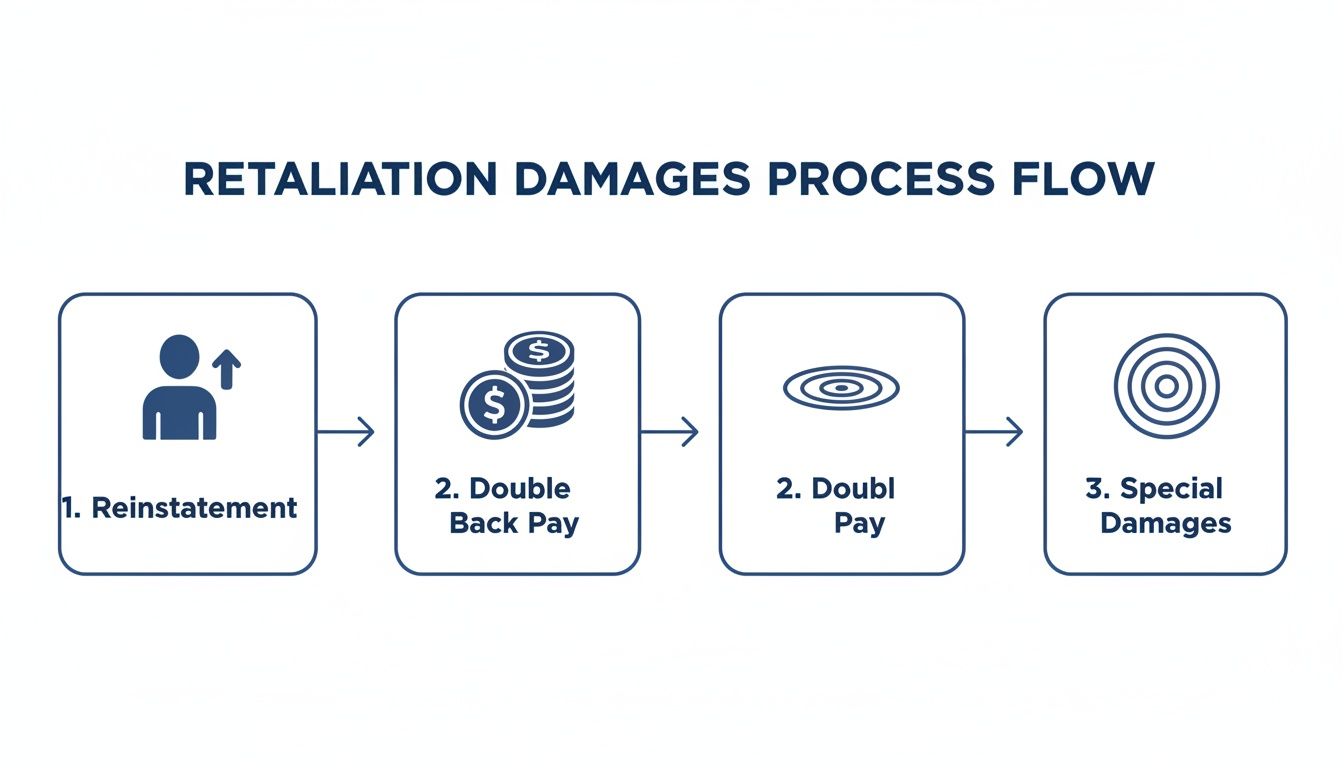
As you can see, the path to recovery is a combination of distinct remedies, all working together to fully restore what was taken from you.
Quantifying Your Special Damages
Now, let's get to what is often the most complex part of the equation: putting a number on your special damages. This is where we account for the non-economic harms—the kind of damage that doesn't show up on a pay stub but can be just as devastating. This is where your personal story truly matters.
Think about a real-world scenario we often see with Mississippi workers:
A nurse at a Tupelo clinic has solid proof of Medicare fraud and reports it. A few weeks later, she’s fired over a minor mistake that would have been ignored for anyone else. Beyond the immediate loss of income, her professional reputation in a tight-knit medical community is destroyed. She can't sleep and feels a constant sense of dread and anxiety.
To get her the compensation she deserves, we have to document every single one of those harms. This could mean claiming damages for:
- Emotional Distress: Proving this often involves records from a therapist or doctor that show the mental and emotional toll the firing has taken.
- Reputational Harm: We might show how the termination has made it nearly impossible to find a comparable job, sometimes even bringing in an expert to testify on the damage to her career.
- Out-of-Pocket Costs: This is where we submit every receipt, from co-pays for therapy sessions to fees paid to a career coach to help her get back on her feet.
When you meticulously account for every consequence, a single act of illegal retaliation can rightly result in a substantial financial award.
It's also important to know that because Mississippi does not have a human rights commission, your claim will go directly to federal court. This makes it absolutely critical to have an attorney who not only knows the law but also understands federal court procedures inside and out. Most attorneys who specialize in these cases work on a contingency fee basis, meaning their fee—usually 40-50% of the recovery—is only paid if and when you win your case.
Building a Winning Retaliation Case in Federal Court
When you’ve been retaliated against for doing the right thing, it’s not enough to just be angry or know you were wronged. To win a claim for false claims act retaliation damages in federal court, you have to prove it, and the clock is ticking.
You have a strict three-year statute of limitations to file your claim, and that deadline starts the very day the retaliation happens. Miss it, and you could lose your right to seek justice forever.
The Three Pillars of Your Case
So, what does it actually take to build a winning case? You'll need to convince a court of three specific things:
- You were involved in a "protected activity"—things like investigating fraud, reporting it internally, or helping the government with a case.
- Your employer knew what you were doing.
- Your employer took a negative action against you (like firing you, demoting you, or creating a hostile work environment) because of your protected activity.
That last part, connecting the dots between your actions and your employer's retaliation, is often the toughest hurdle. This is where the evidence you've gathered becomes absolutely critical.
Documentation Is Your Best Defense
The moment you even suspect things are turning sour, you need to start keeping records of everything. Seriously, everything. Save every email, text message, performance review, and internal memo that could be relevant.
This paper trail helps you construct a timeline that a judge and jury can easily understand.
Think of it this way: if you have years of glowing performance reviews and then suddenly get put on a performance improvement plan right after you reported potential fraud, that's powerful evidence. An unexpected transfer, a sudden demotion, or a string of hostile emails from a supervisor can all serve as the building blocks for a strong case.
Because False Claims Act retaliation lawsuits are filed directly in federal court in Mississippi, you need an attorney who doesn't just know employment law but is also a seasoned pro in federal court. This isn't the kind of fight you want to take on alone. You can learn more about the first steps by reading our guide on how to file a whistleblower complaint.
Settlement vs. Court Judgment
At some point, you'll likely face a major decision: accept a private settlement or take your case all the way to a trial. A settlement gives you a guaranteed outcome without the stress and uncertainty of a public trial. On the other hand, a trial could result in a larger award, but it also comes with the risk of losing.
An experienced lawyer can help you analyze the strength of your evidence, predict your employer’s defenses, and make the right call for your situation. If you do head to court, it's vital to understand the strategies for preparing for trial and winning your case.
Why an Experienced Mississippi Employment Lawyer Is Essential

Let's be blunt: a company willing to defraud the U.S. government won't think twice about using aggressive, intimidating legal tactics against you. Trying to handle a false claims act retaliation damages claim on your own is a true David vs. Goliath fight. You need a slingshot, and that comes in the form of a formidable advocate.
Hiring an experienced Mississippi employment lawyer isn't just a good idea—it’s the most important move you can make. A skilled attorney completely levels the playing field. They bring a deep understanding of federal court procedures and the specific nuances of retaliation law that you simply can't learn from a book.
Your lawyer knows how to gather compelling evidence, depose hostile company witnesses, and build a powerful, persuasive story that clearly connects your whistleblowing to the employer's illegal actions.
Maximizing Your Recovery and Minimizing Your Risk
An attorney's most critical role is fighting to ensure you recover the full value of your claim. This is particularly true when it comes to calculating complex special damages, like proving emotional distress or putting a number on the harm done to your professional reputation. Without an expert's guidance, you are almost guaranteed to leave money on the table.
Most top-tier employment law firms understand the financial strain whistleblowers face, which is why they work on a contingency fee basis.
This model is a lifeline for whistleblowers. It means you pay absolutely no upfront legal fees. Your lawyer only gets paid a percentage of the recovery if—and only if—you win your case.
This arrangement means your attorney is 100% invested in getting the best possible outcome for you. The average contingency fee typically ranges from 40-50% of the total award.
Because Mississippi does not have a human rights commission to process these types of claims, your only path to justice is through the federal court system. This makes having experienced legal representation non-negotiable. To connect with those in need, it's also crucial for a modern law firm to boost your online visibility.
If you believe you have been retaliated against in Mississippi for whistleblowing, don't wait. Contacting a lawyer immediately is the best way to protect your rights and understand the true potential of your case.
It’s easy to feel isolated when you’re facing retaliation for doing the right thing. But it's important to understand that your personal fight is part of a much bigger picture—one that has a massive impact on protecting American taxpayers.
When you blow the whistle on government fraud, you're not just fighting for yourself. You become a critical part of the single most effective system our government has for recovering stolen funds.
Your Courage Is the Engine of Recovery
Think about it this way: the government can't be everywhere at once. It relies on insiders—people just like you—to expose fraud that would otherwise go unnoticed. And the law is designed to back you up, providing powerful financial remedies like double back pay precisely because protecting whistleblowers is the best way to protect the public's money.
The results speak for themselves. The False Claims Act has been instrumental in recovering billions of dollars that were fraudulently taken from taxpayers.
In fiscal year 2026 alone, settlements and judgments under the False Claims Act hit $6.8 billion, a record-breaking figure. Since the law was overhauled in 1986 to better empower whistleblowers, the government has recovered more than $85 billion.
The vast majority of this success comes directly from whistleblower-initiated cases. In fact, fiscal year 2026 saw whistleblowers file 1,297 new qui tam lawsuits, the highest number ever recorded in a single year. You can learn more about these landmark whistleblower-driven recoveries and the incredible impact they've had.
Seeing these numbers helps put your own situation into perspective. You're not just a victim of illegal retaliation; you are a vital partner to the U.S. government in its fight against fraud. The false claims act retaliation damages you're entitled to aren't just about making you whole. They're a clear acknowledgment of the crucial role you play and the bravery it takes to stand up.
Common Questions About FCA Retaliation in Mississippi
Facing retaliation after blowing the whistle can leave you feeling isolated and unsure of what to do next. It's a confusing time, but you have rights. Here are some straightforward answers to the questions we hear most often from Mississippi employees who've been punished for doing the right thing.
What Exactly Counts as a Protected Activity Under the FCA?
Many people think you’re only protected if you’ve already filed a formal lawsuit. That’s simply not true. The law defines “protected activity” very broadly to include almost any lawful action you take to stop government fraud.
You are likely covered by the False Claims Act’s anti-retaliation rules if you:
- Started looking into potential overbilling or other suspicious financial practices.
- Raised questions about illegal conduct during a team meeting or with a supervisor.
- Reported your concerns about fraud to the Human Resources department.
- Refused to follow a manager's order to participate in a fraudulent scheme.
Basically, if your actions were part of an effort to stop your employer from defrauding the government, the law is on your side. You can see more real-world situations by reviewing these whistleblower retaliation examples.
Can I Win My Retaliation Case if the Fraud Case Fails?
Yes, absolutely. It's critical to understand that your retaliation claim stands on its own. It is completely separate from the underlying fraud (qui tam) case.
The law protects you for having the courage to report potential fraud in good faith. It doesn't require you to be right. You can still win your retaliation lawsuit—and recover all the damages you’re entitled to—even if the government declines to intervene in the fraud case or if the case is ultimately dismissed. The only thing that matters for your claim is proving your employer punished you because you reported the misconduct.
How Long Do I Have to File a Lawsuit in Mississippi?
You have a three-year statute of limitations to file an FCA retaliation claim. This is a hard deadline. The clock starts ticking on the day the retaliation occurs—for example, the day you were fired, demoted, or had your pay cut.
Since Mississippi does not have a human rights commission that handles these types of claims, your only path forward is to file a lawsuit in federal court. This makes it absolutely essential to speak with an attorney as soon as possible, or you could lose your right to sue forever.
I Signed a Severance Agreement—Can I Still Sue?
It's very possible. While the specific wording in your severance package is important, courts are often skeptical of agreements that try to muzzle whistleblowers or prevent them from reporting illegal activity. These types of clauses can be deemed unenforceable because they violate public policy.
Never just assume you’ve signed away your rights to report fraud or seek justice for being illegally punished. An experienced employment attorney can review your severance agreement and explain what it really means for your case. The law is designed to encourage whistleblowers, not silence them.
If you believe you've been punished for reporting government fraud in Mississippi, you don’t have to fight this battle on your own. At Nick Norris, P.A., we offer dedicated and knowledgeable representation to protect your rights and help you secure the justice you deserve. To discuss your case, please contact us today by visiting our website at https://www.nicknorris.law.
This article has been reviewed for legal accuracy by Nick Norris. For employment law matters in Mississippi, consult with an attorney licensed to practice in your state.
Leave a Reply