
How to File a Whistleblower Complaint: A Guide for Mississippi Employees
When you see something illegal happening at work, it’s a tough spot to be in. Figuring out how to actually file a whistleblower complaint is the first real step toward doing something about it. It’s a process, one that involves pinpointing the exact misconduct, documenting everything you can, and making a crucial decision: do you report it inside the company or go straight to a government agency?
Since Mississippi does not have a state-level human rights commission, your path will almost always lead to federal authorities.
Your First Steps as a Mississippi Whistleblower
Becoming a whistleblower is a big deal, and it’s not a decision to take lightly. Before you make any moves, you have to be clear on what actually counts as a valid complaint. This isn’t just about being unhappy with your boss; it’s about reporting conduct you have a good reason to believe is illegal.
This all starts with a gut check and a reality check. Is what you’ve seen a violation of a specific law or regulation, or is it a personal beef or a general workplace problem? The difference matters—a lot. Federal agencies are looking for clear-cut legal violations, not just bad management.
Is Your Concern a Valid Complaint?
Let’s be clear: not every bad day at the office is grounds for a whistleblower claim. A valid complaint needs to be tied to actions that break the law. Think things like threatening public health, committing financial fraud against the government, or violating specific labor and safety laws.
For instance, if your manager has a terrible attitude, that’s a classic HR grievance, not a whistleblower case. But if that same manager is telling your team to dump hazardous waste behind the building to save money? Now you’re talking about a serious violation of environmental law. That’s a solid basis for a complaint.
A strong whistleblower claim is built on facts, not feelings. A vague sense that “something’s not right” won’t cut it. You have to be able to connect your employer’s actions to a specific violation of the law.
Internal Reporting Versus External Filing
Once you’re confident the misconduct is illegal, you’ve got a choice to make. Do you use your company’s internal channels, or do you file a complaint directly with an outside government agency?
-
Internal Reporting: Sometimes, going to HR or your company’s compliance department can get a quick fix, especially if the company genuinely wants to do the right thing. The big risk? You’re outing yourself internally and could face immediate retaliation before you have any official protection.
-
External Filing: On the other hand, filing with a federal agency like OSHA or the SEC creates an official record from day one and activates powerful legal protections. Because Mississippi lacks a state equivalent for most of these issues, federal agencies are your main recourse. This route almost always offers stronger shields against retaliation.
This first decision is one of the most critical you’ll make. It really sets the tone for everything that comes next.
Deciding Where to Report Misconduct
The very first decision you make—where to take your complaint—is one of the most critical. This choice really sets the tone for everything that follows, from how quickly things move to the kind of legal protection you’ll have. It all boils down to one fundamental question: do you report the problem inside the company, or do you go straight to an outside government agency?
Going to your own HR department or using an internal hotline can sometimes get you a quick fix, especially if the company genuinely tries to do the right thing. But let’s be clear: it’s a path loaded with risk. You’re essentially putting your employer on notice that you’re the one raising the alarm, often before any formal legal protections kick in. This can leave you vulnerable to both obvious and subtle retaliation.
The other route is filing directly with a federal agency. This immediately creates an official, dated record of your report and activates powerful anti-retaliation laws. Since Mississippi does not have its own human rights commission or a single state-level agency for most whistleblower issues, heading to a federal body is often the safest and most effective move for employees here.
Internal Reporting: A Calculated Risk
Taking your concerns to management first requires some serious thought. If you genuinely trust your supervisors and believe the misconduct is an isolated slip-up, not a part of the company culture, it might be worth a shot. A company that cares about its reputation might jump to correct the problem.
But the potential downside is huge. If the company culture is toxic or senior leaders are involved in the wrongdoing, an internal report can get buried fast. Even worse, it can put a target on your back, making you a prime candidate for retaliation before you’ve had a chance to get an outside agency involved.
This chart can help you think through whether your situation is a simple workplace grievance or something that points to illegal activity requiring an external complaint.
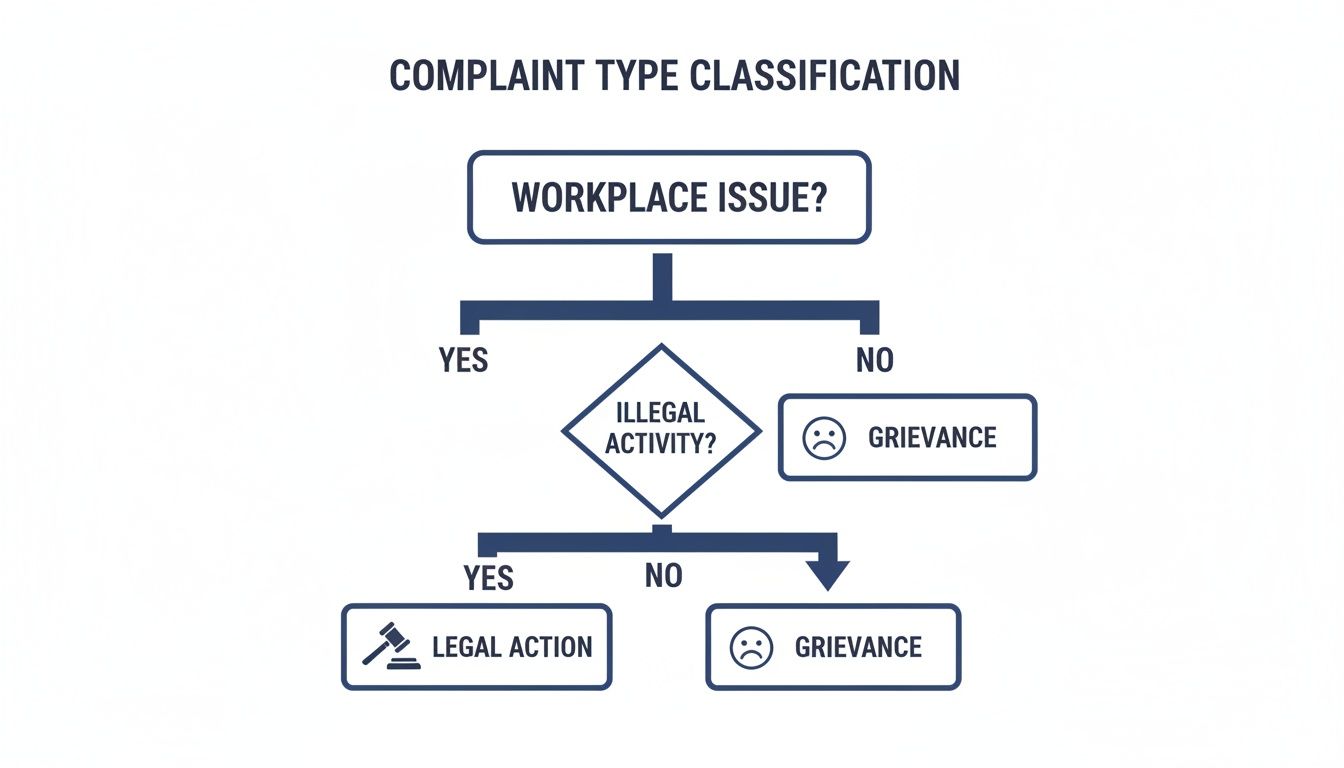
As the flowchart shows, a personal grievance is usually an HR matter. But if you’re dealing with illegal activity, it’s time to look at external reporting options.
Navigating Federal Agencies
Once you’ve decided to file externally, you need to pinpoint the right government agency. This isn’t a minor detail—it’s crucial. The agency you choose depends entirely on the type of wrongdoing you’ve witnessed. Filing with the wrong one can lead to major delays or even get your case thrown out.
For Mississippi employees, these are the main federal agencies you’ll be dealing with:
- Occupational Safety and Health Administration (OSHA): Is your complaint about unsafe working conditions? Think lack of safety gear on a construction site or exposure to dangerous chemicals. If it’s a workplace health and safety issue, OSHA is your go-to.
- Equal Employment Opportunity Commission (EEOC): The EEOC is the place for retaliation claims tied to discrimination or harassment. For instance, if you were demoted right after you backed up a colleague’s sexual harassment claim, the EEOC is who you need to talk to. We cover this in more detail in our guide on how to report workplace harassment.
- Securities and Exchange Commission (SEC): If you’ve uncovered financial wrongdoing at a publicly-traded company—things like accounting fraud, insider trading, or lying to investors—the SEC is the agency with the authority to investigate.
Choosing the right agency isn’t just a box to check; it’s a strategic move. Each one operates with its own rulebook, deadlines, and investigation methods. Getting it right from the very beginning gives your claim the best shot at success.
Picking the wrong agency can mean your complaint goes nowhere, gets rejected because they don’t have jurisdiction, and forces you to start all over. By then, you might have missed a strict filing deadline. This is exactly where getting legal advice upfront can save you from a critical mistake. An experienced employment attorney can look at the facts and make sure your report lands on the right desk, with the agency that can offer the strongest protections. That initial guidance can make all the difference.
Building a Credible and Documented Case
When it comes to a whistleblower complaint, suspicion and gut feelings won’t get you very far. A strong case is built on a foundation of solid, verifiable proof. Before you even think about filing, your main job is to put together a file so clear and well-documented that it leaves little room for doubt. This means systematically gathering evidence and keeping meticulous records of everything.

Think about it from the investigator’s perspective. They’re looking at two files. One is a jumble of notes and vague claims. The other contains dated emails, clear photos, and a coherent timeline. Which one do you think gets their attention first? Your goal is to make their job as easy as possible.
What Kind of Evidence Matters Most
Not all evidence carries the same weight. You need to focus on collecting objective proof that directly connects to the illegal activity you’re reporting. Vague accusations are easy to brush aside, but a folder full of concrete evidence is tough to ignore.
Here’s what you should be looking for:
- Written Communications: Emails, internal memos, text messages, and chat logs are often your strongest allies. They provide a timestamped, undeniable record of conversations and directives.
- Financial Records: If you’re dealing with fraud, documents like invoices, doctored expense reports, or internal accounting spreadsheets are gold. This is the hard data that can directly prove financial misconduct.
- Visual Proof: A picture really is worth a thousand words. Photos or videos of safety violations—like blocked fire exits or faulty equipment—can be incredibly persuasive.
- Witness Information: On your own time, make a private list of colleagues who saw what happened. Jot down their names, contact info, and what they witnessed. Their testimony can add significant credibility to your complaint.
A crucial word of caution here: do not break the law or violate company policy to get this information. Accessing files you aren’t authorized to see or secretly recording conversations can backfire, jeopardizing your case and even landing you in legal trouble. Stick to collecting documents you can legitimately access as part of your normal job.
Create an Unbreakable Timeline
A detailed timeline is the backbone of your entire case. It organizes all your evidence into a story that an investigator can easily follow. Grab a notebook or start a secure document on your personal computer and start logging everything.
For each event, you should record:
- Date and Time: Be as specific as you can.
- Location: Where did this happen?
- People Involved: List everyone present, with their full names and job titles.
- What Happened: Give a factual, objective description. Stick to what was said and done, and leave out emotional language or your own assumptions.
- Relevant Evidence: Make a note of which document, photo, or email backs up this entry.
Your timeline should tell a story. It connects the dots from the first time you witnessed wrongdoing to every conversation, action, or instance of retaliation that followed. This narrative is what turns a pile of documents into a compelling case.
Documenting Retaliation Separately
If you start facing pushback after raising concerns, you need to document it meticulously. Retaliation is illegal, and having a clear record is your best defense. Keep this personal journal at home, never on a work computer or device.
For every instance of suspected retaliation, log the same details: date, time, who was involved, and a factual description of what occurred. Were you suddenly pulled off a key project? Left out of meetings you always used to attend? Hit with a surprisingly negative performance review? Write it all down immediately while it’s fresh in your mind. This log will be invaluable if you need to file a separate retaliation claim.
Recent data shows just how critical this kind of detailed documentation is. Whistleblower programs are seeing record submissions, with one report showing a peak substantiation rate of 46% across 2.15 million reports globally. Interestingly, web-based submissions had a 40% substantiation rate—significantly higher than the 33% for old-school hotlines. This trend underscores the power of well-documented, digitally filed complaints. You can read the full 2025 whistleblowing benchmark report from NAVEX to see how these trends are shaping the landscape. By building a thorough case file, you’re creating the kind of detailed, evidence-backed complaint that actually gets results.
Understanding Your Protections Against Retaliation
Let’s be honest: the number one reason people hesitate to blow the whistle is the fear of payback. It’s a completely natural and valid concern. The good news is that federal law provides a strong shield for employees who speak up. The moment you file a whistleblower complaint, you activate legal protections designed specifically to stop your employer from punishing you.

This protection is called anti-retaliation, and it’s the bedrock of whistleblower law. In simple terms, it makes it illegal for your employer to take any “adverse employment action” against you for reporting what you reasonably believe is a violation of the law. Knowing your rights here is your best defense against unfair treatment.
What Counts as Illegal Retaliation?
Retaliation is a much broader concept than just getting fired. It’s any negative action from your employer that could talk a reasonable person out of filing a complaint or supporting one. Federal laws are written to cover a wide range of retaliatory behaviors.
Here are some of the most common ways illegal retaliation shows up:
- Termination or Layoff: The most blatant example, especially if it happens shortly after you report misconduct.
- Demotion: Suddenly finding yourself in a lower-level role with less pay or responsibility.
- Pay Cuts or Reduced Hours: Getting your salary docked, your hours cut back, or being denied overtime you used to get.
- Unfavorable Reassignments: Being moved to a less desirable location, department, or shift for no good business reason.
- Harassment or Intimidation: Your boss or coworkers suddenly creating a hostile environment through threats, bullying, or constant, unfair scrutiny.
- Sudden Negative Performance Reviews: Receiving a poor evaluation that just doesn’t line up with your actual work performance.
If you think you’re facing payback, it’s crucial to see these actions for what they are. You can get more familiar with these behaviors by reading our guide on the common signs of retaliation at work.
Your legal protections kick in the moment you engage in a “protected activity.” This includes filing a formal complaint, cooperating with an investigation, or even just raising your concerns about illegal conduct internally. The law is on your side every step of the way.
The Federal Laws Protecting You
Since Mississippi does not have a dedicated state-level human rights commission for these kinds of issues, your protections almost always come from federal statutes. Several powerful laws have specific anti-retaliation rules built right into them.
The specific law that shields you depends on what you’re reporting. For example, the Sarbanes-Oxley Act (SOX) gives robust protection to employees of publicly traded companies who report financial or securities fraud. The Dodd-Frank Act goes even further, providing both anti-retaliation safeguards and potential financial rewards for people who report violations to the SEC.
And these aren’t just laws on paper—they are actively enforced. Sadly, retaliation is still a huge problem; one survey found that nearly 50% of employees who report misconduct experience it. But federal agencies are cracking down. In fiscal year 2024 alone, the SEC pursued 11 enforcement actions against retaliators, including a massive $18 million penalty against one company for trying to silence whistleblowers.
Immediate Steps to Take if You Suspect Retaliation
If you think you’re being retaliated against, you have to act fast. The deadlines for filing a retaliation claim, known as the statute of limitations, are incredibly strict. For some claims, you might have as little as 180 days from the retaliatory act to file.
Here’s what you need to do right away:
- Document Everything. Just like you documented the original wrongdoing, start a detailed private log of every retaliatory incident. Write down the date, time, location, who was involved, and a factual account of what happened.
- Preserve Evidence. Save every email, text message, performance review, or any other document that could back up your claim. Make copies and keep them somewhere safe at home—never on a work computer.
- Consult an Attorney. Don’t wait. An experienced whistleblower attorney can evaluate your situation, tell you if you have a valid retaliation claim, and make sure you get the necessary complaint filed before the deadline passes.
Taking these steps gives you the ammunition you need to fight back and hold your employer accountable for breaking the law.
When to Get a Whistleblower Attorney in Your Corner
Trying to take on a whistleblower complaint by yourself is like navigating a minefield blindfolded. The legal system is littered with procedural traps and tight deadlines that can sink even the most solid case before it ever gets started. A good whistleblower attorney isn’t just a lawyer—they’re your strategist, your advocate, and your shield.
I see it all the time: people hesitate to call a lawyer because they’re worried about the cost. That’s a huge misconception, and frankly, it keeps a lot of good people from getting the justice they deserve. The truth is, getting expert legal help is much more attainable than most people realize.
Why You Need to Talk to a Lawyer—Yesterday
The absolute best time to talk with an attorney is before you file anything. Seriously. The moves you make in the very beginning, even before you officially report anything, can make or break your case. An attorney can stop you from making critical mistakes right out of the gate.
Here’s what a seasoned lawyer brings to the table from day one:
- A Reality Check: They’ll give you a straight, unbiased opinion on your case’s strengths and weaknesses. You’ll know if you actually have a viable claim worth pursuing.
- Pointing You in the Right Direction: They know exactly which federal agency to file with. This is non-negotiable, since Mississippi does not have its own state-level human rights commission to handle these claims.
- Building Your Evidence Arsenal (Legally): A lawyer will show you how to gather and save evidence the right way, without breaking the law or violating company policies.
Hiring an attorney isn’t admitting defeat; it’s leveling the playing field. Your employer has a team of lawyers on standby. You deserve an expert in your corner, too.
Having a law firm on your side also puts a powerful layer of protection around you. When your employer gets a letter from an attorney, it sends a clear signal: you know your rights, and you’re not messing around. This alone can be a strong deterrent against retaliation. To get the most out of that first meeting, it pays to understand how to prepare for your first talk with an employment lawyer.
How Can You Afford a Lawyer? The Contingency Fee
The biggest roadblock for most employees is the perceived cost. This is where the contingency fee model changes everything. Almost every whistleblower attorney I know works on this basis, which means you pay zero dollars upfront.
Here’s the breakdown:
- Your lawyer takes your case without you paying a dime.
- They front all the expenses needed to build and file your claim.
- You only pay legal fees if they win your case and you get a settlement or award.
The attorney’s fee is simply a pre-agreed percentage of what you recover. In whistleblower cases, that percentage is typically between 40% and 50%. This system perfectly aligns your goals with your lawyer’s. If you don’t get paid, they don’t get paid. It’s as simple as that.
The Real Value of Having a Pro on Your Side
At the end of the day, hiring an attorney is about giving yourself the best possible shot at success while minimizing the personal and professional risks. They handle the legal gymnastics, deal with federal investigators, and craft a powerful narrative from the evidence you’ve collected.
This partnership frees you up to focus on your own well-being during what is an incredibly stressful period. You can rest easier knowing a dedicated professional is fighting to protect your rights and ensure the wrongdoing you exposed is held to account. Blowing the whistle is an act of courage; getting an expert to back you up ensures your voice is heard.
What Happens After You Submit Your Complaint?
Taking the step to submit your complaint is a huge accomplishment, but it’s really just the beginning of a whole new phase. Once you’ve filed, the process is largely out of your hands and in the hands of the government agency. From my experience, I can tell you that patience is probably the most important virtue you can have right now—these investigations are almost never quick.
The first thing that will happen is a preliminary review. Someone at the agency, usually an intake officer or an agent, will look over everything you sent. They’re trying to answer two main questions: Does this complaint fall under our authority, and is there enough credible information here to justify a full-blown investigation? This is the first gate your carefully prepared case needs to pass through.
The Investigation Unfolds
If the agency decides to move forward with your complaint, they’ll assign it to an investigator. This is the person who might reach out to you for a formal interview or ask for more documents to clear up some details in your report. Your job here is simple: be responsive, stick to the facts, and provide everything they ask for.
That said, don’t be surprised if the communication is spotty at best. Federal agencies are often buried under a mountain of tips. The SEC, for example, receives thousands of tips every year, and other agencies face similar backlogs.
A key piece of advice I give my clients: prepare for long stretches of silence. Just because you haven’t heard anything doesn’t mean your case is dead in the water. Federal investigations are incredibly thorough and, by law, confidential, which means you won’t be getting weekly progress reports.
Potential Outcomes and What to Expect
As the investigation moves along, there are a few ways it can go. It’s crucial to manage your expectations because not every complaint ends with a splashy headline or a massive enforcement action.
Here’s a look at the most common outcomes:
- A Settlement: Sometimes, the employer will decide to negotiate a settlement to resolve the matter quietly without a formal government ruling.
- Agency Action: The agency might find evidence of a violation and decide to impose fines, sanctions, or other penalties on the company.
- Case Closure: If the investigators can’t find enough evidence to prove the allegations, they will simply close the case. You’ll typically get a notification, but the specific reasons for their decision often remain confidential.
While all this is happening, it’s absolutely vital that you don’t discuss the investigation with anyone—especially your coworkers. It could be viewed as an attempt to obstruct the investigation and could seriously damage your case. If anyone from work starts asking questions, the smartest and safest thing to do is refer them to your attorney. Your only job is to cooperate with the agency and protect yourself.
Answering Your Top Questions About Whistleblowing in Mississippi
When you’re thinking about blowing the whistle, a thousand questions probably run through your mind. It’s a daunting process, and getting clear, straightforward answers is the first step toward feeling in control. Let’s tackle some of the most common concerns Mississippi employees have.
Can I File a Whistleblower Complaint Anonymously?
Technically, yes. Federal agencies like the SEC and OSHA do accept anonymous tips. But you need to understand the trade-off.
Going anonymous keeps your name out of it, which feels safer. The downside? It can hamstring the investigation. If the agency has a follow-up question or needs more information to build a solid case, they have no way to contact you. Your well-intentioned report could hit a dead end.
There’s a much better way to handle this: have an attorney file the complaint for you. This strategy gives you the best of both worlds. Your identity remains shielded from your employer and the public, but the agency has a direct line to your lawyer. This keeps the lines of communication open and allows the investigation to move forward without a hitch.
How Long Do I Have to File a Complaint?
This is where things get tricky, and where many people unfortunately lose their rights. The deadlines, legally known as statutes of limitation, are incredibly strict and vary wildly depending on which law applies to your situation.
For instance, if you’re filing a retaliation claim under certain OSHA provisions, you might have as little as 180 days from the day the retaliation happened. Miss that deadline by even a single day, and your case is likely gone for good. Time is not on your side.
Because these deadlines are so unforgiving and confusing, this is not something you should try to figure out on your own. Speaking with an employment lawyer right away is the only surefire way to identify the correct deadline and ensure you don’t accidentally forfeit your right to seek justice.
What if My Employer Retaliates Against Me?
This is a huge fear for most whistleblowers, and for good reason. Thankfully, federal laws have strong anti-retaliation protections built-in.
If your employer punishes you in any way for reporting misconduct—whether it’s firing, demoting, harassing you, or cutting your hours—that’s illegal. Plain and simple.
If you find yourself in this situation, you can file a separate retaliation complaint. The most important thing you can do is document everything. Keep a detailed personal log with dates, times, witnesses, and exactly what was said or done. Every single incident matters. Bring this evidence to your attorney or the investigating agency immediately to build your case and fight back against the illegal retaliation.
Thinking about blowing the whistle or already facing retaliation is an incredibly stressful experience. You don’t have to navigate this alone. The legal team at Nick Norris, P.A. focuses on defending the rights of Mississippi employees. Contact us today for a confidential consultation to discuss your situation and learn how to secure the protection you deserve.
This article has been reviewed for legal accuracy by Nick Norris. For employment law matters in Mississippi, consult with an attorney licensed to practice in your state.
Leave a Reply