

Mississippi Guide: How Long Does a Wrongful Termination Case Take?
If you believe you were wrongfully fired in Mississippi, one of the first things you'll wonder is, "How long is this going to take?" There’s no single answer, but the timeline generally falls into one of two buckets: a case can be over in as little as six months, or it can stretch out for beyond two years.
The biggest factor dictating that timeline is whether your case settles or has to go all the way to a trial.
An Overview of the Wrongful Termination Timeline
Think of your case as a path with a major fork in the road. One direction leads to a negotiated settlement, which is the shorter route. The other leads to a full-blown trial, a much longer and more demanding journey. Which path your case takes will depend on things like how complicated the facts are, how willing your former employer is to negotiate, and the quality of the evidence your lawyer gathers.
It’s also important to know that in Mississippi, an "at-will" employment state, your case probably won't start in a local courthouse. Most successful wrongful termination claims here are based on federal laws against discrimination or retaliation. That means the process kicks off with a mandatory administrative filing, not a lawsuit.
This graphic gives you a bird's-eye view of how those two paths—settlement versus trial—compare.
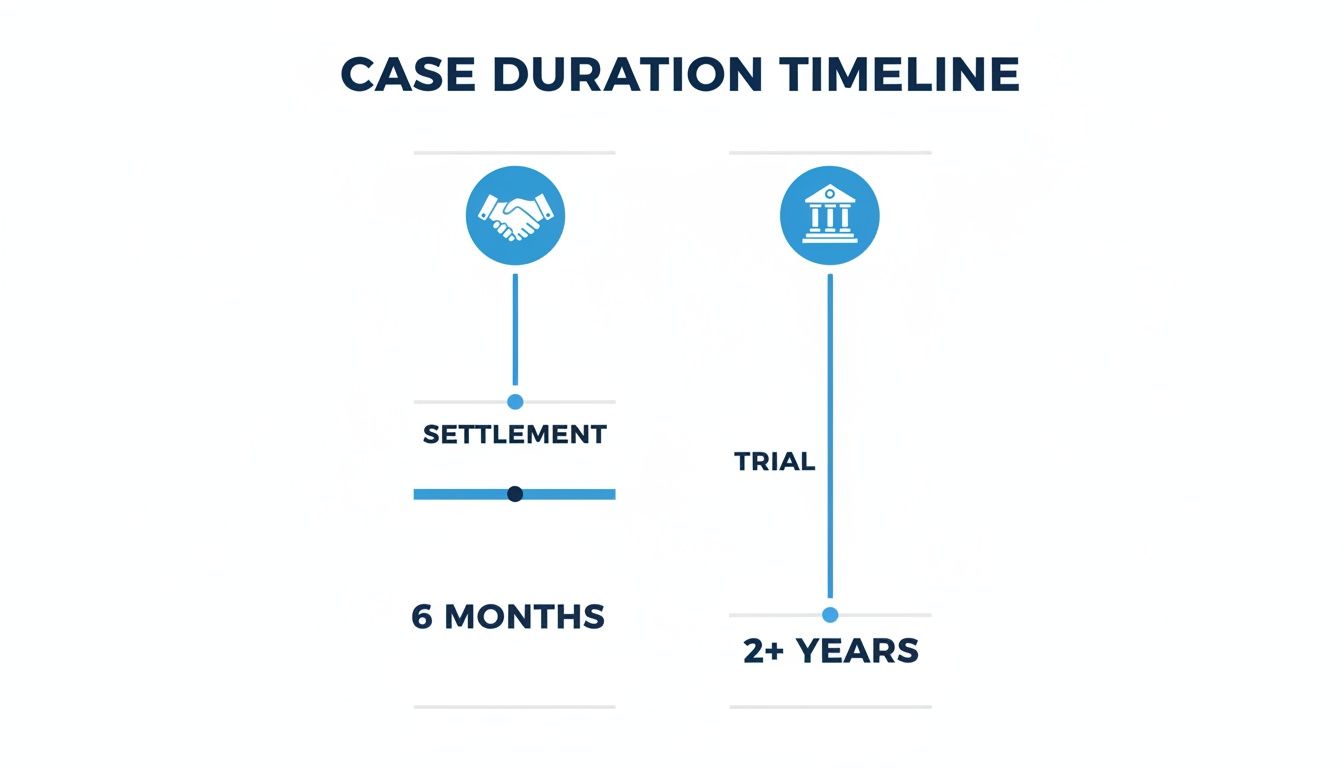
As you can see, a settlement brings closure much, much faster.
The Two Paths: Settlement vs. Trial
The good news is that the vast majority of wrongful termination cases never see the inside of a courtroom. They end in a settlement, which is a formal agreement where your ex-employer pays you compensation to resolve the dispute.
Settlements offer certainty and speed. In fact, solid research shows that around 90% of these cases settle out of court, providing a much quicker resolution than fighting it out until the very end. You can read more about wrongful termination case outcomes to understand the statistics.
A trial is the alternative. It’s the long, expensive, and unpredictable path where you present your case to a judge or jury. This route involves several time-consuming phases, each adding months to the clock:
- Administrative Filings: The required first step with agencies like the EEOC.
- Discovery: A lengthy period where both sides exchange evidence, documents, and testimony.
- Pre-Trial Motions: Legal arguments filed with the court that can delay or even dismiss parts of a case.
- Trial and Appeals: The main event, followed by the potential for appeals, which adds even more time.
To give you a clearer picture, let's break down what to expect from each path.
Estimated Timeline for Wrongful Termination Cases
The table below provides a rough estimate of how long each stage might take, depending on whether your case is on the settlement track or heading for trial.
| Case Stage | Settlement Path (Approx. Timeline) | Trial Path (Approx. Timeline) |
|---|---|---|
| Initial Investigation & EEOC Charge | 1–2 months | 1–2 months |
| EEOC Investigation | 4–10 months | 6–12 months |
| Filing the Lawsuit | N/A (Settled before suit) | 1–2 months |
| Discovery Process | N/A (Settled before discovery) | 6–12 months |
| Mediation & Settlement Talks | 1 month (Successful) | 1–2 months (Unsuccessful) |
| Pre-Trial Motions & Hearings | N/A | 3–6 months |
| Trial | N/A | 1–2 weeks |
| Appeals | N/A | 12+ months |
| Total Estimated Time | 6–12 Months | 24–36+ Months |
Remember, these are just estimates. A case can settle at any point—even on the courthouse steps right before a trial begins. However, this breakdown shows why we always explore settlement first. It’s the most efficient way to get you fair compensation and help you move forward.
Your First Step: Filing an EEOC Charge

If you’ve been wrongfully fired in Mississippi because of illegal discrimination—like your race, sex, age, religion, or a disability—you can’t just march into a courthouse and file a lawsuit. The journey has a mandatory first stop. You are required to begin by filing a formal Charge of Discrimination.
This charge gets filed with the U.S. Equal Employment Opportunity Commission, better known as the EEOC. Think of the EEOC as the official starting gate. Because Mississippi does not have its own human rights commission to handle these claims, the federal EEOC is the body tasked with enforcing anti-discrimination laws for all of us here.
Skipping this step isn't an option. It’s a legal requirement that protects your right to sue your former employer down the road. Filing the charge is what gets the ball rolling.
The Critical EEOC Filing Deadlines
When it comes to filing your charge, the clock is your biggest enemy. It starts ticking the very day you're fired, and the deadlines are incredibly strict. If you miss them, you could lose your right to bring a case forever, no matter how strong it is.
You absolutely need to be aware of these timeframes:
- The 180-Day Rule: For the vast majority of discrimination claims in Mississippi, you have exactly 180 days from the date you were terminated to file your charge with the EEOC. This is not a suggestion; it's a hard deadline.
- The 300-Day Exception: While the deadline can sometimes be extended to 300 days in a few specific situations, it's very risky to assume this applies to you without getting advice from a lawyer.
The single best thing you can do is act fast. Waiting puts your entire case in jeopardy. Calling an attorney right after being fired is the surest way to make sure these critical deadlines are met.
Once your charge is on file, the EEOC officially notifies your old boss. From there, the agency kicks off its own review, which is the next stage of the process. You can get a much deeper look into what that part of the journey looks like in our guide to the EEOC investigation process.
Navigating the EEOC Investigation and Mediation
After you file your Charge of Discrimination, the EEOC takes the reins. From here, your case will typically go down one of two roads: a formal investigation or a voluntary mediation. The path your case takes will have a huge impact on how long this initial stage lasts, so it's good to know what to expect with each.
Most of the time, your case will head straight into an EEOC investigation. Think of the EEOC as a neutral referee. Their job is to gather facts from both sides to see if there's reason to believe discrimination occurred. They'll start by asking your former employer for a formal response, called a "Position Statement," which is the company's official side of the story.
From there, the investigator might request documents, conduct interviews with you, and talk to your old boss or coworkers. This isn't a quick process. The reality is that the EEOC is swamped with cases, and they have limited staff. A standard investigation can easily take six months to a year, and sometimes even longer. Your role during this waiting period is simple: be responsive and work with your attorney to provide any information the investigator needs.
The Faster Route: EEOC Mediation
There is, however, a potential shortcut. The EEOC might offer you and your former employer the chance to try mediation. This is a completely voluntary and confidential meeting where a neutral third party—the mediator—helps you and the company try to negotiate a settlement.
The goal of mediation isn't to decide who was right or wrong. The only objective is to see if you can find a middle ground and resolve the case right then and there. This is often a huge opportunity to speed things up.
- It's Fast: You can often get a mediation session scheduled within a few months of filing your charge. This means you could have a resolution before a formal investigation even gets off the ground.
- It's Informal: This isn't a courtroom drama. It’s a structured conversation designed to find a solution, which makes it far less stressful than a formal hearing.
- You're in the Driver's Seat: Nothing happens without your approval. You and your lawyer have the final say on accepting or rejecting any offer. If you can't reach a deal, no harm done—your case just goes back in line for a standard investigation.
Mediation is often the first and best chance to settle a wrongful termination claim quickly. It puts you in a position to secure a financial settlement and get closure without the drawn-out uncertainty of a full investigation and a possible lawsuit.
Comparing the Two Paths
So, do you wait out the long investigation or push for the quicker mediation? It’s a strategic decision. An investigation builds a formal record of evidence, but it demands a lot of patience. Mediation, on the other hand, is like an express lane to a potential settlement. To see what this process looks like in more detail, feel free to read our guide on how to prepare for mediation.
Your attorney will help you weigh the pros and cons for your specific case. But if the employer shows any willingness to talk, trying mediation is almost always the smarter, more efficient move. It could save you many months of waiting and worrying.
Filing a Lawsuit and Entering the Discovery Phase

If the EEOC investigation doesn't result in a settlement, the agency will close its file on your case. When that happens, they’ll mail you a document called a "Notice of Right to Sue." Think of this letter as the official green light to take your fight from the administrative level to the federal court system.
But that green light comes with a very firm expiration date. You have exactly 90 days from the date you receive that letter to file your lawsuit. This is a hard, non-negotiable deadline. If you miss that 90-day window, you lose your right to sue in federal court, and your case is essentially over before it even begins.
This is where having an experienced attorney becomes absolutely critical. They ensure all the complex paperwork is filed correctly and, most importantly, on time. Federal court is the primary place where these employment cases are heard.
The Longest Stage Begins: The Discovery Process
Once your lawsuit is on file with the court, your case officially enters what is almost always the longest and most demanding phase of the entire journey: discovery. It's the number one reason these cases take time. Realistically, you can expect the discovery phase to last anywhere from six months to well over a year.
Discovery is basically a legally-mandated show-and-tell. Both sides are required to turn over all the information and evidence they have that's relevant to the case. For your attorney, the goal is simple: to dig deep and build a powerful, fact-based story that proves your claim while poking holes in the employer’s defense.
This isn’t a friendly chat or an informal exchange of notes. It’s a formal process guided by strict court rules, and it involves some very specific legal tools to get the job done.
What Happens During Discovery
During the discovery phase, your attorney will methodically work to uncover every document, email, text message, and company policy connected to your termination. It’s a meticulous evidence-gathering mission that typically includes a few key components.
- Interrogatories: These are written questions your attorney sends to your former employer. The company is legally required to answer them in writing and under oath.
- Requests for Production of Documents: This is a formal demand for physical evidence. We're talking about your complete personnel file, performance reviews, emails between your managers, and even disciplinary records for other employees.
- Requests for Admission: These are simple, direct statements that the employer must either admit or deny. This helps us lock in certain facts and narrow down what's actually in dispute.
- Depositions: This is often the most revealing part of discovery. It’s where your attorney gets to question key people—like your old boss, HR staff, and coworkers—under oath, with a court reporter transcribing every word.
The discovery process is where the truth usually surfaces. We get to see behind the curtain and look at the company's internal communications and practices. This is where we find the hard evidence needed to build leverage for a fair settlement.
This phase takes a while because there are often fights over what evidence is relevant and what the other side has to turn over. But a thorough discovery process is absolutely essential. It’s the foundation upon which a strong case is built, and it’s a necessary step before any serious settlement talks or a trial can happen. To get a better sense of this part of the process, you can learn more by reading our guide on how to prepare for a deposition.
Surviving Pre-Trial Motions and Final Negotiations

Just when you think the long process of discovery is finally over, your case enters what is often its most decisive phase before trial. This is where your former employer’s legal team will try to land a knockout punch to get your case thrown out completely.
Their weapon of choice is a Motion for Summary Judgment.
Think of this motion as the employer’s formal argument to the judge, saying, "Even if you believe every piece of evidence the plaintiff has gathered, it's still not enough to win. The law is on our side, so there's no need for a trial." It’s a very serious legal maneuver that can easily add several months to your case's timeline.
Your attorney's role here is critical. We have to fire back with a powerful, evidence-rich response that shows the judge exactly why a jury needs to hear your story. We meticulously lay out the disputed facts and legal arguments that prove your case has merit. Once both sides have filed their briefs, it becomes a waiting game for the judge's ruling.
The Make-or-Break Moment
That waiting period can be nerve-wracking, but when the judge denies the employer's motion, it’s a massive victory. It’s the court’s way of saying that your case is strong enough and has a legitimate chance of success at trial. This single decision completely changes the dynamic of the entire case.
Suddenly, the employer is staring down the barrel of a public, expensive, and unpredictable jury trial. This is the moment the pressure truly mounts, and it’s often when we see the most serious settlement talks begin. Defeating the summary judgment motion gives your lawyer tremendous leverage to negotiate a much more favorable settlement for you.
The vast majority of cases that survive summary judgment settle before trial. An employer's risk skyrockets at this point, making a guaranteed settlement far more appealing than the unpredictable outcome of a jury verdict.
If, for some reason, a settlement can't be reached, your case gets put on the court's trial docket. In reality, though, very few cases ever make it to a courtroom. The sheer cost, time, and emotional toll of a trial push most people toward finding a resolution beforehand.
The Final Stretch: Trial and Appeals
For that tiny fraction of cases that don't settle, the last leg of the journey involves the trial itself and the possibility of appeals. While the trial might only take a few days or a week, the preparation leading up to it is incredibly intense for everyone involved.
And even after a jury delivers a verdict, it might not be the end of the road. The losing side almost always has the right to appeal the decision to a higher court. It’s important to understand that an appeal isn't a do-over; it’s a complex legal argument focused on whether the trial judge made a significant legal error that affected the outcome.
The appeals process can drag things out for another one to two years. This extra time, expense, and uncertainty is yet another powerful incentive for both sides to settle, even after a trial is over. The finality of a settlement starts to look very good compared to several more years of litigation.
How an Experienced Attorney Changes the Game
Trying to handle a wrongful termination claim on your own is, to put it mildly, a tough road. It's not just about filling out paperwork; it's a strategic battle against an employer who has a legal team on their side. Bringing in an experienced employment lawyer isn't just helpful—it completely changes the dynamic of your case.
A good lawyer knows the playbook. They've seen the defense tactics employers use time and time again. They know which deadlines are critical, what evidence actually matters, and how to shut down the delay tactics companies often use to wear you down and make you give up. Their job is to move your case forward with purpose and strength.
The Numbers Don't Lie: A Lawyer's Impact on Your Bottom Line
This isn't just a feeling; we have hard data to back it up. The difference between having a lawyer and going it alone is stark. Research shows that about 64% of employees who hired legal counsel received some form of compensation. For those who represented themselves, that number plummets to just 30%.
The financial gap is even more telling. The average payout for those with a lawyer was $48,800. For those without? Only $19,200. You can read more about these wrongful termination case findings to see the full breakdown.
An attorney's job is to get you the best possible result, as quickly as possible. Your goal becomes their goal, whether that means negotiating a powerful settlement out of court or taking the fight to a jury.
But How Can I Afford a Lawyer?
This is the number one question we get, and the answer brings a lot of relief. Nearly all reputable employment attorneys in Mississippi work on a contingency fee basis.
What does that mean for you?
- No upfront costs. You don't pay anything out of pocket to hire the firm.
- The lawyer gets paid when you get paid. Their fee is a percentage of the money they recover for you, either from a settlement or a court verdict.
- No win, no fee. If your case is not successful, you owe zero attorney's fees.
In Mississippi, this fee is typically 40-50% of the recovery. This arrangement aligns our interests perfectly—we are fully invested in getting you the maximum compensation because our success is tied directly to yours.
Frequently Asked Questions About Case Timelines
After walking through the typical stages of a wrongful termination claim, you probably still have some practical questions about how it all plays out in the real world. Let's dig into some of the most common concerns we hear from workers in Mississippi.
Can I Speed Up My Wrongful Termination Case?
While you can't force the legal system to move faster, you absolutely have a role to play in keeping your case on track. The best thing you can do is be organized and incredibly responsive. When your lawyer asks for documents or information, getting it to them quickly prevents unnecessary logjams.
But frankly, the single most impactful thing you can do is hire a skilled employment lawyer right from the start. An experienced attorney knows the delay tactics employers use and can proactively shut them down. They know how to manage the evidence-gathering phase efficiently and put you in the best position to secure a strong, early settlement if that's your goal.
Does Settling Mean My Claim Was Weak?
Not at all. In my experience, it’s usually the exact opposite—settling is often a direct result of having a strong claim. The overwhelming majority of strong wrongful termination cases end in a settlement, not a dramatic courtroom verdict.
A settlement isn't a surrender; it's a strategic business decision. It locks in a guaranteed financial recovery and lets you avoid the enormous stress, expense, and total uncertainty of a jury trial. It gives you closure and allows you to move on with your life much, much sooner.
What Are the Biggest Causes of Case Delays?
Hands down, the discovery phase is the most time-consuming part of any lawsuit. This is where both sides exchange evidence, and it can easily stretch from six months to over a year. The process often gets bogged down in legal fights over what documents or testimony have to be turned over.
Another common bottleneck happens when an employer files a motion for summary judgment. This is a legal maneuver asking the judge to dismiss your case without a trial. Once all the arguments are filed, everything grinds to a halt while you wait for the judge to rule, which can take several months.
If you feel you were fired unfairly, don't let time slip away. The team at Nick Norris, P.A. is here to defend the rights of Mississippi workers and give you the straightforward advice you deserve. Contact us today to understand your legal options and start building your case.
This article has been reviewed for legal accuracy by Nick Norris. For employment law matters in Mississippi, consult with an attorney licensed to practice in your state.
Leave a Reply