

How to Prepare for Deposition in a Mississippi Employment Case: Essential Guide
Preparing for a deposition is one of the most important things you’ll do in your employment case. It’s not just about reviewing documents or knowing the facts; it’s about learning how to tell your story clearly and consistently under oath. Your success on this day hinges almost entirely on thorough preparation.
Why Your Deposition Is a Decisive Moment in Your Employment Case
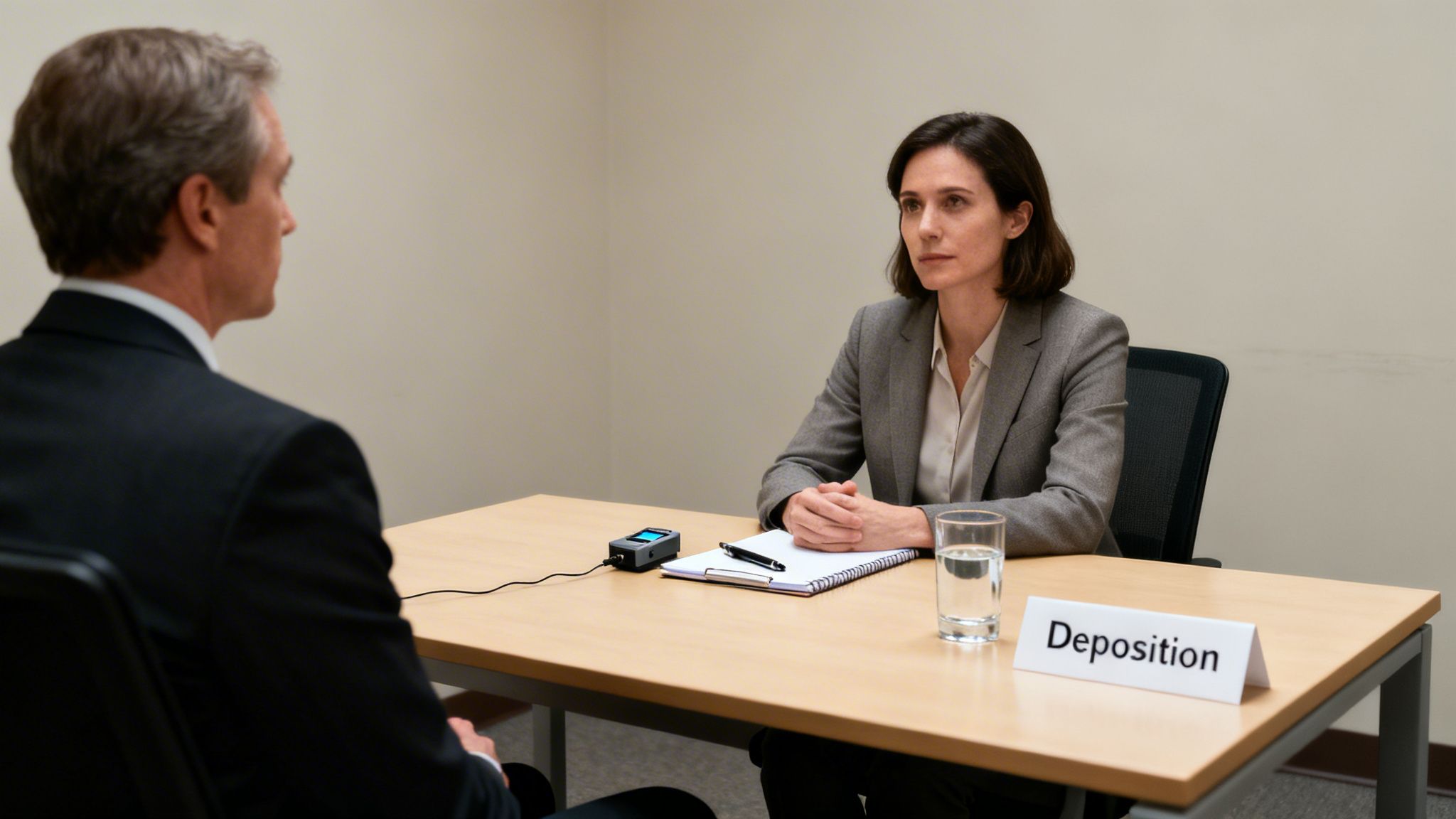
Many people mistakenly see a deposition as just another pre-trial meeting. It’s not. For anyone involved in a Mississippi employment lawsuit, whether it’s for wrongful termination or discrimination, this is a pivotal moment where your case can gain serious momentum—or lose it.
From the other side of the table, your former employer’s attorney has two main goals. First, they want to hear your side of the story, in your own words. But just as importantly, they are sizing you up. They’re trying to figure out if a jury would find you believable, sympathetic, and credible.
Key Takeaway: A strong, honest, and consistent performance during your deposition can dramatically improve your chances of reaching a favorable settlement. The other side is evaluating not just the facts, but the strength of the witness presenting them.
The Purpose and Impact of Your Testimony
Think of the deposition as the opposing attorney’s chance to “test drive” your case before a potential trial. They want to pin you down on every detail and lock you into a specific version of events. Every word you say is recorded, creating an official transcript that can and will be used to challenge you later if your story changes even slightly. This is exactly why learning the ropes of deposition prep isn’t just a good idea—it’s absolutely essential.
This guide is designed to pull back the curtain on the deposition process for Mississippi employees. We’ll walk through practical, real-world strategies for:
- Working with your attorney to build a solid game plan.
- Handling the tricky questions designed to throw you off balance.
- Conducting yourself professionally on the day of your testimony.
The Rising Stakes in Employment Litigation
The importance of a solid deposition is only growing. Federal employment lawsuits have been on the rise, with filings climbing from 20,895 in 2022 to 25,367 in 2026. As more employees stand up for their rights, the pressure to present a compelling case from day one has intensified.
The data backs this up. Studies have found that deponents who put in 4-6 hours of targeted practice with their lawyer can cut down on damaging contradictions by as much as 70%. That kind of preparation transforms your testimony from a liability into a cornerstone for a successful outcome. You can read more about the impact of these employment litigation trends on cases like yours.
Building a Winning Strategy with Your Attorney
Your deposition is far too important to go into unprepared. Think of the meetings with your lawyer beforehand as your playbook sessions. This is where you and your attorney get on the same page, turning a collection of facts into a clear, compelling story for your case.
This isn’t just about memorizing a timeline. It’s about strategy. Your lawyer is trained to spot the central theme that will drive your case home—whether it’s a relentless pattern of harassment, the clear-cut retaliation you faced after reporting an issue, or a blatant FMLA violation.
Nothing Is Off-Limits: The Need for Total Honesty
To build that winning strategy, you have to be an open book with your lawyer. This is a judgment-free zone. No detail is too small, too embarrassing, or too damaging to share—especially the things you’re worried might hurt your case.
Your attorney works for you. Their job is to anticipate every angle the other side will use to attack your story and your credibility. By getting ahead of any potential “weak spots,” you strip away the element of surprise and give your lawyer the tools they need to defend you effectively.
The biggest mistake I see clients make is hiding a “bad fact”—like a previous disciplinary write-up or a personality clash with a coworker. The truth is, hiding it is what does the real damage. It hands the other side a “gotcha” moment. Telling your lawyer everything lets you frame the narrative on your own terms.
For instance, let’s say you were written up for being late a year before you were fired. Don’t hide it. The company’s lawyers will absolutely find that record and try to paint you as a problem employee. When you tell your own attorney, they can prepare. They can be ready to show how that single incident had nothing to do with the string of excellent performance reviews you received right before your termination. For more on this crucial relationship, check out our guide on what to expect during your first talk with an employment lawyer.
Practice Makes Perfect: The Mock Deposition
One of the best ways to get ready is to run through a dress rehearsal. Your attorney will almost certainly want to conduct a “mock deposition” (sometimes called a “murder board” session). This is where your lawyer steps into the shoes of the opposing counsel and hits you with the tough questions you’re bound to face.
These practice runs are incredibly valuable. They help you:
- Get used to the rhythm of question, pause, and answer.
- Learn to be concise and resist the natural urge to over-explain or volunteer information.
- Build confidence by facing the hardest questions in a safe, controlled setting before the real thing.
A good strategy also covers the nuts and bolts. With many depositions now happening over video, your lawyer will make sure the technical side is handled. They will know how to put together an untouchable video conferencing deposition so you can focus on your testimony, not the technology.
Understanding the Financials: Your Attorney’s Role and Fees
It’s also critical to understand how the money side of things works. Here in Mississippi, nearly all employment lawyers handle cases on a contingency fee basis. Simply put, you don’t pay your lawyer out of your own pocket.
Instead, the attorney’s fee is a percentage of the money they recover for you, whether from a settlement or a court verdict. Typically, that fee is between 40-50% of the total recovery.
This system is a huge benefit for employees. It means your lawyer’s financial interests are directly tied to yours—they only get paid if they win your case. This gives you access to justice without facing crippling hourly legal bills. Since Mississippi does not have a human rights commission to investigate these claims, a skilled lawyer is your best and often only path to holding an employer accountable in federal court. Don’t hesitate to ask your attorney to clarify any questions you have about their fee agreement during your prep sessions.
2. Mastering Your Documents and Timeline of Events
Think of every email, text message, performance review, and company policy as a brick in the foundation of your case. The opposing attorney’s job is to find cracks in that foundation. They will come to your deposition armed with every single one of these documents, hoping to catch you in a contradiction or trip up your memory.
Your job, with my help, is to build an unshakable case. That means knowing your story and the documents that back it up, cold.
This isn’t about memorizing thousands of pages. It’s about understanding the key evidence and how it fits together. The entire preparation process really boils down to three core activities we’ll do together.
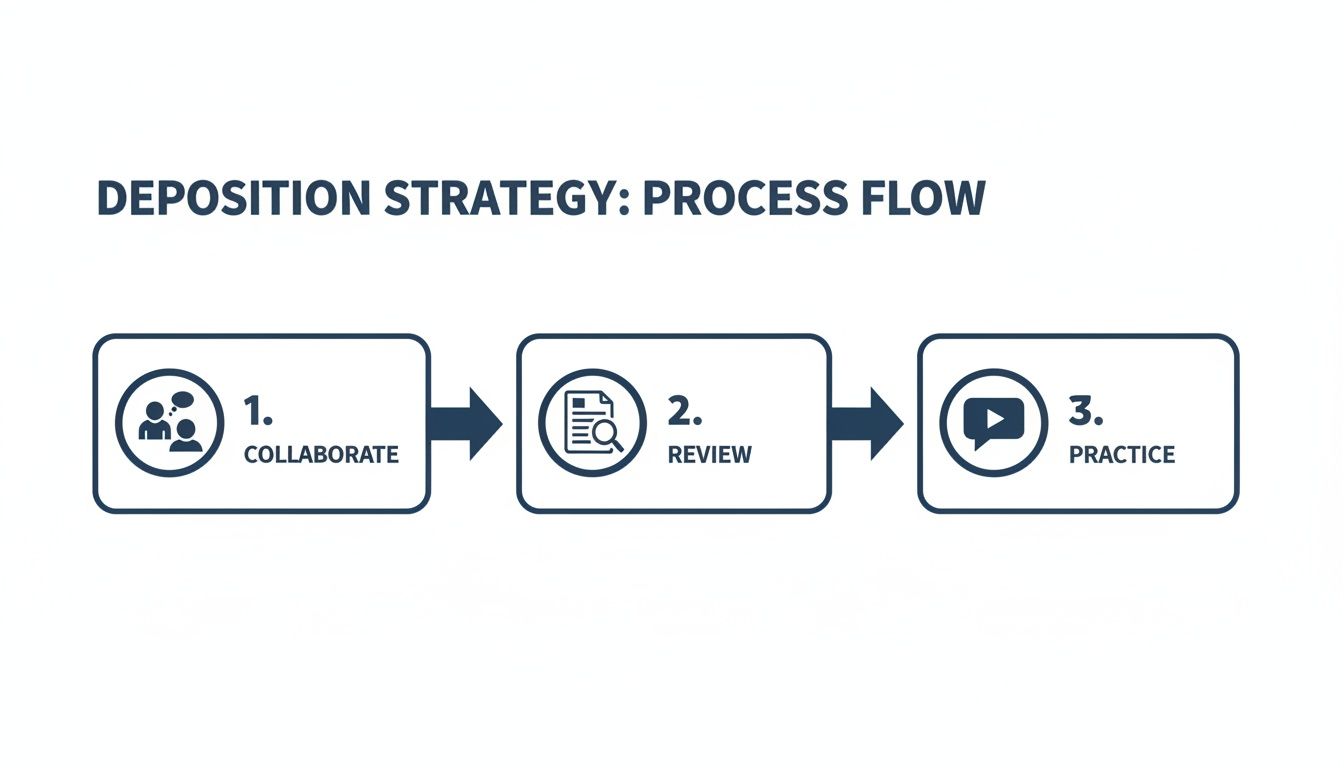
We’ll work as a team to turn a potentially overwhelming pile of paper into a clear, consistent story that you can tell with confidence.
Build a Rock-Solid Chronology
The first thing we’ll do is create a master timeline of events. This becomes your roadmap for the entire deposition, keeping your testimony grounded in specific, verifiable facts. It’s surprisingly easy to get dates mixed up under pressure, and this timeline is your defense against that.
We’ll start with the big picture—your hire date, job titles, and who you reported to. Then, we get granular, adding in every critical event that led to your lawsuit.
For a wrongful termination case, this might include:
- Dates of positive performance reviews or awards.
- The specific day you reported harassment or illegal conduct.
- The date of any retaliatory write-up.
- The day you were fired and the reason they gave you.
This chronology isn’t just a list; it’s the narrative of your case. It ensures you can recall events accurately and powerfully when it matters most.
Essential Document Checklist for Your Deposition Prep
To build a consistent, fact-based testimony, we need to gather and review all the key documents. This table outlines what we’ll be looking for and why each piece is so crucial for your preparation.
| Document Category | Specific Examples | Why It’s Important |
|---|---|---|
| Communications | Emails, text messages, Slack/Teams messages with supervisors, coworkers, or HR. | These often contain the “smoking gun” evidence of discrimination, retaliation, or admissions. |
| Performance Records | Official performance reviews, letters of commendation, awards, positive feedback emails. | This evidence directly counters any argument from the company that you were a poor performer. |
| Disciplinary Actions | Any write-ups, verbal warnings, or performance improvement plans (PIPs). | We need to know about these upfront to prepare a response and show how they were pretextual or unfair. |
| Company Policies | Employee handbook, code of conduct, anti-harassment policies, termination procedures. | This shows the rules the company was supposed to follow, which we can compare to what they actually did. |
| Personal Notes | Your own logs or journals detailing incidents, dates, and conversations. | Your personal, contemporaneous notes can be powerful for refreshing your memory and establishing a timeline. |
Gathering these documents is a team effort. You’ll have access to personal notes and messages, while I will formally request your complete personnel file and other records from your employer. Being organized from the start makes our job much easier.
Connect the Dots: Turn Documents Into a Story
Simply reading the documents isn’t enough; you have to see how they connect to tell your story. An email from your boss praising your project on a Friday becomes incredibly powerful when they fired you for “poor performance” the following Monday. That’s not just a document; it’s evidence of pretext.
During our prep sessions, I’ll ask questions designed to forge these connections: “The company handbook says they follow a progressive discipline policy. Where in these documents did they give you a verbal warning before this write-up?” Knowing the answer to that question is critical, especially when dissecting the company’s version of a workplace investigation process.
Expert Tip: Don’t be afraid of the “bad” documents. If you have a mixed performance review or an email where you complained about a project, that’s okay. We need to face these head-on. The key is to be prepared to explain the context honestly and prevent the other side from surprising you with them.
In Mississippi, building this fact-based case is even more critical because Mississippi does not have a human rights commission to do the initial investigation for you. Your case will likely be in federal court, where the strength of your documented evidence is everything. That’s why we put in this hard work. The attorney’s contingency fee—often 40-50% of any recovery—is earned by meticulously preparing you and your case for success. There are no shortcuts.
The Ground Rules for Answering Questions Under Oath

Let’s talk about what happens inside the deposition room. The air can feel heavy. You’ll have the company’s lawyer staring you down, a court reporter transcribing every sound, and your own attorney watching intently. This is the moment all your preparation was for. It’s your chance to answer questions honestly and strategically, without accidentally handing the other side ammunition.
Think of these as the fundamental rules of the game. Internalizing them will help you stay in control and protect your story.
Listen Carefully and Answer Only What Is Asked
This is the golden rule, and it’s also the one people break constantly. It’s human nature to want to be helpful, to explain, to fill in the silent gaps. In a deposition, you have to fight that instinct. Your job isn’t to tell a story; it’s to provide truthful, narrow answers to the exact questions asked.
If the opposing lawyer asks, “Did you speak with Mr. Smith on Tuesday?” your answer is “Yes,” “No,” or “I don’t recall.” It is absolutely not, “Yes, and he told me that he was planning to…” Volunteering extra information is the most common and damaging mistake you can make.
A Pro Tip From Experience: Always let the lawyer finish their entire question before you even start thinking of an answer. Don’t jump ahead. A lawyer might start a question one way and then tack on a twist at the end designed to trip you up.
For example, they might ask a loaded question like: “You’d agree your performance wasn’t perfect, right?” A quick “yes” creates a soundbite they can use against you. It’s better to pause, recognize the trap in the word “perfect,” and give a more precise answer like, “I always performed my job to the best of my ability.”
The Power of the Pause
The most powerful tool in your arsenal isn’t a document or a fact—it’s silence. After the other lawyer asks a question, take a deliberate pause. Breathe. Give it two or three seconds before you say a word.
This simple technique does three critical things for you:
- It lets you actually process the question. You can make sure you understand precisely what they’re asking before you’re locked into an answer.
- It gives your lawyer a chance to object. That pause is the window your attorney needs to jump in and stop you from answering an improper question.
- It shatters the other lawyer’s rhythm. Rapid-fire questions are a classic tactic to make you rush and stumble. Pausing forces them onto your timeline, not the other way around.
Never, ever feel rushed. This is your testimony. You set the pace.
Three Powerful Phrases to Remember
You won’t have a perfect memory of every single detail, and that’s okay. Honesty about what you don’t know is far better than a guess that can be proven wrong. These three phrases are your best friends:
- “I don’t know.” If you genuinely don’t know the answer, this is a complete and perfect response. Don’t guess. Don’t speculate. Just say you don’t know.
- “I don’t recall.” This is for when you might have known the information once but can’t bring it to mind at this moment. It’s different from a flat “I don’t know.”
- “Can you rephrase the question?” If a question is confusing, long-winded, or vague, don’t try to decipher it. Make the lawyer do their job and ask a clear question.
Using these phrases isn’t a sign of weakness—it’s the mark of a well-coached witness who is committed to accuracy. Remember, a guess can be disproven, but an honest “I don’t recall” is rock-solid.
In Mississippi, where Mississippi does not have a human rights commission to vet your case first, the credibility you build in this federal deposition is everything. Your lawyer is your advocate, but they can’t testify for you. By sticking to these ground rules, you deliver clean, truthful testimony that strengthens your case. Since your attorney is likely working on a contingency fee, often 40-50%, your strong performance is a direct investment in the successful outcome you’re both fighting for.
How to Handle Common Deposition Traps and Tactics
While your deposition is about giving truthful testimony, it’s not a friendly chat. The opposing counsel’s entire job is to poke holes in your story and frame the facts in a way that helps their client—your former employer. They are trained professionals who have a whole playbook of questioning tactics designed to trip you up.
Knowing their game plan is your best defense. Once you can spot these tactics, you can see them for what they are and respond calmly and factually, without getting pulled into an emotional reaction.
The Overly Friendly Lawyer
Don’t be surprised if the lawyer starts out acting like your new best friend. They might ask about your kids, where you went to school, or your favorite SEC team. This isn’t just small talk; it’s a calculated move to get you to lower your guard.
When you feel comfortable, you’re more likely to start volunteering information, sharing opinions, or just plain talking too much. Remember, no matter how nice they seem, the opposing lawyer is not on your side. Be polite, but keep it professional. Answer the question asked, then stop talking.
The Aggressive Questioner
On the flip side, some lawyers use intimidation. They might talk over you, ask rapid-fire questions, raise their voice, or even suggest you aren’t being truthful. The goal is simple: to make you angry, nervous, and defensive.
If you let them get under your skin and start arguing, you’ve already lost. The absolute best response is to stay calm. Your attorney is right there to protect you if things get out of hand, but your own composure is your most powerful tool. A quiet, factual answer in the face of their aggression makes them look like a bully.
A classic tactic is asking the same question over and over, just phrased a little differently each time. They’re hoping to catch you in a contradiction. Don’t fall for it. If your answer was true the first time, it’s still true the fifth time. Just give the same consistent, truthful answer.
Vague and Sweeping Questions
Watch out for questions that are so broad they’re impossible to answer accurately. These are traps designed to get you to speculate or ramble, potentially saying something you’ll regret.
You might hear questions like:
- “Tell me everything that happened on March 15th.”
- “Were you always on time for work?”
- “Did anyone else complain about that manager?”
Trying to answer “tell me everything” is a recipe for disaster. A much better approach is to put the ball back in their court by saying something like, “Can you be more specific about what you’d like to know?” For a question like “Were you always on time?”, a simple “yes” can be problematic. A stronger answer is, “I always did my job to the best of my ability.”
Questions About Your Legal Case
The other lawyer will almost certainly ask you what you’ve discussed with your attorney. You should never, ever reveal the specific advice your lawyer has given you. That information is completely protected by the attorney-client privilege.
You may also be asked about your financial arrangement with your lawyer. In Mississippi, it’s common knowledge that employment lawyers work on a contingency fee basis, so there’s no need to be secretive about it. It’s fine to state that your attorney is working on a contingency fee and, if asked, that you believe the fee is in the standard range, which is often 40-50%. Keep the answer brief and don’t elaborate.
It’s important to understand just how high the stakes are for your deposition. Because Mississippi does not have a human rights commission to screen employment cases, most lawsuits go directly to federal court. This makes your deposition the primary event where the other side gets to see you, hear your story, and decide how credible you are. A strong, prepared performance here is absolutely essential to getting the justice you deserve.
What to Expect After Your Deposition Is Over
The deposition is done. You can finally take a deep breath. That feeling of relief is completely normal, but your job isn’t quite finished. What happens next is just as important for making sure all your hard work pays off.
Reviewing Your Deposition Transcript
Soon after the deposition, a court reporter will turn every word from the session into an official written document—the transcript. Understanding the role of transcription in legal proceedings really highlights how this document becomes the official, locked-in version of your testimony.
My team and I will get a copy, and so will you. Your task is to read it. Every. Single. Word. You’re hunting for errors—a misspelled name, a mixed-up date, or even a sentence that was written down in a way that changes its meaning. We’ll list any corrections on a document called an errata sheet, which you’ll sign. This sheet then becomes an official part of your testimony.
Crucial Reminder: I tell every client this: do not sign off on that transcript until we have reviewed it together, line by line. A simple, uncorrected mistake can be twisted and used against you later. Accuracy is everything here.
What Happens Next in Your Case
Once finalized, your deposition transcript becomes one of the most powerful pieces of evidence in your case. The other side will comb through it, looking for strengths and weaknesses. I’ve seen it time and again: a strong, consistent deposition is often the final push that brings the defense to the table for serious settlement talks.
Your testimony gives us incredible leverage. We’ll use it to craft legal arguments and plan our next move, whether that’s pushing for a great settlement or gearing up for trial.
If the case does move toward settlement, you’ll be heading into a different type of meeting altogether. You can get a head start by reading our guide on how to prepare for mediation.
Finally, we’ll sit down and debrief. It’s a chance for you to process everything and for us to talk about how the deposition went and what it means for our strategy moving forward in your fight for justice.
Your Mississippi Deposition: Answering Common Questions
As you get ready for your deposition, a lot of questions are probably running through your mind. It’s completely normal. Let’s walk through some of the most common concerns I hear from clients in Mississippi so you know exactly what to expect.
How Long Will This Actually Take?
This is usually the first thing everyone wants to know. While there’s no single answer, most employment depositions last anywhere from a few hours to a full day.
Federal court rules generally cap a deposition at one day of seven hours. But the real-world time depends on the specifics of your case—how complex your claims are, the number of documents, and frankly, how the other attorney likes to operate. We’ll talk it over and I’ll give you a more precise estimate based on what we’re facing.
What Should I Wear?
My best advice is to dress like you’re going to court. Think business casual—something you’d wear to a professional job interview. You want to look credible and show that you’re taking this seriously.
Stay away from casual clothes, anything with big logos, or t-shirts with slogans. Your deposition will likely be videotaped, and that recording becomes a permanent part of your case. Your appearance matters.
What If I Get Emotional?
Discussing harassment, discrimination, or being fired is tough. Emotions are a natural part of that. If you start to feel overwhelmed or find yourself getting upset, that’s okay.
The most important thing to do is ask for a break. Just say, “I need to take a moment.” We can pause the deposition, you can step out, gather your thoughts, and come back when you’re ready. Never feel pressured to push through tears or anger.
Your job is to provide clear, factual answers. Taking that short break helps you reset so you can answer the question that was asked, and only that question, without letting emotion cloud your testimony.
Remember, because Mississippi does not have a human rights commission to hear these cases first, your federal deposition is a make-or-break moment. With your attorney likely working on a contingency fee of 40-50%, a well-prepared and composed testimony is your best tool for moving your case toward a successful outcome.
At Nick Norris, P.A., we are dedicated to helping Mississippi workers understand and protect their rights. If you are facing an employment dispute and need clear, compassionate guidance, contact us for a consultation. Learn more about how we fight for employees.
This article has been reviewed for legal accuracy by Nick Norris. For employment law matters in Mississippi, consult with an attorney licensed to practice in your state.
Leave a Reply