

What Is a Right to Sue Letter in Mississippi?
What Is a Right to Sue Letter? Your Key to Federal Court
Think of the federal courthouse as having a locked door. A Right to Sue letter is the special key that opens it, giving you the official permission you need to file a discrimination lawsuit against your employer.
If you’re a Mississippi employee who has been wronged, understanding this letter—what it is, and just as importantly, what it isn’t—is the critical first step toward getting justice.
Let’s be clear about one thing: receiving this letter doesn’t mean you’ve won or lost your case. It simply means the Equal Employment Opportunity Commission (EEOC) has finished its part of the process. It’s a procedural green light, signaling that your case is now eligible to move forward.
The EEOC’s Role: The First Step to Court
Before you can sue an employer for discrimination under federal laws like Title VII or the Americans with Disabilities Act, you can’t just walk into a courthouse and file a lawsuit. You first have to file a “Charge of Discrimination” with the EEOC. The agency acts as a gatekeeper, investigating workplace discrimination claims nationwide.
Filing that charge is a mandatory first step. When you get a Right to Sue letter, it means you’ve completed that requirement, and the path is now clear for you to take the next one: filing a formal complaint in federal court.
Your Right to Sue letter is your official permission slip to sue. Without it, a federal court will almost certainly throw out your case for “failure to exhaust administrative remedies.” It’s the piece of paper that proves you followed the rules.
Why This Letter Is So Important for Mississippi Workers
This federal process is especially critical for employees here in Mississippi. That’s because Mississippi does not have a statewide human rights commission or a similar fair employment agency to handle these claims.
For most Mississippi workers, the EEOC is the only place to file an administrative charge of discrimination. This elevates the importance of the whole process and makes that final Right to Sue letter the one and only gateway to the courthouse. Understanding the rules tied to this letter isn’t just a good idea—it’s essential.
The Start of a Strict and Unforgiving Clock
Here is the single most important detail on a Right to Sue letter: the deadline. From the day you receive it, an absolute, non-negotiable 90-day clock starts ticking. You have exactly 90 days to file your lawsuit in federal court.
This isn’t a suggestion or a soft deadline. If you miss that 90-day window, even by one day, you permanently lose your right to sue your employer for that specific claim. It doesn’t matter how strong your case is; the court will bar it on procedural grounds.
This unforgiving timeline creates immediate urgency. The moment that letter arrives, you need to act decisively. It’s time to stop waiting and start planning, which usually means contacting an experienced employment lawyer right away.
How the EEOC Process Leads to Your Letter
A Right to Sue letter doesn’t just show up in your mailbox by chance. It’s the key that unlocks your ability to file a lawsuit, and it only comes at the end of a required administrative process. For workers in Mississippi, that journey almost always begins with the Equal Employment Opportunity Commission (EEOC), the federal agency responsible for enforcing our nation’s anti-discrimination laws.
Think of it this way: before you can have your day in court, you first have to “exhaust your administrative remedies.” This starts by filing a formal complaint, called a Charge of Discrimination, with the EEOC. This document is your official statement, detailing who you are, who your employer is, and exactly what happened that you believe was illegal discrimination. Filing this charge is a mandatory first step.
The EEOC’s 180-Day Investigation Period
Once you file your charge, the clock starts ticking. The EEOC legally has 180 days to investigate your claim. During this window, an investigator might interview you, your coworkers, and your managers, as well as request documents and a formal position statement from your employer.
The agency’s main job here is to decide if there is “reasonable cause” to believe discrimination took place. It’s a massive undertaking. To give you some perspective, the EEOC’s intake teams recently fielded over 553,000 calls and handled more than 90,000 emails from workers in a single year. You can see how busy they are and why the process can feel slow. For more data on these trends, legal experts at Hunton Andrews Kurth LLP offer some great insights.
When the investigation wraps up, it usually ends in one of a few ways:
- A “Cause” Finding: The EEOC believes discrimination likely happened. The agency will first try to broker a settlement through a process called conciliation. If that fails, the EEOC has the option to sue the employer on your behalf, but this is quite rare.
- A “No Cause” Finding: The investigator didn’t find enough evidence to support your claim. This is not a final judgment on your case’s value—it’s just the EEOC’s administrative conclusion. You can still proceed with a lawsuit.
- Administrative Closure: The case might be closed for other reasons, like if the agency can’t find you or decides it doesn’t have jurisdiction.
Regardless of the outcome, if the EEOC isn’t going to file a lawsuit itself, it will issue you a “Dismissal and Notice of Rights.” This document is your official Right to Sue letter.
Requesting Your Letter Early: A Strategic Choice
What if you don’t want to wait the full 180 days? You don’t always have to.
The law allows you to ask for your Right to Sue letter early. If it’s clear the EEOC won’t be able to finish its work within the 180-day period (which is often the case), it will typically grant your request. This can be a smart strategic decision, especially if you and your attorney feel you have a strong case and want to get it in front of a judge sooner rather than later. We cover the ins and outs of this in our complete guide to the EEOC investigation process.
The infographic below shows how the entire process flows, from filing your charge to finally getting into court.
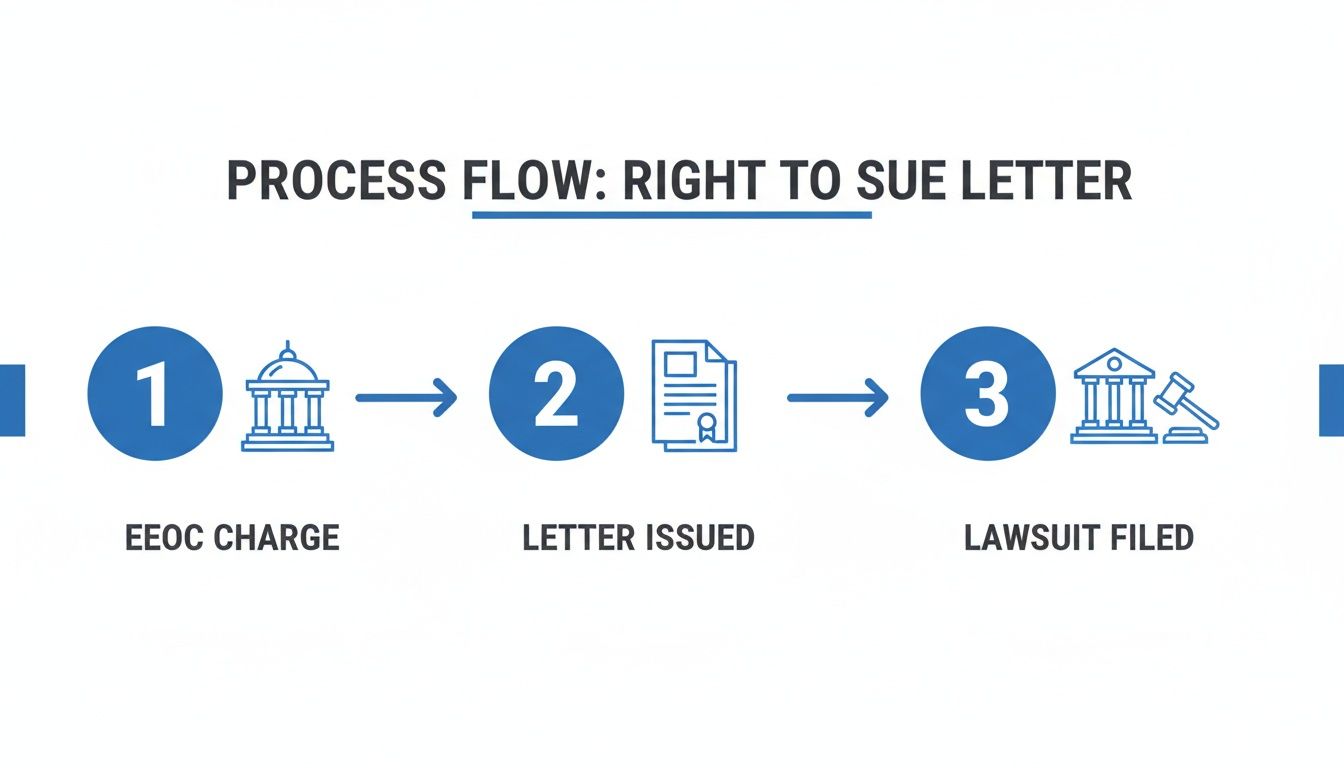
As you can see, the Right to Sue letter acts as the bridge connecting the EEOC’s administrative phase with the litigation phase in federal court. It’s the non-negotiable ticket you need to move your case forward.
The Unforgiving 90-Day Clock: Your Filing Deadline

When your Right to Sue letter arrives, the most critical phase of your case begins. That piece of paper triggers a strict, non-negotiable deadline: you have exactly 90 days to file a lawsuit in federal court.
Let’s be clear: this isn’t a guideline or a suggestion. It’s one of the most rigid deadlines in all of employment law. The countdown starts the moment you receive the letter, not the date it was mailed. This is a crucial detail that has, unfortunately, ended many valid claims before they even started.
Think of it as a gate closing. Once that 90th day passes, the gate to the federal courthouse slams shut on your claim—permanently. It doesn’t matter how strong your evidence is or how blatant the discrimination was. If you miss the deadline, you lose your right to sue that employer in federal court for that issue.
Federal Laws Driving the Deadline
This 90-day filing rule comes directly from the same federal laws that protect you from workplace discrimination in the first place. It’s a mandatory procedural step built into some of the most important worker protection statutes. For most of us here in Mississippi, these federal laws are often the only path to justice.
The key laws include:
- Title VII of the Civil Rights Act of 1964: The foundational law prohibiting discrimination based on race, color, religion, sex, and national origin.
- The Americans with Disabilities Act (ADA): Protects qualified employees with disabilities from unfair treatment.
- The Age Discrimination in Employment Act (ADEA): Shields workers aged 40 and older from age-based discrimination.
This is especially critical because Mississippi does not have its own human rights commission. That means sticking to the federal rules isn’t just a good idea; it’s everything. The 90-day deadline is the key you need to unlock these powerful protections. Keep in mind that different claims have different time limits, so it’s vital to understand the specific employment law statute of limitations that applies to your case.
The Immediate Need for Legal Counsel
The second you have that letter in your hands, you need to act. Your very first call should be to an experienced employment lawyer. An attorney needs time—and a lot of it—to properly review your claim, collect evidence, and draft a formal complaint that will stand up in court.
Waiting until the last minute is a recipe for disaster. A lawyer who gets a call on day 85 simply may not have enough time to prepare and file a solid lawsuit, potentially leaving you with no options at all.
Contacting an attorney right away takes the pressure of a ticking clock and turns it into a manageable timeline for action. It’s the single best thing you can do to protect your rights and ensure your chance for justice doesn’t disappear because the calendar ran out.
Practical Next Steps After You Get the Letter

That letter is now in your hands. The waiting period with the EEOC is over, and you officially have the green light to take your employer to court. What you do next is absolutely critical, because an unforgiving 90-day clock just started ticking.
This isn’t a time for hesitation. Your very first move should be to contact an experienced Mississippi employment lawyer. An attorney needs as much of that 90-day window as possible to evaluate your claim, gather evidence, and draft a solid federal lawsuit before the deadline hits. Waiting even a week or two can put your entire case at risk.
Getting Your Case in Order
While you’re scheduling a consultation, you can get a huge head start by organizing the key pieces of your story. This prep work will make your first meeting with an attorney far more productive and helps them see the strengths of your case right away.
Here’s what you should focus on immediately:
- Build a Timeline of Events: Start from your hire date and work forward. Note every important moment: promotions, positive reviews, the first instance of discrimination, meetings with HR, and your final day of employment. Be as specific with dates as you can.
- Identify Key People (Witnesses): Who saw or heard what happened? List the names and job titles of coworkers, managers, or even customers who witnessed the mistreatment.
- Gather Your Documents: Collect every scrap of paper and every digital file related to your job. This means pay stubs, your employee handbook, performance reviews, emails, termination letters, and any other correspondence you can find.
The Power Is in the Proof
Think of your evidence as the foundation of your legal case. No detail is too small or unimportant at this stage. Your goal is to create a complete, undeniable record of what you experienced.
A personal journal where you wrote down what happened, when it happened, can be incredibly persuasive. Notes jotted down in the moment often carry more weight than memories recalled months later.
Start a binder or a dedicated digital folder to keep everything organized. This simple step shows you’re serious and helps your lawyer get up to speed quickly. Your evidence will likely fall into a few key categories:
- Electronic Communications: Emails, text messages, and workplace chats are often where the most damning evidence is found. Knowing how to print legally admissible text messages from your iPhone for court can be a surprisingly important skill.
- Official Company Paperwork: Your job description, performance improvement plans (PIPs), disciplinary notices, and the official termination letter are all crucial.
- Medical Records: If your case involves a medical condition, disability, or FMLA leave, documentation from your doctor is non-negotiable.
For a complete checklist of what to bring and what questions you should be ready to ask, take a look at our guide on how to prepare for your first talk with an employment lawyer.
What Happens After You Hire a Lawyer?
Once you have an attorney on your side, they’ll handle the complex legal steps. Their first job is to file a formal “Complaint” in federal court—the document that officially begins your lawsuit. The Right to Sue letter is the key that unlocks this door.
With projections for 2026 showing that Title VII and ADA claims could make up 59.5% and 43.2% of filings respectively, having an expert navigate this process is more important than ever.
The Complaint lays out the facts of your case and details how your employer broke federal law. After it’s filed, your former employer is “served” with the lawsuit and must formally respond. This kicks off a phase called “discovery,” where both sides exchange evidence and testimony under oath.
While many cases settle out of court, preparing from day one as if you’re going to trial is the surest way to achieve a fair outcome.
Navigating Your Claim in Mississippi

When it comes to workplace discrimination, understanding the federal process isn’t just a good idea for Mississippi employees—it’s absolutely essential. While many states have their own local agencies that work alongside the EEOC to handle these issues, Mississippi is different.
Here’s a crucial piece of information every Mississippi worker should know: Mississippi does not have a human rights commission or any similar statewide agency for employment discrimination claims. This means for most workplace injustices, your only administrative option is the federal Equal Employment Opportunity Commission (EEOC).
This isn’t just a minor detail. It means every federal rule, especially the one about your Right to Sue letter, carries immense weight. Because there’s no state-level backup, your entire ability to file a lawsuit depends on navigating the EEOC process correctly and meeting that strict 90-day federal deadline.
Your Strongest Protections Are Federal
Without a state agency to turn to, the powerful protections written into federal law become the main line of defense for Mississippi employees. In many cases, these laws are the only legal tool you have to hold an employer accountable for breaking the law.
These federal statutes provide a solid foundation for justice:
- Title VII of the Civil Rights Act: This is the cornerstone, protecting you from discrimination based on race, color, religion, sex, and national origin.
- The Family and Medical Leave Act (FMLA): This act secures your right to take job-protected leave for your own serious health condition or to care for family.
- The Uniformed Services Employment and Reemployment Rights Act (USERRA): This law protects the civilian jobs of our country’s service members.
Think of these laws as your rights, and your Right to Sue letter as the key that unlocks the courthouse doors so you can enforce them.
How Can You Afford to Fight for Justice?
Going up against a company with significant resources can feel daunting, particularly if you’ve recently lost your income. Many people understandably worry about how they could possibly afford a lawyer. But the system has a way of leveling the playing field.
Most experienced employment law firms in Mississippi work on a contingency fee basis. This means you don’t pay any attorney’s fees out of your own pocket. The law firm advances the costs of litigation, and they only get paid if you receive a settlement or a favorable court verdict.
This setup removes the financial risk from your shoulders. A typical contingency fee is between 40-50% of the final recovery, which is an investment that allows you to challenge even the biggest companies on a fair footing. Your case is judged on its merits, not the size of your wallet.
At the end of the day, your Right to Sue letter is more than a piece of paper; it’s your green light. Claims under Title VII of the Civil Rights Act of 1964 are incredibly common in the EEOC system—some estimates suggest they could make up 59.5% of all charges filed in 2026. For Mississippians who have been retaliated against for being a whistleblower or were part of an illegal mass layoff under the WARN Act, getting that letter is the final confirmation that you’ve done what’s required and can now seek real justice. You can find more on these workplace trends in legal news reports at JD Supra.
Your Right to Sue Letter: Answering the Tough Questions
Getting that official Right to Sue letter can be both a relief and a source of new questions. It’s the green light you’ve been waiting for, but it also starts a timer on your rights. Let’s walk through some of the most common questions we hear from Mississippi employees to clear things up.
The EEOC Found No Cause for My Claim. Can I Still File a Lawsuit?
Yes, you absolutely can. This is one of the biggest points of confusion, so let’s be crystal clear: a “no cause” finding from the EEOC is not the end of the road.
All it means is that the agency, with its limited resources, didn’t find enough evidence to sue the employer on your behalf. It is not a final judgment on your case. Your Right to Sue letter gives you permission to take your claim to federal court, where you and your attorney can present your full story to a judge and jury. Many strong, successful employment lawsuits started right here, so don’t be discouraged.
What Happens if I Miss the 90-Day Deadline?
Missing the 90-day filing deadline is, frankly, fatal to your federal claim. If you don’t file a lawsuit in federal court within those 90 days, you lose your right to sue that employer for that specific issue forever.
Courts are incredibly strict about this deadline. It is a hard-and-fast rule with almost no exceptions. This is precisely why it’s so critical to contact an employment attorney the very day you receive the letter. The clock is ticking, and there’s no time to waste.
Can I Request My Right to Sue Letter Early?
Yes, you can request it. If 180 days have passed since you first filed your charge with the EEOC, you have the right to ask for your letter. You can sometimes even get it earlier if the EEOC agrees it won’t be able to finish its investigation within that timeframe.
Requesting it early can be a strategic decision. If you and your lawyer feel that waiting won’t help your case, moving forward to court might be the right call. Just remember: the moment you request and receive that letter, your 90-day countdown begins. It’s a move that requires careful consideration with your legal counsel.
Do I Have to Pay a Lawyer Upfront to Take My Case?
No, you shouldn’t have to. Most experienced employment law firms in Mississippi, including ours, handle these cases on a contingency fee basis. This model was created to ensure everyone has access to justice, not just those who can afford to pay a lawyer out of pocket.
Here’s how it works for you:
- No Upfront Fees: You don’t pay a dime in attorney’s fees to get your case started.
- Costs are Covered: The law firm advances all the necessary litigation costs, like court filing fees or paying for depositions.
- We Only Get Paid if You Do: The firm’s fee is “contingent” on winning a settlement or a verdict for you. The fee is a pre-agreed percentage of the amount recovered, typically between 40-50%.
This system levels the playing field. It allows you to stand up to even the largest employers without the constant worry of mounting legal bills. Your case will be judged on its merits, not your bank account.
If you’ve received a Right to Sue letter or feel your rights at work have been violated, you don’t have to figure this out on your own. The team at Nick Norris, P.A. is ready to give you the clear guidance and determined advocacy you deserve. Contact us today to protect your rights and understand your legal options.
This article has been reviewed for legal accuracy by Nick Norris. For employment law matters in Mississippi, consult with an attorney licensed to practice in your state.
Leave a Reply