

Should I Sign a Severance Agreement? A MS Guide
Losing your job is hard enough. Getting handed a severance packet at the same time can make a bad day worse.
Faced with this situation, a pressing question arises: should i sign a severance agreement? My answer is direct. Don’t sign it on the spot. Take the document home, read it carefully, and get legal advice before you give away rights you may never get back.
A severance agreement can help you bridge a gap after termination. It can also lock you into terms that hurt your finances, your job search, and your legal position. In Mississippi, that risk is even sharper because state-law protections are limited, and many workers depend heavily on federal law to protect them.
You Just Lost Your Job and They Handed You a Packet
You go into a meeting expecting a write-up, a restructuring update, or maybe a change in duties. Instead, HR slides a packet across the table and tells you your employment is over. They may say the offer is “standard,” “fair,” or “time-sensitive.” They may tell you signing quickly will make this easier.
That moment rattles people. You’re thinking about your mortgage, your insurance, your next paycheck, and how you’ll explain this at home. Then you’re expected to read legal language that most non-lawyers would struggle to interpret under the best circumstances.

I’ve seen workers focus on the severance number and miss the rest. That’s understandable. But the money is only one part of the deal. The legal language is often the part that matters most.
Practical rule: If your employer wants your signature immediately, that’s a reason to slow down, not speed up.
Some employees start by reading general resources from a severance lawyer to understand the common issues in these contracts. That can help you spot the basic moving parts. But if you work in Mississippi, general advice isn’t enough. The local legal environment changes your negotiating strength and what rights may still matter.
You don’t need to panic. You do need to be disciplined. Put the pen down. Keep the packet. Start asking better questions before you sign away anything.
What a Severance Agreement Really Is
A severance agreement is not a gift. It’s a contract.
Your employer is offering money, benefits, or some other separation terms in exchange for something valuable from you. What they usually want is legal peace. They want you to take the payment and give up claims tied to your employment and termination.
The real trade
The heart of most severance agreements is the release of claims. That clause is the point of the document. As explained by this discussion of severance waivers and legal review, severance agreements operate through a legally binding release of claims clause that functions as a liability shield for employers by requiring employees to waive their right to pursue legal action across multiple claim categories, including wrongful termination, discrimination, harassment, retaliation for whistleblowing, and wage-and-hour violations. Once signed, the employee loses the ability to seek judicial remedy even if the employer violated federal or state employment law.
That means you are not just signing for a check. You are trading legal rights for compensation.
Why that matters in plain English
If your termination was a routine layoff with no illegal conduct behind it, a severance agreement may be worth signing after review and negotiation.
If your termination followed protected medical leave, military service, a complaint about discrimination, a wage dispute, or protected whistleblowing, the document may be far more valuable to your employer than the amount they offered you.
Think of it this way:
- The employer’s payment: short-term money
- Your payment: long-term surrender of legal rights
- The key question: is what they’re offering enough for what they’re asking you to give up?
Your employer already knows why they want your signature. You should know too.
What you should assume going in
Start with these assumptions:
- The agreement was drafted to protect the company
- The first offer may not be the best offer
- The language may be broader than it first appears
- Once you sign, you usually can’t undo it
That’s why a quick signature is usually a mistake. A severance agreement should be treated like a settlement document, because that’s often what it is.
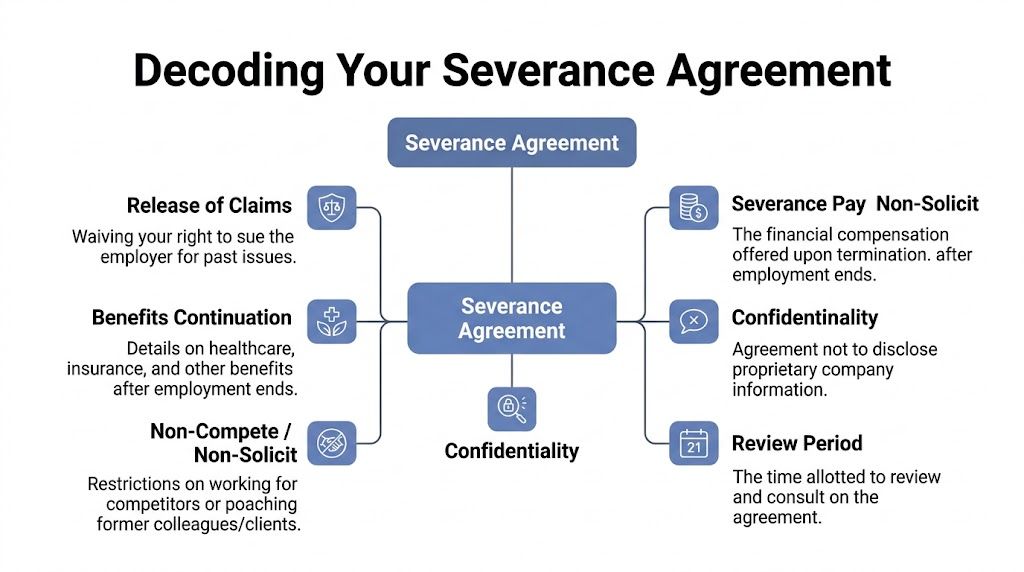
Decoding the Fine Print Important Clauses to Understand
Most severance agreements use familiar-looking words that carry serious consequences. Read every clause as if it will matter later, because it might.
Release of claims
This is the clause that usually matters most. It says you waive legal claims tied to your job and termination. Sometimes the wording is narrow. Sometimes it is sweeping.
Read for these issues:
- How broad it is: Does it cover only known claims, or unknown ones too?
- What laws it mentions: Federal leave rights, retaliation claims, wage claims, discrimination laws, and military-service protections may all be referenced.
- What period it covers: Is it limited to events before signing, or written more broadly?
If you’re already dealing with an agency process, you may also want to understand related documents such as a right to sue letter in employment cases, because timing and claim handling matter.
Confidentiality and non-disparagement
These clauses sound similar, but they do different things.
Confidentiality usually limits what you can say about the agreement itself, the amount paid, or company information.
Non-disparagement usually limits negative statements about the employer, managers, products, or workplace.
A few concerns to watch:
- Broad wording: If the clause is vague, you may not know what speech it restricts.
- No carve-outs: You should look for language that preserves your ability to speak truthfully in legal or agency matters.
- One-sided restrictions: If only you are gagged, that’s worth discussing.
A clause can look harmless until you imagine it being enforced by the least charitable reader possible.
Non-compete and non-solicit terms
Some employers use the severance packet to reassert or expand post-employment restrictions. That can affect where you work next, especially in a small Mississippi industry where everyone knows everyone.
Look closely at whether the agreement:
- adds a new restriction that did not exist before,
- extends an old restriction,
- limits contact with customers, clients, or coworkers,
- uses language so broad that it chills ordinary job hunting.
Cooperation and return-of-property clauses
A cooperation clause may require you to help the employer later with investigations, litigation, or transition matters. That’s not always unreasonable. But the details matter.
Ask basic questions:
- How much time could this require?
- Do they have to reimburse expenses?
- Are you expected to be available indefinitely?
- Does the clause interfere with your new job?
A return-of-property clause is standard, but make sure it doesn’t create a false basis to accuse you of breach later. Return devices, documents, keys, and access credentials promptly. Keep records of what you returned and when.
Red Flags and What You Can Negotiate
A severance agreement is not automatically unfair. But some terms should make you stop and reassess. Other terms are often negotiable, even when the employer acts like the packet is final.
Before you respond, it helps to treat the document like a markup project. If you’ve never had to redline a contract, reviewing one outside the employment context can help you understand how changes get proposed and tracked.
Severance Terms Evaluation
| Potential Red Flags to Watch For | Commonly Negotiable Terms |
|---|---|
| Overbroad release language that seems to waive everything without clear limits | Severance pay amount and the payment schedule |
| Confidentiality wording that appears to silence truthful reporting or cooperation | Benefits continuation, including transition details |
| Non-disparagement terms that are one-sided or too vague | Reference language, including a neutral reference or agreed wording |
| New non-compete or non-solicit restrictions added at exit | Restrictive covenants, including narrowing or removing them |
| Cooperation clauses with no time limits or reimbursement terms | Deadlines to sign, if you need more time for review |
| Repayment or clawback terms triggered by unclear conduct | Mutual non-disparagement, so the company has obligations too |
What should worry you most
The biggest red flags are the ones that create future risk while giving you little in return.
For example:
- A broad release plus a small offer often means the employer is buying more than it’s paying for.
- A vague speech restriction can chill your ability to explain your departure accurately.
- A new post-employment restriction can interfere with your next job long after the severance money is gone.
What I’d push on first
If I were advising a Mississippi worker in this spot, I’d usually look at these items first:
Money
If the employer wants a broad release, the payment should reflect that.Reference terms
A short, agreed reference can matter more than people think.Restrictive clauses
If the agreement limits future work, it needs careful revision.Clean-up language
Deadlines, confidentiality scope, return-of-property details, and mutual obligations all matter.
Don’t ask only, “How much are they offering?” Ask, “What are they buying from me?”
Negotiation can change the outcome. Many workers assume they have no power because they’ve already been fired. That’s not always true. If the employer wants finality, your signature has value.
A Framework for Your Decision
You need a process, not a panic response. A good severance decision comes from slowing down and measuring the offer against the facts of your termination and the realities of your future.

Step one uses time on purpose
Don’t waste your review period. Use it.
Gather the documents that matter:
- termination letter,
- severance packet,
- handbook,
- recent performance reviews,
- pay records,
- bonus or commission documents,
- emails or texts tied to the termination.
If you’re also trying to stabilize income, review practical information about unemployment benefits after termination while your severance agreement is being evaluated.
Step two asks why you were really let go
You don’t need a perfect legal theory on day one. You do need an honest timeline.
Write down what happened in order. Include things like:
- protected leave,
- internal complaints,
- requests for accommodation,
- military-service issues,
- wage disputes,
- reports of harassment or discrimination,
- sudden discipline after protected activity.
A simple layoff and a retaliatory firing are not the same thing. Don’t analyze them the same way.
Step three values the offer honestly
The check amount is not the true value of the deal.
You also need to consider:
- taxes,
- benefit loss,
- unpaid compensation issues,
- restrictions on future work,
- the practical value of the rights being waived.
If the agreement gives the company broad protection and gives you only short-term breathing room, that may be a poor trade.
Decision test: If you would feel trapped by the agreement six months from now, don’t sign it just because you feel scared today.
Step four includes the human cost
This part gets ignored too often. The choice is not only legal and financial. It can affect your career and your mental health.
According to this summary discussing severance red flags, a 2025 SHRM report reveals employees signing severance post-wrongful termination face 28% longer unemployment and 15% wage suppression in reemployment. APA studies also link suppressed legal claims to 40% higher depression rates over two years. If your termination involved discrimination or retaliation, signing quickly may carry consequences that outlast the payment.
That doesn’t mean you should reject every severance offer. It means you should stop treating the decision like a simple cash calculation.
Step five gets a second set of eyes
Legal review is essential. A lawyer can inform you whether the release is broad, whether the restrictive clauses are dangerous, whether the amount is worth discussing, and whether your circumstances indicate a stronger bargaining stance.
One option is Nick Norris, P.A., which reviews and negotiates severance agreements for Mississippi workers as part of its employment practice. Whether you use that office or another attorney, the point is the same. Get the document reviewed before you decide.
Special Considerations for Mississippi Employees
Mississippi workers need to think about severance agreements differently than workers in states with broader state-law protections. That’s not theory. It affects bargaining power.
Why Mississippi changes the analysis
Mississippi is an at-will employment state. It also does not have a state human rights commission. That means many discrimination and retaliation issues are driven through federal law and federal agencies, not a broad state administrative system built for these disputes.
That gap matters when you’re staring at a release. In some states, workers have more overlapping state-law avenues. In Mississippi, federal protections often do more of the heavy lifting.
The practical result is simple. If your severance agreement asks you to waive claims tied to leave, layoff notice, military-service rights, retaliation, discrimination, or wage issues, you should assume the document may be cutting off some of your most important protections.
Federal rights often carry the weight here
For Mississippi employees, federal protections are especially important. As noted in this Mississippi-focused discussion of when not to sign a severance agreement, the EEOC filed 456 retaliation charges in Mississippi in FY2023, many tied to FMLA or WARN Act violations. That same discussion explains that signing a severance agreement without review by local counsel who understands this legal environment means you risk unknowingly forfeiting claims with significant value under these federal statutes.
That should get your attention if your termination happened after leave, a complaint, a layoff event, or protected service.
Two Mississippi points people often miss
First, Mississippi does not provide protection from retaliation for filing a workers compensation claim. Workers are often surprised by that. They assume every unfair firing tied to a workplace injury report creates the same kind of retaliation claim. Mississippi law does not give you that safety net.
Second, because Mississippi lacks many state-level analogues, a local attorney’s role is not just reading contract language. It is spotting whether the severance packet is trying to wipe out federal claims that may be your main source of bargaining power.
If you work in Mississippi, generic internet advice is not enough. Your decision needs a Mississippi-specific review.
Your Questions Answered and How to Get Help
Can I get unemployment if I sign
Sometimes yes, but it depends on the facts, the wording of the agreement, and how the separation is characterized. Don’t assume signing automatically fixes or destroys your unemployment position. Review both together.
What does it cost to have a lawyer review this
Some lawyers handle severance review for a flat fee. If the dispute becomes a larger employment case, contingency arrangements may come into play. In this area, a common contingency range is 40 to 50 percent. That’s one reason an early review can be smart. You may be able to improve your position before the problem gets bigger.
How long do I have to decide
The agreement should state the deadline. Do not rely on what HR says out loud if it conflicts with the written document. Read the actual review period and any revocation language carefully.
If you’re still asking what happens next, start with a clear explanation of what an employment lawyer does in cases involving termination, retaliation, discrimination, wage issues, and severance review.
Your severance packet is not just exit paperwork. It may be the most important employment document you sign all year. Treat it that way.
If you were just fired and handed a severance agreement, get advice before you sign away your rights. Nick Norris, P.A. helps Mississippi employees review severance agreements, assess whether federal employment claims may exist, and decide whether to sign, negotiate, or walk away. A timely review can protect your financial future and prevent a rushed mistake.
This article has been reviewed for legal accuracy by Nick Norris. For employment law matters in Mississippi, consult with an attorney licensed to practice in your state.
Leave a Reply