

When to Sue Your Employer: Mississippi Guide
You’re probably reading this after a bad meeting, a humiliating write-up, a sudden firing, a leave denial, or weeks of being treated differently after you spoke up. You know something is wrong. You may also know Mississippi workers don’t get much help from state systems, and that’s where people get stuck. They wait, hope it blows over, and miss the deadline that mattered most.
That’s the mistake I want you to avoid.
Suing your employer isn’t about being dramatic or vindictive. It’s about deciding whether your employer crossed a legal line, whether you can prove it, and whether acting now protects your job, your income, and your bargaining position. In Mississippi, timing matters more than many workers realize because many workplace claims depend on federal law and federal procedures. If you miss those, your claim can die before it starts.
Are You Considering a Lawsuit Against Your Employer
A common Mississippi scenario looks like this. You complain about harassment. A week later, your supervisor cuts your hours, starts documenting every minor mistake, and tells you that you’re “not a team player.” Or you ask for medical leave and suddenly HR goes silent, payroll gets messy, and your position “changes” before you return.
You feel cornered. You also feel unsure, because employers rarely say the illegal part out loud.
That confusion is normal. Most workers don’t call a lawyer because they’re eager to fight. They call because they’ve hit the point where staying quiet feels dangerous and acting feels risky.
Practical rule: If your employer’s treatment changed after you reported discrimination, asked for leave, requested an accommodation, or complained about unlawful conduct, stop guessing and get the timeline reviewed.
Mississippi is a hard state for employees. Employers often rely on the fact that workers think unfair treatment automatically equals a lawsuit. It doesn’t. But illegal treatment does, and the difference is where cases are won or lost.
That’s why the first question usually isn’t “Should I sue today?” It’s “What kind of claim do I have, and what deadline controls it?” If you don’t know the answer, start with a statute-of-limitations overview like this one on employment deadlines: https://nicknorris.law/2026/01/29/employment-law-statute-of-limitations/
What people usually get wrong
Workers often make one of three mistakes:
- They wait for things to get worse. That can destroy a claim if a filing deadline runs.
- They resign too fast. Quitting may help in some situations, but it can also complicate damages and proof.
- They trust HR to fix it. Sometimes HR helps. Sometimes HR builds the employer’s defense.
What to do tonight
Before you decide when to sue your employer, do these things:
- Write out the dates.
- Save emails, texts, schedules, write-ups, and pay records.
- Stop discussing the case with coworkers who may repeat it.
- Don’t sign severance or settlement papers without legal review.
- Get advice while you still have options.
You do not need perfect proof before you call a lawyer. You need enough facts to preserve your rights and make a smart decision.
Is Your Claim Legally Valid Understanding Protected Classes
Mississippi is an employment-at-will state. That means your employer can usually fire you for a bad reason, a dumb reason, or no stated reason at all. That part is harsh, but it’s real.
What your employer can’t do is take action against you for an illegal reason.

The line between unfair and illegal
A boss can be rude, inconsistent, petty, or incompetent without creating a lawsuit. A claim becomes legally serious when the conduct is tied to a protected class or another protected legal right.
The main protected classes under federal law include:
- Race
- Color
- Religion
- Sex
- National origin
- Age
- Disability
If your firing, demotion, transfer, reduced duties, schedule change, denial of opportunity, or discipline happened because of one of those categories, that’s not just unfair. That may be illegal discrimination.
Harm can be smaller than people think
A lot of workers wrongly assume they don’t have a case unless they were fired. That’s outdated thinking.
The Supreme Court’s 2024 decision in Muldrow v. City of St. Louis lowered the bar for discrimination claims. Employees now need to show “some harm” instead of “significant harm.” The same source notes a record 20,265 federal discrimination lawsuits were filed in 2025, which is why prompt evaluation matters even more (Muldrow and 2025 discrimination filings).
That matters in real life. An unwanted transfer. A shift change that wrecks childcare. A reduction in responsibilities that damages your career. Being pushed off key accounts. Those actions may now support a stronger claim than many employees realize.
You don't need to wait for the worst thing your employer could do. If they changed your job in a way that caused some real harm and the reason was discriminatory, get it evaluated.
What illegal discrimination often looks like
Discrimination cases usually aren’t built on one dramatic statement. They’re built on patterns and comparisons.
Look for facts like these:
- Different treatment: A coworker outside your protected class broke the same rule and wasn’t punished.
- Sudden scrutiny: Your reviews were fine until a new manager learned your religion, pregnancy status, disability, or age.
- Changed explanations: The employer gives one reason in person, another in writing, and a third to the EEOC.
- Selective policies: Rules exist on paper but only get enforced against certain employees.
Protected class claims are not the only valid claims
Some valid cases don’t depend on protected class status at all. Leave rights, military reemployment rights, wage claims, and some retaliation claims can stand on different legal grounds. But if you’re asking when to sue your employer in a discrimination case, protected status is the starting point.
Here’s my direct advice. Don’t waste energy trying to decide whether your employer’s conduct feels “bad enough.” Focus on whether the action harmed your job and whether the reason was illegal. Those are the questions that matter.
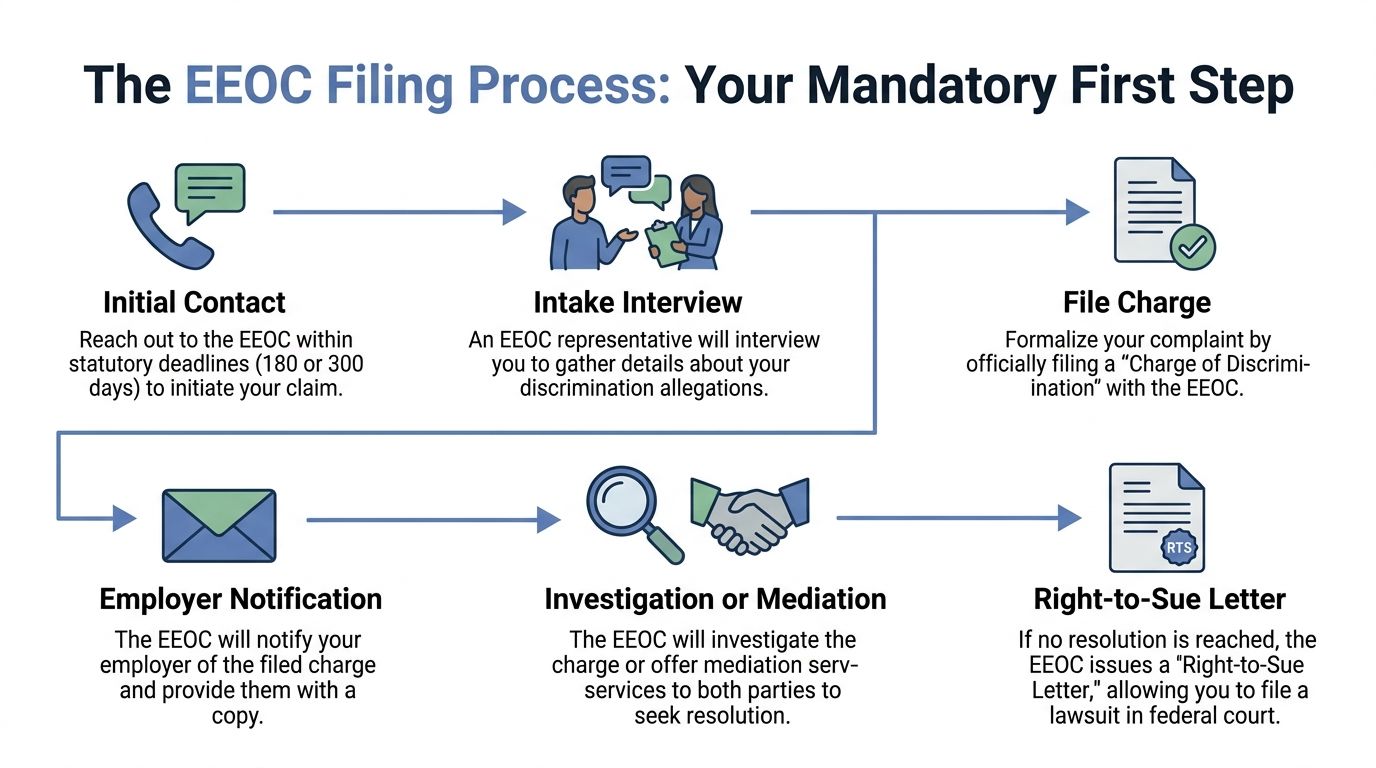
The Critical First Step The EEOC Filing Process
If your claim involves discrimination, harassment, or retaliation tied to a protected class, you usually cannot go straight into federal court. You must first go through the EEOC process.
That step is mandatory in most of these cases.
Mississippi workers have a harder path here because the state does not have its own human rights commission handling these claims. In practical terms, that means you usually rely on the federal system from the start. There is no state agency safety net catching these cases for you first.
The deadline is the first battle
For many Mississippi workers, the safest approach is to treat a certain number of days from the discriminatory act as the deadline you cannot miss. Some federal frameworks refer to a longer period, but relying on the longer period without legal analysis is risky, especially in a state without its own human rights commission.
If you’re close to the deadline, stop researching and act.
What the EEOC process looks like
The process is more administrative than dramatic. That’s one reason people underestimate it.
- You contact the EEOC
Start the intake process with the dates, names, and core facts. - You give a factual statement
This is not the place for a rant. It needs to be accurate, organized, and tied to protected conduct or protected status. - You file a Charge of Discrimination
That charge frames your case. If it leaves out a claim, that omission can cause trouble later. - The employer gets notice
Your employer learns you filed. That’s one reason documentation after filing matters so much. - The EEOC may investigate or offer mediation
Some cases resolve there. Some don’t. - You get a Right-to-Sue letter
That letter is what usually opens the door to filing in federal court.
A fuller breakdown of what happens after filing is here: https://nicknorris.law/2026/03/27/eeoc-investigation-process/
Retaliation is the most common issue alleged in EEOC charges, making up nearly 60% of all claims filed according to this employment-law statistics summary, which is exactly why workers should document everything that happens after a complaint (retaliation in EEOC charges).
What to gather before you file
Don’t file blind. Pull together:
- Dates that matter: Complaint date, discipline date, termination date, leave request date.
- Names and titles: Supervisors, HR staff, witnesses, decision-makers.
- Documents: Write-ups, reviews, emails, text messages, schedules, handbook excerpts.
- Comparators: People treated better under similar circumstances.
Mediation can be useful, but don't confuse it with justice
The EEOC may offer mediation. Sometimes that’s productive. Sometimes the employer uses it to test your resolve.
Go in with a goal. Do you want your job back, a clean exit, policy changes, compensation, or provide a stronger legal position? If you don’t know what outcome you want, mediation can turn into a waste of time.
This short video gives a basic overview of the process and what workers can expect:
Mistakes that hurt EEOC claims
File early, not elegantly. A strong lawyer can improve a live claim. Nobody can revive a dead deadline.
Avoid these errors:
- Waiting for internal HR results: Internal complaints don’t automatically stop the federal clock.
- Telling a broad story with no dates: The EEOC needs specific acts tied to specific timeframes.
- Leaving out retaliation: If your employer punished you after you complained, say so clearly.
- Assuming a transfer or schedule change is too minor: That assumption is even more dangerous after the lowered harm standard discussed earlier.
If you think you may have a discrimination or retaliation claim, the EEOC charge is not optional paperwork. It is the gatekeeper.
Common Employment Claims and What You Must Prove
The biggest mistake workers make is treating every bad workplace experience as the same kind of case. It isn’t. A strong lawsuit depends on matching the facts to the right legal theory.
Discrimination claims
To prove discrimination, you need more than your own belief that your boss disliked you. You need facts showing the employer acted because of a protected characteristic.
That often means proving:
- you belong to a protected class,
- the employer took action against you,
- the action caused real harm to your job, and
- the surrounding facts point to discrimination as the reason.
Sometimes the proof is comparative. A younger employee got a pass. A male employee kept the assignment. A worker outside your race or religion category wasn’t disciplined for the same conduct. Sometimes the proof is pattern-based, such as repeated comments, unequal enforcement, or suspicious timing.
Retaliation claims
Retaliation claims are often stronger than the underlying discrimination complaint.
Why? Because retaliation has a cleaner timeline. You complained, requested leave, reported harassment, opposed unlawful conduct, or participated in an investigation. Then the employer took adverse action.
Your job is to connect the dots:
| Element | What it means in practice |
|---|---|
| Protected activity | You reported discrimination, asked for accommodation, requested protected leave, or raised another legally protected complaint |
| Employer knowledge | The decision-maker or company knew about it |
| Adverse action | Firing, demotion, schedule cuts, write-ups, hostility, exclusion, or other harmful job action |
| Causal link | The facts show the action happened because you engaged in the protected activity |
Texts, email timestamps, and calendar entries matter. If your manager praised your work until you complained, then started building a paper trail against you, that sequence can be powerful evidence.
FMLA interference and retaliation
Family and Medical Leave Act cases are technical. If your facts are strong but your eligibility is weak, the case can collapse.
Under the FMLA, employees have 2 years to file suit from the last violation, but that extends to 3 years if the violation was willful, meaning the employer knew it was breaking the law or acted with reckless disregard (FMLA filing deadline and willfulness).
That legal difference matters. If you delayed getting counsel, proof of willfulness may keep the claim alive.
Start with eligibility before emotion
For an FMLA claim, ask these questions first:
- Covered employer: Does the employer meet the FMLA coverage rules?
- Time on the job: Have you been employed long enough?
- Hours worked: Do your time records support eligibility?
- Notice and paperwork: Did the employer handle your leave request lawfully?
A common FMLA case involves an employee who requests leave, gets jerked around by HR, then comes back to discipline or termination. Another common case involves an employer counting absences against a worker after a valid leave request.
Religious accommodation claims
Religious accommodation is getting more attention for good reason. After Groff v. DeJoy, employers face a tougher standard when denying accommodation requests. They must show substantial increased costs, not a trivial burden, before rejecting requests such as Sabbath observance or prayer-time accommodations. EEOC religious discrimination charges rose 12% in FY2023 to 2,136, according to this discussion of the post-Groff situation (religious accommodation after Groff).
That means denial alone isn’t the whole story. The employer’s process matters too.
Did they explore shift swaps? Did they discuss alternatives? Did they shut the request down without real analysis? Those details can shape the claim.
Workers' compensation retaliation in Mississippi
This is the part many injured workers hate hearing. Mississippi does not provide protection from retaliation for filing workers compensation claims.
That does not mean every fired injured worker is out of luck. It means the workers' comp filing itself is not the retaliation hook many people assume it is. You may still have other claims, depending on the facts. Leave interference, disability discrimination, failure to accommodate, or another federal claim may apply. But “they fired me because I filed workers' comp” is not enough by itself under Mississippi law.
Don't force your facts into the wrong claim. A bad legal theory can sink a good case.
Wage, military, and mass layoff claims
Some workers should also look at:
- Unpaid overtime and wage claims
- USERRA claims involving military service and reemployment rights
- WARN issues tied to layoffs or plant closings
These claims have their own rules and proof structures. The practical lesson is simple. Don’t decide whether to sue based on your anger alone. Decide based on the specific claim you can prove.
Building Your Case An Evidence Checklist
Good employment cases are built on boring documents. Not outrage. Not long speeches. Not what your coworkers “know happened.”
Start gathering proof before documents disappear, phones get replaced, and your memory gets fuzzier.
What to save right away
Your first job is preservation. Save records outside your work systems if you can do so lawfully. Don’t alter anything. Don’t take trade secrets. Don’t forward confidential customer files just because you’re angry.
A practical support tool for reviewing records is this AI Legal Employment Document Analyzer, which can help you sort and extract key points from employment-related documents before your lawyer reviews them.
Essential Evidence Checklist for Your Employment Claim
| Evidence Category | Specific Examples | Why It's Important |
|---|---|---|
| Digital communications | Emails, text messages, Slack or Teams messages, calendar invites | These often show timing, notice, hostility, shifting explanations, or retaliation after a complaint |
| Official employment records | Performance reviews, disciplinary write-ups, termination letter, promotion denials, leave paperwork | These documents help compare what the employer said before and after the dispute started |
| Pay and time records | Pay stubs, schedules, timecards, PTO balances, leave records | Useful in wage claims, FMLA disputes, and damages analysis |
| Personal chronology | A dated timeline, notes after meetings, names of witnesses, who said what | Memory fades fast. A same-day note is usually more useful than a vague recollection months later |
| Company policies | Employee handbook, anti-harassment policy, leave policy, complaint policy, accommodation policy | Policies can show whether the employer ignored its own rules |
| Comparator evidence | Names of coworkers treated differently in similar situations | Often critical in discrimination cases where unequal treatment is the core issue |
Your private timeline matters
Write down events in order. Keep it simple.
Include:
- Date and time
- Who was involved
- What happened
- What documents exist
- Who may have witnessed it
If you later give a deposition, that timeline will matter. A useful primer on preparing for that stage is here: https://nicknorris.law/2026/03/25/how-to-prepare-for-deposition/
Evidence people forget
Workers often save the obvious items and miss the useful ones.
Don’t forget:
- Job postings for your former role
- Meeting invitations you were excluded from
- Changes to schedule or territory
- Messages praising your work before the complaint
- Notes from HR calls
- Medical certification exchanges in leave cases
The best evidence usually answers one of three questions. What changed, when did it change, and who knew why it changed?
If you’re serious about when to sue your employer, stop trying to memorize everything. Build a file.
Realities of a Lawsuit Suing Versus Negotiating
Some clients need to sue. Some need a stronger negotiating position. Some need a clean exit with terms they can live with. Those are not the same goal.
Litigation is a tool. It is not automatically the smartest first move.

What a lawsuit gives you
A filed case gives you subpoena power, formal discovery, sworn testimony, and pressure. If the employer won’t deal fairly before suit, litigation may be the only way to get the records and answers you need.
But the cost is real. Lawsuits are slow. Depositions are stressful. Your employment history becomes part of the fight. The employer’s lawyers will test your credibility, your timeline, your social media, and your damages.
What negotiation gives you
Negotiation can happen before a lawsuit, during an EEOC matter, after a demand letter, or after a case is filed. It is often faster and more private. It can also be more practical if your main goal is money, a neutral reference, cleanup of your personnel file, or a structured exit.
That doesn’t mean negotiation is soft. Good negotiation works because the employer believes you can sue and win if needed.
Side-by-side reality check
| Option | Main advantage | Main downside |
|---|---|---|
| Negotiate early | Faster, more private, less emotionally draining | Employer may lowball you if your evidence is weak |
| File suit | Stronger pressure and formal evidence tools | Longer process, public filings, more stress |
| Continue agency process | May resolve without immediate litigation | Limited control over timing and outcome |
Fees and economics matter
Most employee-side employment cases are handled on a contingency fee, and a significant percentage is common in this space. You also need to ask about case costs. Filing fees, records, depositions, transcripts, experts, and other litigation expenses are separate issues from the attorney fee.
Ask those questions early. Don’t be embarrassed about it.
For leave cases, the practical details can decide whether the economics make sense. For example, FMLA eligibility often turns on whether the employee worked 1,250 hours in the prior 12 months, which is over 24 hours per week, making time records central to the case from the start (FMLA hours requirement).
My blunt advice
If your employer still employs you, think strategically before filing suit. A well-prepared claim letter or EEOC charge may create a strong negotiating position without forcing immediate scorched-earth litigation.
If you’ve already been fired and the employer is stonewalling, negotiation without pressure may go nowhere. In that situation, filing may be the point.
Your Next Steps How to Contact a Mississippi Employment Lawyer
If you remember only three things, remember these.
First, deadlines control everything. Waiting because you’re overwhelmed can cost you the claim.
Second, save evidence before it disappears. Your phone, emails, schedule records, leave paperwork, and write-ups may matter more than your memory.
Third, separate unfair treatment from illegal treatment. That distinction decides whether you have a lawsuit or just a painful work story.
What to do before you make the call
Get these together:
- A short timeline
- Key documents
- Your employer’s name and size if you know it
- The date of the last bad act
- Any severance, warning, or leave paperwork
Then call. Don’t overprepare. Don’t wait until your notes are perfect.
What happens in an initial consultation
A good first consultation is straightforward. You tell the story. The lawyer asks for dates, decision-makers, documents, and what outcome you want. You should expect a candid assessment, not false hope.
That conversation may end with one of several recommendations:
- file an EEOC charge,
- preserve an FMLA or retaliation claim,
- negotiate before suit,
- avoid signing a release,
- or walk away from a weak case before spending more energy on it.
For law firms handling a high volume of employment matters, operational support also matters. Services like Hire Legal assistants are one example of how legal teams organize documents, timelines, and client communication behind the scenes. That matters because employment cases are won on detail, not drama.
If you need representation focused on Mississippi workers, Nick Norris, P.A. handles claims involving discrimination, harassment, retaliation, FMLA, WARN, USERRA, unpaid overtime, and wrongful termination under applicable federal law. The point of calling isn’t to commit to a lawsuit on the spot. The point is to find out whether you have a claim worth protecting before the clock runs out.
You don't need to know exactly when to sue your employer before you reach out. You need to know whether waiting will hurt you. In Mississippi, it often will.
If you believe your employer crossed a legal line, contact Nick Norris, P.A. for a confidential case review. Bring your timeline, your documents, and your questions. You’ll get a direct assessment of whether you may have a viable federal employment claim, what deadline matters most, and whether the smarter move is an EEOC filing, negotiation, or litigation.
This article has been reviewed for legal accuracy by Nick Norris. For employment law matters in Mississippi, consult with an attorney licensed to practice in your state.
Leave a Reply