

FMLA Military Leave: A Mississippi Employee’s Guide
If you're reading this, there's a good chance your phone has already rung with news that changed the week. A spouse just got deployment orders. A parent in uniform was hurt and needs help at home. A brother came back from service with injuries that now require appointments, supervision, and a lot more hands-on care than anyone expected.
For Mississippi families, that moment usually collides with work fast. You still have a shift to cover, a supervisor to notify, bills due at the end of the month, and no time to sort through federal acronyms. What most workers need first is simple: Can I take leave without losing my job?
The answer may be yes under fmla military leave. Federal law gives some employees protected leave for military family situations that don't fit the usual medical-leave box. One type covers urgent deployment-related needs. The other covers caring for a servicemember or recent veteran with a serious injury or illness.
These cases are rarely neat on the ground. Employers may treat the issue like ordinary time off. Human resources may ask for the wrong paperwork. Workers sometimes hear "that's not FMLA" when the problem is really that the employer hasn't identified the military-leave category correctly. If you need a broader refresher on baseline leave rights, this overview of employee rights under FMLA is a useful starting point.
An Introduction to FMLA Military Leave for Mississippi Families
A Mississippi worker may need leave for military service in two very different ways.
One situation is immediate and logistical. Your spouse is called to covered active duty, and suddenly you need to rearrange childcare, attend a military briefing, handle legal papers, or deal with a short-notice change in family responsibilities.
The other situation is deeper and longer. A servicemember comes home with a serious injury or illness, and the family needs someone present for treatment, recovery, transportation, supervision, or day-to-day care.
Both situations can fall under the Family and Medical Leave Act. They don't create paid leave by themselves, but they can create job-protected unpaid leave if you qualify.
Practical rule: The first question isn't whether your employer feels sympathetic. It's whether federal leave law applies to your situation.
That matters in Mississippi because many workers are employed by smaller operations or multi-location employers where coverage questions get messy quickly. I've seen workers focus on proving the family emergency while the actual dispute was something else entirely, such as whether the worksite met the coverage threshold, whether the leave was coded correctly, or whether the employer gave the required notices.
FMLA military leave is best understood as a safety net with two separate openings. If the issue is a deployment-related disruption, you're likely looking at qualifying exigency leave. If the issue is caring for a seriously injured servicemember or certain recent veterans, you're likely looking at military caregiver leave.
The difference matters because the length of leave, the people covered, and the documents your employer can request are not the same.
The Two Types of FMLA Military Leave Explained
Think of fmla military leave like a toolbox with two different tools. If you use the wrong one, the job gets harder than it needs to be.
Qualifying exigency leave is the tool for urgent family logistics tied to covered active duty. Military caregiver leave is the tool for caring for a servicemember or recent veteran with a serious injury or illness.
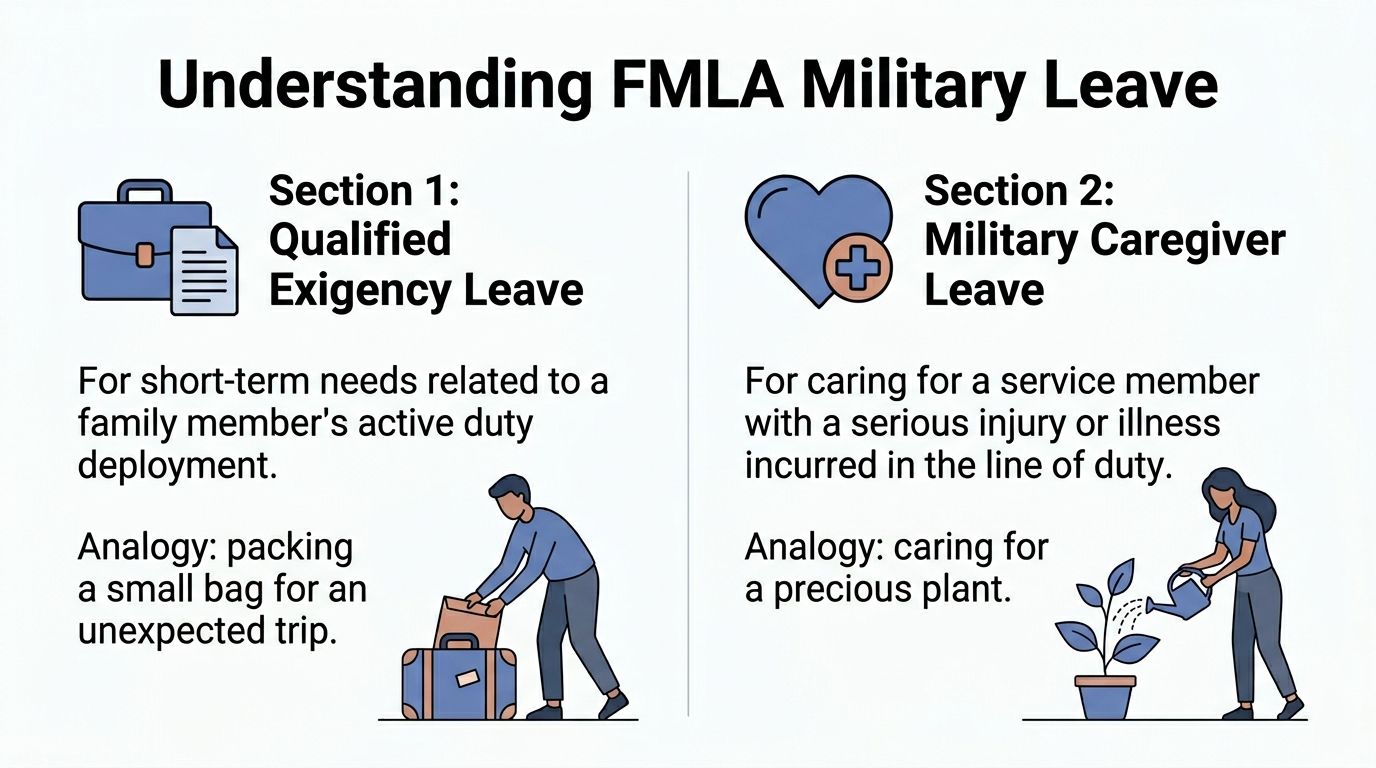
The basic framework is straightforward. FMLA military leave encompasses two primary entitlements: Qualifying Exigency Leave (up to 12 workweeks in a 12-month period) and Military Caregiver Leave (up to 26 workweeks in a single 12-month period beginning on the first day of such leave), both designed to support family members of servicemembers facing deployment or serious injury (justiceadmin.org PDF on FMLA military leave).
Qualifying exigency leave
This leave fits short-term demands caused by a family member's covered active duty or call to active duty.
Examples can include childcare arrangements, attending military events, handling financial or legal matters, or dealing with a short-notice deployment issue. In practice, this is often the leave workers need in bursts. A few hours here. A day there. Several separate blocks over a deployment cycle.
A common mistake is assuming this leave is only for a dramatic emergency. It isn't. The issue is whether the need arises from covered active duty, not whether the event feels catastrophic.
Military caregiver leave
This leave addresses a very different reality. A covered servicemember has a serious injury or illness, and a spouse, child, parent, or next of kin needs time away from work to provide care.
That care may involve attending appointments, helping with recovery, monitoring symptoms, coordinating treatment, or being available during rehabilitation. This category also extends to certain recent veterans, which matters for families whose care needs continue after discharge.
The timeline is longer because the demands are usually heavier. Caregiving cases also tend to generate more paperwork, more scheduling disruption, and more employer skepticism if the worker asks for intermittent leave rather than one continuous block.
Qualifying Exigency vs. Military Caregiver Leave
| Feature | Qualifying Exigency Leave | Military Caregiver Leave |
|---|---|---|
| Main purpose | Handle urgent needs arising from a family member's covered active duty | Care for a covered servicemember or certain recent veterans with a serious injury or illness |
| Maximum leave | Up to 12 workweeks in a 12-month period | Up to 26 workweeks in a single 12-month period |
| Typical use pattern | Often intermittent, short blocks, or reduced schedule | Often longer blocks, but intermittent use can also matter |
| Who triggers the leave | A spouse, son, daughter, or parent on covered active duty or called to it | A covered servicemember or recent veteran with a serious injury or illness |
| Who may take the leave | Eligible family member employee | Eligible spouse, child, parent, or next of kin |
| Common documents | Active-duty orders or other military verification, plus details about the exigency | Certification supporting the servicemember's serious injury or illness and need for care |
| Common employer error | Treating deployment logistics like ordinary personal leave | Acting as if only spouses qualify, or ignoring next-of-kin rights |
What tends to work and what doesn't
Workers usually do better when they identify the leave type early and use that exact label in writing.
These requests often go sideways when the employee says only, "I need some time off because of military issues." That may be true, but it leaves too much room for an employer to classify the request under a generic attendance policy.
Use the legal category if you know it. "I'm requesting qualifying exigency leave" or "I'm requesting military caregiver leave" is clearer than "I need family leave."
Another practical point. Don't assume human resources will sort this out for you. Some HR teams do. Some don't. The cleaner your request, the harder it is for the employer to claim confusion later.
Are You Eligible for FMLA Military Leave in Mississippi
Before you argue with HR about paperwork, check whether you qualify in the first place. FMLA rights are powerful, but they don't apply to every worker or every employer.
For military caregiver leave, the federal fact sheet states that eligible employees can receive up to 26 workweeks of unpaid, job-protected leave, but only 56% of U.S. workers qualify because of employer-size and tenure rules (U.S. Department of Labor fact sheet on military caregiver leave).
The three-part checklist
You generally need to satisfy all three of these points:
- Covered employer. Your employer must have 50 or more employees within 75 miles of your worksite.
- Length of service. You must have worked for the employer for 12 months.
- Hours worked. You must have at least 1,250 hours of service in the prior 12 months.
That sounds simple. In real workplaces, it isn't always.
Where Mississippi workers run into trouble
The biggest issue is often employer size. In Mississippi, many people work for smaller businesses, family-owned operations, local shops, or rural employers that may not hit the federal threshold. Workers sometimes assume "big enough company" means FMLA applies, but the law looks at the employee count tied to the worksite and distance, not just the brand name on the building.
A second problem is the hours requirement. Salaried workers often don't know whether they meet it. Hourly workers may have irregular schedules that make the math harder. If you've had reduced hours, leave periods, or a recent change in assignment, don't guess. Ask for your pay records and time data.
Questions to ask before you request leave
- How many employees work for this employer within 75 miles of my site?
- Have I been employed for 12 months total?
- Have I worked 1,250 hours in the last 12 months?
- Am I the family member covered under the specific military leave category involved?
If any answer is uncertain, pin it down before your employer does it for you.
Eligibility is not the same as approval
Even when you're eligible, your employer may still ask for documentation showing that the reason for leave qualifies. That's normal. The problem starts when an employer uses uncertainty about documents as an excuse to ignore the request altogether.
The strongest position is this: know your eligibility, identify the correct leave category, and request the forms promptly.
Workers also sometimes focus on the wrong issue. They spend days trying to prove the seriousness of the family situation when the actual dispute is whether they personally fit the relationship category. For example, caregiver leave can involve next of kin in some situations, which is broader than many workers expect.
That kind of detail matters. It can be the difference between protected leave and a denial based on an incomplete understanding of the law.
Navigating the FMLA Request and Documentation Process
This is the part where many valid claims get damaged. Not because the worker lacked a real need, but because the request wasn't framed clearly, the documents came in incomplete, or the employer later said it never understood what was being requested.

If you need a basic walkthrough of the mechanics, this guide on how to apply for FMLA is a useful companion. For military leave, the key is precision.
Step one, give notice early and plainly
You don't need to write like a lawyer. You do need to be clear enough that the employer understands the request may be FMLA-covered.
Say what is happening and connect it to military leave. Examples:
- Deployment issue. "My spouse has covered active duty orders, and I need leave for deployment-related family matters."
- Caregiver issue. "I need leave to care for my family member who is a servicemember or recent veteran with a serious injury or illness."
Written notice is usually safer than a phone call alone. Email creates a record. If you speak first, follow up in writing the same day.
Step two, ask what certification is required
Employers may require documentation. That doesn't mean they can ask for anything they want.
For qualifying exigency leave, employers commonly want military orders or other military verification and information about the specific exigency. For caregiver leave, they may require the appropriate certification tied to the servicemember's condition and the need for care.
The practical question isn't "Can they ask for papers?" Usually they can. The practical question is whether they're asking for the right papers for the right type of leave.
Step three, complete the correct form set
Workers often hear references to Department of Labor forms such as WH-384 for qualifying exigency leave and WH-385 or WH-385-V for caregiver leave involving a current servicemember or veteran.
The form name matters less than accuracy. Fill out every section carefully. Match names, dates, military status details, and your relationship to the servicemember. If the employer gave you internal forms too, keep copies of those as well.
What to keep in your file
Create a folder, digital or paper, and save everything.
- Initial request. Keep the email, letter, or text where you first gave notice.
- Employer responses. Save every HR message, supervisor reply, and benefits notice.
- Military documents. Retain orders, verification, or any official paperwork tied to the leave request.
- Certification forms. Keep signed copies before and after submission.
- Attendance records. Preserve schedules, write-ups, and timesheets if the employer starts counting absences against you.
Deadlines and detail matter
The military-leave guidance discussed earlier notes that employees may need to provide facts within a set period and that employers have designation obligations once they have enough information. In practice, disputes often turn on timing.
If HR asks for documents, don't sit on the request. If you need extra time because military paperwork is delayed, say so in writing. If the employer refuses to explain what is missing, ask them to identify the specific deficiency.
A vague denial is a red flag. A proper process usually includes a specific request for what information is still needed.
Common mistakes that cause avoidable problems
Some are employee mistakes. Some are employer mistakes. Most can be reduced with better records.
Using only verbal notice
A manager may forget, deny, or misunderstand what you said.Calling it vacation or personal time
That gives the employer room to process it under ordinary attendance rules.Submitting incomplete certifications
Missing relationship information or missing military verification can stall designation.Assuming HR's silence means approval
If you don't have something in writing, follow up.Failing to preserve a paper trail
If retaliation starts later, documentation matters.
Understanding Your Rights and Your Employers Obligations
Once leave is properly approved or should have been approved, FMLA is more than permission to be absent. It carries real workplace protections.
For qualifying exigency leave, eligible employees may receive up to 12 workweeks of unpaid, job-protected time in a 12-month period, and the same federal source notes that 44% of the private sector workforce remains ineligible, largely because of the small-employer exemption (U.S. Department of Labor fact sheet on qualifying exigency leave).
Job protection means your position can't simply vanish because you used leave
At the end of protected leave, the employer generally must return you to the same job or an equivalent one. Equivalent doesn't mean "whatever slot is open." It means a comparable position.
That protection matters most when the workplace starts acting annoyed. A worker may come back and find a worse shift, a reduced role, or a sudden performance campaign that began only after the leave request. The employer may not label that retaliation, but labels don't control the facts.
Health coverage must be handled correctly
Group health coverage generally must continue on the same terms during FMLA leave. The practical issue is often premium payment and communication during the leave period.
If employment later ends or coverage changes, some workers need to understand COBRA continuation coverage so they don't confuse temporary FMLA benefit protections with post-employment insurance options.
Intermittent leave is often where the fight begins
Military family needs don't always fit a single start date and a single return date.
A worker might need:
- Separate days off to attend military events or handle legal matters tied to deployment.
- Reduced hours for a period while assisting a recovering veteran with appointments.
- Unpredictable short absences when treatment schedules shift or military logistics change.
Those patterns can still be protected if the underlying leave qualifies. Employers often prefer one continuous block because it's easier to track, but convenience isn't the legal test.
What employers must do
A covered employer's obligations usually include recognizing when a request may trigger FMLA, giving the required notices, evaluating certification properly, designating qualifying leave, and not interfering with or retaliating against the employee for using it.
When an employer counts protected military leave under an attendance policy, the problem is often not "bad communication." It's interference with a federal right.
What doesn't work well for employees
Workers lose their advantage when they accept informal promises instead of formal designation. "We'll work with you" sounds good until attendance points appear, benefits get mishandled, or the manager who made the promise leaves.
The better approach is simple. Get the designation, the dates, and any scheduling expectations in writing.
FMLA and USERRA How These Laws Work Together
The most common legal mix-up I see in military-related leave cases is confusing FMLA with USERRA. They can arise from the same family event, but they protect different people and solve different problems.

A cited source on veterans' workplace rights notes that there is frequent confusion between FMLA protections for family members and USERRA rights for servicemembers themselves, and it states that a 2023 DOL enforcement data report showed USERRA complaints rising 15% in Southern states like Mississippi due to reemployment disputes (lawforveterans.org discussion of FMLA military provisions and USERRA overlap).
The clean division
FMLA generally protects the employee who needs leave because of a family member's military service or military-related injury.
USERRA generally protects the servicemember's own employment and reemployment rights when that person leaves civilian work for military service and then returns.
Those are different rights. One law is about family leave. The other is about the servicemember's job status and return to work.
Where they overlap in real life
A Mississippi National Guard member is called up. The servicemember's civilian employer may have USERRA obligations when that person leaves and later seeks reemployment. At the same time, the spouse may need qualifying exigency leave from a different employer to handle family responsibilities created by the deployment.
Or take a second example. A servicemember returns with a serious injury. The servicemember may have USERRA-related issues with reinstatement, position, or benefits. A family member may separately need military caregiver leave under FMLA to provide care.
The laws don't replace each other. They can run side by side.
Why this confusion hurts workers
Some employers respond to a military-related request as though all military protections are basically the same. They're not.
That leads to mistakes such as:
- Misclassifying the request. HR may treat a family member's leave request like the servicemember's own military leave issue.
- Ignoring reemployment rights. A returning Guard or Reserve worker may be told to use ordinary leave policies when USERRA is the actual framework.
- Missing combined claims. One family event can create separate violations under separate federal laws.
For families coordinating long-term support after discharge, practical care planning matters too. This overview of Veteran Directed Care can help explain one support path some households look at while handling work leave issues.
A more focused summary of the servicemember's side of the issue is available in this discussion of USERRA law.
A short explainer can help if you're sorting out the difference visually.
FMLA protects the family member who needs leave. USERRA protects the servicemember's own civilian employment rights. If your household is dealing with both, analyze both.
Common Employer Violations and Your Next Steps in Mississippi
Most FMLA military leave disputes don't begin with an outright firing. They start smaller. A supervisor says the leave "doesn't count." HR asks for the wrong records. Attendance points appear. A worker gets pushed to use vacation instead of protected leave. Then the discipline starts.

One cited source states that 25% of Southern FMLA complaints involve military leave denials tied to inadequate notice or certification, and that these matters are often left unresolved because of poor state-federal coordination (DOL-linked fact sheet page cited for military caregiver enforcement issues).
Red flags employees should take seriously
- Discouraging the request. "Can't your sister handle this?" or "You don't want to start an FMLA process over this."
- Mislabeling absences. Approved or approvable military leave gets counted under attendance rules.
- Demanding unnecessary information. The employer asks for documents that don't match the leave category involved.
- Failing to designate leave. HR has enough information but never marks the time as FMLA-protected.
- Retaliation after the request. Schedule cuts, write-ups, hostility, demotion, or termination following the leave request or use.
What to do next
Start with records. Save emails, screenshots, handbooks, write-ups, schedules, and any messages that show timing. Build a simple timeline while events are still fresh.
Then consider your enforcement options. In Mississippi, workers often deal directly with federal processes because the state doesn't have a human rights commission handling this kind of claim. For FMLA issues, one option is filing a complaint with the U.S. Department of Labor. Another may be pursuing a private case in federal court.
If you're consulting counsel, ask direct questions about scope, timing, and fees. Employment cases are often handled on a contingency basis, and a common range is 40% to 50%. That matters because you need to understand the economics before you commit.
One practical option for Mississippi workers is Nick Norris, P.A., which handles employee-side matters involving FMLA and USERRA, among other federal workplace claims.
Bottom line: If the employer is treating your military family leave like an attendance problem instead of a protected-rights issue, don't assume it will fix itself.
If your employer denied fmla military leave, counted protected time against you, or retaliated after a request tied to deployment or caregiving, Nick Norris, P.A. may be able to help you evaluate the records, identify whether FMLA, USERRA, or both apply, and map out practical next steps under federal law.
This article has been reviewed for legal accuracy by Nick Norris. For employment law matters in Mississippi, consult with an attorney licensed to practice in your state.
Leave a Reply