

How to Find an Employment Lawyer in Mississippi: A Guide
You may be reading this after a firing, a write-up, a demotion, a denied leave request, or a meeting that left you with a sick feeling in your stomach. Those in that position don’t start with legal terms. They start with questions. Was this legal? Did my employer cross a line? Do I need a lawyer now, or should I wait?
In Mississippi, those questions get complicated fast. A lot of national advice about how to find an employment lawyer assumes your state has agencies and protections that Mississippi doesn’t have. It also tends to blur together every workplace dispute, even though a wage claim, a discrimination claim, an FMLA case, and a USERRA case are not evaluated the same way.
That’s why the search has to be practical and local. The good news is that you are not looking for help in a tiny or disappearing field. The employment law industry includes 29,004 businesses in 2024, and the market reached $25.5 billion, with industry revenue growing at an annualized 2.7% over the prior five-year period, according to IBISWorld’s employment law firms industry data. There are qualified lawyers doing this work. The issue is finding one who handles employee-side Mississippi cases and understands the federal laws that often drive them.
Starting Your Search When Your Job Is on the Line
A common Mississippi scenario looks like this. You report harassment, ask for medical leave, complain about unpaid overtime, or come back from military service expecting your job to be there. Then the employer suddenly says your performance is the problem. The timing feels wrong, but you don’t yet have a clean answer.

That’s usually the moment people make one of two mistakes. They either hire the first lawyer who calls them back, or they spend weeks reading generic articles written for California, New York, or “all 50 states.” Neither approach works well in Mississippi.
What usually works first
Start narrow. Employment law is a specialty, not a side issue. Even within the profession, many lawyers don’t regularly handle employee discrimination, retaliation, leave, wage, or reemployment claims. The broader legal profession is large and stable, with 731,340 lawyers nationally, and the Bureau of Labor Statistics projects lawyer employment to grow 4 percent from 2024 to 2034, with about 31,500 openings projected annually during that period, according to the BLS lawyer occupation profile. That tells you qualified counsel exists. It does not mean every lawyer you find is the right fit for your case.
Practical rule: The best lawyer for a car wreck, divorce, or real estate closing is not automatically the right lawyer for a federal employment claim.
What Mississippi employees need to keep in mind
Mississippi workers often rely heavily on federal law. That matters when you’re choosing counsel. A lawyer who knows FMLA, WARN, USERRA, wage law, discrimination law, and retaliation law will usually evaluate your facts more efficiently than someone who handles “a little bit of everything.”
Focus on facts that can be checked early:
- Who the lawyer represents: Make sure the lawyer primarily represents employees, not management.
- What claims they handle: Ask whether they routinely work on leave cases, discrimination, unpaid wages, retaliation, severance disputes, or reemployment issues.
- How quickly they can spot deadlines: In employment law, delay can damage a good claim.
You don’t need to walk in knowing the law. You do need a plan for finding someone who does.
Where to Find a Qualified Mississippi Employment Lawyer
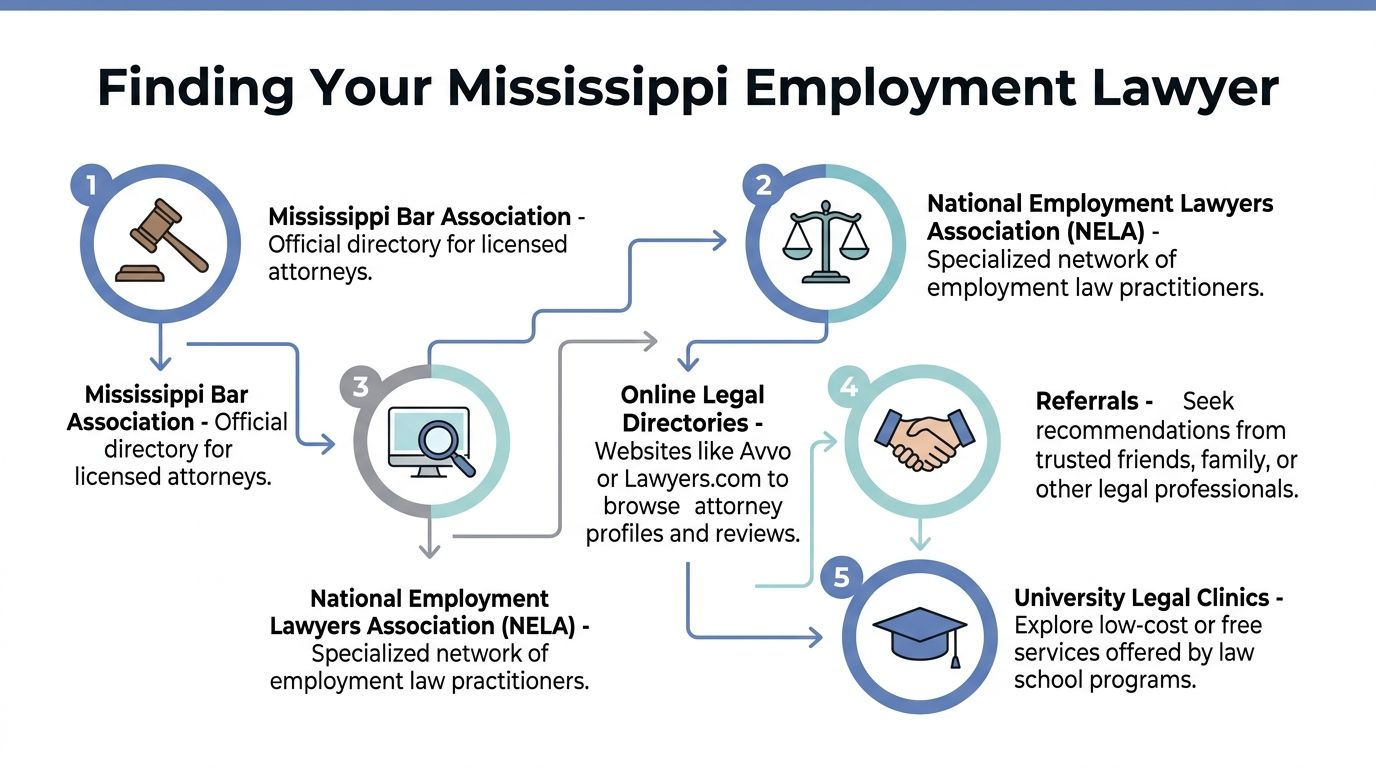
The best search usually starts away from a broad Google query. Specialized directories do a first round of filtering for you. Guidance on finding employment counsel recommends starting with places like NELA, MWELA, Avvo, and Nolo because they focus your search on lawyers with employment backgrounds instead of mixing in defense-side and general-practice attorneys. That first filter matters because broad search results can include both plaintiff-side and management-side lawyers, creating a 50%+ filtering inefficiency, as explained in this discussion of specialized directory filtering for employment cases.
Start with sources that actually help
Use a short list, not a free-for-all:
Mississippi Bar lawyer search
Confirm the lawyer is licensed and in good standing. This is also where you should check disciplinary history before you schedule or hire.NELA and other employment-focused directories
These are better than random search results because they are built around practice area.Avvo or similar profile-based directories
Read these carefully. Don’t focus on marketing language. Look for actual employment law experience, writing, case focus, and whether the attorney represents workers.Referrals from lawyers in other fields
A good local attorney who doesn’t handle employment law may still know who does.Federal agency pathways
In Mississippi, this is especially important because the state does not have a human rights commission for employment discrimination claims. For many workers, the EEOC is the main administrative agency in play.
Why generic state-by-state advice breaks down here
For Mississippi employees, local knowledge matters because access to employment lawyers can be 40% lower per capita than in states like California, and workers often need lawyers fluent in federal statutes such as FMLA, WARN, and USERRA, according to the Mississippi-specific gap identified through California court self-help materials discussing state resource differences. In practice, that means you should put more weight on bar-verified experience and federal employment knowledge than polished branding.
If you’re specifically dealing with a firing or forced resignation, it also helps to compare attorneys who regularly handle those disputes. This guide to best wrongful termination lawyers near me can help you narrow what to look for.
Mississippi employees waste time when they search for a state agency that doesn’t exist. For discrimination and many retaliation issues, the federal route is usually where the analysis begins.
A fast screening method
Before you book a consultation, check these three things:
- Employee-side focus: If the lawyer also regularly advises employers, ask direct questions about conflicts and current practice focus.
- Recent employment content: Articles, case summaries, or presentations often show whether employment law is a real part of the practice.
- Mississippi and federal familiarity: You want someone who understands local judges, local practice, and the federal framework your claim may depend on.
How to Prepare for Your Initial Consultation
Good consultations don’t happen by accident. The lawyer can only evaluate what you bring, and employment cases turn on details that clients often leave out because they don’t realize those details matter.

Build a timeline before you call
Write down the sequence of events in date order. Keep it simple and factual. Start with when the problem began, then note complaints, leave requests, write-ups, schedule changes, pay issues, HR reports, and termination or resignation.
The first consultation is a critical diagnostic phase. Best practice is to come prepared with a detailed background, and to evaluate whether the attorney asks clarifying questions, explains the law that may apply, and outlines a possible strategy. It’s also wise to do 3-5 consultations so you can compare responsiveness, competence, and transparency, as described in this consultation guidance for hiring an employment lawyer.
Gather documents that answer the lawyer’s first questions
Bring or upload the records that shape the case. The exact list depends on your problem, but most consultations improve when you have:
- Job documents: Offer letter, contract, handbook acknowledgments, arbitration agreement, non-compete, severance papers.
- Pay records: Pay stubs, time records, commission records, bonus plans.
- HR records: Complaints, emails to HR, investigation notes, warning notices, performance reviews.
- Medical or leave papers: Doctor notes, leave requests, FMLA paperwork, return-to-work forms.
- End-of-employment papers: Termination notice, resignation email, exit paperwork, COBRA or benefits notices.
If you want a more detailed checklist before that first call, this practical guide on how to prepare for your first talk with an employment lawyer is worth reviewing.
Write a one-page summary
Don’t send a lawyer fifty screenshots with no explanation. Write a one-page summary that answers these questions:
- What happened?
- Who made the decision?
- When did the key events occur?
- What protected activity or legal issue do you think is involved?
- What harm followed?
That summary helps the lawyer test the facts quickly. It also helps you stay focused during the call.
A short video can help you think through that first conversation and what the lawyer needs to hear.
Protect yourself while gathering evidence
Don’t take confidential company files you were never allowed to access. Don’t record calls unless you understand the risks. Don’t alter documents. Preserve what you already have lawfully, and let the lawyer advise you on the rest.
Bring facts, not conclusions. “I reported harassment on Tuesday, and they fired me Friday” is more useful than “They violated five laws.”
Key Questions to Ask Before You Hire an Attorney
A consultation is not only for the lawyer to evaluate you. It’s for you to evaluate the lawyer. The right questions expose whether the attorney understands your problem, whether the firm has the resources to carry it, and whether you’ll be dealing with the person you met.

Questions that tell you something real
Ask direct questions and listen for direct answers. Vague confidence is a warning sign.
| Category | Question to Ask |
|---|---|
| Experience | Do you regularly handle employee-side employment cases in Mississippi? |
| Claim fit | Have you handled cases involving facts like mine, such as FMLA, WARN, USERRA, discrimination, retaliation, or wage claims? |
| Forum | Is this the kind of case you usually pursue through an EEOC charge, negotiation, arbitration, or federal litigation? |
| Strategy | What do you see as the strongest issue in my case, and what concerns you most? |
| Staffing | Who will actually handle my case day to day? |
| Communication | How often should I expect updates, and who returns calls or emails? |
| Costs | How are fees and case expenses handled if the case settles, goes deep into litigation, or doesn’t recover money? |
| Conflicts | Do you represent only employees, or do you also represent employers? |
| Capacity | Do you have the resources to fund experts, depositions, and other case costs if needed? |
| Risk review | Are there any documents I should not sign right now, such as severance or arbitration-related paperwork? |
Red flags clients should take seriously
Some warning signs are easy to miss because people are stressed and want reassurance.
- Guaranteed outcomes: No honest lawyer can promise you a win.
- No real questions: If the lawyer barely asks about dates, decision-makers, comparators, documents, or your employer’s size, that’s a bad sign.
- Unclear staffing: If you can’t tell who will handle the case, expect frustration later.
- No discussion of downsides: Every employment case has risks. A lawyer who won’t discuss them may be selling, not advising.
There’s another issue clients often overlook: how the firm handles sensitive records. Employment cases often involve medical leave documents, pay records, personnel files, and internal communications. If you want a plain-English primer on what good law firm data security should look like, that resource is useful when you’re trusting a firm with highly personal material.
The answer you’re listening for
You want a lawyer who can explain your case in ordinary language. A strong consultation usually sounds something like this: here’s the claim I think may fit, here’s what I need to confirm it, here’s what could weaken it, and here’s the next step.
A good employment lawyer doesn’t just sound knowledgeable. They make your facts make sense.
Understanding Legal Fees and Contingency Agreements
For many Mississippi workers, cost is the reason they delay the call. That hesitation is understandable, especially for hourly workers and anyone who just lost a paycheck.
The most common arrangement in employee-side employment cases is a contingency fee. That means the lawyer’s fee comes from a recovery, not from a standard bill sent every month. In Mississippi, the author’s brief for this article notes that the average contingency fee is 40-50%. You should still ask for the exact percentage in writing, because the agreement controls, not assumptions.
What to ask about besides the percentage
The fee percentage is only part of the financial picture. Ask how the firm handles case costs such as filing fees, records, depositions, experts, and transcripts. Ask whether those costs are advanced by the firm, when they are repaid, and whether you owe them if the case doesn’t recover money.
Affordability concerns are real, especially in wage cases. 62% of U.S. wage-and-hour claims come from hourly workers earning under $50,000, yet many hesitate to seek counsel because they believe they can’t afford it, according to LAFLA’s employment help information. That same source warns that some firms may charge non-refundable costs that can absorb up to 40% of an award. Read the fee contract carefully.
Common fee structures you may see
- Contingency fee: Most common when the claim may produce a settlement or judgment.
- Hourly fee: More common for contract review, severance advice, or targeted counseling.
- Hybrid fee: A mix of reduced hourly billing and a smaller contingent interest.
If a firm offers a contingency arrangement, ask two plain questions. First, “What do I pay if we lose?” Second, “What comes out before my share is calculated?” Those answers matter.
Don’t sign what you don’t understand
Fee contracts are negotiable in some cases, especially on costs. If a term is unclear, ask the lawyer to explain it line by line. You’re not being difficult. You’re doing what a careful client should do.
Navigating Next Steps and Critical Legal Deadlines
Once you choose a lawyer, the immediate next step is usually signing a representation agreement and getting your documents organized for action. Depending on the facts, your lawyer may start by preserving evidence, reviewing an arbitration agreement, contacting the employer, evaluating severance language, or preparing an agency charge.
In Mississippi employment cases, many claims center on federal administrative and federal court processes, not some broad state-level system. That’s one reason speed matters. Employment deadlines can be unforgiving, and waiting too long can destroy a claim before the merits are ever addressed.
What usually happens soon after hiring
Your lawyer may do several things quickly:
- Review deadlines: This often comes first because missed deadlines can end the case.
- Assess forum and procedure: EEOC charge, negotiation, arbitration analysis, or other required steps.
- Warn you about documents: Severance agreements, releases, and internal statements can change the case.
If your employer gives you an agreement to sign, slow down and read it closely. If you need help understanding markup changes in severance or settlement language, a simple explainer on how to redline a contract can help you see what changed before you approve anything.
Mississippi-specific realities clients should know
Two points are important here. First, Mississippi does not have a human rights commission, so many workers end up dealing with federal channels early. Second, the author’s brief for this piece correctly notes that Mississippi does not provide protection from retaliation for filing workers compensation claims. People are often surprised by that. Don’t assume a workplace action is protected just because it feels unfair.
If your lawyer mentions a right-to-sue notice, it helps to understand what that means and why it matters. This explanation of what is a right-to-sue letter gives a useful overview.
The main point is simple. Act early, preserve documents, and get specific advice before you sign, delete, post, or wait.
If you’re a Mississippi employee dealing with discrimination, retaliation, unpaid wages, denied leave, harassment, or wrongful termination, Nick Norris, P.A. focuses on representing workers across the state. You can reach out to discuss your situation, get clear guidance on your options, and take the next step before a deadline slips away.
This article has been reviewed for legal accuracy by Nick Norris. For employment law matters in Mississippi, consult with an attorney licensed to practice in your state.
Leave a Reply