

Family Medical Leave Act Violations: Your Rights
A lot of Mississippi workers first realize they may be dealing with family medical leave act violations in a very ordinary moment. A parent goes into the hospital. A doctor orders treatment that will take weeks, not days. You tell your supervisor you need leave, and the response isn’t a clear yes or no. It’s pressure. “We really need you here.” “Can’t someone else handle it?” “If you take that much time, I can’t promise anything about your position.”
That’s where many FMLA cases begin.
The law is supposed to give eligible employees breathing room during a medical or family crisis. In practice, employers sometimes deny leave outright, drag their feet, count leave incorrectly, cut off benefits, or punish workers for asking. In Mississippi, that problem matters more because workers often have to rely on federal protections and federal enforcement, not state-level backup systems.
Understanding FMLA and Its Importance for Mississippi Workers
The Family and Medical Leave Act, usually called FMLA, is a federal law that gives eligible employees up to 12 weeks of unpaid, job-protected leave for qualifying reasons. That can include your own serious health condition, caring for a spouse, child, or parent with a serious health condition, the birth of a child, adoption or foster placement, and certain military-related situations.
For a Mississippi worker, that protection can be the difference between keeping a job and losing one during a family emergency.

What the law is supposed to do
FMLA isn’t a paid leave law. It doesn’t require your employer to keep paying wages while you’re out unless paid leave is being used at the same time under workplace policy. What it does require is job protection for eligible workers and continuation of group health coverage on the same terms while the leave is protected.
That sounds simple. It often isn’t.
Many employees don’t get a clean answer from HR. Instead, they get vague language, mixed messages from a supervisor, or discipline that starts right after the leave request. Some workers are told they don’t qualify when they are eligible. Others are approved for leave, only to be moved into a lesser position when they return.
Why Mississippi workers need to take this seriously
This is not a niche issue. In fiscal year 2024, the U.S. Department of Labor’s Wage and Hour Division closed 349 FMLA violation cases and recovered over $1.8 million in back wages for employees, according to the reported FY 2024 WHD enforcement data.
That matters here because Mississippi employees usually don’t have a state family leave system to fall back on. If your employer violates your rights, you need to understand the federal rules quickly and act with purpose.
Practical rule: If your employer starts treating you differently right after you mention a medical condition, surgery, pregnancy-related limitation, or the need to care for a close family member, don’t assume it’s just bad management. It may be an FMLA problem.
What tends to go wrong in real life
A worker may ask for time off to care for a sick parent and get told to “use vacation first,” without any real FMLA paperwork.
A hospital employee may need intermittent leave for treatment appointments and get marked absent under the attendance policy.
A manufacturing worker may come back from approved leave and find that the title is the same, but the duties, schedule, or status aren’t.
Those details matter. FMLA cases often turn on the paper trail, the timing, and whether the employer followed the required process.
Determining If You Are Covered by FMLA
Before you can prove a violation, you need to know whether the law covers you. Coverage is where employers make some of the most costly mistakes.
The three-part eligibility check
Start with a simple checklist:
| Requirement | What to look for |
|---|---|
| Covered employer | Public agencies, schools, and private employers with 50 or more employees within 75 miles |
| Length of service | You’ve worked for the employer for at least 12 months |
| Hours worked | You’ve worked at least 1,250 hours during the 12 months before leave starts |
If one of those pieces is missing, the FMLA may not apply. If all three are present, your employer should treat the request seriously and follow the law’s notice and designation rules.
Where employers often get it wrong
Eligibility errors are common. Miscalculating FMLA eligibility is one of the most common employer violations, affecting roughly 25 to 35 percent of DOL cases, often because the employer miscounts hours or misapplies the 50 employees within a 75-mile radius rule, as described in this summary of common FMLA violations.
That means a denial doesn’t always mean you’re ineligible. Sometimes it means the employer counted wrong.
A common example is when an employer looks only at your home office or one store location and ignores nearby sites that should count toward the headcount test. Another is when payroll records don’t accurately reflect actual hours worked.
Qualifying reasons for leave
FMLA leave can apply when you need leave for:
- Your own serious health condition that keeps you from doing your job
- Care for a spouse, child, or parent with a serious health condition
- Birth of a child
- Adoption or foster placement
- Certain military family needs
Some leave can be taken in a block. Some can be intermittent, such as treatment appointments or flare-ups of a chronic condition.
If your employer is acting like leave only counts when you are out for weeks at a time, that’s often a warning sign. Intermittent leave is one of the areas where employers regularly make mistakes.
A practical self-audit
Pull together these records before you assume you’re not covered:
- Pay records that help show your hours worked.
- Your hire date and any breaks in service.
- The locations where your employer has employees near your worksite.
- The reason for leave, stated in plain terms.
If you need help with the paperwork side, this guide on how to apply for FMLA is a useful starting point.
Identifying Common Family Medical Leave Act Violations
Once eligibility is on the table, the next issue is conduct. The core question is whether the employer interfered with your rights or punished you for trying to use them.
Interference with leave rights
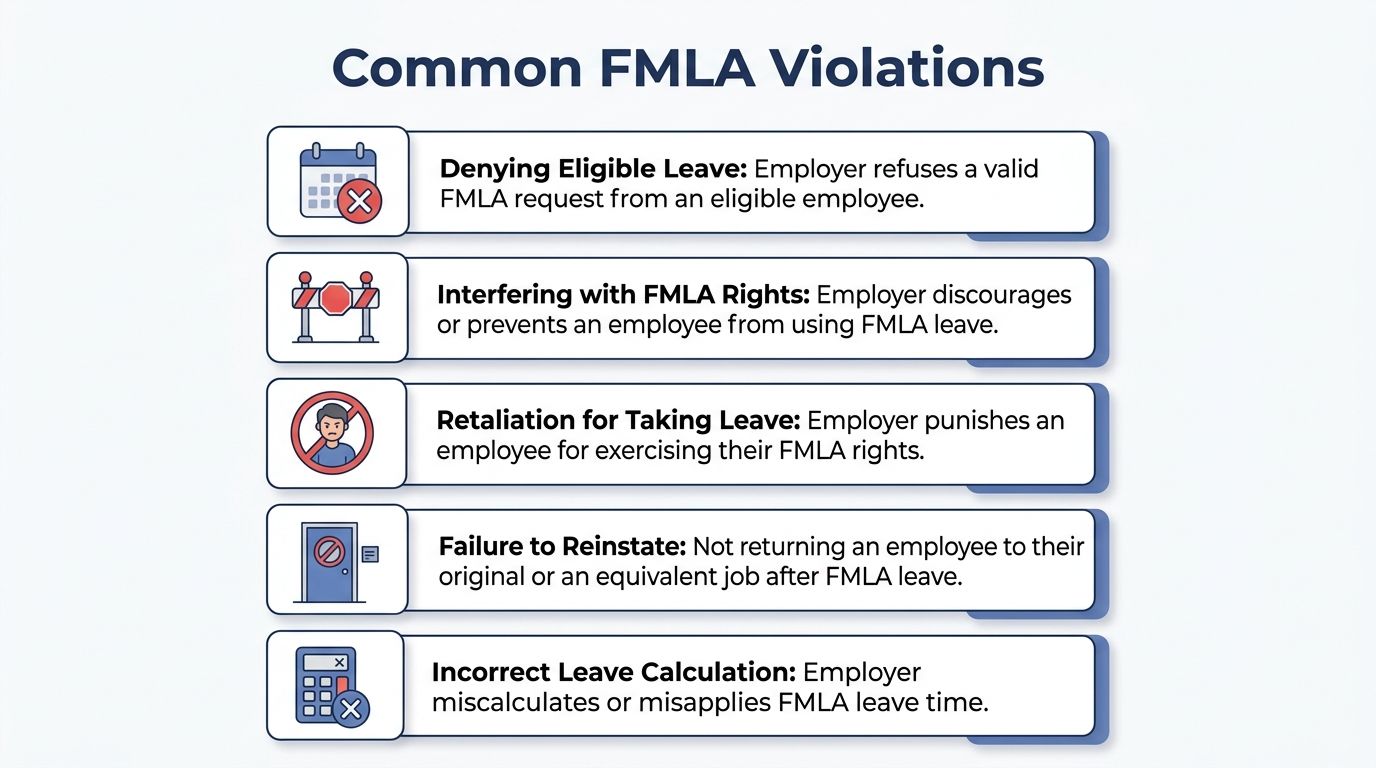
Interference happens when an employer blocks, restrains, or discourages lawful leave. Sometimes it’s obvious. Sometimes it’s subtle.
A supervisor may say, “If you take leave now, don’t expect to move up here.” HR may never provide the right notices. A manager may insist you find your own replacement before taking leave.
Those aren’t minor management issues. They can be FMLA interference.
According to aggregated enforcement summaries, retaliation and interference are dominant FMLA violation types, and employer mistakes also include failing to provide required notices in 30% of violations and health benefits lapses in 15% of violations, as summarized in this FMLA statistics overview.
Denial of eligible leave
Some employers refuse qualifying leave.
That can happen because they dispute whether the condition is serious enough, claim the employee waited too long to request leave, or wrongly insist that vacation policy controls the issue. In many cases, the denial is tied to poor recordkeeping or a manager who doesn’t understand the law.
A denial also doesn’t have to be written. If an employer makes the process so difficult that a reasonable worker gives up, that can still matter.
Retaliation after a request or leave
Retaliation is about punishment. The worker asks for leave, takes leave, or returns from leave, and then the employer takes adverse action.
Examples include:
- Discipline that appears out of nowhere after a leave request
- A schedule change designed to force the employee out
- A poor evaluation that doesn’t match the worker’s prior history
- Termination tied closely to the leave
This is where timing matters. A clean record followed by sudden write-ups after FMLA activity is often one of the first things an attorney will examine.
For a closer discussion of conduct that can cross the line, see what is considered FMLA harassment.
Failure to reinstate
One of the most important protections under FMLA is the right to return to the same job or an equivalent one.
That does not mean the employer can put you in a role with the same paycheck but less authority, worse duties, lower status, or a materially worse schedule and call it equivalent. If your old position disappears during leave, the employer still has legal obligations. “Equivalent” has real content.
Coming back to a different job with less prestige, less opportunity, or a worse shift can be an FMLA issue even if the employer keeps your pay the same.
Incorrect leave calculation and benefits problems
Employers also violate the law by miscounting leave time, forcing full-day absences when shorter intermittent leave should be allowed, or treating protected absences as attendance violations.
Another recurring issue is benefits. If your group health coverage lapses while you are on protected leave, that can create a separate layer of harm at exactly the wrong time.
In practice, these cases often overlap. A worker may be denied notice, forced into using leave incorrectly, and then disciplined for absences that should have been protected in the first place.
Your Rights and Potential Remedies Under Federal Law
When an employer violates the FMLA, the point isn’t just proving they were wrong. The point is getting a meaningful remedy.
The main remedies available
A serious FMLA case can involve several forms of relief:
- Reinstatement to your position, or to a legally equivalent position
- Back pay for lost wages and compensation tied to the violation
- Restoration of benefits if coverage or related employment benefits were improperly affected
- Attorney fees and costs in appropriate cases
- Liquidated damages, which can double back pay under the statute in the right circumstances
A critical violation is failing to return an employee to the same or an equivalent position. Under 29 U.S.C. § 2617, remedies can include backpay, liquidated damages, and attorney fees, and courts may award damages when the employee’s rights were prejudiced even without direct economic loss, as reflected in the Department of Labor’s FMLA materials.
What “equivalent position” really means
This part is often misunderstood.
An equivalent position is not just a similar title. It should be comparable in pay, benefits, duties, shift, and status. If you return from protected leave and find that your responsibilities have been stripped down, your route to promotion has changed, or your work conditions are materially worse, that deserves close review.
In real disputes, employers often focus on labels. Courts and investigators look harder at substance.
What usually works and what usually doesn’t
What helps employees:
- Clear medical documentation
- Prompt written notice to the employer
- Copies of HR forms, emails, and texts
- Evidence of job duties before and after leave
- Records showing a sudden negative shift in treatment
What hurts employees:
- Relying only on verbal conversations
- Waiting too long to gather records
- Assuming HR’s denial is final
- Resigning too quickly without legal advice
Bottom line: If your employer’s explanation keeps changing, treat that as evidence to preserve, not a problem to debate in the hallway.
Paying a lawyer in an FMLA case
Many Mississippi employment lawyers handle these cases on a contingency fee. That usually means the client doesn’t pay attorney fees up front, and the fee comes from a recovery if the case succeeds. In Mississippi employment litigation, contingency fees commonly fall in the 40 to 50 percent range.
That financial structure matters because workers are often dealing with missed paychecks, medical stress, or both.
If you’re trying to understand the legal side in plain language, employee rights under FMLA gives a helpful overview of the rights at stake. Firms such as Nick Norris, P.A. also represent employees in FMLA matters involving denied leave, retaliation, and reinstatement disputes.
How to Document FMLA Violations and Key Deadlines
If you think your employer violated the FMLA, start building your file immediately. Don’t wait for HR to “sort it out.”

What to save first
Keep copies of anything connected to the leave request or the fallout from it.
- Texts and emails from supervisors, HR, and managers
- Doctor notes and certification forms
- Pay stubs and schedules
- Handbook policies on attendance, leave, and discipline
- Performance reviews from before and after the leave issue started
If a conversation happens in person or by phone, make your own written log the same day. Note who was there, what was said, and when it happened. Simple, dated notes can become important later.
Build a timeline, not just a folder
A strong case file tells a sequence. It shows when you asked for leave, what the employer said, when documents were provided, when discipline started, and what changed after that.
That timeline often reveals patterns a single email won’t.
If you have recorded meetings, long voicemails, or detailed interviews to preserve, accurate transcripts can make the evidence easier to organize and share with counsel. Tools and providers that focus on legal transcription services can help turn messy audio into a usable record.
Write down the date of every request, every denial, every doctor submission, and every disciplinary action. Cases are often won or lost on timing.
Deadlines matter
FMLA claims are subject to time limits. In general, an employee has 2 years to file a claim, or 3 years if the violation was willful.
Don’t treat those deadlines as permission to wait. Witnesses leave. Emails disappear. Memories get cleaned up.
Here’s a practical explainer that covers common FMLA issues:
A short evidence checklist
Use this before your next HR meeting:
- Print key emails to a personal device or personal records file where lawful.
- Download pay and schedule records before access is cut off.
- Preserve the job description you had before leave.
- Keep benefit records if insurance or payroll deductions change.
- Avoid editing old messages or paraphrasing them. Keep originals.
The best documentation is boring, organized, and complete. That’s what makes it persuasive.
A Step-by-Step Action Plan for Mississippi Employees
Mississippi workers need a direct path, because the state does not have its own state-level family leave act and does not have a state human rights commission handling these claims. For FMLA disputes, the focus is federal.
Step 1 Report the problem internally, but do it carefully
If it’s safe to do so, report the issue to HR or the person designated in your employer’s policy. Keep it short and factual.
State that you requested leave for a qualifying reason, identify the problem, and ask for a written response. Don’t turn the complaint into a long emotional narrative. You’re creating a record.
Examples of useful language include: you requested protected medical leave, you believe the leave was denied or mishandled, your benefits changed during leave, or you were not returned to the same or an equivalent job.
Step 2 File with the U.S. Department of Labor
Because Mississippi workers must rely on federal protection here, understanding the federal enforcement route is critical. As this discussion of Mississippi’s reliance on federal FMLA protections explains, the key options are filing with the U.S. Department of Labor or pursuing a claim in federal court.
The Wage and Hour Division can investigate, request records, and attempt to resolve violations. This route can be useful when the employee needs an official investigation or wants an agency involved early.
A DOL complaint can also help frame the dispute before positions harden.
Step 3 Evaluate a federal court claim
Some cases need to move beyond an agency complaint. If you were fired, demoted, not reinstated, or pushed out after leave, a federal court case may be the stronger path.
That decision depends on the facts, the available evidence, and the remedy you need. A worker trying to get back pay and reinstatement may have different priorities than someone primarily focused on a clean exit and compensation.
Step 4 Avoid common mistakes during the process
Don’t do these things if you can avoid them:
- Don’t resign quickly unless you’ve gotten legal advice.
- Don’t rely on phone calls alone when email will create a record.
- Don’t send angry messages that distract from the core legal issue.
- Don’t assume retaliation for workers’ compensation activity is separately protected by Mississippi law. Mississippi does not provide protection from retaliation for filing workers compensation claims, so keep the FMLA analysis focused on the actual federal rights involved.
Step 5 Get a case assessment early
An experienced employment lawyer can assess whether the problem is interference, retaliation, denial, reinstatement failure, or a combination. That matters because the evidence strategy changes depending on the claim.
Early advice can also help you preserve the right records, avoid deadline problems, and decide whether to proceed through the Department of Labor, federal court, or both.
When You Need to Contact a Mississippi FMLA Attorney
Some situations justify a call right away.
If you were fired after requesting leave, demoted after returning, told not to apply for FMLA, disciplined for protected absences, or denied reinstatement, don’t wait to see if the problem fixes itself. It usually doesn’t. The employer is already building its version of events.
You should also speak with a lawyer quickly if HR keeps changing the reason for denial, your health insurance changed during leave, or your supervisor is pressuring you to come back before your protected leave should end.
In Mississippi, these cases are federal matters, and the path to relief usually runs through the U.S. Department of Labor and federal court. A Mississippi employment lawyer can review your documents, identify the claim, explain the likely remedies, and help you decide the next move before avoidable mistakes make the case harder.
If you're dealing with family medical leave act violations in Mississippi, Nick Norris, P.A. can help you evaluate the facts, understand your federal options, and decide how to protect your job, your income, and your rights.
This article has been reviewed for legal accuracy by Nick Norris. For employment law matters in Mississippi, consult with an attorney licensed to practice in your state.
Leave a Reply