
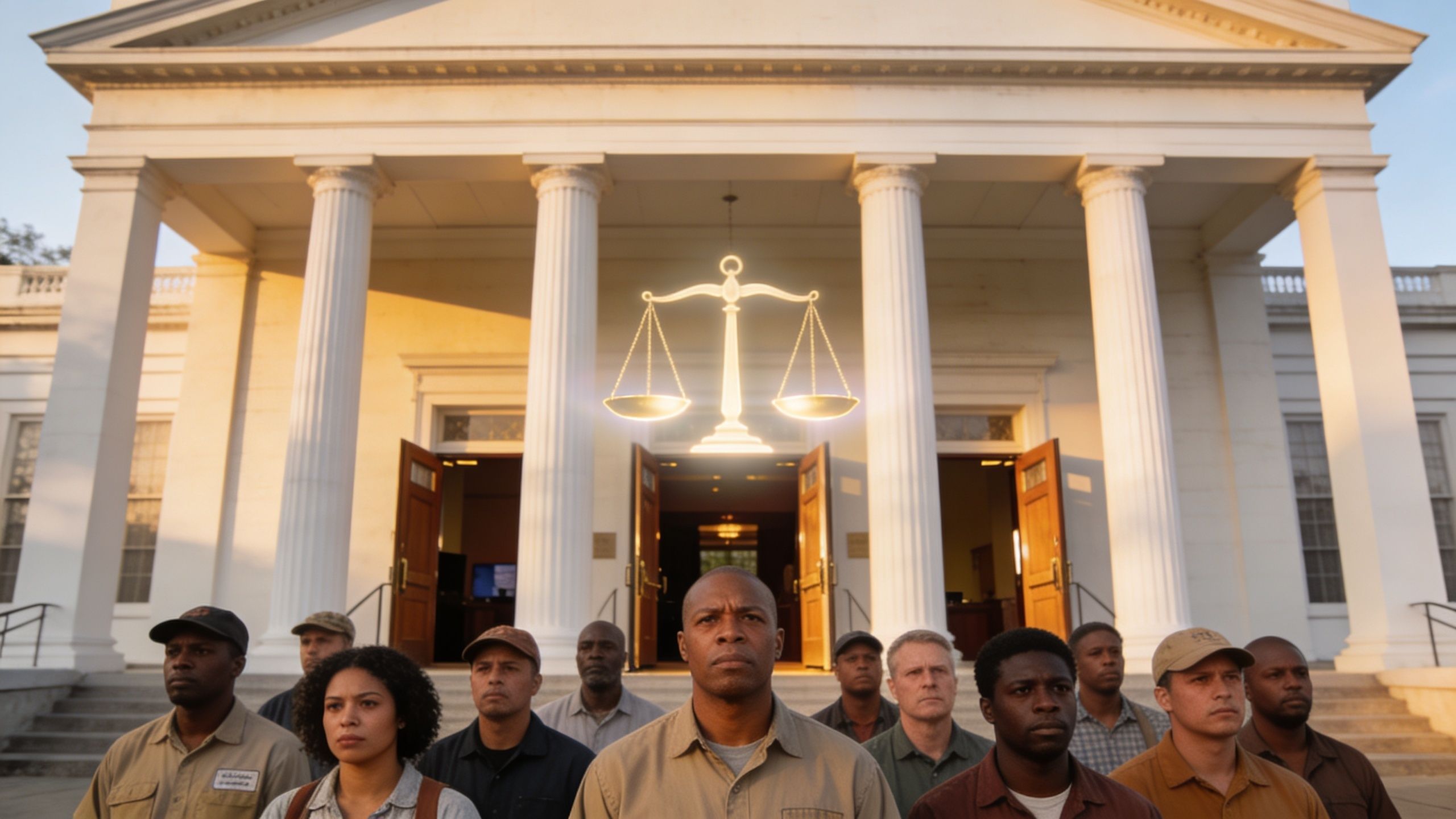
You notice the same thing three times in one week.
Your paycheck is short again. The supervisor tells everyone to clock out before finishing cleanup. A coworker says she was written up after asking for FMLA paperwork. Another says promotions always go to the same kind of person, and nobody ever sees an actual posting for the job.
At first, most workers assume it's just bad luck, bad management, or a problem they have to solve alone. Then the pattern gets harder to ignore. The issue isn't only what happened to you. It's what happened to a whole group of employees under the same policy, same manager, or same pay practice.
That is where a class action employment lawsuit starts to make sense.
Employment class actions aren't some fringe part of the legal system anymore. Labor and employment class actions represented 43.4% of all class action matters in 2023, and total class action settlements exceeded $70 billion in 2025, according to employment class action litigation data summarized here. For Mississippi workers, that matters because many workplace problems in this state have to be pushed through the federal system. Mississippi does not have a human rights commission to investigate discrimination claims at the state level, so federal procedures often matter more than workers expect.
When a workplace violation is built into the way a company operates, one-person-at-a-time litigation may not be the best tool. A class case can force an employer to answer for a company-wide policy, not just one bad interaction.
When Your Workplace Problem Is Bigger Than Just You
A warehouse employee in Mississippi notices that everyone on her shift is expected to put on protective gear before clocking in. A hospital worker learns that meal break deductions are automatic, even when staff regularly work through lunch. A retail employee sees the same unposted management jobs handed to insiders over and over.
Those stories look different on the surface. Legally, they can have the same core feature. The employer may be using one practice that affects many people in a similar way.
That distinction matters. If ten workers are all harmed by one overtime policy, one attendance rule, or one promotion system, the case is no longer only about an isolated dispute. It may be about a pattern that belongs in federal court as a class or collective action.
What workers usually see first
Most employees don't start with legal labels. They start with facts:
- Pay problems that repeat: missing overtime, unpaid prep time, off-the-clock work, automatic deductions, or a salary label that doesn't match the job duties.
- Leave problems that look standardized: the same FMLA forms, the same denial language, or the same return-to-work rule used across a department or company.
- Promotion and discipline patterns: jobs never posted, favored candidates preselected, or complaints punished in a consistent way.
A strong case often begins when workers compare notes and realize the company gave everyone the same answer.
For Mississippi workers, that realization can be powerful. It means the case may not depend only on who was most outspoken or who suffered the biggest loss. It may depend on whether the employer used a policy that can be proven with records, handbooks, emails, payroll data, and testimony from multiple employees.
Why this matters now
The broader trend supports what workers are already experiencing on the ground. Employment-related class litigation has become the largest category of class action practice nationally, as noted in the earlier section. That doesn't mean every unfair workplace experience becomes a class case. It does mean courts, lawyers, and employers are dealing with these disputes far more often than they used to.
For a worker sitting in Mississippi, the practical takeaway is simple. If your problem keeps happening to other people too, it may be time to stop thinking of it as a private workplace disagreement.
Defining the Lawsuit: Class Actions vs Other Legal Actions
A lot of workers hear the phrase "class action" and use it to mean any lawsuit involving more than one employee. Legally, that's too broad. Different group cases follow different rules, and the difference affects who is included, how notice works, and how much pressure the case puts on the employer.

What a Rule 23 class action means
A Rule 23 class action is one case brought on behalf of a larger group of workers with sufficiently similar claims. One or more class representatives stand in for the group, but the court has to approve that structure first. The judge does not automatically accept the word "class" because the complaint uses it.
The court looks at whether the workers share common legal and factual issues in a way that justifies one combined case.
How that differs from an individual lawsuit
An individual case is exactly what it sounds like. One worker sues for harm specific to that worker. That can be the right route when the facts are highly personal, the damages are unique, or the dispute depends on one supervisor's conduct rather than a company-wide rule.
A class case works better when the employer's conduct is standardized. One policy. One system. One repeated practice.
Practical rule: If the proof depends mostly on a written policy, companywide payroll method, common form, or centralized decision, class treatment becomes much more realistic.
Why workers confuse class actions and FLSA collective actions
Wage-and-hour claims often arise under the Fair Labor Standards Act, and those cases frequently proceed as collective actions, not Rule 23 class actions. That distinction is critical.
In an FLSA collective action, workers usually must opt in. They are not part of the case unless they affirmatively join it. In a Rule 23 class action, class members are generally included unless they opt out after certification and notice.
Here is the clearest side-by-side comparison:
| Feature | Rule 23 Class Action | FLSA Collective Action |
|---|---|---|
| Who is included | Workers are typically included unless they opt out | Workers must affirmatively opt in |
| Common use | Discrimination, some leave claims, policy-based claims | Overtime, minimum wage, off-the-clock pay claims |
| Main pressure point | Broad participation can expand employer exposure | Participation depends on workers joining |
| Court focus | Whether common issues justify one class case | Whether similarly situated workers should proceed together |
Why FMLA claims can be especially significant
Some leave cases raise issues that fit Rule 23 particularly well. In Sharp v. United Airlines, Inc., a court certified a class of over 16,000 employees by focusing on the common legal question of whether the employer's policy was unlawful on its face, as described in this analysis of FMLA class certification under Rule 23. That matters because a Rule 23 FMLA class is generally opt-out, which can increase employer exposure compared with an opt-in FLSA collective action.
For workers, the lesson is practical, not academic. Two cases may both involve multiple employees, but the legal vehicle changes everything. If you're evaluating a class action employment lawsuit, you need to know whether the case belongs under Rule 23, under the FLSA's collective action rules, or possibly both.
Common Grounds for an Employment Class Action
Some employment problems are too individualized for group litigation. Others almost invite it. The strongest class and collective cases usually come from conduct that an employer repeats through policies, templates, payroll systems, or unwritten but consistent management practices.

Wage and hour violations
This is one of the most common starting points.
In Mississippi, that often looks like poultry processing, manufacturing, healthcare, retail, hospitality, or service work where employees are expected to perform tasks before clocking in or after clocking out. It can also involve workers paid on a salary basis even though their actual duties don't support exempt status.
A few examples show how these claims develop:
- Off-the-clock work: employees must set up equipment, complete security checks, or finish closing duties without pay.
- Automatic meal deductions: the employer deducts lunch time whether workers received an uninterrupted meal break or not.
- Misclassification: workers are called managers or administrators, but they spend most of their time doing frontline hourly work.
If your issue centers on unpaid time, this overview of wage and hour disputes may help you spot whether the problem is individual or part of a broader pattern.
Systemic discrimination
Discrimination claims become stronger as class cases when the problem isn't just one slur or one unfair review. The issue is a system.
That system might be a promotion process with no posted openings, no written criteria, and no real application path. It might be assignment decisions that funnel certain workers into lower-paying roles. It might be compensation decisions made behind closed doors with no transparent standards.
Mississippi workers feel this especially hard because there is no state human rights commission to serve as a local administrative backstop. In practice, many workers must rely on federal procedures to challenge patterns of race, sex, pregnancy, disability, religion, or national origin discrimination.
Research cited by the Institute for Women's Policy Research found that 70% of certified employment discrimination class actions required transparent criteria for promotions, compared with 5% in non-class settlements, according to IWPR's review of court-supervised settlements.
That matters because some cases are about more than money.
A good class case can force an employer to post jobs, define promotion criteria, and stop making advancement decisions through private favoritism.
FMLA and leave policy claims
Leave claims can become group cases when the same flawed form, attendance rule, or paid leave policy affects many workers in the same way. If a company uses one centralized policy that allegedly shortchanges FMLA rights, the case may fit a class framework better than workers expect.
That is different from a one-off mistake by one HR employee. The legal value in a class case comes from proving the company's common rule.
Retaliation and newer federal theories
Retaliation isn't always a one-person claim either. Sometimes an employer responds to complaints in a repeated way across teams or facilities.
There is also an emerging federal trend involving workers who say they were targeted because of perceived association with DEI efforts or advocacy for protected groups. A recent class case filed on behalf of federal workers alleges Title VII violations tied to DEI-related terminations, as described in this case summary from Lieff Cabraser. Mississippi workers employed by government contractors or employers with federal ties should pay attention to that kind of shift, especially where retaliation theories are evolving.
One caution is important here. Mississippi does not provide protection from retaliation for filing workers' compensation claims. Workers often assume every complaint to an employer creates a retaliation claim. That isn't true. The legal protection depends on the statute involved, the kind of complaint made, and the facts.
The Lifecycle of a Class Action Lawsuit
Most workers imagine one dramatic filing and a quick result. Class litigation doesn't work that way. It moves in stages, and each stage serves a different purpose.

Investigation and filing
Before a strong case is filed, the legal team usually looks for patterns. That means reviewing pay records, handbooks, attendance policies, leave documents, emails, text messages, and accounts from multiple workers.
At this stage, lawyers aren't just asking whether something unfair happened. They're asking whether the same thing happened to enough people in a sufficiently similar way.
A weak start in a class case is costly. If the proposed class is too broad, too mixed, or too individualized, the employer will attack it early.
Certification is the gatekeeping stage
The motion for class certification is often the most important fight in the case. Think of it as the point where the judge decides whether one lawsuit can fairly speak for a larger group.
The court evaluates whether the named plaintiff's claims are sufficiently typical, whether common issues unite the class, and whether a class action is a practical method to resolve the dispute. If certification is denied, the case may proceed in a more limited capacity, but the negotiating power shifts.
Notice to workers
If the court certifies a class, workers usually receive notice explaining the case and their rights. In a Rule 23 case, that notice often tells workers how to exclude themselves if they don't want to be bound. In an FLSA collective action, notice typically invites workers to join.
That notice is not junk mail. It can affect your legal rights, your deadlines, and whether you share in any recovery.
When workers get legal notice in the mail or by email, they shouldn't ignore it because they assume someone else already handled it.
Discovery is where documents matter
After certification issues are litigated, the parties exchange evidence. That process is called discovery. It can include payroll records, scheduling data, internal policies, management communications, HR files, and witness testimony.
In class cases, discovery often reveals whether a written policy matches what happened in practice. Employers may have a lawful handbook on paper but a different system in the actual workplace.
This is also where modern federal employment disputes keep changing. Questions about protected status, retaliation theories, and federal enforcement priorities are shifting. For example, recent DEI-related federal worker class claims show how Title VII theories can develop in politically charged settings, particularly for workers connected to federal agencies or contractors, as noted in the earlier discussion.
A short explainer can help if you'd rather see the process visually:
Settlement, trial, and possible appeals
Most class cases resolve through negotiated settlement, but not all of them. Settlement may include money, revised policies, notice to workers, training requirements, or other injunctive terms. If settlement doesn't happen, the case can proceed to trial on certified issues.
Appeals are common, especially around certification orders and settlement approval. That is one reason class litigation can take time.
Here is the part many workers need to hear early:
- You may not have to carry the case alone. Class and collective litigation spreads factual proof across multiple workers.
- You still matter as a witness. Even if you're not the class representative, your records and testimony may strengthen the case.
- Patience matters. These cases usually move slower than workers want, but speed is not the same thing as strategic advantage.
Weighing Your Options: Pros and Cons for Employees
Joining or pursuing a class action employment lawsuit is a strategic decision. It isn't automatically better than an individual case. It isn't automatically worse either. The right choice depends on the kind of claim, the proof available, the number of affected workers, and what outcome matters most to you.
Why workers choose the group route
The biggest advantage is collective power. Many employment violations are too small to justify a solo federal lawsuit on a practical level, even when the employer clearly broke the law. When many workers pool similar claims, the case becomes harder for the employer to dismiss as a personal dispute.
There is also efficiency. One court can resolve common questions once instead of forcing dozens of employees to fight the same issue separately. In discrimination cases, class relief can also change the workplace itself, not just compensate one worker.
Another advantage is emotional. Some workers are more willing to come forward when they know they are not the only person challenging the practice.
What employees give up
The trade-off is control.
In a class case, the named representatives and class counsel make many major decisions. You may not control settlement timing, litigation strategy, or what legal theories receive the most attention. If your personal damages are unusually high, an individual case might offer more specific relief.
There is also the issue of pace. Class cases can move slowly because certification, notice, discovery, and approval steps take time. Employers often fight hard at every stage.
And not every worker wants to stay connected to a group case while still employed.
Some workers want maximum individual control. Others want the strongest practical tool against a companywide policy. Those are not always the same thing.
One issue that can change the whole analysis
Arbitration agreements can block or limit court-based class litigation. Employers often place arbitration clauses in onboarding packets, handbooks, or electronic acknowledgment systems. Some clauses also include class action waivers.
That doesn't end every claim, but it can change the forum and the strategy. If you're unsure whether you signed one, this discussion of an arbitration clause in employment contract is worth reviewing before you assume a class case is available.
A practical way to think about the decision is this:
| Consideration | Class or collective case may fit better | Individual case may fit better |
|---|---|---|
| Nature of problem | Companywide policy or repeated common practice | Highly personal facts or unique harm |
| Desired outcome | Broad policy change and shared recovery | Individualized damages and control |
| Proof | Payroll, policies, forms, centralized decisions | One-off conduct, specific manager dispute |
| Risk tolerance | Willing to proceed as part of a group | Wants direct say over settlement and strategy |
Determining Your Eligibility and Deadlines
The first question isn't whether your employer acted unfairly. The first question is whether your claim fits the group.
A worker is usually a plausible class or collective member when the same policy, pay practice, or decision-making system affected that worker in a similar way as others. Similar doesn't mean identical. But the core issue must line up.

What to gather now
Don't wait for perfect evidence. Start preserving what you have.
- Pay records: check stubs, time records, schedules, bonus statements, and screenshots from timekeeping apps.
- Policy documents: handbooks, FMLA forms, attendance policies, job postings, or emails explaining company rules.
- Your timeline: dates of complaints, leave requests, write-ups, denials, and termination decisions.
- Names of witnesses: coworkers who saw the same practice or experienced it themselves.
Deadlines can end the case before it begins
Federal employment claims run on deadlines, and missing them can destroy an otherwise strong claim. The exact deadline depends on the statute and the procedural path, which is why broad internet advice is risky.
For Mississippi workers, urgency matters even more because many claims must move through federal administrative or federal court processes rather than a state human rights commission. If you're trying to get oriented, this overview of the statute of limitations in MS is a useful starting point, but the specific deadline in your case may depend on the claim type and the facts.
Waiting to "see what happens" is one of the most common ways workers lose good claims.
If you suspect the same thing happened to other employees, move quickly. Delay can affect both your own rights and the strength of any group case.
Taking the Next Step: How to Protect Your Rights in Mississippi
If you're considering a class action employment lawsuit, the next move is usually not filing papers yourself. The next move is getting the facts organized and having them reviewed by an employment lawyer who handles federal worker-side litigation.
Start with the documents that tell the story. Gather pay stubs, schedules, offer letters, handbooks, write-ups, HR emails, leave paperwork, texts from supervisors, and your own timeline. Keep copies in a safe personal location, not only on a work phone or work laptop.
Then prepare for the consultation like a witness, not like a legal scholar. Be ready to explain what happened, when it started, who else was affected, whether you complained internally, and whether you signed arbitration paperwork. If you've ever had to deal with another kind of civil case, the basic discipline is similar. For example, this consumer guide on how to respond to a debt lawsuit is a useful reminder that deadlines, records, and prompt action matter in any legal dispute.
What to expect on fees
Most employee-side employment firms handling these cases work on a contingency fee. That means you generally don't pay upfront attorney's fees for the case to begin. In Mississippi employment practice, a typical contingency fee often falls in the 40% to 50% range, depending on the case, the risk, and whether the matter resolves early or goes deep into litigation or appeal.
That doesn't mean every case should be filed. A responsible lawyer should tell you when the facts are too thin, the class theory doesn't fit, or the arbitration language creates a serious obstacle.
The right consultation should leave you with a clearer view of three things:
- Whether your claim is individual, collective, or class-based
- What records still need to be preserved
- How fast you need to act
If you believe your employer's conduct affected more than just you, Nick Norris, P.A. helps Mississippi workers evaluate federal employment claims involving unpaid wages, discrimination, retaliation, FMLA violations, WARN issues, USERRA rights, and other workplace disputes. A focused review of the facts can tell you whether you have an individual claim, a collective action, or a potential class case, and what steps make sense next.
Leave a Reply