

Wage and Hour Disputes in MS: A Worker’s Guide
If you're reading this after a shift, looking at a paycheck that feels short, you're not overreacting. A lot of wage and hour disputes start with something that seems small at first. A manager asks you to clock out and finish cleaning. You answer work texts from home. You skip lunch because the store is busy, but your timecard still shows a full unpaid break.
That kind of problem can sit with you for weeks. You know something isn't right, but you may not know whether it was illegal, whether you can prove it, or whether it's worth the trouble. In Mississippi, that uncertainty is even worse because workers don't have the same state-level options people have in other places. For many employees here, federal law is the main source of protection.
You're not alone in this. The U.S. Department of Labor's Wage and Hour Division recovered $259 million in back wages for almost 177,000 employees during fiscal year 2025, an average of about $1,465 per worker, according to HR Dive's report on 2025 Wage and Hour Division recoveries. Those numbers matter because they show that unpaid wages are not rare clerical mistakes. They are common workplace violations.
Are You Being Paid Unfairly at Work
A wage and hour dispute is usually simpler than it sounds. It means your employer didn't pay you what the law required for the work you did.
Sometimes that means unpaid overtime. Sometimes it's being required to work before clocking in or after clocking out. Sometimes it's being treated like a salaried employee when your job duties don't qualify for an overtime exemption. In restaurants and service jobs, it can involve tip issues, side work, or deductions that push pay below what the law allows.
What makes these cases hard isn't always the law. It's the day-to-day reality. Workers second-guess themselves. Employers often say things like, "That's just how we do payroll," or "Everyone stays a few minutes late," or "You're salaried, so overtime doesn't apply." None of those statements settles the legal question.
If your pay doesn't match the hours you actually worked, that's worth a closer look.
I've seen workers wait too long because they thought the amount was too small, or because they assumed a paycheck problem had to be intentional before it became a legal issue. That's not how these cases work. Repeated underpayments, automatic meal deductions, off-the-clock tasks, and misclassification all show up in wage and hour disputes.
The first practical step is to compare three things: the work you performed, the time your employer recorded, and the amount you were paid. When those three don't line up, there may be a claim.
Understanding Your Rights Under Federal Law
In Mississippi, most wage and hour disputes rise or fall under the Fair Labor Standards Act, usually called the FLSA. That's the federal law that governs minimum wage, overtime, and certain recordkeeping duties for covered employers.

What the FLSA does for Mississippi workers
The FLSA gives many employees the right to be paid for all compensable time worked and to receive overtime for hours over forty in a workweek unless a lawful exemption applies. In Mississippi, that federal framework matters even more because workers don't have the broader state wage remedies that exist elsewhere.
That isn't just a technical point. It affects strategy. While overall federal employment litigation hit a record high in 2025, new FLSA cases filed in federal court trended down from their 2016 peak, in part because lawyers have shifted toward states with stronger local laws, as explained in Hoyer Law Group's discussion of 2025 employment litigation trends. For Mississippi workers, that means understanding the federal process isn't optional. It's often the main path that exists.
Exempt and nonexempt are about duties, not titles
Employers and employees often talk past each other. People hear "salaried" and assume that means no overtime. That's not always true.
A simple way to think about it is this:
| Worker status | What it usually means |
|---|---|
| Nonexempt | Overtime protections usually apply |
| Exempt | Overtime protections may not apply if the salary basis and job duties meet the legal test |
Job title alone doesn't decide it. Being called a manager doesn't make you exempt if most of your day is spent doing the same manual or routine work as everyone else. The legal analysis turns on what you do, not what the handbook or payroll system calls you. If you want a deeper breakdown, this guide on what is exempt vs nonexempt employee explains the distinction in practical terms.
Practical rule: If your employer says you're exempt, ask what job duties make that true. If the answer is just "you're salaried," that's not enough.
What doesn't work
Workers often make two assumptions that hurt them. First, they assume a flexible schedule means overtime rules disappear. Second, they assume agreeing to work extra hours waives their rights. Neither assumption is safe. Employers can't avoid wage laws just because everyone was "fine with it" at the time.
Common Wage and Hour Violations in Mississippi
The most common wage and hour disputes don't look dramatic. They look routine. That's why workers often miss them.
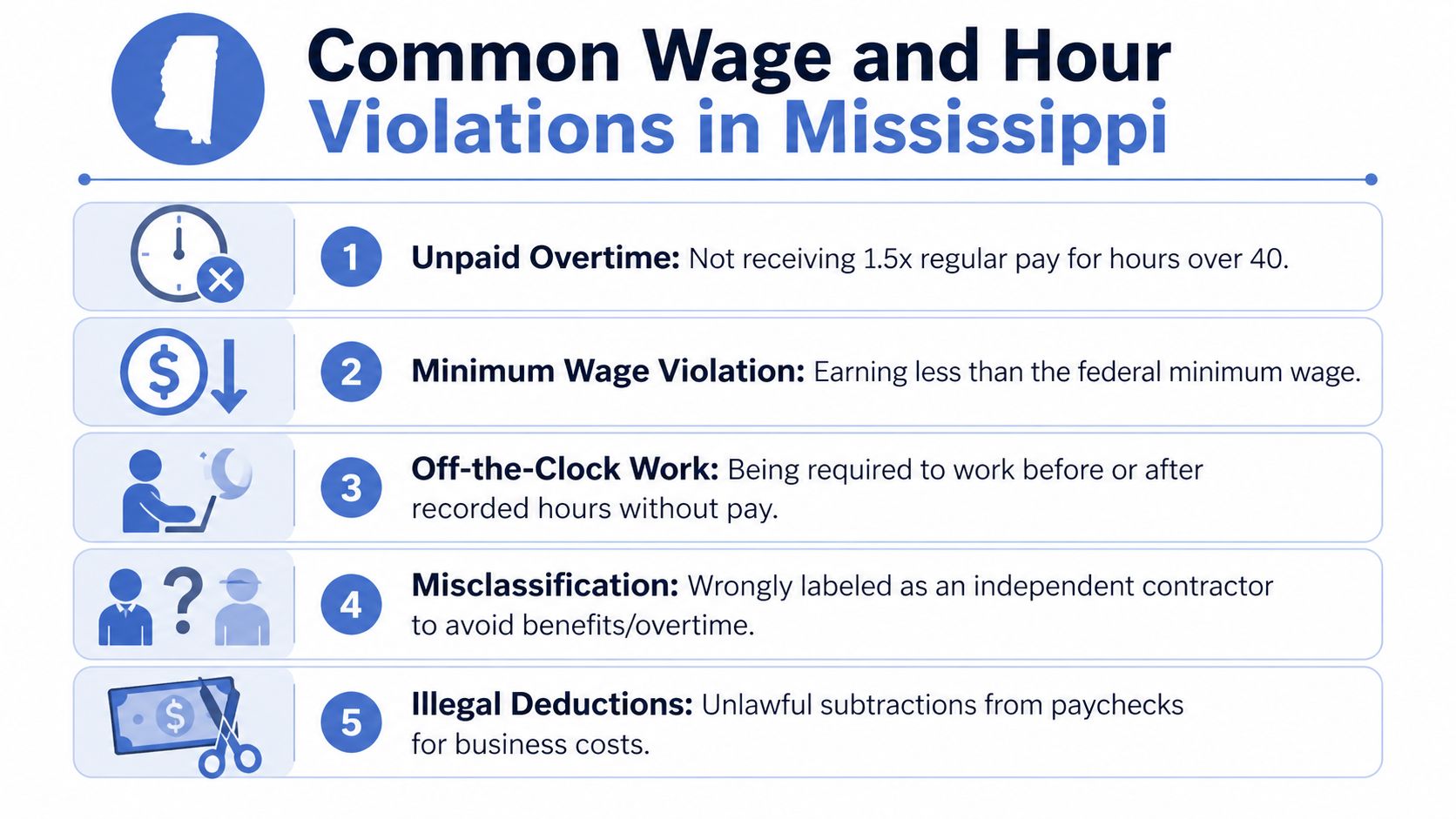
What these violations look like on the ground
A cashier clocks out at the end of the shift, then stays to count drawers because the supervisor says the store can't close until the money is reconciled. A nursing worker gets interrupted throughout lunch but loses break time on every shift anyway. A delivery worker is called an independent contractor but follows a company schedule, company rules, and company directions all day.
Those are familiar fact patterns. They often show up in cases involving:
- Off-the-clock work: pre-shift setup, post-shift cleanup, paperwork, opening or closing tasks, and required messages answered from home.
- Unpaid overtime: working over forty hours in a week without overtime pay.
- Automatic meal deductions: losing time for a lunch break you didn't take.
- Misclassification: being labeled exempt or an independent contractor when your real work arrangement says otherwise.
- Improper deductions: being charged for shortages, uniforms, tools, or other business costs in ways that violate wage rules.
Remote work created new proof problems
Since 2020, remote and hybrid work have created a different kind of dispute. Employees answer emails after hours, finish reports from home, or log into systems before the shift starts. These disputes over compensable time and "invisible" overtime now make up a significant portion of settlements, according to this discussion of remote wage and hour litigation issues.
The legal problem isn't just whether you worked. It's whether you can show it. Computer logins, message timestamps, calendar entries, and after-hours call records can matter a lot in these cases.
Service jobs often hide violations in plain sight
In food service, retail, healthcare, and similar jobs, wage problems are often baked into the schedule. You're told to arrive early but not clock in yet. You work through part of lunch because the floor is short-staffed. You stay late to finish charting, prep, or cleaning because the next shift is already behind.
Language barriers can make this worse. If a worker doesn't fully understand the policies they were given, disputes over timekeeping, breaks, tip handling, and reporting procedures become harder to spot and harder to challenge. For employers and HR teams trying to reduce that confusion, clear multilingual policies matter, and this resource on employee handbook translation gives useful context on how translated workplace policies can affect compliance.
Employers often defend these cases by calling the extra work "minor" or "part of the job." If the time was work, the label doesn't control.
Building Your Case A Documentation Checklist
The strongest wage claims usually start before a lawyer files anything. They start when a worker saves records.

What to gather first
If you think you've been underpaid, collect what you already have access to. Don't alter documents. Don't take confidential business records you aren't entitled to possess. But do preserve your own pay and time information carefully.
Start here:
- Pay stubs and direct deposit records: These show what you were paid and when.
- Schedules: Printed schedules, app screenshots, shift swaps, and calendar invites can help show expected hours.
- Time records: Timeclock screenshots, punch histories, handwritten logs, and any corrections you submitted.
- Texts and emails: Save messages telling you to come in early, stay late, skip lunch, or do tasks from home.
- Personal notes: Write down dates, start times, stop times, and missed breaks while events are fresh.
- Handbooks and policies: Timekeeping rules, break policies, remote-work expectations, and disciplinary write-ups can all matter.
Courts often allow employee time logs and similar personal records when employer records are inaccurate or incomplete. That principle is tied to Anderson v. Mt. Clemens Pottery Co., and Expert Institute's summary of FLSA expert witness practice discusses how experts use those records to reconstruct unpaid hours and damages.
Your own timeline can matter more than you think
Workers sometimes say, "I didn't keep perfect records, so I guess I don't have a case." That's usually the wrong conclusion. A useful log doesn't have to look like an accounting spreadsheet.
A simple running note can help:
- Date worked
- When you started
- When you stopped
- Any unpaid work before or after the shift
- Meal breaks interrupted or missed
- Who told you to do it
If you need a practical starting point for reporting unpaid wages and organizing records, this page on how to report unpaid wages is a good checklist.
After you've gathered the basics, watch this short overview before you make calls or send complaints:
What workers often do wrong
The most common mistakes are predictable. They rely on memory alone. They complain verbally but keep no copy of the complaint. Or they wait until they leave the job and then try to rebuild months of missing details from scratch.
Save first. Report second. Once a dispute starts, access to schedules, apps, and messages can change quickly.
Navigating Your Claim Administrative vs Federal Court Routes
In Mississippi, most workers effectively have two paths when wage and hour disputes become formal claims. One is administrative. The other is federal litigation under the FLSA.

The Department of Labor route
You can file a complaint with the U.S. Department of Labor's Wage and Hour Division. For some workers, that's a good starting point. It can trigger an investigation, and it may lead to recovery without you having to manage a lawsuit yourself.
But there are trade-offs. You don't control the investigation. You don't control the pace. Agencies have limited resources and many complaints. Some cases are a better fit for direct legal action, especially where the pay issue is ongoing, records are contested, or retaliation concerns are growing.
The federal court route
If litigation is necessary, the FLSA claim is brought in federal court. That matters in Mississippi because workers often assume they can solve a wage claim through a local state-court wage process that doesn't really fit the claim. For many unpaid wage and overtime cases here, federal law is the center of gravity.
A federal case can allow stronger case development, formal discovery, and direct pressure on disputed records. It also puts deadlines front and center. FLSA claims are time-sensitive, and waiting can reduce what you can recover.
Here is the practical comparison:
| Route | When it may help | Main limitation |
|---|---|---|
| DOL complaint | Useful when you want agency involvement and an investigation | You don't control speed or scope |
| Federal FLSA case | Useful when facts are disputed, damages matter, or stronger action is needed | Litigation requires structure, evidence, and legal strategy |
Timing matters more than most workers think
The statute of limitations is often two years, and it can be three years for willful violations. That deadline affects what pay periods remain recoverable, so delay can cost real money even when the underlying claim is strong.
Low-wage workers are often at a serious disadvantage when they try to pursue wage claims alone. Jotwell's discussion of low-wage wage claim barriers explains why representation can level the field when employers have better access to records, witnesses, and procedure.
If you're trying to understand what federal filing looks like from a paperwork standpoint, this plain-English guide to court document procedures from FaxZen is a helpful overview. It won't replace legal advice, but it gives a realistic sense of how formal the process becomes.
A late claim can still be a valid claim. But every pay period that ages out narrows your recovery.
Potential Damages and Relief in a Wage Claim
When workers ask, "What can I recover?" the answer usually starts with the wages that should have been paid in the first place.
The basic forms of recovery
A successful FLSA wage claim may include:
- Back wages: the unpaid minimum wage or overtime you were owed.
- Liquidated damages: often an equal additional amount under the statute.
- Attorney's fees and costs: in many successful FLSA cases, the employer may be required to pay these as part of the relief.
That structure matters. It means a wage claim isn't limited to the short paycheck amount alone. In the right case, the law can increase the recovery beyond the underlying unpaid wages.
Why damages disputes get technical fast
Even straightforward claims can become accounting disputes. The employer may argue your regular rate was different, that certain time wasn't compensable, or that your records are incomplete. In more complex cases, lawyers and experts reconstruct hours using payroll records, schedules, messages, and worker logs.
That is why documentation and timing matter so much. A worker who can show when the off-the-clock work happened, how often it happened, and what they were paid has a far stronger path to recovery than someone relying only on memory.
How a Mississippi Employment Lawyer Can Help
Wage and hour disputes look simple from the outside. They rarely stay simple once the employer pushes back.
A lawyer can evaluate whether the problem is unpaid overtime, off-the-clock work, misclassification, deductions, or some combination of those issues. Just as important, a lawyer can decide whether your case is better suited for a Department of Labor complaint, direct negotiation, or a federal FLSA action. That kind of judgment matters in Mississippi because workers don't have the broader state-level wage options found elsewhere.
Representation also changes the evidence picture. Lawyers know what payroll records to request, how to compare them against your own records, and how to challenge an employer's version of events when the time entries don't tell the full story. Nick Norris, P.A. handles wage and hour matters for Mississippi workers and is one option employees can consider when evaluating counsel.
Cost is often the first concern. In this area, many lawyers work on a contingency fee, and the average contingency fee is 40% to 50%. That means the fee is tied to recovery rather than upfront hourly billing. If you're trying to evaluate your options carefully, this guide on how to find an employment lawyer is a useful place to start.
Frequently Asked Questions About Wage Disputes
Can my employer fire me for complaining about unpaid wages
Federal law includes anti-retaliation protections tied to wage complaints and participation in FLSA matters. That does not mean employers always follow the law, and it does not mean every adverse action will be obvious. Some employers cut hours, change schedules, increase scrutiny, or suddenly start writing workers up.
If you raise a wage complaint and your treatment changes, document that shift immediately. Save schedules, write-ups, messages, and any timeline showing what happened before and after your complaint.
I'm salaried. Can I still have an overtime claim
Yes. Salary alone does not end the analysis. A salaried employee can still have an overtime claim if the exemption was applied incorrectly. The key question is what work you performed and whether your pay structure and duties satisfy the legal requirements for exemption.
I don't have perfect records. Is my case over
No. Many workers don't have complete records. That's common. Your own notes, texts, emails, schedules, and pay documents may still be enough to start building the case, especially where the employer's records are incomplete or misleading.
Do I have to file in state court
For the kind of FLSA wage and hour disputes discussed here, focus on the federal process and administrative options through the U.S. Department of Labor. Mississippi workers are often better served by understanding those routes clearly instead of assuming there is a separate state-court wage path that fits the claim.
How much does it cost to hire a lawyer for this kind of case
Many employment lawyers handling these claims work on contingency. As noted above, the average contingency fee is 40% to 50%. You should still ask how costs are handled, whether litigation expenses are separate, and what happens if the case resolves early versus later.
What if I'm scared to come forward because I need the job
That's one of the hardest parts of these cases, and it's a real concern. Fear keeps many valid claims quiet. Before you act, gather your records, avoid emotional workplace confrontations, and get legal advice about strategy. In some situations, the smartest move is a measured one.
If you think your employer didn't pay you for all the time you worked, don't guess your way through it. Nick Norris, P.A. helps Mississippi workers understand whether they have a wage claim, what evidence matters, and what federal options may be available. A consultation can help you figure out what happened, what your rights are, and what to do next.
This article has been reviewed for legal accuracy by Nick Norris. For employment law matters in Mississippi, consult with an attorney licensed to practice in your state.
Leave a Reply