

Workplace Harassment Lawyer Free Consultation in Mississippi
You may be reading this after a shift where your stomach stayed tight the whole drive home. A supervisor kept making comments. A coworker crossed a line again. You reported it, and now your schedule changed, your manager got colder, or HR acted like you were the problem.
That mix of anger, confusion, and fear is common. So is the urge to wait a few weeks and hope it settles down. In Mississippi, waiting often makes things harder, not easier.
A workplace harassment lawyer free consultation gives you something most workers don’t have when this starts: a structured way to sort facts from assumptions, legal claims from workplace unfairness, and urgent next steps from things that can wait. The point isn’t to turn every bad job into a lawsuit. The point is to find out where you stand before evidence disappears and before a federal filing deadline passes.
Many people come into a consultation worried they need a perfect case before they call. They don’t. They need a clear timeline, the documents they still have access to, and an honest account of what happened. If you’re still deciding whether to report internally, this guide on how to report workplace harassment can help you think through that step.
Your First Step When Facing Workplace Harassment
A Mississippi worker usually reaches out for legal help at a messy point, not a neat one. The harassment may still be happening. The worker may still need the paycheck. The evidence is often scattered across texts, emails, screenshots, write-ups, and memories of conversations that happened fast.
That’s why the consultation matters. It creates order.
What a first conversation should do
A useful first call or meeting should help you answer a few practical questions:
What exactly happened
Was the conduct verbal, physical, written, digital, or a mix of all of it?Why do you think it happened
Harassment law usually turns on whether the conduct was connected to a protected characteristic.Who knew about it
A lawyer needs to know whether a supervisor, HR, owner, or manager had notice.What changed after you spoke up
Sometimes the strongest issue isn’t only the harassment. It’s what followed the complaint.
The first legal task isn’t telling your story in the most emotional way. It’s telling it in the clearest sequence.
What usually does not help
Workers often hurt their own position by doing one of three things.
Deleting messages out of embarrassment
Even humiliating evidence can matter.Quitting before getting advice
Sometimes resignation is necessary. Sometimes it creates avoidable problems. Don’t guess if you can avoid it.Assuming HR protects your rights automatically
HR may help, but HR’s role and your legal rights are not the same thing.
The consultation should leave you calmer, not because the situation is easy, but because the path is clearer.
What Counts as Illegal Harassment in Mississippi
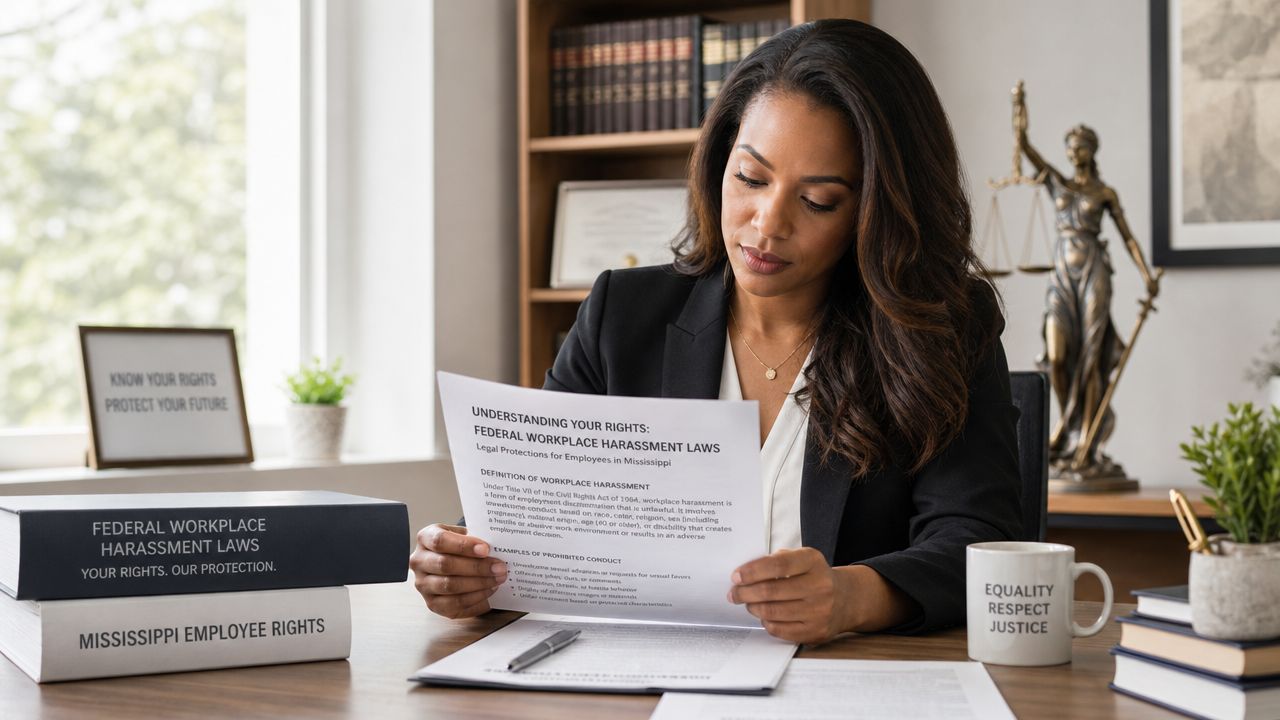
Mississippi workers usually rely on federal law, not a state human rights commission process, when they’re dealing with workplace harassment. The modern federal framework comes from Title VII of the Civil Rights Act of 1964, and the EEOC enforces those protections. A legal review matters early because harassment claims depend on whether the conduct was tied to a protected class and whether it was severe or pervasive enough to change the terms and conditions of employment. The filing timeline can also be tight, including a 180-day deadline for many claims, which is why an early consultation is often the first meaningful step (Title VII and EEOC framework).
If you want a deeper look at the legal threshold, this page on what qualifies as workplace harassment is a useful companion.
Protected status matters
Not every awful workplace experience is illegal harassment. Federal harassment law usually requires that the conduct be connected to a protected characteristic, such as race, color, religion, sex, national origin, age, or disability.
That distinction matters because a lot of workplaces are rude, political, unfair, or badly managed. Those problems may be real and serious, but they are not automatically unlawful harassment. If a boss is nasty to everyone, that may be poor management. If a boss targets someone because of sex, race, disability, or another protected category, that raises a different legal issue.
Severe or pervasive is the hard part
Workers often ask whether one incident is enough. Sometimes the answer is yes if the conduct was severe enough. Other cases are built on repeated conduct that, taken together, created a hostile environment.
A lawyer usually looks at things like:
Content
Were there slurs, sexual comments, threats, humiliating remarks, or degrading conduct?Frequency
Did it happen once, occasionally, or repeatedly?Power dynamics
Was the person a supervisor, owner, or someone with influence over your job?Effect on work
Did it interfere with your ability to do your job or change the conditions of employment?
Illegal harassment is not defined by whether it upset you alone. It’s defined by what happened, why it happened, and whether the law recognizes it as protected-class harassment.
A quick comparison
| Situation | Likely legal view |
|---|---|
| General bullying with no protected-class link | May be unfair, but not necessarily illegal harassment |
| Sexual comments from a supervisor after you objected | May support a harassment claim |
| Racial slurs or repeated race-based mockery | May support a harassment claim |
| Discipline after reporting protected-class harassment | May point to retaliation issues as well |
A workplace harassment lawyer free consultation is where this gets sorted. Most workers don’t need more internet articles. They need someone to apply the legal standard to their actual facts.
How to Find the Right Mississippi Employment Lawyer
The legal market has made free initial consultations a standard access point in harassment matters, and that makes sense. These cases often require an early assessment of dates, witnesses, documents, and procedural risk before anyone decides whether to move forward with an EEOC charge (free consultation as a standard intake model).
That doesn’t mean every lawyer offering a free consultation is the right fit for a Mississippi worker.
Start with fit, not slogans
Look for a lawyer who handles employment law for employees, not just anyone who says they also do labor or civil cases. A harassment matter in Mississippi usually turns on federal procedure, evidence preservation, and EEOC strategy. You want someone who understands that process from the employee side.
A few practical ways to screen firms:
Read practice descriptions carefully
If the site talks mostly about defending businesses, move on.Check whether employment law is a core part of the practice
You don’t want your case treated like an occasional side matter.Ask who handles the intake
Some firms screen carefully. Others treat every inquiry like a generic lead form.
Questions to ask before scheduling
When you call, keep it simple. You’re not trying to prove your whole case to intake staff. You’re trying to see whether the firm is built for this type of problem.
Ask questions like:
- Do you represent employees in workplace harassment matters?
- Do you handle EEOC charges?
- What documents should I gather before the consultation?
- Will the consultation focus on harassment only, or also retaliation and termination issues if they’re connected?
- How is communication handled after I contact the office?
One practical clue is responsiveness. If you’re calling after work, during a break, or late in the evening because that’s the only safe time you have, the office’s intake process matters. Firms that use tools like 24/7 phone answering for law firms can make it easier for workers to reach someone without waiting for regular office hours.
Mississippi-specific judgment matters
Mississippi workers often need someone who understands that there is no state human rights commission process doing this screening for them. That makes the private consultation even more important. It’s often the first real place where someone maps the facts, spots the federal claim, and identifies the next deadline.
One Mississippi option is Nick Norris, P.A., which represents employees in employment matters including harassment and retaliation. Whether you contact that office or another employee-side lawyer, the important point is the same: find counsel who treats intake as legal triage, not a sales script.
Your Pre-Consultation Checklist
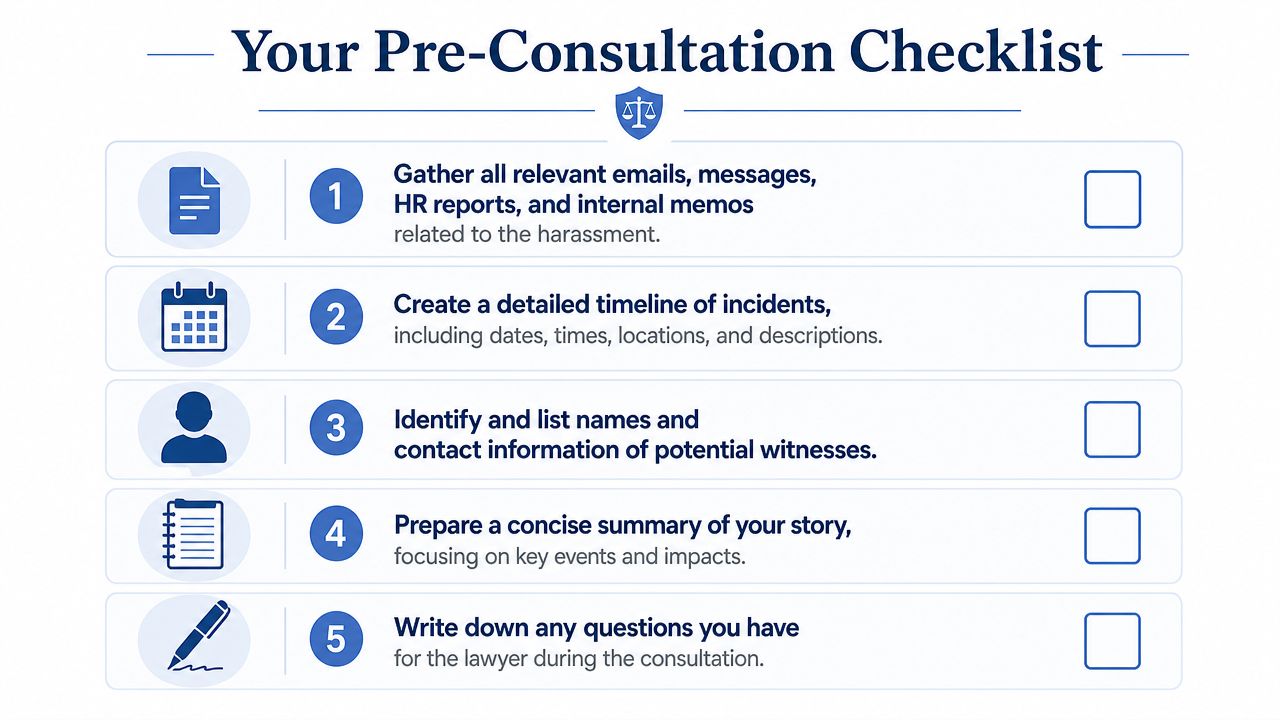
The quality of a consultation often depends on two things: document completeness and chronology quality. Attorneys commonly ask for employment contracts, emails, performance evaluations, pay records, policy documents, correspondence, and a dated incident log because those materials help show whether conduct was unwelcome, whether the employer had notice, and whether damages can be evaluated (documents lawyers request for early case review).
For a broader planning guide, review how to prepare for your first talk with an employment lawyer.
Build a clean timeline first
Start with a simple document. Put events in order. Don’t try to write a legal brief.
Include:
Dates or approximate dates
If you don’t know the exact day, say so. “Early March” is better than guessing.Who was involved
Name the person who acted, anyone who witnessed it, and anyone you told.What happened
Use plain language. Quote exact words if you remember them.Where it happened
Office, warehouse floor, break room, parking lot, work text thread, email, video meeting.What happened next
Did you report it? Did management respond? Did your schedule, pay, duties, or reviews change?
A strong timeline lets a lawyer see patterns quickly. It also helps separate harassment issues from retaliation, attendance disputes, leave problems, or ordinary performance management.
Gather the documents that usually matter
Most workers already have more evidence than they think. Start with what you can access lawfully and safely.
Messages and emails
Save texts, emails, chat messages, and voicemails that show the conduct or your complaint.Policies and handbook
If the employer had an anti-harassment policy or complaint procedure, that matters.Performance records
Reviews, warnings, commendations, and coaching notes can show whether your treatment changed after you spoke up.Pay records and schedules
These can matter if hours were cut, shifts changed, or losses followed the complaint.Internal complaints
HR reports, manager emails, written statements, and follow-up correspondence are often central.
Practical rule: Don’t alter screenshots, forward chains selectively, or rewrite old notes to make them stronger. Clean, original records carry more weight.
Identify witnesses without coaching them
Write down names, job titles if known, and what each witness likely observed. Keep this separate from your own timeline if that helps you stay organized.
Useful witness categories include:
| Witness type | Why it matters |
|---|---|
| Direct eyewitness | Saw or heard the conduct |
| Report recipient | Received your complaint |
| Pattern witness | Experienced similar conduct or saw repeated behavior |
| Job-impact witness | Saw changes in schedule, discipline, isolation, or reassignment |
Don’t pressure coworkers to “be on your side.” Just note who may have relevant knowledge.
Prepare your questions
A consultation is not only for the lawyer to evaluate you. It’s also for you to evaluate the lawyer. Write your questions down beforehand so stress doesn’t wipe them out.
Good questions include:
- Do my facts point to harassment, retaliation, or both?
- What should I do right now to preserve evidence?
- Should I report internally if I haven’t already?
- What deadlines concern you most?
- What facts are helping me, and what facts are hurting me?
If you need to send records before the meeting, use safer methods rather than casual forwarding. This overview of secure document transmission methods is a practical starting point for handling sensitive employment records.
Navigating the Consultation and Understanding Next Steps
A real consultation is often more detailed than workers expect. You may walk in thinking the issue is simple: “My supervisor harassed me.” After twenty minutes of questions, the picture often becomes more complicated. Maybe the harassment is part of it, but the stronger issue is what happened after you complained. Maybe a leave problem got folded into a performance narrative. Maybe the employer began documenting you only after protected activity.
That broader analysis matters. Workplace disputes often overlap, and a good lawyer uses the consultation to decide whether the core issue is harassment, retaliation after reporting it, or another employment problem that only looks like a harassment case at first glance. The same source also notes that retaliation remains one of the most common claim categories in EEOC enforcement reporting, which is why the full sequence of events matters so much (overlap between harassment and retaliation issues).

What the lawyer will usually ask you
Expect specific questions. Some will feel repetitive. That’s normal.
A lawyer may ask:
- When did the conduct start, and when did it change?
- What protected characteristic do you believe was involved?
- Did you tell anyone internally?
- Who made the decision to discipline, transfer, cut hours, or terminate?
- What documents back up your account?
- Are there witnesses, and are they still employed there?
Those questions aren’t meant to challenge your credibility. They help identify proof problems early.
What you should ask in return
The consultation should also help you judge the lawyer’s approach. Ask direct questions and listen for direct answers.
- How do you see the main legal issue?
- What are the weaknesses in my facts?
- What should I do this week?
- What communication can I expect if I hire you?
- How are fees handled?
Fee structure and EEOC next steps
In Mississippi, many plaintiff-side employment cases are handled on a contingency basis. The average contingency fee is 40-50%. Ask whether costs are handled separately, whether the percentage changes if the matter becomes more involved, and what happens if no recovery is obtained. Get the fee agreement in writing and read it carefully.
A good consultation should leave you with an action list. Preserve this. Gather that. Don’t say this to HR without advice. Watch this deadline.
In many Mississippi harassment matters, the next major step after a favorable consultation is the EEOC process. That is an administrative process. It usually begins with preparing and filing a charge, identifying the protected basis and adverse conduct, and organizing the supporting records. From there, the process may involve a response from the employer, agency review, requests for information, mediation in some matters, or a notice that affects what comes next.
What it should not feel like is a mystery. If your consultation is any good, you should leave knowing whether the lawyer thinks your facts fit a federal claim, what evidence needs to be preserved immediately, and what the near-term path through the EEOC likely looks like.
Red Flags When Choosing Your Legal Advocate
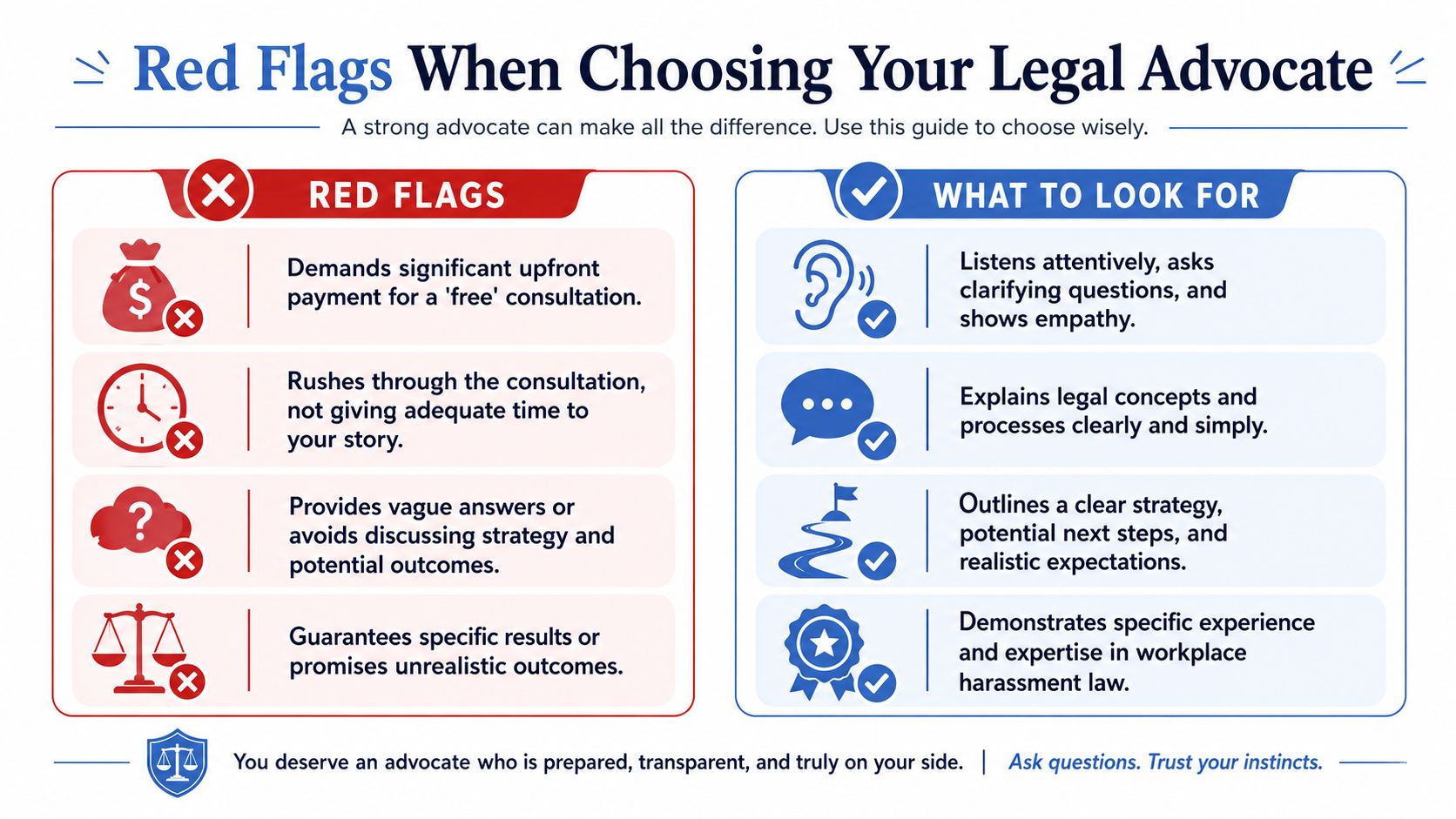
A free consultation can help you protect a claim, but only if the lawyer uses that time well. One common problem in online advice is that it treats the consultation like a casual screening call. A stronger consultation should identify urgent filing deadlines and give immediate guidance on preserving evidence, because workers can lose otherwise viable claims on timing and procedure (why the consultation should address deadlines and evidence preservation).
Red flags
Some warning signs are obvious. Others show up in tone.
Guaranteed outcomes
No honest lawyer can promise a specific recovery or result from an intake call.Pressure to sign immediately
If the office pushes you to commit before you understand the strategy and fee terms, slow down.Vague answers about process
If they can’t explain what they need, what deadline matters, or what the likely next step is, that’s a problem.Poor handling of sensitive records
Harassment matters involve personal and employment data. A firm should take document security seriously. Basic guidance on protecting client data for law firms shows the kind of issues a responsible office should already be thinking about.
Green flags
Good lawyers usually sound measured, not theatrical.
| Red flag | Better sign |
|---|---|
| “You’ve got a huge case.” | “Here are the strengths and the risks.” |
| “Sign today or you may lose your chance.” | “Review the agreement and ask questions.” |
| “Don’t worry about documents yet.” | “Preserve records now and stop deleting anything.” |
| “We handle everything.” | “Here’s what we need from you and what we’ll do.” |
The lawyer works for you. If the consultation leaves you confused, rushed, or talked over, keep looking.
Trust clarity over confidence
Some workers choose the most aggressive-sounding lawyer because they want certainty. That’s understandable. But certainty at the intake stage is often fake. Clarity is better.
A reliable advocate usually does three things. First, they listen carefully. Second, they explain the legal problem in plain English. Third, they tell you what could go wrong, not just what could go right.
Take the Next Step with a Dedicated Mississippi Advocate
If you’re dealing with harassment at work, you don’t need to have every answer before you call a lawyer. You do need to act with purpose. In Mississippi, that usually means treating the consultation as the moment where your case gets organized, your documents get matched to a legal theory, and your next move gets tied to the federal EEOC process.
Preparation helps. A clean timeline helps. The right documents help. Choosing a lawyer who gives realistic advice helps even more.
A workplace harassment lawyer free consultation should do more than tell you whether your experience sounds unfair. It should tell you what facts matter, what evidence to preserve, what deadlines may control your options, and whether the core issue is harassment, retaliation, or a related employment problem that grew out of your complaint.
If you’re a Mississippi worker trying to make sense of a hostile work situation, it makes sense to speak with a lawyer who focuses on employment law for employees and understands the federal framework that usually governs these claims here. Clear advice early can prevent expensive mistakes later.
If you need practical guidance about workplace harassment, retaliation, termination after a complaint, or related employment issues in Mississippi, contact Nick Norris, P.A. for a confidential free consultation. The office represents Mississippi employees, explains the process in plain language, and helps workers evaluate what to do next under federal employment law.
This article has been reviewed for legal accuracy by Nick Norris. For employment law matters in Mississippi, consult with an attorney licensed to practice in your state.
Leave a Reply