
How to report workplace harassment: A clear guide for Mississippi
When you’ve just experienced workplace harassment, the world can feel like it's spinning. It's disorienting and deeply upsetting. In that moment, your instincts should be focused on two things: your immediate safety and documenting what just happened.
Getting yourself to a safe place—physically and emotionally—is priority number one. After that, creating a detailed, private record of the incident is the single most powerful step you can take. It’s the foundation for everything that might come next.
What to Do Immediately After Workplace Harassment
Feeling overwhelmed and unsure of what to do after being harassed is completely normal. The stress is immense. Your first move, always, is to ensure your own safety.
If you feel physically threatened or unsafe in any way, get out of that situation. That might mean walking away from your desk, going to a trusted colleague’s office, or even leaving the building for the day. Nothing is more important than your well-being.
Once you’re in a safe spot, take a moment to breathe and ground yourself. The emotional fallout from harassment—the anxiety, the anger, the confusion—is real. Call a friend or a family member you trust. Do whatever you need to do to feel a sense of control again. Your emotional health matters just as much as your physical safety.
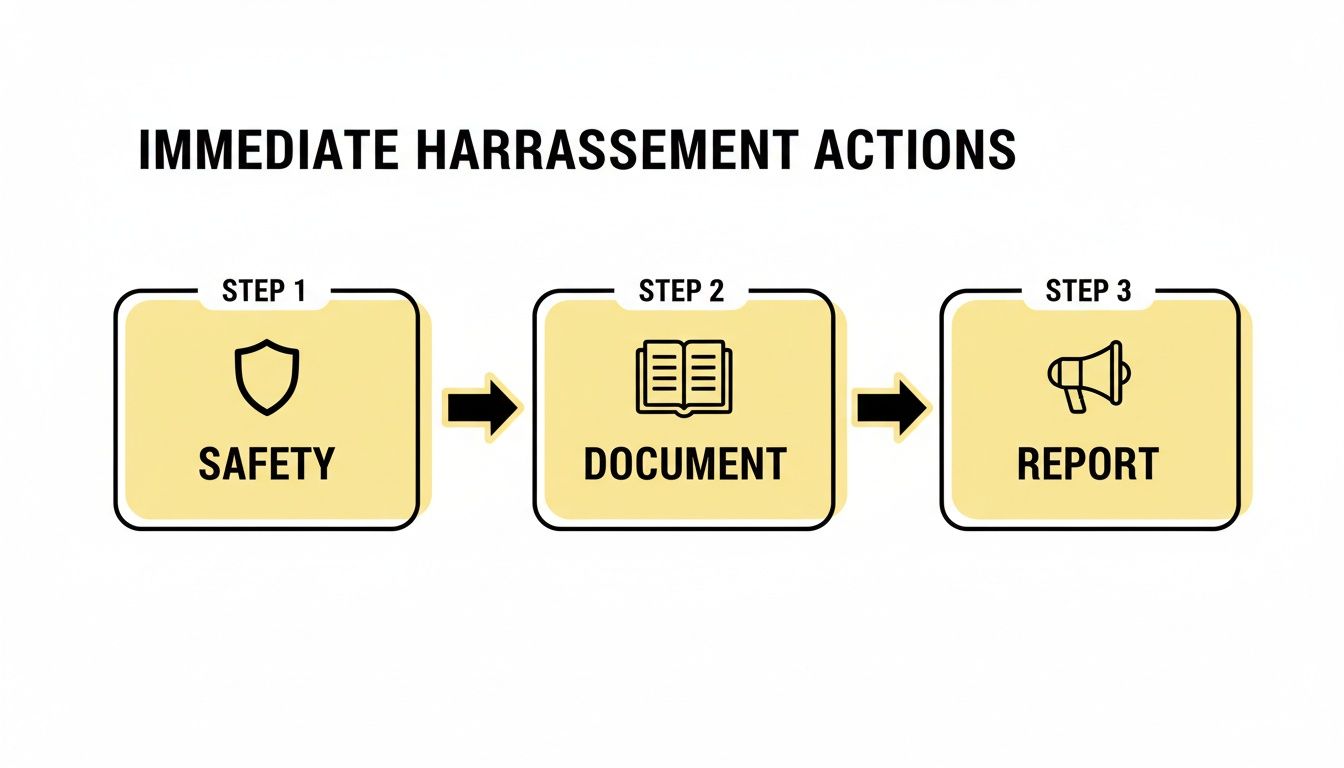
This graphic breaks it down into a clear path: first, safety. Then, meticulous documentation. Only after that should you start thinking about the formal reporting process.
Understanding Your Rights and Next Steps
Once you've handled your immediate needs, it's time to shift your focus to documentation. I can’t stress this enough: this is the bedrock of any complaint you might file later, whether it’s with HR or a government agency.
Start a private journal. And I mean private—use a personal device, not a work computer. Write down every single detail you can remember about the incident.
Be sure to include these key facts:
- Date and Time: Pinpoint it as closely as you can.
- Location: Where did it happen? Be specific.
- Who was involved: Name the harasser and anyone who might have seen or heard what happened.
- What was said or done: If you can remember direct quotes, write them down. Describe their actions, your response, and how it made you feel.
This detailed log turns a painful, subjective memory into a factual account that is much harder for an employer to ignore or dismiss. It's the concrete evidence you'll need.
Here is a quick reference checklist to guide you in those first critical moments.
Immediate Action Checklist After a Harassment Incident
Use this checklist as a quick reference for the essential first steps to take right after an incident of workplace harassment occurs.
| Action Item | Why It Matters | Practical Example |
|---|---|---|
| Ensure Personal Safety | Your physical and emotional well-being is the top priority. | Leave the immediate area, go to the restroom, or step outside for fresh air if you feel threatened or overwhelmed. |
| Document Immediately | Memories fade quickly. Capturing details while they are fresh is crucial for accuracy. | On your personal phone's notes app, write down the time, location, who was present, and exact quotes or actions. |
| Do Not Use Work Devices | Your employer can access work computers, emails, and phones. | Use your personal email to send a detailed account of the incident to yourself. This creates a timestamped record. |
| Identify Witnesses | Corroboration from others can strengthen your claim significantly. | Make a private note of colleagues who were nearby and may have seen or heard the harassment. |
| Preserve Evidence | Tangible proof like emails, texts, or photos is invaluable. | Take a screenshot of an inappropriate text message and email it to your personal account. Don't delete the original. |
Following these steps doesn't lock you into a formal complaint, but it keeps all your options on the table for when you're ready to decide what to do next.
Why Many People Hesitate to Report
It’s completely understandable to feel hesitant about reporting. The truth is, most people who experience harassment never file a formal complaint. A 2025 Traliant survey revealed that only 51% of employees would report an incident if it meant using their name. The other 49% feared retaliation, damage to their reputation, or simply didn't know how to report it.
This fear is exactly why knowing the process—and your protections—is so critical. You can learn more about these barriers in this workplace statistics report.
Taking these initial steps doesn't commit you to any specific path, but it preserves your options. By documenting everything, you empower yourself to make a clear-headed decision later about how you want to proceed.
Before you make any formal moves, it's smart to get a handle on the legal landscape. Understanding your rights provides much-needed clarity. Our guide on how to prepare for your first talk with an employment lawyer is a great place to start. This initial phase is all about taking back control—one step at a time.
Building Your Case: How to Document Workplace Harassment

When you’re facing harassment at work, your single most powerful tool is meticulous documentation. A detailed, factual record can transform a situation that feels like your word against theirs into a clear, undeniable pattern of behavior. This is what gets HR, government agencies, and attorneys to sit up and take notice.
Think of it this way: your goal is to build a timeline so solid that no one can dismiss your experience as a "misunderstanding" or a one-off incident. This isn’t about venting or writing down your feelings; it's about methodically collecting the facts.
What a Strong Log Entry Looks Like
First things first: keep this log somewhere private. Use a personal notebook, a document on your home computer, or a notes app on your personal phone—never use company property. They have the right to monitor that, and you need this to be confidential.
For every single incident, no matter how small it might seem at the time, get in the habit of recording the specifics immediately. A powerful entry captures the crucial details:
- Who was involved? Name the person or people responsible for the harassing behavior.
- What exactly happened? Write down precisely what was said or done. Use direct quotes if you can remember them. For non-verbal actions, be descriptive (e.g., "He stood over my desk, leaning in so close I could feel his breath on my neck," not just "He was intimidating").
- When did it happen? Note the full date and the specific time of day.
- Where did it take place? Be specific. "In the third-floor breakroom by the window," is much stronger than "in the breakroom."
- Were there any witnesses? Write down who else was present and could have seen or heard what happened. You don't have to talk to them, but knowing they were there is critical.
This consistent, detailed approach is what builds a compelling narrative. Anyone can try to explain away a single event, but a documented pattern stretching over weeks or months is incredibly difficult to dispute.
Don't Forget Digital and Physical Proof
Beyond your personal notes, you need to collect any tangible proof you can get your hands on. In today's workplaces, so much communication leaves a digital trail. You just have to be smart about preserving it.
Here’s how to secure that evidence:
- Forward inappropriate work emails to your personal email address.
- Screenshot text messages or internal chats (like on Slack or Teams) and email the images to yourself.
- Save any offensive images, altered documents, or other relevant files to a personal cloud drive or a USB stick.
Always make sure you capture the full context, including who sent the message and the date and time it was sent. This kind of hard proof, paired with your detailed log, creates an ironclad record. For things like unwelcome physical contact or verbal threats that don't leave a digital trace, your notes become even more vital. To better understand what types of behavior cross the legal line, you can find a comprehensive overview of Mississippi sexual harassment law.
An Expert Tip: Your power is in the facts. Avoid adding emotional language or personal interpretations to your log. Instead of writing, "He tried to intimidate me," describe the action: "He stood in the doorway, blocking my path, and spoke in a lowered, threatening tone." Let the facts paint the picture.
Critical Mistakes to Avoid When Documenting
Just as important as knowing what to do is knowing what not to do. A few missteps can seriously undermine your credibility or even get you into trouble.
- Illegal Recordings: Mississippi is a "one-party consent" state, which means you can legally record a conversation if you're a part of it. However, many companies have policies strictly forbidding recordings at work. Violating that policy could get you fired, complicating your case. The safer bet is to write down a detailed summary of the conversation in your log immediately after it ends.
- Using Company Tech: It bears repeating: never use your work computer, work phone, or company email account to create or store your harassment log. Your employer can and often does monitor these systems. This not only puts your privacy at risk but could also tip off the harasser.
- Adding Opinions: Stick to what happened, not what you think the harasser was trying to do. Avoid assumptions about their intent or emotional commentary. The objectivity of your log is what makes it so credible.
By carefully and consistently gathering this evidence, you aren't just getting ready to report harassment—you are building a powerful case to protect your career and hold the responsible parties accountable.
Using Your Company's Internal Reporting System

Deciding to report harassment is a major step. For many, starting with your company's own internal process is the necessary first move before taking things further. It can feel daunting, I know, but using the system correctly can make all the difference.
When you file a formal complaint, you’re essentially putting the ball in your employer’s court. At that point, they have a legal duty to step in, investigate, and take reasonable action to stop the behavior.
Your first stop should almost always be the employee handbook. Buried in there is the company’s anti-harassment policy, and that's your roadmap. It will tell you exactly who to talk to—maybe it's a specific person in HR, a designated manager, or even an anonymous ethics hotline. The policy should also name an alternate contact in case the person you're supposed to report to is the one harassing you.
Finding the Right Person and Preparing Your Complaint
Once you know who to contact, it's time to prepare a formal, written complaint. A quick chat might feel less confrontational, but a written report creates an official record. It can't be easily ignored, forgotten, or misinterpreted down the line.
Your goal is to be professional, factual, and clear. You're presenting the evidence you’ve carefully collected.
I recommend structuring your complaint this way:
- A simple introduction: Clearly state that you are filing a formal complaint of workplace harassment.
- The specific incidents: Give a chronological account of what happened, pulling directly from the log you’ve been keeping. Include dates, times, locations, and any direct quotes you remember.
- Reference your evidence: Mention that you have documentation (like emails, texts, or screenshots) and are ready to provide it.
- State your desired outcome: Be direct about what you want. Do you want the harassment to stop? Do you expect a formal investigation? Do you want measures put in place to prevent it from happening again?
Keep the emotion out of it and stick to the facts. You’re building a case that compels your employer to take you seriously.
What to Expect During the Internal Investigation
After you’ve submitted your complaint, your employer is legally obligated to conduct a prompt, thorough, and impartial investigation. They can't just have a quick chat with the harasser, take their word for it, and call it a day. A real investigation involves interviewing you, the person you accused, and any witnesses you named.
It’s interesting to see how workforce dynamics can play a role here. Data shows that younger employees and women often experience and report harassment differently. For example, one study found 52% of Gen Z employees had witnessed workplace harassment in the past five years, compared to just 33% of Baby Boomers. Younger generations also tend to be more comfortable with anonymous reporting channels. You can read more in this global study on workers' experiences with workplace violence and harassment. This is why having clear, accessible reporting systems is so vital for companies.
During the investigation, you should be kept in the loop on the general progress, but don’t expect a play-by-play. Confidentiality rules will prevent them from sharing every detail.
Key Takeaway: The law doesn’t force your employer to fire the harasser. It requires them to take action that is "reasonably calculated to stop the harassment." That could mean anything from a formal warning to sensitivity training or even termination, depending on how severe the conduct was.
Staying Calm and Assertive
Talking to HR or your manager about harassment is never easy. It's stressful. But your ability to stay calm and assertive is one of your biggest strengths in this situation. Walk into every meeting with your notes in hand and a clear idea of what you need to say.
If you feel yourself getting emotional or overwhelmed, it is perfectly okay to ask for a minute to compose yourself.
Just stick to the facts you’ve documented. Don't get pulled into arguments or make accusations you can't back up. The more professional you are, the more seriously your complaint will be taken.
And remember, this internal process is just one path. If your company fails to act, dismisses your complaint without a real investigation, or—even worse—retaliates against you for speaking up, your next step is to file a formal charge with an outside agency like the EEOC.
Filing an EEOC Claim in Mississippi

What happens when your company’s internal process doesn't work? If you’ve reported harassment and nothing changes—or worse, you face retaliation for speaking up—it’s time to take your complaint to the next level.
Your most powerful move is filing a formal charge with the Equal Employment Opportunity Commission (EEOC). This federal agency is tasked with enforcing the laws that are supposed to protect you from workplace discrimination and harassment.
Taking this step officially moves your complaint outside the company’s control and into a formal, legal process. The EEOC's entire purpose is to investigate your claim impartially, figure out if federal law was broken, and help you find a resolution. It’s a crucial tool for holding employers accountable when they fail to protect their people.
Internal Reporting vs EEOC Filing Key Differences
It’s important to understand the fundamental shift that occurs when you go from reporting to HR to filing with the EEOC. They are two very different processes with different goals and outcomes.
This table compares the purpose, process, and potential outcomes of reporting harassment within your company versus filing a formal charge with the EEOC.
| Aspect | Internal Company Report | EEOC Charge |
|---|---|---|
| Purpose | To notify the employer and give them a chance to correct the behavior. | To initiate a formal, legal investigation by a federal agency. |
| Investigator | The company's HR department or management. | A neutral investigator from the EEOC. |
| Legal Standing | An internal step; not a formal legal proceeding. | A prerequisite for filing a federal lawsuit for harassment. |
| Potential Outcomes | Disciplinary action against the harasser, policy changes, or no action. | Mediation, settlement, a "Right to Sue" letter, or direct EEOC litigation. |
Moving from an internal issue to a federal one is a major step. It gives your complaint legal weight and wraps a new layer of protection around you.
The Critical 180 Day Deadline
Before you even think about the process, you have to know the single most important rule: the deadline.
In Mississippi, you have exactly 180 calendar days from the date of the last harassing incident to file your charge with the EEOC.
This is a hard-and-fast deadline, not a friendly suggestion. If you miss it, you almost certainly lose your right to ever pursue your claim in federal court. It’s a brutal reality of the system, which is why acting quickly is so vital.
If the harassment is ongoing, each new incident can potentially reset the 180-day clock under what’s known as the "continuing violation" doctrine. But you should never, ever rely on this. The moment you feel ready to move forward, start the process to protect your rights.
Starting Your Claim with the EEOC
The first real step is submitting an inquiry to the EEOC. You can get the ball rolling by using their online Public Portal, calling them, or visiting the Jackson Area Office in person. This initial contact isn't the formal charge itself—it's how you get your foot in the door.
After your inquiry, the EEOC will schedule an intake interview. This is the moment where all that meticulous documentation you’ve been keeping truly pays off.
During the interview, be ready with your evidence:
- Your detailed log of every incident, including dates, times, locations, and exactly what was said or done.
- The names of the person harassing you and anyone who saw or heard it happen.
- Copies of any physical proof you have—emails, text messages, photos, or screenshots.
The EEOC investigator will listen to your account, look over your evidence, and help you draft the official "Charge of Discrimination." You’ll have to sign this document under penalty of perjury, so making sure every detail is accurate is absolutely essential.
What Happens During an EEOC Investigation
Once your charge is officially filed, the EEOC sends a notice to your employer, and the investigation begins. From here, the process can take a few different paths.
The EEOC will often suggest mediation first. This is a voluntary and confidential meeting where a neutral third party helps you and your employer try to work things out. If you both agree to it and find a resolution, the case is closed. It can be a surprisingly effective and quick way to solve the problem.
If mediation doesn't happen or doesn't work, a full investigation kicks off. An investigator will start gathering evidence—they might interview your colleagues, request personnel files from your employer, and scrutinize company policies. This isn't a quick process; it can easily take several months, sometimes longer, depending on how complicated the case is.
The EEOC's role can be powerful. In 2023 alone, the agency recovered approximately $664 million for workers through its enforcement actions, a nearly 30% jump from 2022. These numbers, detailed in a comprehensive workplace harassment report, show that employers face serious financial risk for letting harassment go unchecked.
At the end of the investigation, the EEOC will issue a decision. If they find "reasonable cause" to believe harassment occurred, they’ll try to settle the case with your employer. If they can’t find enough evidence, or if a settlement can't be reached, they will issue you a "Notice of Right to Sue." This letter is your key to the courthouse—it gives you 90 days to file a lawsuit in federal court. This is the point where having a skilled employment attorney on your side becomes absolutely critical.
How to Identify and Document Retaliation
The fear of getting fired or punished is the number one reason people hesitate to report harassment. It's a real, valid concern. You've already been through enough, and the last thing you want is to make your work life even worse for speaking up.
The good news? The law is on your side. Both federal and Mississippi laws make it illegal for an employer to take any negative or "adverse" action against you for engaging in a "protected activity"—and reporting harassment is a classic example of that.
But here’s what you need to know: retaliation isn't always as obvious as your boss handing you a pink slip. It often creeps in through subtle, insidious actions designed to make you so miserable that you quit. Recognizing these tactics is the first step in fighting back.
Recognizing the Many Faces of Retaliation
Sure, retaliation can be blatant, but more often than not, it shows up in quieter, more damaging ways. Your employer might start a campaign to "manage you out" by making your job unbearable.
Keep an eye out for these kinds of retaliatory behaviors:
- The Obvious Moves: This is the easy stuff to spot—getting fired, demoted, having your pay docked, or being reassigned to a dead-end role in an office across town.
- The Sudden "Performance Problem": You've had nothing but glowing reviews for years. Suddenly, right after you file a complaint, you're hit with a Performance Improvement Plan (PIP) for vague, subjective reasons.
- The Cold Shoulder: You’re suddenly left off the invite list for key meetings, pulled from projects you were leading, or find that your supervisor and even coworkers are now avoiding you.
- The Micromanager: All of a sudden, your boss is breathing down your neck, triple-checking every email, and questioning decisions they never would have before. Impossible deadlines become the new norm.
- The Bad Reference: You decide to leave, but your old boss gives a potential new employer an unfairly negative review of your work, costing you the job.
The common thread here is that these actions are meant to punish you. The key is connecting the dots: if a negative shift in your employment happens right after your employer learns about your harassment report, you may be looking at illegal retaliation.
Documenting Retaliation Is Its Own Battle
Just like you documented the original harassment, you need to start a completely new log for every retaliatory act. Think of it as a separate case, because legally, it is. It needs its own evidence.
Apply the same detailed, just-the-facts approach. For every incident, write down the date, time, location, who was there, and exactly what was said or done.
For example, don't just write, "My boss is ignoring me." Get specific.
"On Tuesday, March 5th at 10:00 AM, the weekly project planning meeting for the Miller account took place. I have led this meeting for the past six months. Today, I was not invited. When I asked my manager, Jane Doe, why, she said, 'We decided to go in a different direction.'"
This kind of detail is gold. It builds a powerful, undeniable timeline showing a pattern of negative treatment that started right after you spoke out.
Amending Your EEOC Charge to Include Retaliation
If you've already filed a harassment charge with the EEOC and the retaliation starts, you don't need to file a brand-new case. You can—and absolutely should—amend your existing charge to add a claim for retaliation.
This is a critical strategic move. In my experience, retaliation claims are often more straightforward to prove than the underlying harassment. The timing does all the talking. When a string of negative actions kicks off right after your complaint, it creates a powerful assumption that one caused the other.
Get in touch with your EEOC investigator and tell them you need to amend your charge. Hand over your new log of retaliatory incidents. This not only strengthens your entire case but also adds another layer of legal protection. To get a better handle on this, you can find more in-depth information on our page about workplace retaliation in Mississippi.
Dealing with a hostile work environment while a case is pending is incredibly stressful. But by carefully identifying and documenting every move they make, you’re not just enduring it—you’re building a rock-solid case to hold them accountable.
Frequently Asked Questions About Reporting Harassment
Thinking about reporting workplace harassment naturally brings up a lot of tough, practical questions. You’re likely wondering about your specific situation, the risks involved, and what your rights really are. Let's walk through some of the most common concerns we hear from workers here in Mississippi.
What If My Boss Is the One Harassing Me?
This is easily one of the most stressful situations anyone can face at work. When the person harassing you is the one who controls your job, your assignments, and your future at the company, it's easy to feel like you have nowhere to turn. But you absolutely have options.
If your company has a Human Resources department, this is your first stop. Your boss doesn't get a pass just because of their title. You should go straight to HR and report the behavior. They are obligated to investigate claims, even when they involve senior management.
But what if it's a small business and the owner is the problem? In that scenario, an internal complaint obviously won't work. Your best move is to go directly to an external agency like the EEOC or speak with an employment lawyer right away. The EEOC is set up to handle complaints against employers of all sizes, and an attorney can give you confidential advice on how to protect yourself and your job.
Can My Employer Fire Me for Reporting Harassment?
Let me be direct: no. It is explicitly illegal for an employer to fire, demote, cut your pay, or take any other kind of negative action against you for reporting harassment you genuinely believe is against the law.
This is called retaliation, and it's prohibited by federal law.
These protections cover you whether you report the issue to HR or file a formal charge with the EEOC. In fact, if you get fired or disciplined right after you make a complaint, you could have a powerful retaliation claim on top of your original harassment claim. This is precisely why documenting the timing of your report and any negative actions that follow is so crucial.
A key thing to remember: The law protects you from being punished for reporting. It doesn't guarantee your employer will agree with your claim, but it does shield you from any penalty for speaking up in good faith.
What Should I Do If I Witness Harassment?
Seeing a colleague get harassed puts you in a difficult spot, but you can be an incredibly important ally. Your actions can make all the difference for the person being targeted.
First, try to speak with your coworker privately. Offer your support and just ask if they're okay. Sometimes, simply knowing they aren't alone and that someone else saw it is a huge relief. You can mention what you witnessed and let them know you’re willing to back them up if they decide to report it.
Second, make your own notes about what you saw or heard. Write down the date, time, location, and the specifics of what happened. Most company policies actually encourage—and sometimes require—witnesses to report harassment. Your account can provide the corroboration needed to validate the victim's claim and demonstrate that this isn't an isolated incident, but a problem affecting the whole work environment. Just like the person being harassed, you are also protected by law from retaliation for reporting what you witnessed.
How Long Do I Have to File a Claim in Mississippi?
This is one of the most critical pieces of information you need to know, because the deadline is non-negotiable. In Mississippi, you must file a charge of harassment with the EEOC within 180 calendar days from the date the harassment happened.
This isn’t a suggestion—it's a hard deadline. If you miss that 180-day window, you will almost certainly lose your right to take legal action under federal law.
If the harassment is ongoing over a period of time, the 180-day clock might reset with each new incident under a concept known as the "continuing violation doctrine." But you should never count on this. The safest and smartest path is to act quickly to preserve all your options. With such a tight timeframe, it's vital to start documenting everything right away and contact the EEOC or an attorney as soon as possible.
If you are facing workplace harassment or retaliation in Mississippi, you do not have to handle it alone. The legal system can feel complex, but an experienced advocate can guide you through every step. At Nick Norris, P.A., we are dedicated to protecting workers' rights and ensuring your voice is heard. Contact us for a confidential evaluation of your case by visiting our website.
This article has been reviewed for legal accuracy by Nick Norris. For employment law matters in Mississippi, consult with an attorney licensed to practice in your state.
Leave a Reply