

How to Calculate Emotional Distress Damages in Mississippi
If you're reading this after months of dreading work, lying awake at night, and wondering whether what happened to you “counts,” you're not alone. A lot of Mississippi employees come in with the same question: they know the workplace situation hurt them, but they don't know how that hurt gets turned into a legal claim.
That confusion makes sense. Lost pay is easy to spot on a paycheck stub. Emotional distress isn't. It shows up in missed sleep, panic before a shift, crying on the drive home, snapping at family, or feeling sick every Sunday night because Monday is coming. In employment law, those harms can matter. The hard part is proving them in a way an employer, agency, judge, or jury can evaluate.
The practical answer is this: emotional distress damages are not guessed. They are built from evidence. In Mississippi workplace cases, especially discrimination, harassment, and some retaliation claims under federal law, the value usually turns on severity, duration, credibility, and whether the evidence ties the emotional harm to what happened at work.
What Counts as Emotional Distress in a Mississippi Workplace
A Mississippi employee might start out thinking, “I should just tough this out.” Then the comments keep coming. The supervisor humiliates her in front of coworkers. The harassment gets more personal. She stops sleeping well. Her stomach stays in knots on the drive to work. Her spouse notices she's withdrawn. Her friends notice she cancels plans. She still shows up and does the job, but the job is changing her.
That is often what emotional distress looks like in a workplace case.
Emotional distress damages are meant to address non-economic harm. That means harm that doesn't arrive as a bill or wage statement. In employment cases, this can include anxiety, depression, insomnia, humiliation, panic, fear, shame, and the loss of normal daily functioning. It can also include the way those symptoms spill into family life, social life, and job performance.
What the law is trying to measure
The law isn't paying someone because work made them briefly upset. Illegal workplace conduct often causes something more serious than ordinary frustration. The issue is whether the conduct led to a meaningful emotional injury and whether that injury can be shown with believable proof.
Common examples include:
- Sleep disruption: Trouble falling asleep, waking up repeatedly, nightmares, or dreading the next workday.
- Anxiety symptoms: Racing thoughts, panic, shaking, nausea, or fear tied to the workplace.
- Depressive symptoms: Isolation, crying spells, hopelessness, loss of energy, or loss of interest in normal life.
- Humiliation and shame: Especially in harassment or public mistreatment cases.
- Relationship strain: Conflict at home, withdrawal from friends, or changes others can see.
If you're not sure whether what happened fits, it often helps to compare your experience with recognized workplace misconduct such as conduct that qualifies as workplace harassment.
Practical rule: Emotional distress is strongest when you can show not only how you felt, but how your daily life changed.
Why clients often underestimate this part of the case
Many workers think emotional distress only counts if they were hospitalized or diagnosed right away. That's not how real life works. People keep working because they need the paycheck. They put off counseling because they're embarrassed, overwhelmed, or can't afford it. None of that means the harm wasn't real.
It can also help to understand the coping side of the problem. Some people dealing with manipulative or dominating coworkers benefit from a counseling-focused resource on a holistic approach to workplace narcissists, not as legal proof by itself, but as a way to recognize patterns that often drive the distress.
In a Mississippi employment case, the question is usually not whether emotional distress is “real enough” in the abstract. The question is whether the evidence shows the distress was serious, work-related, and legally tied to unlawful conduct.
Common Methods for Quantifying Your Suffering
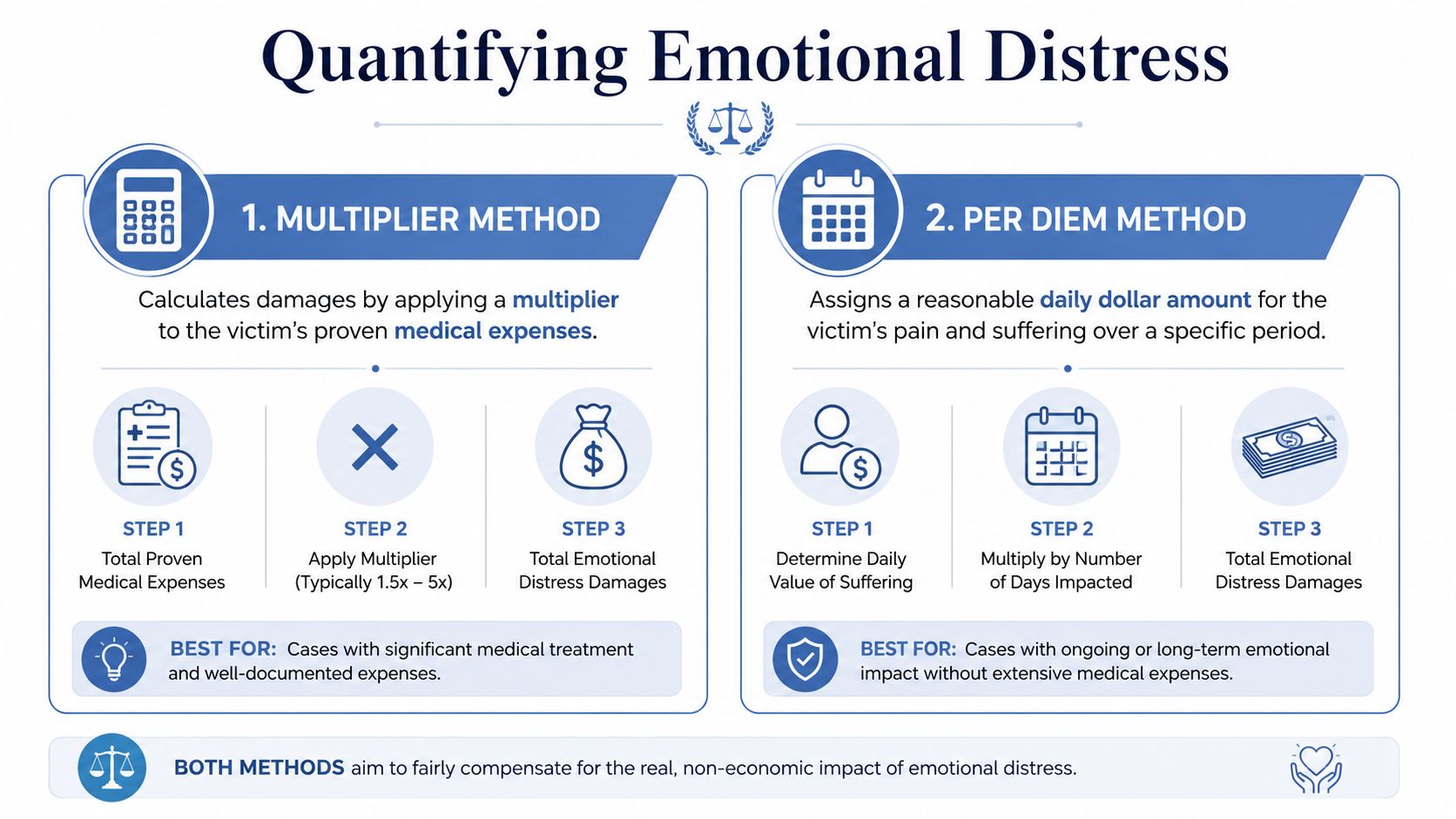
Lawyers and claims professionals usually start with a framework. They need one because emotional harm doesn't come with a price tag. Two common methods are the multiplier method and the per diem method. Neither one is magic. Both are ways to organize proof into a number that can be defended.
The multiplier method
A foundational way courts and claims professionals estimate emotional distress damages is the multiplier method, which takes proven economic losses such as medical bills and lost wages and multiplies them by a factor typically between 1.5 and 5. For example, if economic damages are $50,000 and the facts support a 3x multiplier, the emotional distress component would be $150,000, as explained in this discussion of the multiplier method for emotional distress damages.
That sounds simple, but the actual work is choosing the multiplier and justifying it.
A lower multiplier may fit a case where symptoms were real but short-lived. A higher multiplier may fit a case involving more serious trauma, longer disruption, or a lasting effect on the employee's ability to function. In practice, people arguing for a higher number need stronger proof. That usually means documentation, consistent testimony, and a clear story about how the workplace conduct affected the person over time.
Where the multiplier method works well
This method often makes the most sense when the case already has identifiable economic losses, such as:
- Lost wages tied to the workplace problem
- Medical or counseling expenses
- Other documented out-of-pocket losses connected to the claim
It is less helpful when the emotional harm is substantial but the papered economic damages are modest.
A formula helps only if the facts support it. A high multiplier without strong evidence usually looks inflated.
The per diem method
Another common model is the per diem method. This assigns a daily dollar amount to the suffering and multiplies that amount by the number of days the distress is expected to continue. A published example uses $200 per day for 210 days, producing $42,000 in damages, in this explanation of the per diem approach to emotional distress valuation.
The appeal is obvious. It turns an abstract injury into a daily cost.
When a daily-rate model makes sense
The per diem method tends to work best when the distress period is finite and can be tied to a recovery timeline. That may include a period of counseling, a documented stretch of symptoms after termination, or a span tied to a known event in the case.
Courts and attorneys often want to see facts that make the daily figure more defensible, such as:
| Issue | Why it matters |
|---|---|
| Duration | You need a sensible beginning and end point |
| Consistency | Ongoing symptoms are easier to value than vague, occasional distress |
| Impact | Sleep, work, and relationships help show the distress was substantial |
What works and what doesn't
People often ask which method is “right.” The practical answer is that the facts drive the tool, not the other way around.
What usually works:
- A calculation tied to real records
- A timeline that doesn't shift
- Witnesses who noticed changes
- Symptoms described in concrete terms
What usually doesn't work:
- Round numbers with no explanation
- Claims that sound bigger than the records
- Trying to force a severe-damages argument from thin proof
In some cases, mental health evidence matters a lot, especially where trauma symptoms are part of the story. If that issue is in play, materials discussing the legal relevance of complex PTSD can help a reader understand why diagnosis and symptom patterns may matter in litigation.
If a case may require specialized testimony, it's also worth understanding the role of an expert witness in an employment case. An expert doesn't automatically create value, but the right expert can help explain causation, severity, and duration.
Proving Harm When You Have No Medical Bills
This is the point many Mississippi workers get stuck on. They assume that if they didn't see a therapist every week, they can't recover emotional distress damages. That's not right.
In employment cases, courts still consider severity, duration, and whether the emotional harm was caused by the employer rather than other life events, and proof can come from the employee and witnesses even without extensive treatment records. Litigators build value from sleep disruption, humiliation, panic, relationship strain, and witness testimony, rather than treating treatment records as the only meaningful metric, as discussed in this analysis of emotional distress proof in employment discrimination and retaliation cases.

Why this issue comes up so often
Employees delay treatment for all kinds of human reasons. They're afraid of being judged. They don't want anything in their medical records. They don't have time. They don't have money. They think they should be able to handle it on their own.
A defense lawyer will often try to use that gap against you. The argument is predictable: if the harm was serious, why didn't you get treatment? Sometimes that argument lands. Sometimes it doesn't. It depends on whether the rest of the evidence fills the gap.
Here's a practical discussion that often helps workers identify whether their day-to-day experience reflects actionable mistreatment: workplace verbal abuse and what it can look like.
A short video can also help frame how these claims are built in practice.
Evidence that can matter even without large bills
The strongest non-medical proof usually comes from lived facts, not labels.
- Your own account: Specific testimony about panic, crying spells, sleeplessness, fear, embarrassment, or withdrawal.
- Family and friends: They can describe the change in your mood, behavior, and relationships.
- Coworkers: They may have seen the mistreatment or its effect on your focus and demeanor.
- Contemporaneous writing: Notes, messages, calendars, or journal entries made while the events were happening.
- Workplace records: Complaints, reports to HR, write-ups after protected activity, or emails showing the environment.
The absence of therapy bills doesn't end the claim. It shifts the focus to credibility, corroboration, and detail.
The trade-off you should understand
Medical records can give structure to a case. Without them, the story has to be tighter. The timeline has to be cleaner. The witnesses have to be credible. A vague claim of “I was stressed” usually won't carry much weight standing alone.
A detailed claim can. “I stopped sleeping after the supervisor started cornering me in the stockroom. My sister noticed I quit coming to church. My husband can describe the panic attacks. My texts to a coworker that month show I was afraid to go in.” That kind of proof is far more usable.
Gathering the Evidence to Build Your Case
The best emotional distress claims are documented early. Not polished. Not exaggerated. Just documented. If you're dealing with an illegal workplace situation, start preserving the facts before memories blur and phones get replaced.
Start a plain, factual journal
Use a notebook, notes app, or document you can keep private. Write in ordinary language. You are not trying to sound legal. You are trying to create a reliable record.
Include details like:
- Dates and events: What happened, who was there, and what was said or done.
- Physical and emotional effects: Trouble sleeping, crying, panic, headaches, nausea, or fear of going to work.
- Life impact: Missed family events, isolation, arguments at home, or inability to concentrate.
- Work impact: Declining focus, mistakes, calling in sick, or dread before a shift.
Write close in time to the event. A short entry made the same day usually carries more weight than a polished summary written months later.
Preserve digital communications
Most workplace cases are built from small pieces that add up. Save those pieces.
That includes:
- Emails and texts
- Performance reviews
- HR complaints
- Schedules and write-ups
- Messages to trusted people describing what was happening
Don't alter screenshots. Don't crop out dates and names if you can avoid it. Keep the full exchange when possible because context matters.
Save first, sort later. People often lose useful proof because they assume one ugly email isn't important.
Identify the people who can corroborate you
Think in categories, not just names. Who saw the conduct? Who saw your condition change? Who heard you describe what was happening while it was ongoing?
A useful witness list might include:
| Witness type | What they may add |
|---|---|
| Coworker | Saw comments, exclusion, touching, or retaliation |
| Family member | Saw sleep loss, crying, withdrawal, anger, or fear |
| Friend or pastor | Heard contemporaneous reports and noticed changes |
| Supervisor or manager | Can confirm complaints, schedule changes, or discipline |
You don't need every witness to say the same thing. In fact, stronger proof often comes from different people describing different parts of the same pattern.
Be careful about common mistakes
Some evidence problems are avoidable.
- Don't embellish: If a fact is bad, say it plainly. Overstatement damages credibility.
- Don't delete posts selectively: Missing context can become a problem.
- Don't confront the employer in anger by text or email if you can avoid it: Those messages often get pulled into the case.
- Don't assume memory will be enough: It usually isn't.
If you're already talking with counsel, one option for evaluating the proof and building the narrative is a Mississippi-focused employment practice such as Nick Norris, P.A., which handles workplace claims involving discrimination, harassment, retaliation, wage issues, and related federal employment laws.
Mississippi Rules and Federal Damage Caps
Mississippi workers need a practical point of orientation here. Mississippi does not have its own human rights commission. In many workplace discrimination and harassment matters, that means the legal path runs through federal law and federal procedures rather than a state agency system built for these claims.

What that means for emotional distress damages
That matters because the number you can justify factually and the number the law allows are not always the same thing. In some federal employment claims, emotional distress falls within compensatory damages that may be limited by federal law. So even when the evidence of suffering is strong, legal limits can affect the final value.
This is one reason online comparisons can mislead people. A worker may read about a large verdict in some other context and assume the same result applies to a Mississippi employment claim. Often it doesn't.
Why expectations need to stay grounded
A realistic valuation takes at least three things into account:
- The proof of distress itself
- The type of employment claim involved
- Any legal limits that apply to that claim
Good case evaluation is not about picking the biggest number. It's about identifying the most defensible number under the facts and the law.
The published example using the per diem method of $200 per day for 210 days, resulting in $42,000, is useful because it shows how a damages model can produce a concrete figure, but any actual Mississippi workplace claim still has to be measured against the governing legal framework for that particular federal cause of action.
For that reason, emotional distress calculations should be treated as valuation tools, not promises.
When and Why to Partner With a Mississippi Employment Lawyer
Learning how to calculate emotional distress damages helps. Proving them against an employer is something else. Employers usually don't evaluate these claims through the lens of your lived experience. They evaluate risk. They look for missing records, other stressors in your life, inconsistent dates, and witnesses who won't commit.
A lawyer's job is to tighten that up.
What counsel actually does in these cases
A good employment lawyer doesn't just put a dollar figure on your pain. The lawyer tests the claim.
That usually includes:
- Separating legal claims from workplace unfairness: Not every bad workplace is an illegal one.
- Building causation: Showing the distress came from the unlawful conduct, not unrelated life events.
- Organizing proof: Matching documents, witnesses, and timeline entries so the story holds together.
- Valuing realistically: Avoiding demands that sound dramatic but can't be defended.
Sometimes the most important advice is negative advice. A lawyer may tell you what not to emphasize, which witness is weak, or why a certain argument could backfire.
Why representation matters in Mississippi
Mississippi workers often come into these cases without a deep paper trail. That's especially true where they stayed on the job, never sought much treatment, or tried to keep the problem private. In those situations, presentation matters. Sequence matters. Credibility matters.
An experienced lawyer also helps screen out distractions. For example, some workers assume every workplace wrong creates a retaliation claim. That isn't true, and a case gets stronger when the legal theory matches the actual facts instead of every grievance being thrown into one pile.
The fee issue most people ask about
Cost matters. Most workers can't pay hourly fees to fight an employer through a serious employment case. That's why many employment lawyers use a contingency structure. The author's brief for this piece notes that the average contingency fee is 40-50%. The practical benefit is that a worker may be able to get representation without paying upfront legal fees while the case is pending.
That doesn't mean every case should be brought. It means the lawyer has to make a judgment about evidence, law, and likely value before investing time and resources into it.
The right time to get advice is usually earlier than people think. Early guidance can help preserve evidence, avoid avoidable mistakes, and frame the emotional distress part of the claim in a way that's provable.
If a Mississippi workplace situation has left you dealing with anxiety, humiliation, panic, sleep loss, or strain at home, talking it through with counsel can help you separate what feels unfair from what the law can address. Nick Norris, P.A. represents Mississippi workers in employment matters and can help evaluate what proof exists, what additional evidence may be needed, and how emotional distress may fit into the overall value of a workplace claim.
This article has been reviewed for legal accuracy by Nick Norris. For employment law matters in Mississippi, consult with an attorney licensed to practice in your state.
Leave a Reply